Timing Cardio and Weights: Should You Do Cardio Before, After, or on Separate Days?
Cardio before or after weights? Research shows order matters less than you think, but cardio first costs reps. Get a simple scheduling ladder for lifters.
TL;DR. The short answer
- Hard or long cardio right before lifting reduces reps and power. In one study of trained men, total reps fell 9.1-18.6% after running, and the squat suffered most.
- Over weeks, the order of cardio and weights in one session made no clear difference to muscle size in a meta-analysis of 10 studies. Lifting first did favour lower-body strength.
- A 2022 meta-analysis of 43 studies found concurrent training did not compromise muscle size or maximal strength. Explosive strength dipped, mostly when both were done in the same session.
- The safest hierarchy: separate days or 3+ hours apart, then weights first with easy cardio after, and hard cardio before lifting last.
- Easy cardio on rest days (walking, cycling) is generally fine for most lifters. Hard intervals the day before leg day are the thing to watch.
Part of our complete guide: Cardio and Concurrent Training: Build Endurance Without Losing Muscle (The Interference Effect)
Table of contents
Cardio before or after weights? If you have to pick one session, lift first and do cardio after. Hard or long cardio before lifting reduces the reps and power you have for the lifts that follow, and a meta-analysis found lower-body strength gains were better when weights came first.
That is the short version. The longer version is more forgiving than most gym advice, and it is part of the wider interference effect between cardio and lifting. Order matters less for muscle size than people fear. Intensity, duration and how close the sessions sit to each other matter more.
Does cardio before lifting ruin your workout?
It can dent it. It rarely ruins it.
The cleanest evidence is a small acute study. Eleven resistance-trained men did a lifting session (squat, bench press, deadlift, high pull and push press, 3 sets of 6-10 reps at 70-80% of 1RM) once fresh, and four more times 10 minutes after different running protocols. After running, total reps dropped by 9.1-18.6%, with the squat hit hardest. Power and velocity fell on the high pull, squat and bench press after most protocols. The biggest reductions came after high-intensity interval running (Ratamess et al., 2016).
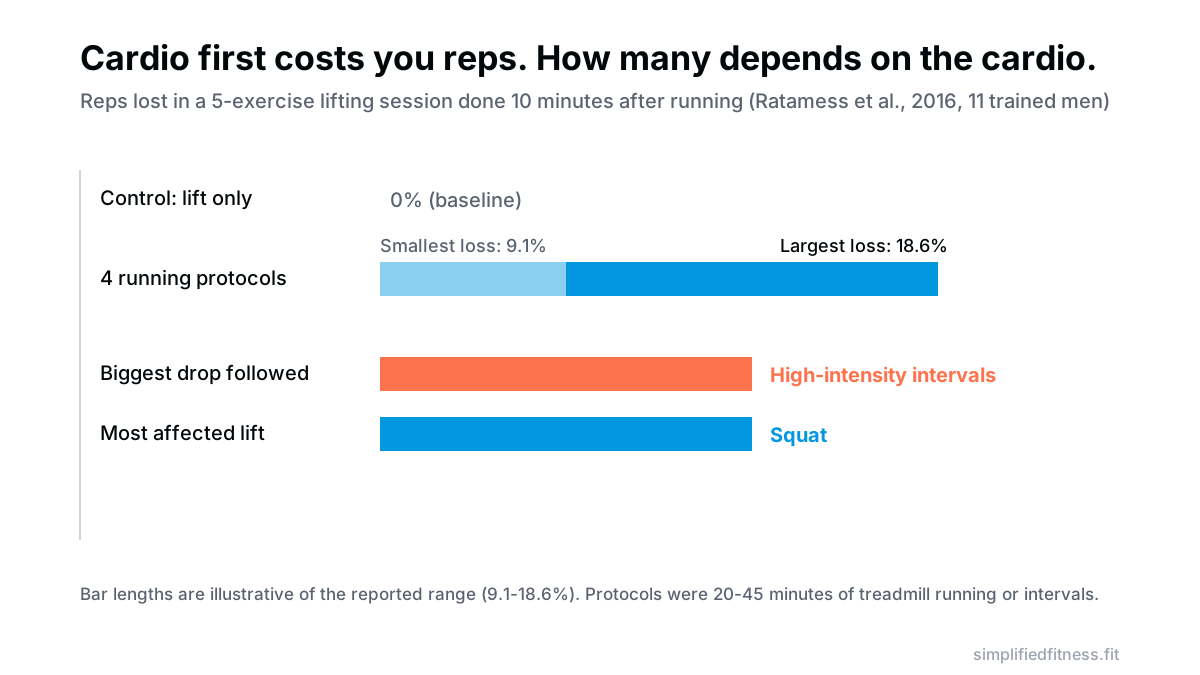
Two caveats. The sample was 11 young men, and the gap was only 10 minutes. Real life, with a 20-minute changing-room break, a drink and a banana, will be different. Still, the direction is clear: if your first working set of squats feels like wading through wet sand, your cardio did that.
You will sometimes see “20-30% lost volume” quoted for this. The study above found less than that, so treat the bigger number as an upper-end guess rather than a measured result.
Cardio before or after weights: what happens over weeks?
This is where the story gets more interesting, and where the short-term finding does not simply carry over.
A systematic review and meta-analysis of 10 studies (training programmes of at least 5 weeks in healthy adults) compared resistance-then-endurance with endurance-then-resistance in the same session. Lower-body dynamic strength improved more when lifting came first (a 6.91% difference, 95% CI 1.96 to 11.87). Order made no difference to lower-body hypertrophy, static strength, maximal aerobic capacity or body fat percentage (Eddens et al., 2018).
A separate meta-analysis looking at the same-session sequence found the same pattern for strength: lower-body 1RM was higher by a pooled 3.96 kg (95% CI 0.81 to 7.10) when strength training came first, and aerobic capacity was unaffected by order (Murlasits et al., 2018).
So the honest reading is this. Lifting first gives a modest strength advantage for the legs. For muscle size, the data do not show a clear order effect. That is not the same as “cardio first is fine for hypertrophy.” It means that in these pooled studies you cannot see a difference, and the individual studies were small.
Is cardio on a separate day better?
Separating sessions is a safe bet, and the evidence supports it for one outcome in particular.
A 2022 meta-analysis of 43 studies compared lifting alone with the same lifting plus aerobic training. Concurrent training did not compromise muscle hypertrophy or maximal strength. Explosive strength was attenuated, and that attenuation was more pronounced when both were done in the same session than when sessions were at least 3 hours apart. The authors found no significant effects of cardio type, weekly frequency, training status or age (Schumann et al., 2022).
Two things stand out. First, mixing cardio and lifting is much less harmful to muscle than the old scare stories suggested. Second, if you care about power (jumping, sprinting, Olympic lifts), spacing sessions helps.
Where does “6 hours” come from? It is a common rule of thumb in coaching circles. The studies we reviewed point to 3 hours or more, and direct comparisons of exact gaps are limited. So treat 3 hours as a reasonable target and 6 as a bonus.
The practical ladder: where to put your cardio
This is a synthesis of the studies above, not a single trial result. It ranks options by how well they protect your lifting.
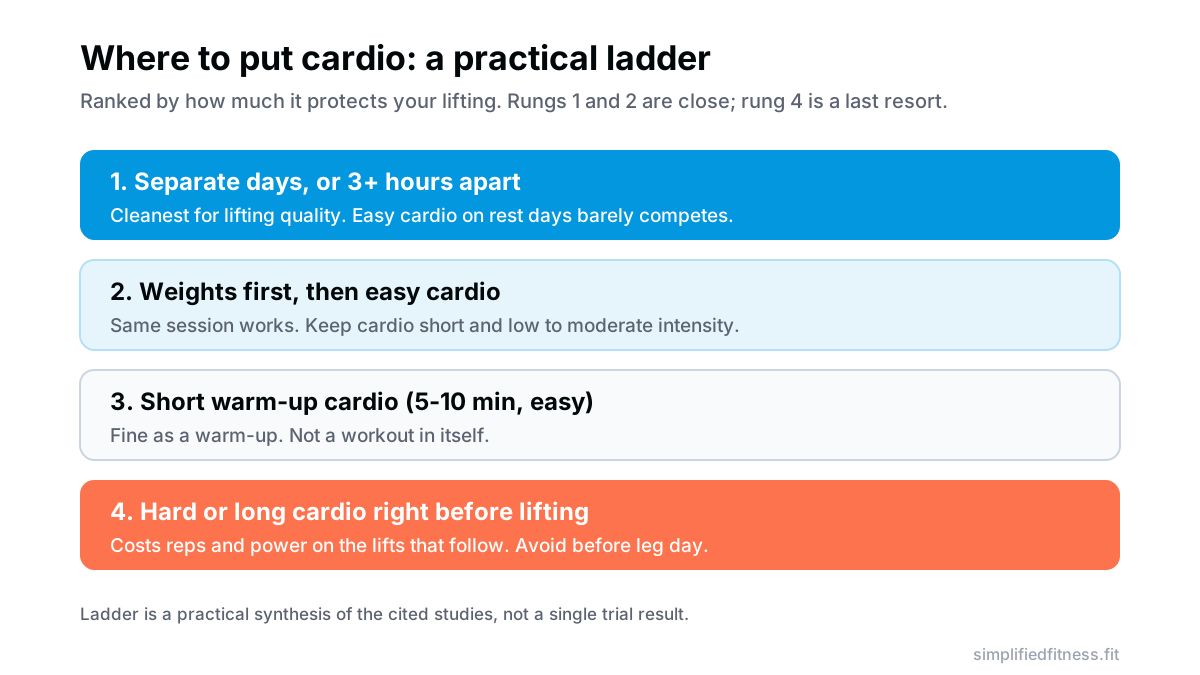
| Option | Lifting quality | Good for | Watch out for |
|---|---|---|---|
| Separate days, or 3+ hours apart | Best protected | Anyone with time and a flexible schedule | Daily life; a stacked week can still add up |
| Weights first, easy cardio after | Protected | Busy lifters with one gym slot | Cardio must stay short and not too hard |
| 5-10 min easy warm-up cardio | Minimal cost | Everyone | Turning the warm-up into a workout |
| Hard or long cardio before lifting | Reps and power fall | Endurance-first goals only | Leg day, heavy compounds, intervals |
Can you do cardio on rest days?
For most healthy lifters, yes. The 2022 meta-analysis above found no compromise to muscle size or maximal strength from concurrent training overall, and walking or easy cycling is a low-cost way to add weekly activity.
The trap is not the rest day, it is the intensity. Hard intervals on the day before leg day are the setup that tends to leave your quads heavy for the next session. If your numbers on the squat or leg press start slipping across two or three weeks, move the hard work earlier in the week or drop it.
If you are cutting, this matters more because recovery is thinner. See our notes on cardio during a cutting phase, and for choosing between steady and interval work, LISS versus HIIT for muscle preservation.
What if you only have one session a day?
Plenty of people do. A 6 am gym slot before the office, or 45 minutes after work, and that is it. Here is a workable default.
- Lift first. Put your heaviest compounds at the start.
- Finish with 10-20 minutes of easy to moderate cardio. A brisk walk on an incline works well, and you can read more in our guide to incline treadmill walking.
- Keep hard intervals for their own day.
- Eat something before you start. In hot Indian summers, take extra water and electrolytes if you sweat heavily, because dehydration can also drag down lifting performance.
If you want to stay in an easy zone, our heart rate zone calculator gives you a target range, and our Zone 2 guide explains why easy work pairs so well with lifting.
Does time of day matter?
Probably less than you think. In a 24-week study, 42 young men did same-session strength and endurance training either in the morning or the evening, in either order. All groups gained strength and muscle. During weeks 13-24, the evening groups gained more muscle mass, and the endurance-first order was somewhat better for endurance performance, but order and time only influenced adaptations after more than 12 weeks (Kuusmaa et al., 2016).
That is a single trial with small groups, in young men. Interesting, not decisive. Pick the time you can repeat for months.
Does running or cycling matter for the timing question?
An older meta-analysis of 21 studies found that running combined with lifting, but not cycling, was linked to decrements in hypertrophy and strength, and that more endurance frequency and duration were associated with larger interference (Wilson et al., 2012). The 2022 update with more studies found no significant difference between running and cycling (Schumann et al., 2022).
Conflicting, then. A reasonable reading: how much and how hard you do cardio probably matters more than which machine. If your knees or shins complain, cycling is a lower-impact option, and for the broader picture see our guide to building muscle as a natural lifter.
A simple weekly template
This is an illustrative layout, not a prescription.
- Mon: lower body, then 10 minutes easy walking
- Tue: upper body
- Wed: 30-40 minutes easy cardio (cycling, brisk walk)
- Thu: upper or push/pull
- Fri: lower body
- Sat: optional intervals (the day after legs, with Sunday rest before Monday’s lower session)
- Sun: rest
Adjust to your own recovery. If your lifting performance falls for a few weeks, reduce the cardio volume or intensity first, and for ready-made lifting splits see our push day, pull day and leg day plans.
When to talk to a doctor
If you have known heart or lung disease, a history of chest pain, unexplained breathlessness, dizziness or fainting during exercise, or you are returning after a long break with health conditions, talk to a doctor before ramping up hard cardio. This article is general education, not a diagnosis. Stop and seek advice if symptoms appear.
Frequently Asked Questions
Should I do cardio before or after weights?
If you must do both in one session, lift first and do cardio after. Cardio before lifting reduces reps and power in the session that follows, and a meta-analysis found lower-body strength gains were somewhat better when lifting came first. If your goal is mainly endurance, the order matters less, so pick the one you will actually stick to.
Does cardio before lifting kill gains?
Not in the dramatic way gym myths suggest, but it can hurt the quality of that workout. In trained men, 20-45 minutes of running before lifting cut total reps by 9.1-18.6%, and fewer hard reps means less training stimulus. A short, easy warm-up on the bike is fine; save the long or hard cardio for later or another day.
Is it OK to do cardio on rest days?
Yes, for most healthy lifters easy cardio on rest days is a sensible option. A 2022 meta-analysis found concurrent training did not compromise muscle size or maximal strength overall. Keep it easy enough that you can still train hard the next day, and pull back if your lifting performance drops.
How long should I wait between cardio and weights?
At least 3 hours is a reasonable target if you can manage it. A 2022 meta-analysis reported that explosive strength was attenuated when cardio and lifting shared a session, but not when separated by at least 3 hours. Most people eat a proper meal and rehydrate in that gap, which also helps.
Is 6 hours between cardio and lifting necessary?
No, 6 hours is not a proven requirement. The research we reviewed points to gaps of 3 hours or more as helpful for explosive strength, and direct comparisons of exact gaps are limited. Treat longer gaps as a bonus, not a rule.
Can I do light cardio as a warm-up before weights?
Yes, 5-10 minutes of easy cardio is a normal warm-up and unlikely to cost you much. The studies showing lost reps used 20-45 minutes of running at moderate to hard effort, which is a different thing. If you notice heavy legs on your first working set, shorten it.
Which cardio hurts lifting the most before a workout?
High-intensity intervals did the most damage to later lifting in a trained-men study. Running intervals at 90-100% of VO2 reserve led to the largest reductions in lifting performance, while steady-state running for 20-45 minutes also reduced reps. Hard intervals belong on separate days or after lifting.
Does the order of cardio and weights change muscle growth?
Over several weeks, not clearly. A systematic review and meta-analysis of 10 studies found no effect of exercise order on lower-body hypertrophy. Lower-body dynamic strength did improve more when lifting came first.
Does running or cycling interfere more with lifting?
In a 2012 meta-analysis, running combined with lifting was linked to reduced hypertrophy and strength, while cycling was not. Later work with more studies found no meaningful difference by cardio type. Cycling is a lower-impact option if your legs are your priority.
Is morning or evening better for combining cardio and weights?
The evidence is thin, so do whichever time you can repeat. In a 24-week study of 42 young men, evening training gained more muscle mass in weeks 13-24 than morning training, but groups were small. Do not rearrange your life around that one finding.
Should I do cardio before or after weights when cutting?
Lifting first is still the better default, because you want your best effort on the sets that tell your body to keep muscle. Keep cardio easy or moderate and watch recovery as calories drop. Our guide to cardio during a cutting phase goes deeper.
Should I do cardio before leg day?
Avoid hard cardio before leg day. The squat showed the largest reduction when lifting followed running in trained men. If you need cardio that day, do it after your lifting or switch to easy walking.
When should I see a doctor before mixing cardio and weights?
See a doctor before starting if you have known heart or lung disease, chest pain, unexplained breathlessness, dizziness or fainting during exercise. This article cannot assess your personal risk. Stop exercising and get medical advice if those symptoms appear.
Sources & References
Every claim above is checked against peer-reviewed research (PubMed, U.S. National Library of Medicine) or guidance from established health bodies. How we fact-check.
- Ratamess NA, et al. Acute Resistance Exercise Performance Is Negatively Impacted by Prior Aerobic Endurance Exercise. J Strength Cond Res. 2016. PMID: 27658232
- Eddens L, et al. The Role of Intra-Session Exercise Sequence in the Interference Effect: A Systematic Review with Meta-Analysis. Sports Med. 2018. PMID: 28917030
- Murlasits Z, et al. The physiological effects of concurrent strength and endurance training sequence: A systematic review and meta-analysis. J Sports Sci. 2018. PMID: 28783467
- Schumann M, et al. Compatibility of Concurrent Aerobic and Strength Training for Skeletal Muscle Size and Function: An Updated Systematic Review and Meta-Analysis. Sports Med. 2022. PMID: 34757594
- Wilson JM, et al. Concurrent training: a meta-analysis examining interference of aerobic and resistance exercises. J Strength Cond Res. 2012. PMID: 22002517
- Fyfe JJ, et al. Interference between concurrent resistance and endurance exercise: molecular bases and the role of individual training variables. Sports Med. 2014. PMID: 24728927
- Kuusmaa M, et al. Effects of morning versus evening combined strength and endurance training on physical performance, muscle hypertrophy, and serum hormone concentrations. Appl Physiol Nutr Metab. 2016. PMID: 27863207

Umair Hazrami · Founder & Head Coach, Simplified Fitness
Umair Hazrami founded Simplified Fitness and the Simplified Lifter channel to cut through fitness noise. With 4+ years of consistent training and 10+ coaching clients, he writes every guide from the peer-reviewed research and links the sources so you can check them. Our editorial standards.
Educational content only, not medical advice. If you have a medical condition, are pregnant, or take medication, talk to a qualified doctor before changing your diet, supplements or training. Full disclaimer.
Keep reading
Strength & Cardio
Aerobic Conditioning and Hypertrophy: How Work Capacity Improves Inter-Set Recovery
Does better cardio help you recover between sets? See what work capacity resistance training research says, where theory outruns data, and what to do.
9 min read

Strength & Cardio
Can Cardio Cause Muscle Loss? The Calorie and Volume Thresholds Behind the Fear
Does cardio cause muscle loss? Not at normal doses. See what the meta-analyses say about deficits, protein and running volume, and how to protect your muscle.
9 min read

Strength & Cardio
Cardio During a Cut: How Much You Need and When to Stop Adding
How much cardio during cutting phase? Learn the food-first rule, a walking base, sample weekly schedules and signs you are doing too much. Every study linked.
7 min read

Strength & Cardio
Cycling vs Running for Lifters: Which Protects Muscle and Squat Strength?
Cycling vs running for lifters: Wilson's meta-analysis found running, not cycling, blunted gains. We compare it with newer reviews and give a bike plan.
8 min read