Cycling vs Running for Lifters: Which Protects Muscle and Squat Strength?
Cycling vs running for lifters: Wilson's meta-analysis found running, not cycling, blunted gains. We compare it with newer reviews and give a bike plan.
TL;DR. The short answer
- Wilson et al. (2012) found that adding running, but not cycling, to lifting produced significant decrements in hypertrophy and strength. Newer reviews are more mixed, so cycling is a safe bet rather than a guaranteed win.
- A 2022 meta-analysis of 43 studies found no significant difference between cycling and running as the aerobic mode, and no overall loss of muscle size or maximal strength from concurrent training.
- A 2022 fibre-level meta-analysis found type I fibre growth fell with running (SMD -0.81) but not cycling, though the authors call this preliminary.
- A common explanation is that running loads the legs eccentrically with every landing while cycling is a smoother, seated push. That mechanism is plausible but not proven as the cause.
- If your legs are your priority, a stationary bike at a conversational pace for 20-40 minutes, 2-3 days a week, is a low-risk way to add cardio.
Part of our complete guide: Cardio and Concurrent Training: Build Endurance Without Losing Muscle (The Interference Effect)
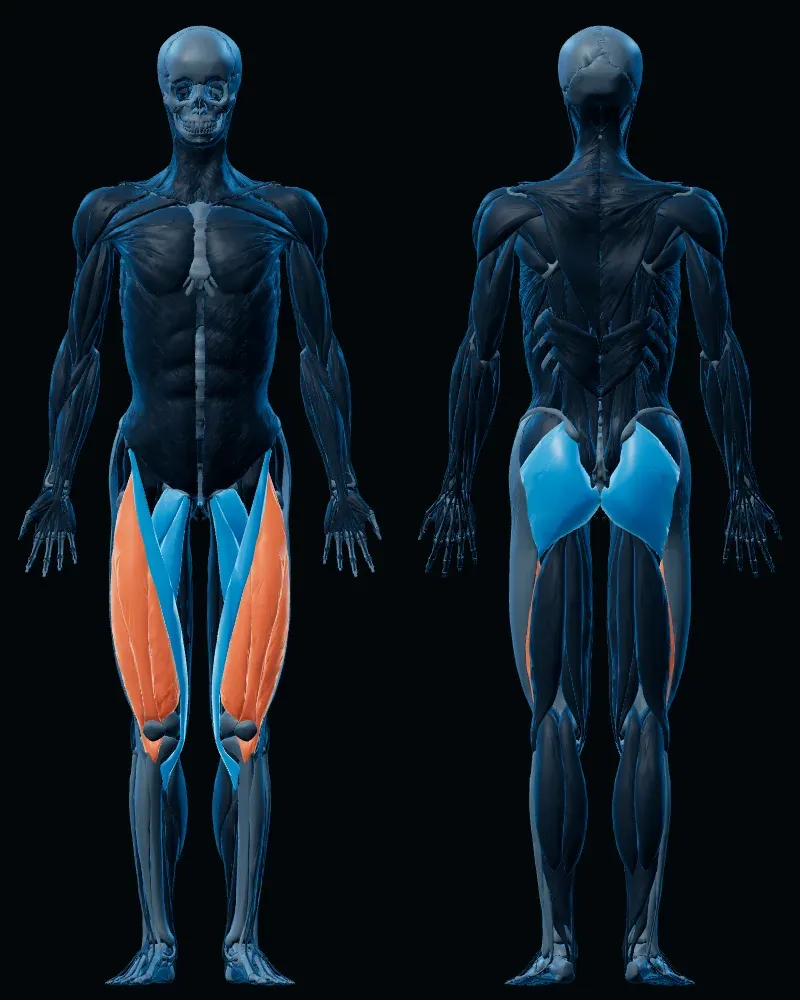
Muscles worked: quads
Main movers: rectus femoris and the three vasti
Assisting: adductors, sartorius and glutes
Table of contents
Cycling vs running for lifters comes down to this: in the best-known meta-analysis, adding running to lifting blunted muscle size and strength gains, while adding cycling did not (Wilson et al., 2012). Newer reviews are less clear-cut, so cycling is the lower-risk pick, not a guarantee.
This article is one part of our guide to the cardio and concurrent training interference effect. Here we stick to one question: if you lift and want cardio, should the cardio be a bike or a run? We will read what each study actually reported, show where they disagree, and finish with a bike plan you can start this week.
What did Wilson’s meta-analysis actually find about cycling vs running?
Wilson and colleagues pooled 21 studies (422 effect sizes) comparing strength training alone with strength plus endurance training. Overall, lifting alone and concurrent training both beat endurance alone for hypertrophy and strength. The modality finding is the one people quote: resistance training combined with running, but not cycling, produced significant decrements in both hypertrophy and strength (Wilson et al., 2012).
They also found that more frequent and longer endurance sessions correlated with smaller gains in hypertrophy, strength and power. The authors concluded that interference depends on modality, frequency and duration.
A few cautions matter here. This is a meta-analysis of older training studies, and the modality comparison is a subgroup finding, not a head-to-head trial. You may see specific effect sizes for running and cycling quoted online. We could not confirm those figures from the paper’s abstract, so we do not repeat them.
Do newer studies still show running hurts more than cycling?
Partly, and this is where the story gets more honest.
A 2022 meta-analysis of 43 studies found concurrent training did not compromise whole-muscle hypertrophy or maximal strength overall. The pooled differences versus lifting alone were -0.01 for muscle hypertrophy and -0.06 for maximal strength, and neither was significant. Crucially for this topic, they tested the type of aerobic training (cycling vs running) as a moderator and found no significant effect (Schumann et al., 2022). Explosive strength did drop a little (SMD -0.28), more so when both were done in the same session.
Then a separate 2022 analysis zoomed in on muscle fibres. Across 15 studies, concurrent training had a small negative effect on fibre size overall (SMD -0.23). For type I fibres, the drop appeared when aerobic work was running (SMD -0.81) but not cycling. The authors describe this as preliminary evidence (Lundberg et al., 2022).
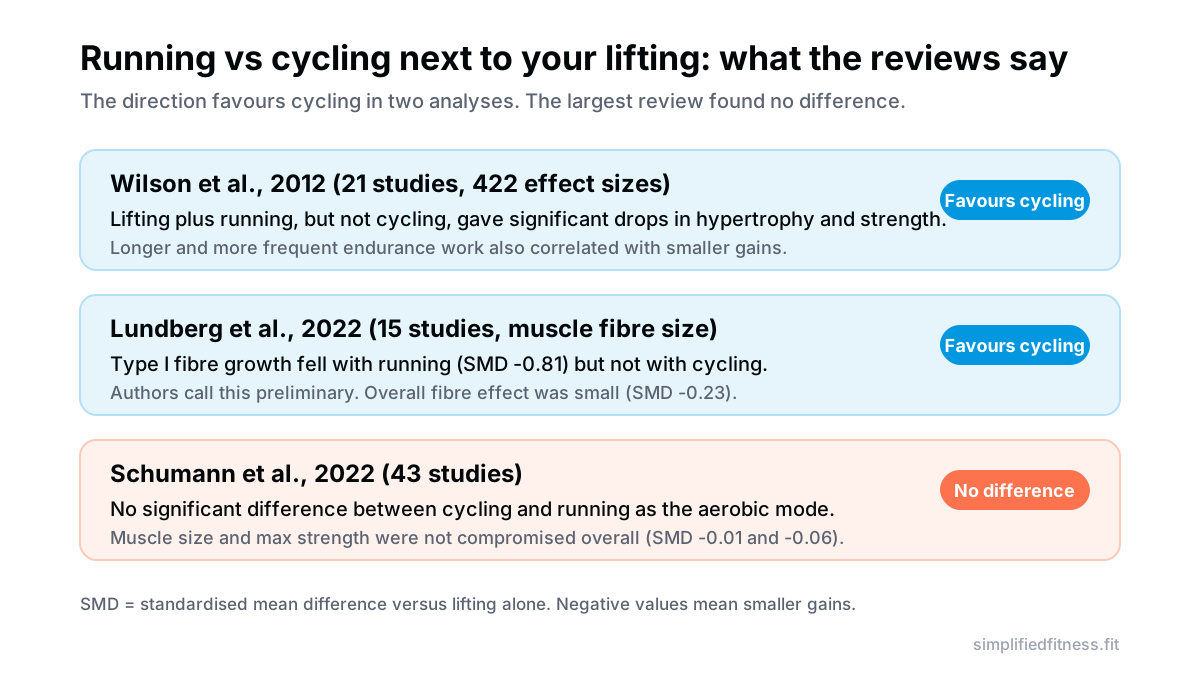
Why might the results differ? Reviews pool different studies, populations and training designs. Whole-muscle measures and single-fibre measures are not the same thing. And subgroup analyses can be underpowered, so a real difference may be hiding in the noise, or a false one may appear.
One more result complicates the “cycling wins” story. A 2024 network meta-analysis of 40 studies (841 participants) found all concurrent modalities were inferior to lifting alone for lower-body maximal strength. For muscle cross-sectional area, moderate-intensity continuous cycling did about as well as lifting alone (SMD 0.07, 95% CI -0.24 to 0.38). Its authors suggested high-intensity interval running might minimise the damage to lower-limb strength (Chen et al., 2024). The confidence intervals are wide, so none of this is clean separation.
Our cautious read: in the Wilson and Lundberg analyses cycling looks better than running, and in Schumann they look the same. Only the Chen network analysis hints that one form of running (high-intensity intervals) may do well. But the gap is smaller and less certain than the loudest versions of the claim.
Why might running interfere more? The mechanics
The usual explanation is mechanical. Running is an impact activity. Each stride has a landing phase where the leg muscles work eccentrically, meaning they lengthen under load to absorb bodyweight and control the descent. A review of running mechanics describes how most leg muscles work eccentrically for part of the gait cycle to support the body and absorb shock, and how this is accentuated in downhill running (Eston et al., 1995). That review links eccentric activation with muscle damage.
Cycling is seated. You push down against the pedals, there is no landing, and the load is mostly a smooth, concentric push. That is one likely reason hard cycling tends to leave your quads burning rather than sore for days.
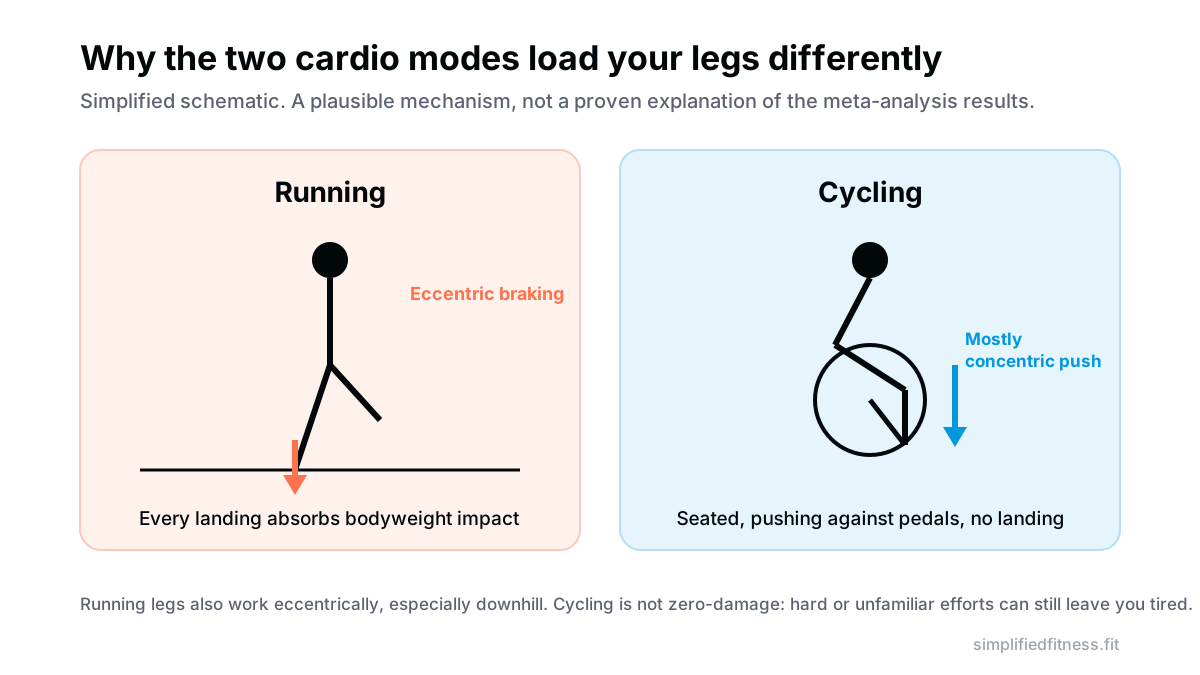
Here is the caveat that keeps this honest. We do not have a study proving that landing forces explain Wilson’s result. Muscle damage can also affect how you feel and perform: for example, damage from downhill running has been shown to impair running economy in later exercise (Assumpção et al., 2013). That supports “damage costs you something”, but it does not prove that damage blunts hypertrophy.
On the molecular side, the picture is also unsettled. A review of the topic noted that although endurance exercise can activate signals that inhibit protein synthesis pathways, human studies have not observed such molecular interference after acute concurrent exercise that would explain reduced hypertrophy (Fyfe et al., 2014). For that side of the debate, see our piece on the AMPK and mTOR interference effect.
Cycling vs running for lifters: a practical comparison
| Factor | Running | Cycling |
|---|---|---|
| Landing impact | Yes, every stride | None |
| Leg muscle action | Includes eccentric braking | Mostly concentric push |
| Soreness risk on legs | Higher, especially downhill or when new | Lower |
| Joint load (knees, shins, feet) | Higher | Lower |
| Easy to dose at a steady effort | Moderate | Easy on a stationary bike |
| Research on interference | Wilson and Lundberg lean negative | Wilson and Lundberg lean neutral; Schumann found no difference |
This table is a coaching summary of the mechanics and the studies above, not a measured result from one trial.
Is cycling really “concentric only”?
Not exactly, and it is worth being precise. Pedalling is mostly a concentric push through the downstroke, with far less braking than running. But your muscles still work to control the leg on the upstroke and at the top and bottom of the circle, and hard intervals or high resistance can leave you fatigued. The point is relative: cycling has less eccentric load and no impact, not zero.
That matters in practice. A first hard session after months off the bike can still leave your quads tired. Easy pedalling at a conversational pace is where the low-interference logic is strongest.
How to set up a stationary bike for lifters
A badly set up bike is uncomfortable and can irritate your knees. These are practical defaults, not outputs from a single trial.
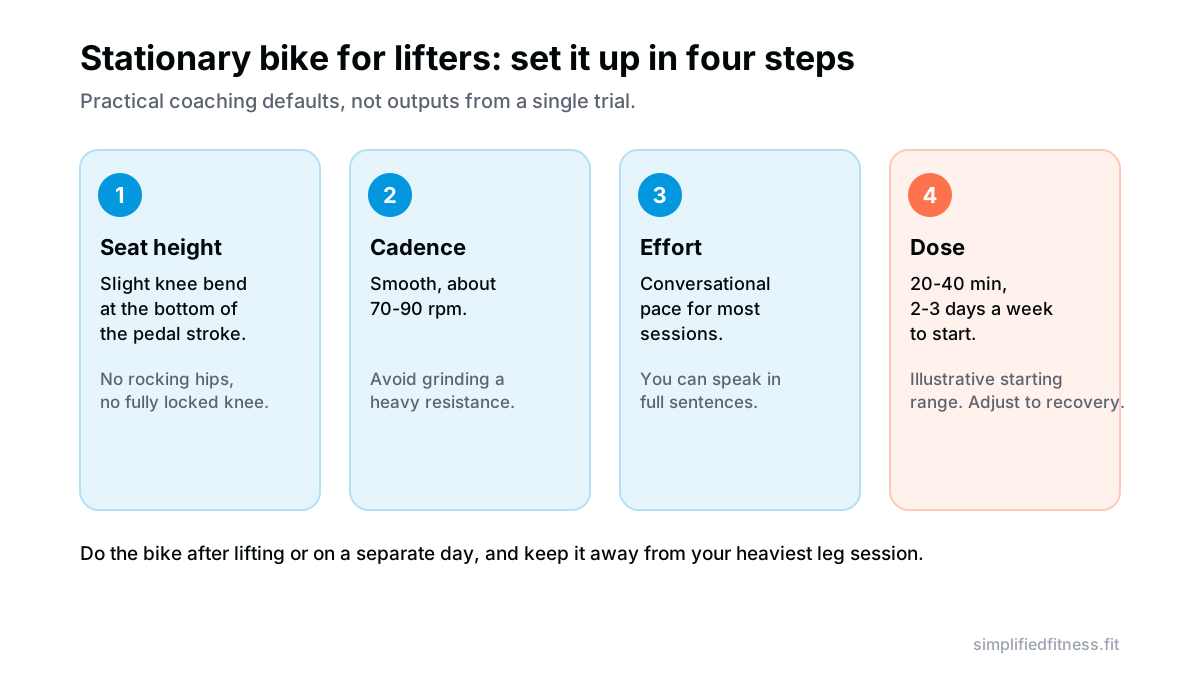
- Seat height: with your heel on the pedal at the bottom of the stroke, your leg should be nearly straight. Pedalling with the ball of your foot will then leave a slight knee bend. If your hips rock side to side, the seat is too high.
- Hip and knee angles: a seat that is too low closes the hip and knee sharply at the top of the stroke, which can irritate knees. If your knees feel pinched, raise the seat a little.
- Cadence: aim for a smooth 70-90 rpm. Grinding at low cadence on heavy resistance loads the quads like a slow squat set and defeats the point.
- Effort: keep most sessions conversational. You should speak in full sentences. Our heart rate zone calculator can give you a target range.
- Duration and frequency: 20-40 minutes, 2-3 days a week is an illustrative starting range. Wilson et al. found longer and more frequent endurance work correlated with smaller gains, so add time slowly.
Where does cycling fit in your week?
If you lift four days a week, a simple pattern is two easy bike sessions on non-leg days, or after upper-body lifting. If you must ride on a squat day, lift first. The Schumann review found explosive strength was blunted less when the sessions were separated by at least 3 hours than when done together (Schumann et al., 2022). We cover the timing question in more detail in our guide to cardio before or after weights.
If you only care about heart health, easy riding is all you need, and you can build the base with zone 2 cardio for lifters. If your goal is fat loss and you are trying to keep muscle, compare options in LISS vs HIIT for muscle preservation.
What if you actually like running?
Then you do not have to quit. The largest 2022 review found no overall hit to muscle size or maximal strength from concurrent training, and no significant difference between modes (Schumann et al., 2022). Many lifters run and still progress.
What helps is keeping the volume and impact in check:
- Keep runs short and mostly easy, away from the day before heavy squats or deadlifts.
- Run on softer or flatter routes where you can, because downhill running accentuates eccentric work (Eston et al., 1995).
- Rotate one run for one bike session if your legs feel flat.
- Watch your squat and leg press numbers over 4-6 weeks. If they stall while cardio rises, trim the cardio.
If you want a low-impact option without a bike, our guide to incline treadmill walking for lifters shows the settings.
When should you be careful?
Cardio is generally safe for healthy adults, but see a doctor before starting if you have heart disease, chest pain, unexplained breathlessness, dizziness or fainting during exercise, or a joint problem that worsens with cycling. This article is educational and does not diagnose anything. If knee pain develops on the bike, adjust the seat first, and see a physio if it persists.
For Indian lifters training in summer heat, an indoor bike with a fan and enough water beats a midday outdoor ride.
The bottom line
Cycling is the lower-risk cardio choice for lifters who want to protect leg size and squat strength. Wilson’s meta-analysis found running, not cycling, blunted hypertrophy and strength, a fibre-level analysis points the same way, and the mechanics make sense. But the largest review found no significant difference, so the real-world gap may be modest.
Use the bike for 20-40 easy minutes, 2-3 days a week, keep it away from your heaviest leg day, and let your squat numbers tell you whether it is working. And if you love running, keep it modest and track your lifts. For the full picture of how cardio and lifting interact, return to our guide to cardio and the interference effect, or read does cardio kill gains. To plan your leg training, try our free leg day plan.
Frequently Asked Questions
Is cycling better than running for lifters?
Cycling is probably the lower-risk choice for lifters who care about leg size and strength, but the evidence is not unanimous. The 2012 Wilson meta-analysis and a 2022 fibre-level meta-analysis favoured cycling, while a larger 2022 review of 43 studies found no significant difference. If your legs matter more than your 5K time, cycling is a sensible default, and you can check how your own squat numbers respond.
Why does running interfere with muscle gain more than cycling?
The honest answer is that nobody has proven it. A common explanation is that running is an impact activity where leg muscles work eccentrically on every landing, which can add soreness and fatigue that eat into lifting recovery. Cycling is seated and smoother, so if your quads feel flat for squats after runs, swapping some sessions to the bike is a cheap experiment.
Does cycling kill squat gains?
In the research it has not clearly done so. Wilson et al. found concurrent training with cycling did not produce significant decrements in hypertrophy or strength, and a 2022 review found maximal strength and muscle size were not compromised overall. Keep the bike moderate, avoid doing long hard rides before squats, and track your working weights.
How much cardio is too much for muscle growth?
Wilson et al. found that more frequent and longer endurance sessions correlated with smaller strength, power and hypertrophy gains. Those were correlations across studies, not a fixed cutoff, but the direction is consistent: more endurance volume usually costs more. Start with 2-3 short sessions a week and increase only if your lifts keep progressing.
Is a stationary bike or an outdoor bike better for lifters?
A stationary bike is easier to control, because you can hold a steady pace and avoid traffic, hills and crashes. Outdoor riding adds hills that can push your effort higher than planned, which is fine if you enjoy it but harder to dose. In a hot Indian summer, an indoor bike with a fan also avoids heat stress.
Can I run and still build muscle?
Yes. The largest 2022 review found concurrent aerobic and strength training did not compromise muscle hypertrophy or maximal strength overall, and no significant cycling versus running difference. Running may cost some people more recovery, so keep the volume modest, separate it from leg day, and judge it by whether your squat keeps climbing.
What is the best low-impact cardio for bodybuilders?
Stationary cycling, incline walking and swimming are common low-impact options, and cycling is the mode most often compared with running in the concurrent training research. Low-impact does not mean no fatigue, so intensity and duration still matter. Pick the one you will do consistently and keep most sessions conversational.
Should I do cycling before or after lifting?
Lifting first, then cardio, is the usual default if both share a session, because it protects the quality of your heavy sets. A 2022 meta-analysis found explosive strength was blunted more when aerobic and strength training were in the same session than when separated by at least 3 hours. If you can, put the bike on a non-leg day or at a different time.
Does HIIT on a bike hurt leg gains?
It can if you do too much of it, because hard intervals are tiring and compete with leg-day recovery. The research here is mixed: a 2024 network meta-analysis suggested high-intensity running intervals minimized lower-limb strength losses compared with other concurrent modes, but its confidence intervals were wide. Keep intervals short and infrequent, and do not stack them the day before squats.
How long should I cycle each session as a lifter?
For most lifters, 20-40 minutes at an easy to moderate pace is a reasonable starting range. Wilson et al. found longer endurance duration correlated with larger decrements, so more is not automatically better. Use our heart rate zone calculator to keep the effort conversational, and add time slowly.
What if I only have a treadmill and no bike?
Use the treadmill on a walking incline rather than a jog, since it keeps the impact low. It also avoids the repeated landing that characterises running. Keep it to 20-40 minutes and see our guide to incline treadmill walking for settings.
Does cycling build leg muscle too?
It can add a little in people who are untrained or returning, but it is not a replacement for squats or leg presses. Heavy resistance training is the main driver of muscle growth, and cycling is there for heart and lung fitness. Keep your leg training in the gym and use the bike as the supporting cardio.
Sources & References
Every claim above is checked against peer-reviewed research (PubMed, U.S. National Library of Medicine) or guidance from established health bodies. How we fact-check.
- Wilson JM, et al. Concurrent training: a meta-analysis examining interference of aerobic and resistance exercises. J Strength Cond Res. 2012. PMID: 22002517
- Schumann M, et al. Compatibility of concurrent aerobic and strength training for skeletal muscle size and function: an updated systematic review and meta-analysis. Sports Med. 2022. PMID: 34757594
- Lundberg TR, et al. The effects of concurrent aerobic and strength training on muscle fiber hypertrophy: a systematic review and meta-analysis. Sports Med. 2022. PMID: 35476184
- Chen Y, et al. Comparative efficacy of concurrent training types on lower limb strength and muscular hypertrophy: a systematic review and network meta-analysis. J Exerc Sci Fit. 2024. PMID: 38187085
- Fyfe JJ, et al. Interference between concurrent resistance and endurance exercise: molecular bases and the role of individual training variables. Sports Med. 2014. PMID: 24728927
- Eston RG, et al. Eccentric activation and muscle damage: biomechanical and physiological considerations during downhill running. Br J Sports Med. 1995. PMID: 7551767
- Assumpção CO, et al. Exercise-induced muscle damage and running economy in humans. ScientificWorldJournal. 2013. PMID: 23431253

Umair Hazrami · Founder & Head Coach, Simplified Fitness
Umair Hazrami founded Simplified Fitness and the Simplified Lifter channel to cut through fitness noise. With 4+ years of consistent training and 10+ coaching clients, he writes every guide from the peer-reviewed research and links the sources so you can check them. Our editorial standards.
Educational content only, not medical advice. If you have a medical condition, are pregnant, or take medication, talk to a qualified doctor before changing your diet, supplements or training. Full disclaimer.
Keep reading
Strength & Cardio
Aerobic Conditioning and Hypertrophy: How Work Capacity Improves Inter-Set Recovery
Does better cardio help you recover between sets? See what work capacity resistance training research says, where theory outruns data, and what to do.
9 min read
Strength & Cardio
Can Cardio Cause Muscle Loss? The Calorie and Volume Thresholds Behind the Fear
Does cardio cause muscle loss? Not at normal doses. See what the meta-analyses say about deficits, protein and running volume, and how to protect your muscle.
9 min read
Strength & Cardio
Cardio During a Cut: How Much You Need and When to Stop Adding
How much cardio during cutting phase? Learn the food-first rule, a walking base, sample weekly schedules and signs you are doing too much. Every study linked.
7 min read

Strength & Cardio
Fasted Cardio vs Fed Cardio: Does Skipping Breakfast Burn More Fat?
Fasted cardio vs fed cardio for fat loss: what the trials show on fat burn, muscle loss and cortisol, plus what to eat before a 6am session. Every study linked.
9 min read