Heart Rate Variability (HRV) in Concurrent Training: Tracking Autonomic Recovery
HRV for lifters doing concurrent training: how to read your rMSSD trend, spot overload from cardio plus lifting, and adjust the week. Every study linked.

TL;DR. The short answer
- HRV (usually rMSSD on a watch or ring) is a rough read on how much your parasympathetic, rest-and-digest side is dominating. A sustained drop below your own baseline can flag that cardio plus lifting is outrunning recovery, but it is not a verdict.
- Use a 7-day rolling average against your personal normal range. A single low morning means very little, because daily readings are noisy.
- HRV-guided training beat fixed plans for improving HRV itself (SMD 0.50) but only by a small, non-significant margin for endurance performance and VO2max (about 0.20 each), and the evidence is mostly in endurance athletes.
- After a hard lifting session in trained men, HRV was back to baseline within 24 hours while perceived recovery was still suppressed at 48 hours, so HRV alone can look better than you feel.
- If HRV stays low for several days and you also feel flat or your lifts slip, trim intervals first, then a few lifting sets. See a doctor for chest pain, fainting or a racing heart.
Part of our complete guide: Cardio and Concurrent Training: Build Endurance Without Losing Muscle (The Interference Effect)
Table of contents
HRV for lifters doing concurrent training is useful as a trend, not as a daily verdict. If your 7-day average sits well below your own normal range for several days, cardio plus lifting may be outrunning your recovery. One bad morning means almost nothing.
That is the short version. This guide sits under our cardio and concurrent training pillar, and here we stay narrow: what the number is, how to build a baseline, what the research actually shows, and what to change in your week when the trend drops.
What is HRV, and what is rMSSD?
Your heart does not tick like a metronome. The gap between beats varies slightly, and that variation is heart rate variability. It is commonly used as a surrogate for autonomic function (Addleman et al., 2024).
Two branches of your autonomic nervous system tug on the heart. The sympathetic side (fight-or-flight) pushes toward faster, more regular beats. The parasympathetic side (rest-and-digest) adds beat-to-beat variation. Higher HRV generally goes along with more parasympathetic activity.
Most watches and rings report rMSSD, the root mean square of successive differences. A 2025 review calls it practical because it tracks parasympathetic activity, is easy to calculate, and holds up in short recordings (Esco et al., 2025). The same review notes its limits: it only reflects the parasympathetic side, and it is easily thrown off by outside factors.
Why HRV matters more when you mix cardio and lifting
Running plus lifting is where recovery gets squeezed. A meta-analysis of 21 studies found the interference effect depends on the modality, frequency and duration of the endurance work. Running, but not cycling, was linked with smaller gains in hypertrophy and strength, and longer or more frequent endurance sessions were associated with worse strength, power and size outcomes (Wilson et al., 2012).
Those are group averages from mixed studies. They do not tell you where your own line sits. That is the gap HRV tries to fill: a personal early-warning signal that says your total load this week, cardio and lifting together, is heavier than you are absorbing. For the molecular side of interference, see our guide to the AMPK and mTOR interference effect.
How do I track my HRV baseline and rolling average?
Keep it boring and consistent.
- Same conditions. Same device, same time, same position. Overnight readings from a ring or watch work fine if you stick with one device.
- Near-daily data. Reviews favour routine near-daily measurement over isolated readings (Esco et al., 2025).
- Rolling 7-day average. Average the last seven days and compare it with your range from the previous few weeks.
- Your range, not a stranger’s. A 35 ms and a 90 ms can both be perfectly normal for two different people.
Why averages? In 37 well-trained athletes, rolling 2-4-day averages gave more precise estimates of mean changes than single-day values, although the averaged values did not clearly link to performance changes and could even blur individual short-term responses (Schneider et al., 2019). Averaging smooths noise. It does not make the number magic.
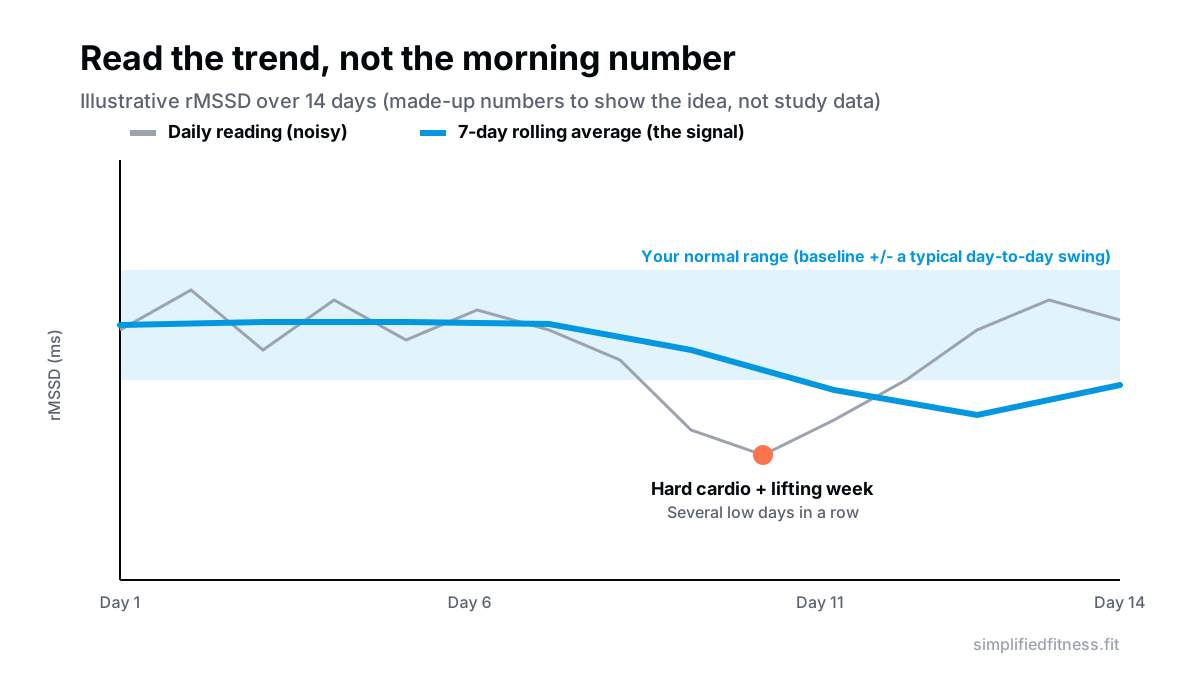
Give yourself two to four weeks of tracking before you trust the range. That span is a practical rule of thumb, not a number from a trial.
What does low HRV mean in the gym?
A low reading means your variation is lower than your usual. It often shows up after heavy training. It also shows up after short sleep, illness, alcohol, stress or a hot, restless night. Here in India, a sweaty, poorly cooled night in summer can plausibly do it too, though I would not call that a proven mechanism.
So the first move is to look for the boring explanation. Did you sleep badly? Drink last night? Come down with a cold? If yes, the drop may say nothing about your program.
Does HRV actually improve training? What the research shows
This is where honesty matters. The evidence is real but modest, and most of it is in endurance training, not lifting.
What supports it. In a 4-week trial, 26 healthy, moderately fit men were split into an HRV-guided group (9 men), a fixed-plan group (8) and a control group. The HRV group used each morning’s reading to decide between hard and easy running (low or falling HRV meant easy or rest). Their maximal running velocity and VO2peak both improved, and the gain in maximal running velocity was significantly greater than in the fixed-plan group. The change in VO2peak did not differ significantly between the two training groups (Kiviniemi et al., 2007).
What tempers it. A meta-analysis of HRV-guided training found it better for improving vagal-related HRV indices (SMD 0.50), but only small, non-significant differences for maximal aerobic capacity (0.20), endurance performance (0.20) and no difference in resting heart rate. The authors conclude that any group-level fitness advantage is “only by a small margin” (Manresa-Rocamora et al., 2021). Another meta-analysis of 8 studies and 198 participants agreed: a medium effect on submaximal physiological measures, small non-significant effects on performance and VO2peak, but fewer non-responders to the HRV-guided approach (Düking et al., 2021).
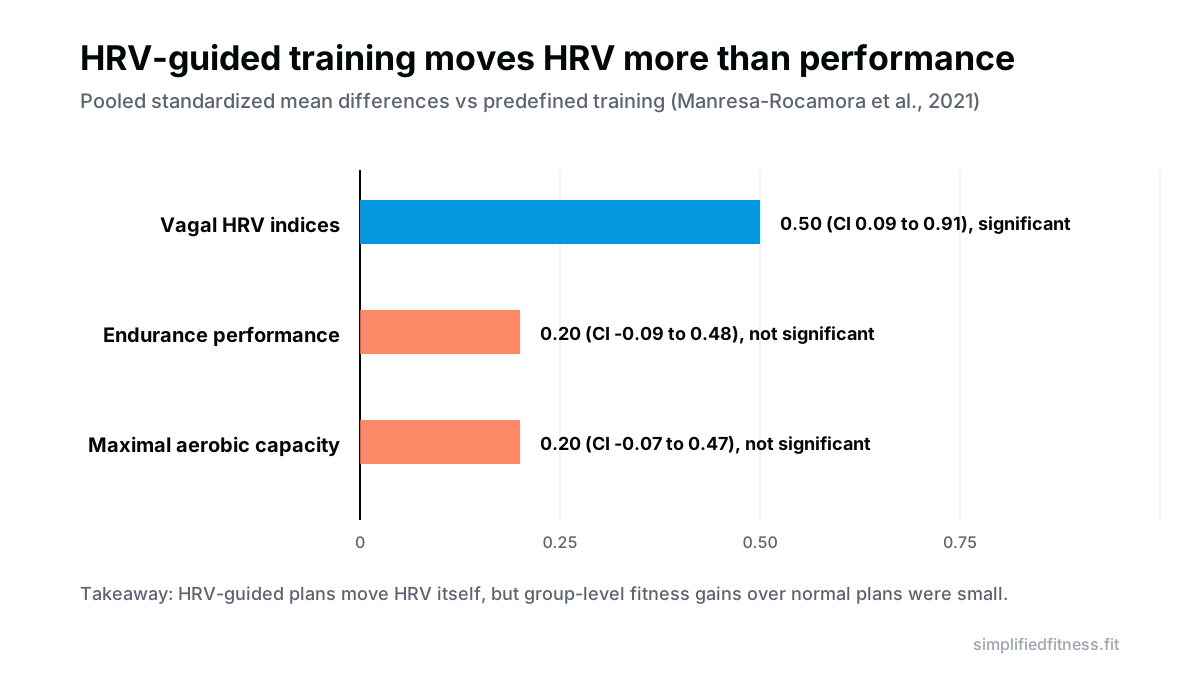
Why might these studies differ from the optimistic early trials? Small samples, short durations, different HRV methods and different ways of setting baselines. Reviewers say best practice for index choice, recording position and baselines still needs study.
The practical reading: HRV-guided training looks like a reasonable way to avoid grinding yourself down, with fewer people responding badly. It does not look like a secret performance engine. And none of these trials were built around lifters who also run, so applying it to concurrent training is an extrapolation.
Does HRV track lifting recovery? Not as neatly as you would hope
You might assume HRV, strength and soreness all recover together. The data say otherwise.
In ten men with over a year of lifting experience, a brutal session (six sets to failure at 90% of 10RM across squat, bench press and pulldown) knocked everything down immediately afterwards. LnRMSSD was back to baseline by 24 hours, neuromuscular markers by 48 hours, and perceived recovery and soreness were still suppressed at 48 hours. The changes in each measure were not significantly associated with each other (Flatt et al., 2019). The authors’ takeaway: one metric should not be used to infer the status of another.
That is ten people, so hold it loosely. But it fits the broader picture. In 37 well-trained athletes over a 6-day overload block, strength and interval overload shifted heart rate and HRV in different ways depending on supine versus standing readings, and the links between those changes and performance were weak or inconsistent (Schneider et al., 2019).
A narrative review adds that reduced HRV may be a sign of overreaching but may not be sensitive in aerobic-trained athletes, so its usefulness depends on who you are (Addleman et al., 2024). For the wider picture of fatigue and overload, our guide on overtraining syndrome versus functional overreaching goes deeper.
How to use HRV to program cardio and lifting
Here is a cautious, gym-level way to use it. This is coaching judgment built on the research above, not a protocol that any trial tested in lifters.
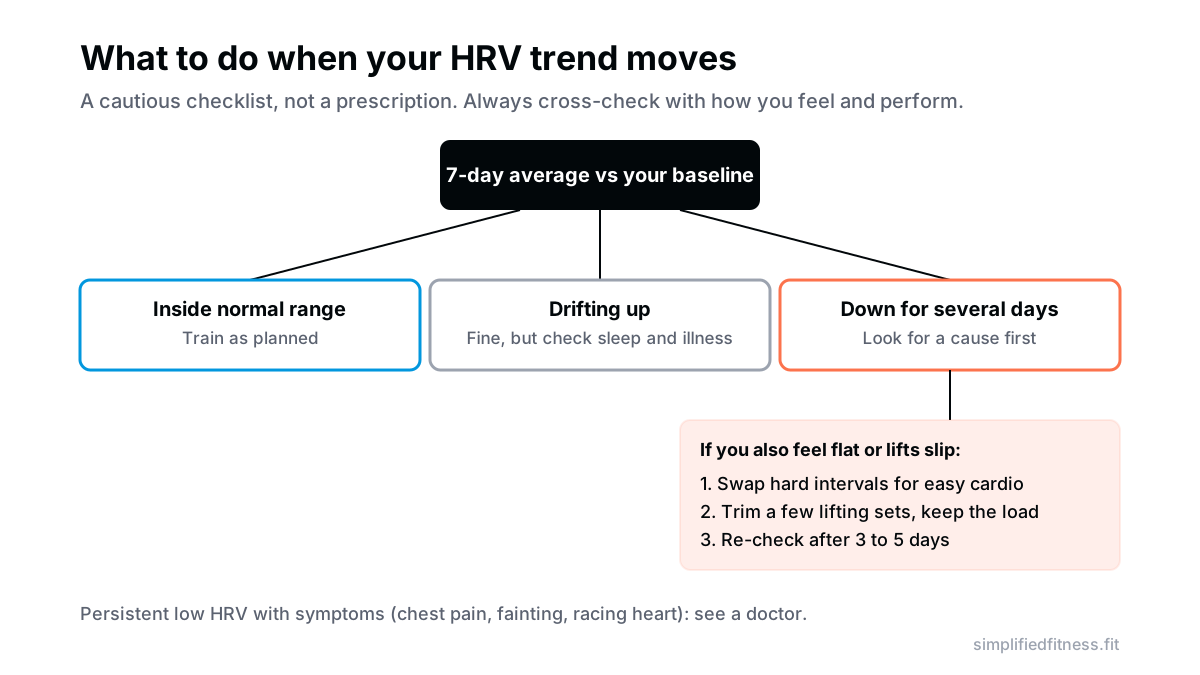
- Fix your non-negotiables. Keep your lifting plan and a sensible amount of cardio on the calendar. HRV adjusts the week, it does not write it.
- Trend normal, feel normal. Train as planned.
- Trend down, feel fine. Check sleep and illness. Keep the plan, but keep any easy cardio truly easy.
- Trend down for several days and you feel flat, or lifts slip. Swap hard intervals for easy cardio first. Then trim a few lifting sets, keeping the load on the bar. Re-check in 3-5 days.
- Trend back to range. Rebuild gradually.
Why intervals first? Hard cardio is usually the easiest piece to swap without losing the lifting stimulus, and the meta-analysis above tied longer and more frequent endurance work to bigger interference (Wilson et al., 2012). Spacing the two types across days is covered in timing cardio and weights, and the recovery tradeoffs during a diet in cardio during a cutting phase.
Can you trust your watch or ring?
Partly. In a study of 35 healthy adults, the Oura Ring measured nocturnal heart rate and rMSSD accurately against an ECG, with error shrinking when averaged per night rather than over 5-minute windows (Cao et al., 2022). That is one device, healthy people, and sleep, so it does not guarantee the same from every wearable or from a workout reading.
Practical rules: use one device, prefer overnight or consistent morning data, and trust the weekly average more than any single score. We compare how reliable different devices are in our guide to wearable recovery trackers.
When HRV is the wrong tool
HRV is not worth stressing over if it makes you anxious about a number, if you skip good training sessions because of a single dip, or if you chase a higher score as a goal. Sleep, food and consistent training matter more than any score. If your lifting and running performance and your mood are fine, a slightly low number is noise.
A wearable cannot diagnose anything. See a doctor if you have chest pain, fainting, a racing or irregular heartbeat, unusual breathlessness, or a resting heart rate that stays high for no clear reason. Do not use HRV to talk yourself out of symptoms.
The bottom line
Track HRV for lifters doing concurrent training as a slow-moving trend against your own baseline. Use the 7-day average, look for ordinary causes first, and act only when the trend and your training both say you are cooked. The research suggests HRV-guided plans can help avoid negative responses, but the performance gain over a good fixed plan is small and mostly shown in endurance athletes.
If you want a structured week to apply this to, start with our free workout plans, and keep the effort honest.
Frequently Asked Questions
What does low HRV mean in the gym?
A low HRV reading means your beat-to-beat variation is lower than your usual, which often goes along with higher stress or incomplete recovery. It can come from hard training, but also from poor sleep, illness, alcohol or a hot night, so one low number is not proof of overtraining. Look at the 7-day trend and how your lifts feel before changing anything.
What is rMSSD and why do lifters use it?
rMSSD is the root mean square of successive differences between heartbeats, a time-domain HRV measure that reflects parasympathetic activity. A 2025 review describes it as practical because it is easy to calculate and reliable in short and ultra-short recordings. Most wearables report some version of it, so use whichever metric your device gives you and stay consistent.
What is a good HRV for a lifter?
There is no good absolute number, because HRV varies a lot between people with age, genetics and fitness. Your own baseline is the only useful comparison. Track yourself for two to four weeks and treat that as your normal range.
How do I set an HRV baseline?
Measure at the same time and in the same conditions most days, ideally on waking or from overnight data, and average the last 7 days. Reviews recommend routine, near-daily measurement and weekly averages over isolated readings. Compare each new week to your range from the previous few weeks.
Can HRV tell me when to do cardio versus lifting?
Only loosely. HRV-guided trials mostly adjusted endurance sessions, and the effect on performance was small, so it should nudge your plan rather than run it. A sensible use is to keep easy cardio on low-HRV days and save hard intervals or heavy lifting for days when your trend is normal.
Does cardio lower HRV in lifters?
Hard or high-volume cardio can push HRV down for a day or more, and so can heavy lifting. In a study of well-trained athletes, strength overload and interval overload produced different autonomic patterns depending on whether readings were taken lying or standing. Easy cardio is likely to cause less disruption, though that is a reasonable assumption rather than something these studies tested, and responses vary between people.
How long does HRV take to recover after lifting?
In ten trained men who did six sets to failure at 90% of 10RM across three exercises, LnRMSSD was back to baseline by 24 hours. Neuromuscular markers took until 48 hours and perceived soreness and recovery were still suppressed at 48 hours. That small study suggests HRV can recover faster than strength or how you feel.
Are Apple Watch, Whoop and Oura HRV readings accurate?
Accuracy varies by device and by what you measure. A study of 35 healthy adults found the Oura Ring measured nocturnal heart rate and rMSSD accurately against an ECG. Treat any wearable as a trend tool, and expect single readings to be noisier than the nightly average.
Should I skip training if my HRV is low?
Not automatically. HRV is one signal, and the research shows it does not always match performance or perceived recovery. If your HRV is low for several days and you feel flat, make the session easier: swap intervals for easy cardio or cut a few sets while keeping the weight.
Can I use HRV if I only lift and do little cardio?
You can, but the evidence is thinner. A 2024 narrative review says reduced HRV may signal overreaching but may not be a sensitive marker in aerobic-trained athletes, so its usefulness differs by population. If you lift only, session performance and effort ratings are often just as informative.
What lifestyle factors change my HRV score?
Sleep, stress, illness, alcohol and heavy training are the usual suspects, and a 2025 review notes RMSSD is susceptible to external confounders. That means a dip often has an ordinary cause. Check sleep and life stress before blaming your program.
When should I see a doctor about my HRV?
See a doctor if low readings come with chest pain, fainting, a racing or irregular heartbeat, or unusual breathlessness, or if your resting heart rate stays unusually high without explanation. Wearable HRV is a wellness metric and cannot diagnose a heart or health condition. Do not use it to override symptoms.
Sources & References
Every claim above is checked against peer-reviewed research (PubMed, U.S. National Library of Medicine) or guidance from established health bodies. How we fact-check.
- Wilson JM, et al. Concurrent training: a meta-analysis examining interference of aerobic and resistance exercises. J Strength Cond Res. 2012. PMID: 22002517
- Manresa-Rocamora A, et al. Heart rate variability-guided training for enhancing cardiac-vagal modulation, aerobic fitness, and endurance performance: a methodological systematic review with meta-analysis. Int J Environ Res Public Health. 2021. PMID: 34639599
- Düking P, et al. Monitoring and adapting endurance training on the basis of heart rate variability monitored by wearable technologies: a systematic review with meta-analysis. J Sci Med Sport. 2021. PMID: 34489178
- Kiviniemi AM, et al. Endurance training guided individually by daily heart rate variability measurements. Eur J Appl Physiol. 2007. PMID: 17849143
- Flatt AA, et al. Heart rate variability, neuromuscular and perceptual recovery following resistance training. Sports (Basel). 2019. PMID: 31635206
- Schneider C, et al. Heart rate variability monitoring during strength and high-intensity interval training overload microcycles. Front Physiol. 2019. PMID: 31178746
- Addleman JS, et al. Heart rate variability applications in strength and conditioning: a narrative review. J Funct Morphol Kinesiol. 2024. PMID: 38921629
- Esco MR, et al. Monitoring training adaptation and recovery status in athletes using heart rate variability via mobile devices: a narrative review. Sensors (Basel). 2025. PMID: 41516438
- Cao R, et al. Accuracy assessment of Oura Ring nocturnal heart rate and heart rate variability in comparison with electrocardiography in time and frequency domains: comprehensive analysis. J Med Internet Res. 2022. PMID: 35040799

Umair Hazrami · Founder & Head Coach, Simplified Fitness
Umair Hazrami founded Simplified Fitness and the Simplified Lifter channel to cut through fitness noise. With 4+ years of consistent training and 10+ coaching clients, he writes every guide from the peer-reviewed research and links the sources so you can check them. Our editorial standards.
Educational content only, not medical advice. If you have a medical condition, are pregnant, or take medication, talk to a qualified doctor before changing your diet, supplements or training. Full disclaimer.
Keep reading
Strength & Cardio
Aerobic Conditioning and Hypertrophy: How Work Capacity Improves Inter-Set Recovery
Does better cardio help you recover between sets? See what work capacity resistance training research says, where theory outruns data, and what to do.
9 min read
Strength & Cardio
Can Cardio Cause Muscle Loss? The Calorie and Volume Thresholds Behind the Fear
Does cardio cause muscle loss? Not at normal doses. See what the meta-analyses say about deficits, protein and running volume, and how to protect your muscle.
9 min read

Strength & Cardio
Cardio During a Cut: How Much You Need and When to Stop Adding
How much cardio during cutting phase? Learn the food-first rule, a walking base, sample weekly schedules and signs you are doing too much. Every study linked.
7 min read
Strength & Cardio
Cycling vs Running for Lifters: Which Protects Muscle and Squat Strength?
Cycling vs running for lifters: Wilson's meta-analysis found running, not cycling, blunted gains. We compare it with newer reviews and give a bike plan.
8 min read