Rucking for Lifters: What Weighted Walking Does for Conditioning and Core
Rucking for lifters explained: how much extra energy a loaded pack costs, what it does for your core, how heavy to go, and how to fit it around leg day.
TL;DR. The short answer
- Rucking is brisk walking with a loaded backpack. Research on load carriage shows the energy cost of walking rises as the pack gets heavier, as you go faster, and as the ground gets steeper.
- A sensible starting pack for most lifters is about 10-15% of body weight, a coaching convention rather than a studied dose. Go up in small steps and add time before weight.
- Your trunk muscles do respond to a pack, but the picture is mixed. Studies show some back muscles work less with a pack while abdominal muscles work harder on slopes, so it is not a core workout in the way planks or carries are.
- No trial shows rucking fixes posture. Its real strength is low-impact aerobic work for lifters, with risks (feet, knees, back) that rise with heavy packs and long distances.
- One or two easy ruck walks a week fits around lifting for most people. Back off if your next leg session suffers, and see a doctor for pain that does not settle.
Part of our complete guide: Cardio and Concurrent Training: Build Endurance Without Losing Muscle (The Interference Effect)
Table of contents
Rucking is just walking with weight on your back, and for lifters it is one of the easier ways to add aerobic work without wrecking your legs. The extra load makes every step cost more energy, but the impact stays far lower than running. That is the real appeal of rucking for lifters.
It is not magic, though. The “burns 3x the calories” and “fixes your posture” claims you see online go well past what the research shows. This guide covers what the studies actually found, how heavy to go, how to set up the pack, and how to fit it into a week of lifting. (For the bigger picture on mixing cardio with weights, start with our guide to cardio and the interference effect.)
What is rucking, and why are lifters doing it?
Rucking comes from the military, where “ruck marching” means walking long distances with a loaded rucksack. The civilian version is simpler: put some weight in a backpack, walk briskly outdoors for 30-60 minutes, go home.
Lifters like it for three reasons.
- It is easy to recover from. You walk at a conversational pace, so it does not compete with leg day the way hard intervals do.
- It is low impact. There is no flight phase, so no running-style pounding on knees and shins.
- It is cheap. A sturdy backpack and a few water bottles, sandbags or old plates will do. No gear budget needed.
If you already like the idea of steady, low-stress movement, it sits nicely next to incline treadmill walking and the lower-intensity work in zone 2 cardio for lifters.
How many calories does rucking burn compared with walking?
More. How much more depends on how heavy the pack is, how fast you walk, the hills, and your own body weight.
A review of soldier load carriage found that the energy cost of walking with a backpack rises progressively with more weight carried, higher body mass, faster speed or steeper grade, and that terrain matters too (Knapik et al., 2004). A treadmill study of 10 young adults found the same pattern with weighted vests at 0, 10, 15 and 20% of body mass: oxygen consumption was significantly higher with every vest load than with none (Puthoff et al., 2006). The same study found the vest also raised ground reaction forces and loading rate, so “low impact” means lower than running, not zero extra load on your joints.
More recently, US Army researchers tested 20 active adults wearing vests from 0 to 66% of body mass across many speeds and built a model that predicted metabolic rate accurately (Looney et al., 2024). The direction is not in doubt. A neat universal “2-3x” multiplier is not something I can pin to these papers, so I would not plan your diet around it.
For a rough personal number, plug your weight and duration into our calories burned calculator, then judge reality by your weekly weight trend, not by a gadget’s estimate.
Does rucking really work your core and back?
Sort of, and the details are more interesting than the hype.
In a lab study, researchers measured torso muscle activity while people walked on flat ground and on 10-degree slopes, with and without a heavy backpack. Abdominal (rectus abdominis) activity was higher on both uphill and downhill walking than on level ground. One back muscle (longissimus) was actually less active when carrying a pack than walking without one, and a hip belt reduced rectus abdominis activity compared with a shoulder-only pack (Sturdy et al., 2023).
Another study of backpack loads found the most critical changes in trunk muscle activation and lumbosacral joint loading at around 10% of body weight, while a very light 3% load slightly reduced peak lumbosacral compression (Li and Chow, 2018).
So what does that mean for you? Your trunk is working, but it does not behave like it does in a plank or a heavy carry. The slope matters, the pack setup matters, and these were short lab measurements, not months of training.
Does rucking fix your posture?
I would not promise that. I could not find a trial showing rucking improves posture over time.
What a pack can do is make you notice your posture. Load sitting close to your centre of mass tends to keep you more upright, similar to unloaded walking, according to the soldier load carriage review (Knapik et al., 2004). A pack that hangs low or pulls you backwards does the opposite. Think “tall and relaxed”, not “leaning like a tired tourist”.
If your goal is better posture, lifting with a full range of motion and breaking up long desk hours will do more than a weekly walk. Our guide to the desk worker workout plan and pelvic tilt covers that side properly.
How heavy should your ruck be?
Start light. The 10-15% of body weight range is a common coaching convention. It is not a dose from a controlled trial, but it keeps you in a zone where your form holds.
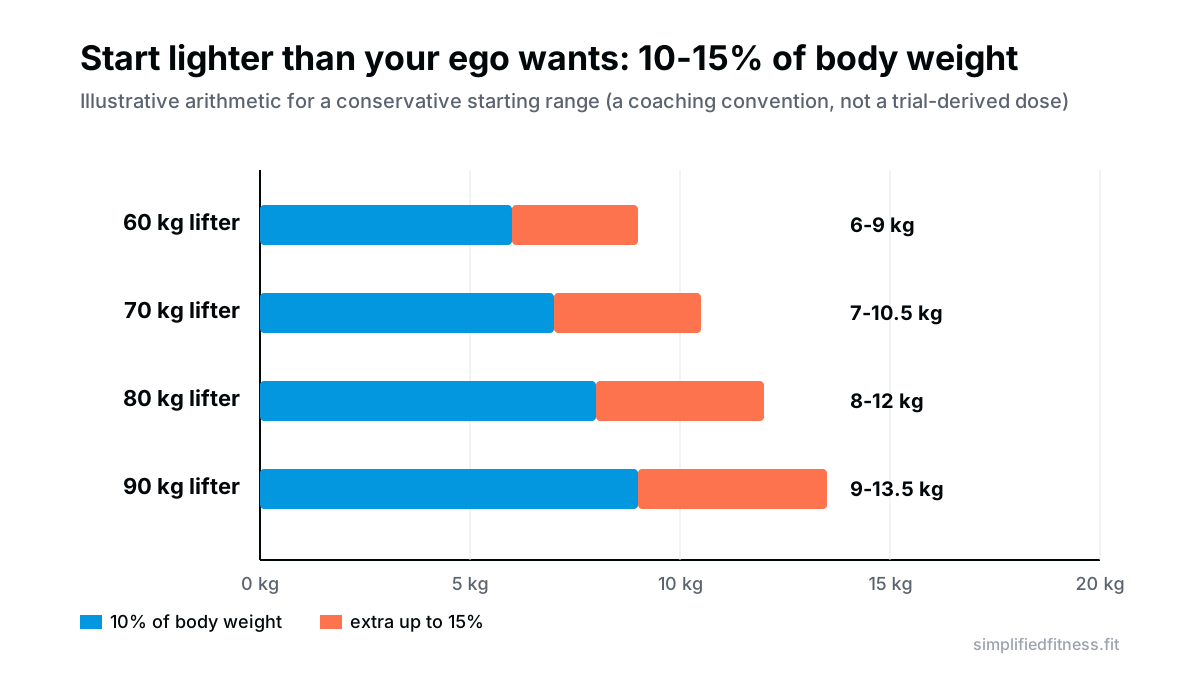
Why not go heavier right away? Load carriage research lists foot blisters, stress fractures, back strains and knee pain among the common injuries with prolonged heavy loads (Knapik et al., 2004). Those are mostly military settings with heavy packs and long distances, so the risk for a 45-minute walk with 8-12 kg is lower, but the lesson holds. Tissue adapts slowly.
How do you set up the pack?
A few details make a big comfort difference.
- Keep the load high and tight against your back. Heavy items close to your spine, not swinging low. Load close to your centre of mass is easier on the body (Knapik et al., 2004).
- Use the hip belt. In 15 young men, using a hip strap lowered the rise in oxygen use and perceived effort over 10 minutes of walking (Pigman et al., 2017). It also moves some weight off your shoulders.
- Pad and secure the weight. Water bottles, sandbags or a folded towel around plates stop it clanging and shifting.
- Walk tall. Eyes forward, ribs down, short natural steps. Do not lean forward to “get under” the pack.
- Wear proper footwear and socks. Blisters end ruck habits faster than anything else.
A weighted vest is a fair alternative. It keeps the load close to your body, and studies show it raises the energy cost of walking with load (Puthoff et al., 2006). Another study in retired soldiers found that distributed military loads changed walking mechanics and energy cost, but the effects looked no larger than those other studies reported for loads carried around the waist, which surprised the authors (Grenier et al., 2012). So the “perfect” carry method is less clear-cut than the internet suggests. Choose what you can tolerate.
How do you program rucking around lifting?
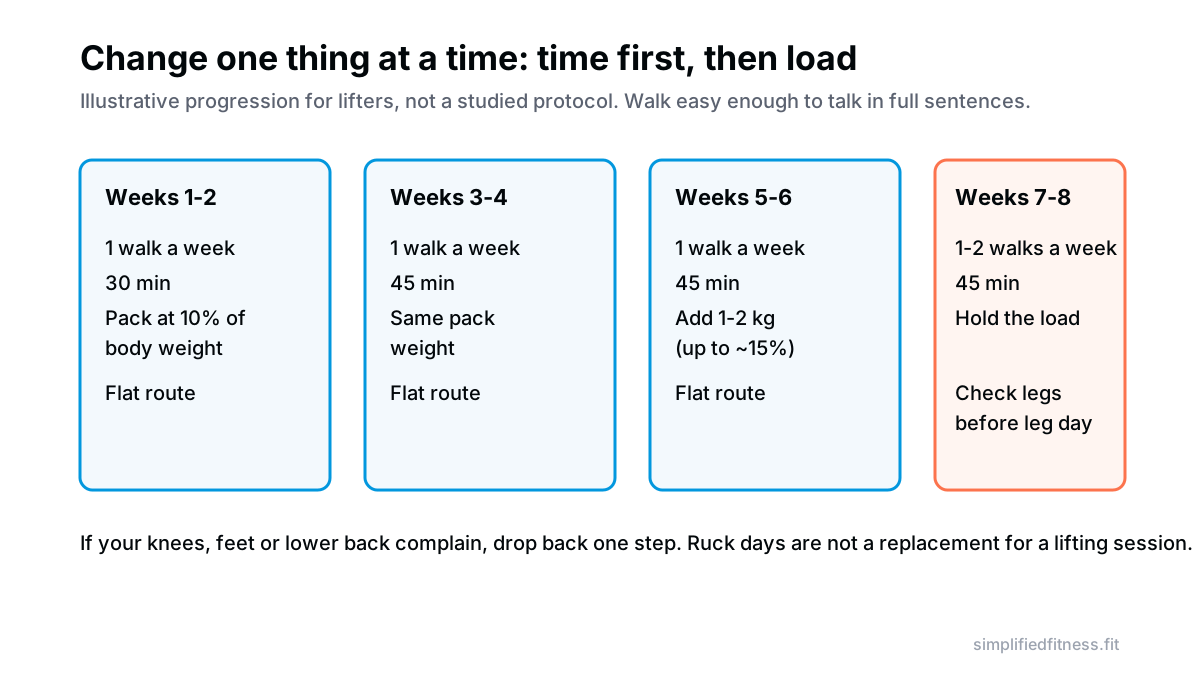
For most lifters, one or two ruck walks a week is enough. Treat it as low-intensity aerobic work, so you should be able to speak in full sentences. Use the heart rate zone calculator if you want a guide, though the talk test works fine.
Practical placement:
- Do it on a rest day, or after an upper-body session.
- Keep it at least a day away from your hardest leg workout.
- Hills raise the effort and the load on your calves and quads, so introduce them gradually. Our piece on Stairmaster versus outdoor incline walking covers knee stress on slopes.
Will rucking help or hurt muscle retention?
There is no direct trial of rucking and muscle mass in trained lifters, so anything firm would be guessing.
What we do have is related. In the INVEST in Bone Health trial, 150 older adults with overweight or obesity lost about 10% of body weight over 12 months, either on diet alone, diet plus resistance training, or diet plus a weighted vest. Resistance training improved mid-thigh muscle area and density, while the vest group showed only a non-significant trend toward trunk muscle preservation versus diet alone (Lynch et al., 2026). Those were older adults, and the vest was not a ruck walk, so I would not stretch it too far. The cautious reading is that weights in a vest are not a stand-in for lifting.
If you are dieting, a ruck is simply a low-stress way to add movement. For the wider picture, see can cardio cause muscle loss and cardio during a cutting phase. And if you are still deciding between walking more and doing harder sessions, our guide on steps versus intense cardio is a good next read.
Rucking in the Indian climate and on a budget
In Indian summers, rucking at midday is a bad idea. A loaded pack traps heat against your back, so go early morning or after sunset, carry water, and cut the load if it is humid. Parks with soft paths are kinder on feet than hard pavement.
Gear does not need to cost much. A sturdy school or trekking backpack, a few 1-litre water bottles and a towel are enough to start. Fuel normally: a roti, dal and curd meal afterwards, or paneer, eggs or soya chunks if you are vegetarian, covers recovery for an easy 45-minute walk.
When to see a doctor
Rucking is usually well tolerated, but get checked if you have pain that does not settle in a couple of days, sharp pain in your foot or shin, back pain that travels down a leg, numbness or tingling in your arms, or chest pain, dizziness or unusual breathlessness. If you have a heart, joint or bone condition, or have been inactive for a long time, speak to your doctor before adding a loaded pack.
The bottom line
Rucking is a practical, low-impact way to add aerobic work and make walking harder without running. The evidence supports higher energy cost with more load, speed and slope. It does not support big promises about posture or core strength.
Start at 10-15% of body weight, use a hip belt, walk easy, and keep lifting as your main priority.
Frequently Asked Questions
Is rucking good for lifters?
Yes, for most lifters it is a reasonable way to add low-impact aerobic work. The load raises the effort of walking without the pounding of running, and the pace is easy enough to recover from. Start with one 30-45 minute walk a week and see how your leg sessions feel.
How many more calories does rucking burn than walking?
More, but the exact multiple depends on pack weight, speed, hills and your body size. Research shows energy cost climbs steadily as backpack load, walking speed or grade increases (Knapik et al., 2004). Instead of trusting a headline multiplier, use a calculator for a rough estimate and judge by your weekly weight trend.
How heavy should a rucking pack be?
A common starting point is 10-15% of your body weight, so about 8-12 kg for an 80 kg lifter. That range is a coaching convention, not a number from a trial, so treat it as a cautious start. Hold the load steady for a few weeks before you add 1-2 kg.
Is rucking better than running for muscle retention?
There is no direct trial that proves it. Rucking is lower impact and usually done at a gentler pace, which many lifters find easier to recover from alongside leg training. If you lift hard and eat enough protein, either can work, so pick the one you will do consistently.
Does rucking build core strength?
It challenges your trunk, but it is not a replacement for direct core work. In one lab study, abdominal muscle activity rose on uphill and downhill walking, while a pack changed how the back muscles worked in different ways (Sturdy et al., 2023). Keep your normal ab, carry and bracing work in the gym.
Does rucking improve posture?
There is no good evidence that rucking improves posture by itself. A pack held close to your body can encourage an upright walking position, but that is different from a lasting postural change. Strength training, desk breaks and a pack that fits properly are better bets.
Can I use a weighted vest instead of a backpack?
Yes. Studies in healthy adults show a vest raises the metabolic cost of walking as load increases (Puthoff et al., 2006). Vests sit close to your centre of mass, but a backpack with a hip belt carries heavier loads more comfortably. Choose the one that does not rub or bounce.
How often should I ruck each week?
One or two sessions of 30-60 minutes is plenty for most lifters. Because rucking loads your legs, hips and feet, more than that tends to eat into leg-day recovery. Space ruck days away from your hardest lower-body session.
Is rucking safe for knees and lower back?
It is gentler than running for many people, but it is not risk free. Reviews of military load carriage list blisters, stress fractures, back strains and knee pain as common injuries with prolonged heavy loads (Knapik et al., 2004). Keep the pack light, wear a hip belt, and see a doctor if pain lingers.
Should I use a hip belt on my rucksack?
Yes, if your pack has one. In a small study of 15 young men, wearing a hip strap lowered energy cost and perceived effort over 10 minutes of walking (Pigman et al., 2017). It also spares your shoulders, which makes a longer walk more comfortable.
Can rucking replace cardio or my steps target?
It can count toward your weekly aerobic work, though it is one tool among several. A ruck is walking with extra effort, so it fits alongside steps, easy cycling or incline walking. Use our heart rate zone calculator to keep it at a conversational pace.
Is rucking good during a fat loss phase?
It can be useful because it is easy to recover from while you are eating less. A weighted vest alone did not clearly protect muscle in older adults losing weight in one trial (Lynch et al., 2026), so keep lifting for that job. Think of rucking as extra low-stress activity, not as muscle protection.
How long does it take to see results from rucking?
Walking pace and comfort with a given pack usually improve within a few weeks of regular sessions. Body composition changes depend far more on your diet and lifting than on a weekly walk. Track the same route and pack weight so you can see your own progress.
Sources & References
Every claim above is checked against peer-reviewed research (PubMed, U.S. National Library of Medicine) or guidance from established health bodies. How we fact-check.
- Knapik JJ, et al. Soldier load carriage: historical, physiological, biomechanical, and medical aspects. Mil Med. 2004. PMID: 14964502
- Puthoff ML, et al. The effect of weighted vest walking on metabolic responses and ground reaction forces. Med Sci Sports Exerc. 2006. PMID: 16679992
- Looney DP, et al. Metabolic costs of walking with weighted vests. Med Sci Sports Exerc. 2024. PMID: 38291646
- Sturdy JT, et al. Walking slope and heavy backpack loads affect torso muscle activity and kinematics. J Electromyogr Kinesiol. 2023. PMID: 37004379
- Li SSW, et al. Effects of backpack load on critical changes of trunk muscle activation and lumbar spine loading during walking. Ergonomics. 2018. PMID: 28791922
- Pigman J, et al. The effect of a backpack hip strap on energy expenditure while walking. Hum Factors. 2017. PMID: 28892419
- Grenier JG, et al. Energy cost and mechanical work of walking during load carriage in soldiers. Med Sci Sports Exerc. 2012. PMID: 22215177
- Lynch SD, et al. Weighted vest use or resistance exercise to offset muscle loss in older adults: secondary findings from the INVEST in bone health RCT. J Gerontol A Biol Sci Med Sci. 2026. PMID: 41761582

Umair Hazrami · Founder & Head Coach, Simplified Fitness
Umair Hazrami founded Simplified Fitness and the Simplified Lifter channel to cut through fitness noise. With 4+ years of consistent training and 10+ coaching clients, he writes every guide from the peer-reviewed research and links the sources so you can check them. Our editorial standards.
Educational content only, not medical advice. If you have a medical condition, are pregnant, or take medication, talk to a qualified doctor before changing your diet, supplements or training. Full disclaimer.
Keep reading
Strength & Cardio
Aerobic Conditioning and Hypertrophy: How Work Capacity Improves Inter-Set Recovery
Does better cardio help you recover between sets? See what work capacity resistance training research says, where theory outruns data, and what to do.
9 min read
Strength & Cardio
Can Cardio Cause Muscle Loss? The Calorie and Volume Thresholds Behind the Fear
Does cardio cause muscle loss? Not at normal doses. See what the meta-analyses say about deficits, protein and running volume, and how to protect your muscle.
9 min read
Strength & Cardio
Cardio During a Cut: How Much You Need and When to Stop Adding
How much cardio during cutting phase? Learn the food-first rule, a walking base, sample weekly schedules and signs you are doing too much. Every study linked.
7 min read
Strength & Cardio
Cycling vs Running for Lifters: Which Protects Muscle and Squat Strength?
Cycling vs running for lifters: Wilson's meta-analysis found running, not cycling, blunted gains. We compare it with newer reviews and give a bike plan.
8 min read