Minimum Effective Dose of Cardio for Longevity: Meeting the 150-Minute Health Guideline
What is the minimum effective dose of cardio for longevity if you lift? The 150-minute guideline, what the research shows below it, and how to fit it in.

TL;DR. The short answer
- The WHO guideline for adults is 150-300 minutes of moderate or 75-150 minutes of vigorous aerobic activity per week, plus regular muscle-strengthening. Lifting covers the second part, not the first.
- In a US cohort of 479,856 adults, meeting both the aerobic and strength guidelines was linked to about 40% lower all-cause mortality than meeting neither (HR 0.60). It is observational, so it shows association, not proof.
- Some benefit appears well below 150 minutes. Pooled running data found any amount, even once a week, was linked to lower mortality than none, so the first minutes count the most.
- Cardio at this dose is unlikely to threaten your gains. Interference in the research grows with the frequency and duration of endurance work, and it was seen with running more than cycling.
- Practical minimum for most lifters: 25 minutes of brisk or incline walking on 6 days, or three 50-minute moderate sessions, kept away from your hardest leg work.
Part of our complete guide: Cardio and Concurrent Training: Build Endurance Without Losing Muscle (The Interference Effect)
Table of contents
If you lift and dislike cardio, you want one number: the minimum effective dose of cardio that still protects your heart. The official answer is 150 minutes of moderate aerobic activity a week (or 75 minutes of vigorous activity), and the WHO itself says some activity is better than none (Bull et al., 2020). Observational data, covered below, suggest the first small doses do a lot of the work.
That is about 20-25 minutes a day of brisk walking. This sits inside our wider guide to cardio and concurrent training, and here we focus on the health side: what the guideline says, what happens below it, and how to fit it around a lifting split without feeling like you have become a runner.
What is the 150-minute cardio guideline?
The WHO 2020 guidelines say all adults should do 150-300 minutes of moderate-intensity or 75-150 minutes of vigorous-intensity aerobic activity per week, or an equivalent mix. They also recommend regular muscle-strengthening activity, and they say plainly that some activity is better than none and more is better for optimal outcomes (Bull et al., 2020).
Two things matter for lifters here.
First, aerobic and strength activity are two separate recommendations. Your lifting ticks the strength box. It does not tick the aerobic one, however hard your leg day feels.
Second, 150 minutes is the start of the recommended range, not a pass mark with a failing grade below it. The range is built on population data, and people are not machines. Treat it as a target to work toward.
Why lifters should still care about cardio
The strongest argument is mortality data. In a US cohort of 479,856 adults followed for a median of 8.75 years, people who met only the aerobic guideline had a hazard ratio for all-cause death of 0.71, those who met only the strength guideline had 0.89, and those who met both had 0.60, all compared with people meeting neither (Zhao et al., 2020).
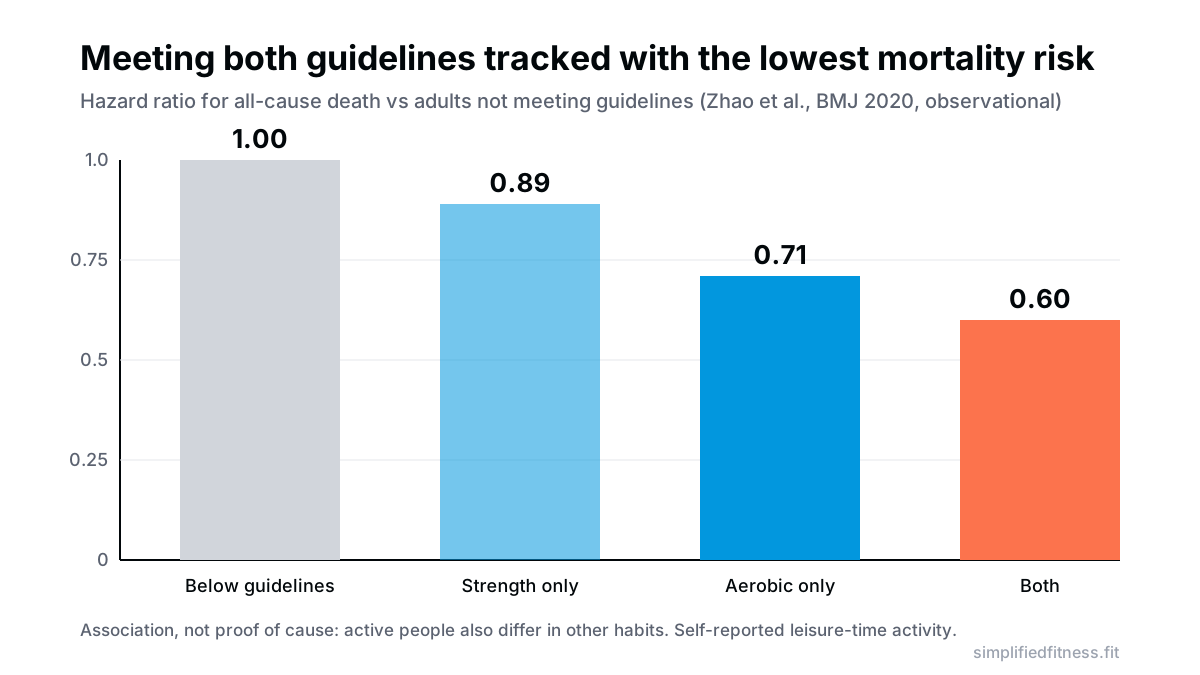
Read that with care. Activity was self-reported, and it is an observational study, so healthier people may simply do more of everything. Even so, the pattern is consistent: both together beat either alone.
Lifting has its own evidence. A meta-analysis of 16 cohort studies linked muscle-strengthening to a 10-17% lower risk of all-cause mortality and cardiovascular disease, with the biggest drop at roughly 30-60 minutes a week. The curve was J-shaped, so whether higher volumes add anything for mortality is unclear, a useful reminder that more lifting does not keep adding protection (Momma et al., 2022).
Then there is fitness itself. An overview of meta-analyses found the highest cardiorespiratory fitness group had an all-cause mortality hazard ratio of 0.47 against the lowest, though the certainty of evidence ranged from very low to moderate (Lang et al., 2024). Fitness is something you can actually train, and a modest weekly dose of aerobic work is how most people hold on to it.
What is the minimum effective dose of cardio?
Nobody has proven a single floor, but the data point in one direction: the first small amount does a lot.
A pooled analysis of 14 running studies (232,149 people) found that running participation was linked to 27% lower all-cause and 30% lower cardiovascular mortality than no running. The meta-regression found no significant dose-response trend for weekly frequency, duration, pace or total volume. The authors concluded that any amount of running, even once a week, was better than none, while higher doses may not bring more mortality benefit (Pedisic et al., 2020).
Do not over-read it. This was running only, in observational cohorts, and “no significant trend” does not prove there is no extra benefit from doing more. But it supports a simple message for people who dislike cardio: the gap between zero and a little is bigger than the gap between a little and a lot.
Does it have to be spread across the week?
Probably not. A pooled analysis of 63,591 adults in England and Scotland compared “weekend warriors” (150 minutes or more of moderate or 75 minutes or more of vigorous activity in one or two sessions) with regularly active people (the same volume over three or more sessions). All-cause mortality hazard ratios against inactive people were 0.70 and 0.65, a small difference with overlapping confidence intervals. Even people doing less than the guideline in just one or two sessions had a hazard ratio of 0.66 (O’Donovan et al., 2017).
The participants were aged 40 or older and the data were self-reported, so take the exact numbers loosely. But if your week is chaotic, one long Sunday walk or ride is a better plan than waiting for the perfect schedule.
How to hit 150 minutes without wrecking your lifting
Here are three ways to reach the number. None needs a gym membership.
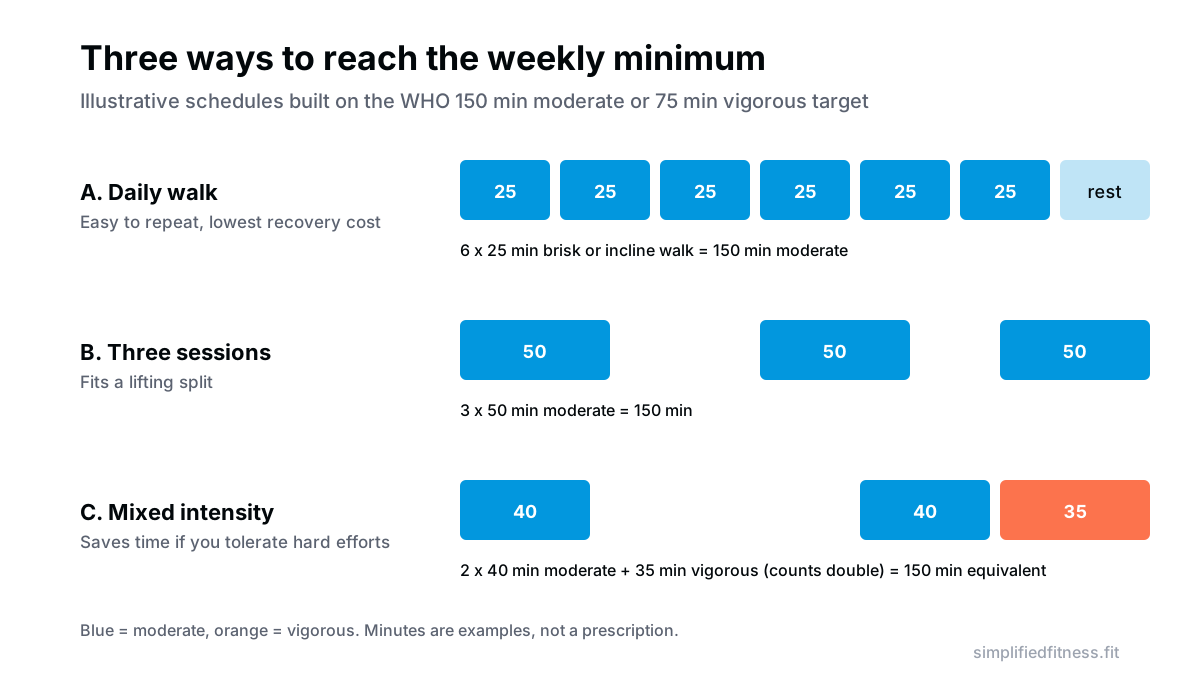
| Option | Weekly layout | Best for | Watch out for |
|---|---|---|---|
| A. Daily walk | 6 x 25 min brisk or incline walk | Anyone who wants low recovery cost | Needs a daily habit |
| B. Three sessions | 3 x 50 min moderate cycling or brisk walking | Lifters with a busy week | Longer blocks to schedule |
| C. Mixed | 2 x 40 min moderate + 1 x 35 min vigorous | People short on time | Hard efforts compete with leg training |
The WHO counts 75 minutes of vigorous work as equivalent to 150 minutes of moderate work, which is why Option C is shorter overall (Bull et al., 2020).
Moderate means your breathing is clearly up but you can still talk in full sentences. Vigorous means a few words at a time. If you want a number, our heart rate zone calculator gives a rough range, and the incline walking guide shows how to make a walk harder without jogging.
Will this much cardio hurt my gains?
At this dose, the risk looks small, but it is not zero in every setup.
A meta-analysis of 21 studies and 422 effect sizes found that concurrent training produced a hypertrophy effect size of 0.85, compared with 1.23 for strength training alone. Moderator analysis showed that running alongside lifting, but not cycling, was linked to decrements in both hypertrophy and strength, and the interference correlated negatively with endurance frequency and duration (Wilson et al., 2012).
Those studies included many programs with far more endurance work than 150 minutes of brisk walking, so the numbers do not map neatly onto this article’s advice. Still, the direction is useful: if you want to protect muscle, keep the work easy, prefer walking or cycling over running, and avoid stacking long sessions on top of heavy leg days. Our guides on Zone 2 cardio for lifters and LISS versus HIIT for muscle preservation cover this in more detail, and can cardio cause muscle loss looks at where the line actually sits.
What about blood pressure?
This is one place where cardio and lifting both help, and the evidence comes from trials rather than only cohorts.
A network meta-analysis of 270 randomised trials (15,827 participants) found resting blood pressure fell after aerobic training (about -4.5/-2.5 mm Hg), dynamic resistance training (about -4.6/-3.0 mm Hg), combined training (about -6.0/-2.5 mm Hg), HIIT (about -4.1/-2.5 mm Hg) and isometric training (about -8.2/-4.0 mm Hg) (Edwards et al., 2023). These trials were not limited to people who already lift, so your own response may differ.
The practical point is that combined training did at least as well as aerobic or resistance training alone (isometric work showed the largest drop of all). If you already lift, a small aerobic add-on fits the picture. If you have high blood pressure, work with your doctor rather than treating exercise as a replacement for treatment.
How to make cardio fit an Indian routine
Heat and time are the real obstacles here, not willpower.
- In summer, walk early morning or after sunset, or use a treadmill indoors. Drink water before and after, and add a pinch of salt or nimbu pani if you sweat heavily.
- Use commutes: walk to the station, take stairs, or cycle for errands. These count if the pace is brisk.
- Take phone calls on a walk. It is an easy way to pick up 15-20 minutes without rearranging your day.
- Eat as normal. Fitting 150 minutes of brisk movement into a week does not change your protein plan, so keep your dal, paneer, curd or eggs where they are.
Most people find the daily walk easier to stick to than three long sessions. If your lifting plan is set, see our push, pull and leg plans to place cardio around it, and the NEAT versus intense cardio guide if steps are your main lever.
When should you do more than the minimum?
Go beyond 150 minutes only when you have a reason: an endurance event, a fat-loss phase, or you want a higher VO2 max. Higher-intensity work like the Norwegian 4x4 protocol can improve fitness efficiently, but it costs recovery.
For general health, the data reviewed here do not show an obvious reason to push far past the guideline. If your gym performance is slipping, your sleep is worse and you are constantly sore, cut cardio back before cutting lifting.
When to see a doctor
Speak to a doctor before you ramp up if you have known heart disease, high blood pressure that is not controlled, diabetes, or you are over 40 and have been inactive for years. Stop and get checked if you get chest pain or pressure, fainting, unusual shortness of breath, or an irregular heartbeat during exercise. This article does not diagnose or treat any condition.
The bottom line
Do some aerobic work every week, keep it easy to repeat, and build toward 150 minutes. Lift as you already do. The data are mostly observational, so they show association rather than proof, but the pattern across guidelines, cohorts and trials points the same way: doing both beats doing one.
Frequently Asked Questions
How much cardio do lifters need per week?
For general health, the WHO recommends 150-300 minutes of moderate or 75-150 minutes of vigorous aerobic activity per week for all adults. Lifting counts toward the separate muscle-strengthening recommendation, not toward this number. Aim for 150 minutes of brisk walking or similar, and treat anything above that as optional.
Does lifting weights count as cardio?
Not for the aerobic guideline. The WHO and US guidelines list aerobic and muscle-strengthening activity as two separate recommendations, and the mortality data show the best outcomes when people do both. A hard, fast-paced circuit might raise your heart rate, but a normal strength session with long rests does not reliably replace dedicated aerobic time.
Is 150 minutes of cardio a week really necessary?
It is the level at which guidelines are set, not a cliff edge. Observational data suggest benefits start well below it, and the WHO itself states that some activity is better than none. Treat 150 minutes as the target and any amount below it as still worth doing.
What is the minimum cardio I can do to stay healthy?
There is no single proven floor. A pooled analysis of running studies found that running even once a week was associated with lower mortality than no running, with no clear extra benefit at higher doses. If you hate cardio, start with 10-15 minutes of brisk walking most days and build toward 150.
What counts as moderate-intensity cardio?
Moderate effort means your breathing is deeper but you can still talk in full sentences, for example a brisk walk or an incline treadmill walk. Vigorous effort means you can only say a few words at a time. Use our heart rate zone calculator for a rough heart-rate range if you prefer numbers.
Is 20-25 minutes of walking a day enough?
Six days of 25 minutes adds up to 150 minutes, which meets the lower end of the WHO adult guideline. The walk needs to be brisk enough that your breathing rises, not a slow stroll. If you can only manage five days, lengthen each walk to 30 minutes.
Can I do all my cardio on the weekend?
Probably yes. A pooled analysis of 63,591 British adults aged 40 and over found people who fit 150 minutes or more of activity into one or two sessions had mortality risk similar to those who spread it across three or more sessions. Spreading it is kinder on recovery, but a long weekend session is better than skipping it.
Will 150 minutes of cardio hurt my muscle gain?
At moderate doses, it is unlikely to matter much. A meta-analysis found interference grew with the frequency and duration of endurance training, and it appeared with running but not with cycling. Choose walking or cycling, keep sessions easy, and separate them from leg day.
Does cardio lower blood pressure in people who lift?
Exercise lowers resting blood pressure in general. A network meta-analysis of 270 randomised trials found aerobic training lowered it by about 4.5/2.5 mm Hg (systolic/diastolic), and dynamic resistance training by about 4.6/3.0 mm Hg. Those trials were not limited to lifters, so treat the numbers as a rough guide and check your own readings.
Is HIIT better than steady cardio for the minimum dose?
HIIT can meet the guideline in half the time, because the WHO counts 75 minutes of vigorous work as equal to 150 minutes of moderate. It is also harder to recover from and can compete with leg training. Use one or two short sessions if you enjoy them, otherwise easy walking is the lower-risk option.
Do I still need cardio if I have a good VO2 max already?
Fitness is protective, but it is not permanent. Cohort data link higher cardiorespiratory fitness to lower mortality risk, and fitness fades if you stop training. Keeping a small weekly dose of aerobic work is the easiest way to hold on to what you have.
When should I see a doctor before starting cardio?
See a doctor first if you have known heart disease, uncontrolled high blood pressure or diabetes, or you get chest pain, unusual breathlessness or dizziness during exercise. Those symptoms need an assessment rather than a guess. Everyone else can generally start with walking and build up gradually.
Sources & References
Every claim above is checked against peer-reviewed research (PubMed, U.S. National Library of Medicine) or guidance from established health bodies. How we fact-check.
- Bull FC, et al. World Health Organization 2020 guidelines on physical activity and sedentary behaviour. Br J Sports Med. 2020. PMID: 33239350
- Zhao M, et al. Recommended physical activity and all cause and cause specific mortality in US adults: prospective cohort study. BMJ. 2020. PMID: 32611588
- Momma H, et al. Muscle-strengthening activities are associated with lower risk and mortality in major non-communicable diseases: a systematic review and meta-analysis of cohort studies. Br J Sports Med. 2022. PMID: 35228201
- Pedisic Z, et al. Is running associated with a lower risk of all-cause, cardiovascular and cancer mortality, and is the more the better? A systematic review and meta-analysis. Br J Sports Med. 2020. PMID: 31685526
- O'Donovan G, et al. Association of 'Weekend Warrior' and Other Leisure Time Physical Activity Patterns With Risks for All-Cause, Cardiovascular Disease, and Cancer Mortality. JAMA Intern Med. 2017. PMID: 28097313
- Edwards JJ, et al. Exercise training and resting blood pressure: a large-scale pairwise and network meta-analysis of randomised controlled trials. Br J Sports Med. 2023. PMID: 37491419
- Wilson JM, et al. Concurrent training: a meta-analysis examining interference of aerobic and resistance exercises. J Strength Cond Res. 2012. PMID: 22002517
- Lang JJ, et al. Cardiorespiratory fitness is a strong and consistent predictor of morbidity and mortality among adults: an overview of meta-analyses representing over 20.9 million observations from 199 unique cohort studies. Br J Sports Med. 2024. PMID: 38599681

Umair Hazrami · Founder & Head Coach, Simplified Fitness
Umair Hazrami founded Simplified Fitness and the Simplified Lifter channel to cut through fitness noise. With 4+ years of consistent training and 10+ coaching clients, he writes every guide from the peer-reviewed research and links the sources so you can check them. Our editorial standards.
Educational content only, not medical advice. If you have a medical condition, are pregnant, or take medication, talk to a qualified doctor before changing your diet, supplements or training. Full disclaimer.
Keep reading

Strength & Cardio
Aerobic Conditioning and Hypertrophy: How Work Capacity Improves Inter-Set Recovery
Does better cardio help you recover between sets? See what work capacity resistance training research says, where theory outruns data, and what to do.
9 min read

Strength & Cardio
Can Cardio Cause Muscle Loss? The Calorie and Volume Thresholds Behind the Fear
Does cardio cause muscle loss? Not at normal doses. See what the meta-analyses say about deficits, protein and running volume, and how to protect your muscle.
9 min read

Strength & Cardio
Cardio During a Cut: How Much You Need and When to Stop Adding
How much cardio during cutting phase? Learn the food-first rule, a walking base, sample weekly schedules and signs you are doing too much. Every study linked.
7 min read

Strength & Cardio
Cycling vs Running for Lifters: Which Protects Muscle and Squat Strength?
Cycling vs running for lifters: Wilson's meta-analysis found running, not cycling, blunted gains. We compare it with newer reviews and give a bike plan.
8 min read