Zone 2 Cardio for Lifters: What It Does for Mitochondria, Capillaries and Work Capacity
Zone 2 cardio for lifters explained: what the pace feels like, what research says about mitochondria and capillaries, and how to add it without hurting gains.
TL;DR. The short answer
- Zone 2 is easy, steady cardio at a pace where you can still speak in full sentences. Exact heart rates differ by person, so feel and a talk test are more reliable than a fixed percentage of max heart rate.
- Low and moderate continuous endurance training raised muscle mitochondrial content by about 23% on average in a 2025 meta-regression, similar to harder intervals, with bigger gains in less fit people.
- Concurrent aerobic and strength training did not compromise muscle size or maximal strength in a 43-study meta-analysis, though explosive strength gains may be blunted when both are done in the same session.
- Better aerobic fitness is strongly linked to lower mortality in cohort data, but those are associations, and Zone 2 is one route to fitness, not the only one.
- Start with 2 sessions of 20-30 minutes a week on non-lifting days or after training, and increase only if your squat and deadlift numbers hold.
Part of our complete guide: Cardio and Concurrent Training: Build Endurance Without Losing Muscle (The Interference Effect)
Table of contents
Zone 2 cardio for lifters is easy, steady aerobic work at a pace where you can still talk in full sentences. It builds the aerobic side of your muscle, meaning mitochondria and capillaries, and the research suggests it can sit alongside lifting without costing you size or maximal strength. Here is what Zone 2 is, what is actually proven, and how to fit it in. (For the wider picture on cardio and gains, see our guide to cardio and concurrent training.)
Zone 2 has become a buzzword in longevity circles. Some of the hype runs ahead of the data, so we will separate what is well supported from what is a plausible idea.
What is Zone 2 and what is the Zone 2 heart rate for lifters?
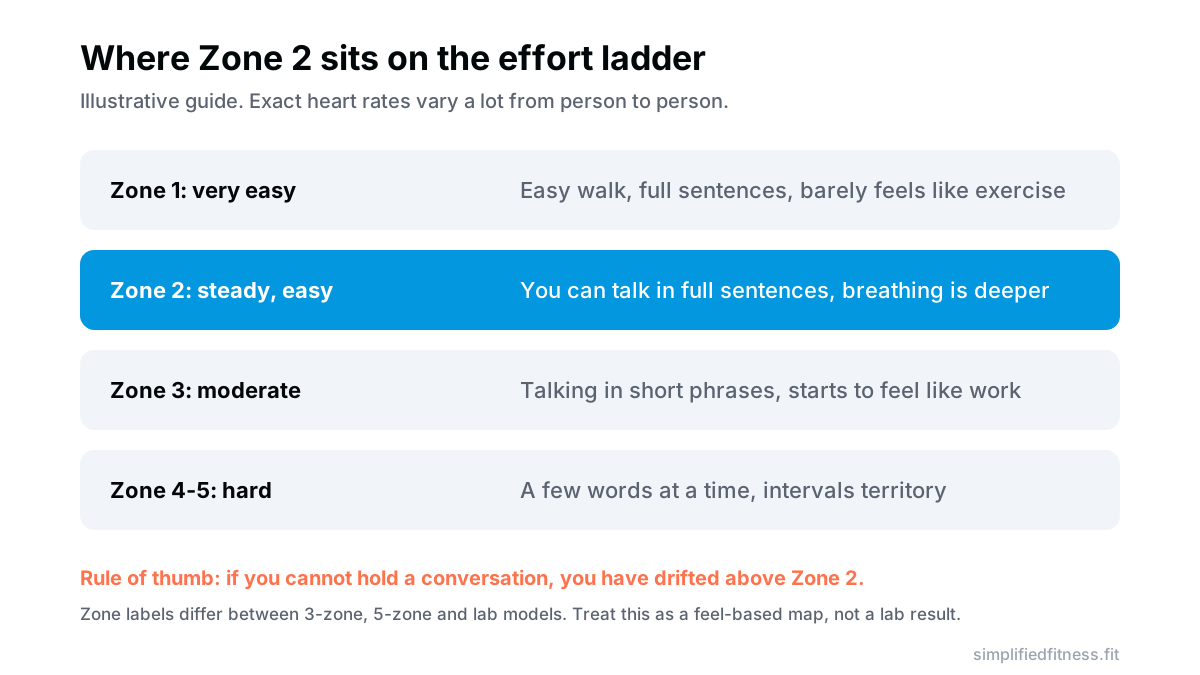
Zone 2 is the second step in the common five-zone system: easy, steady effort, below the point where breathing gets laboured. In the brief version you will see online, it means about 60-70% of max heart rate, below your first lactate rise (often quoted near 2 mmol/L).
Treat those numbers as a rough guide. Zone models differ between sources, max heart rate estimates can be off by a lot, and a hot gym pushes your heart rate up at the same effort.
A more practical check is the talk test. In a small lab study of 15 young, healthy adults, the point where people said they could still speak comfortably lined up with their lactate threshold, and with a heart rate around 82% of max (Quinn and Coons, 2011). That is higher than the textbook 60-70% figure, which shows how much a fixed percentage can mislead. It also means comfortable talking marks the ceiling of easy work, so for Zone 2 aim to sit just below the point where talking starts to feel effortful. It was a small sample of young people, so do not treat it as a rule for everyone.
What does Zone 2 do to your muscles?
Two adaptations matter most for lifters: more mitochondria and more capillaries.
Mitochondrial biogenesis from lifting and cardio
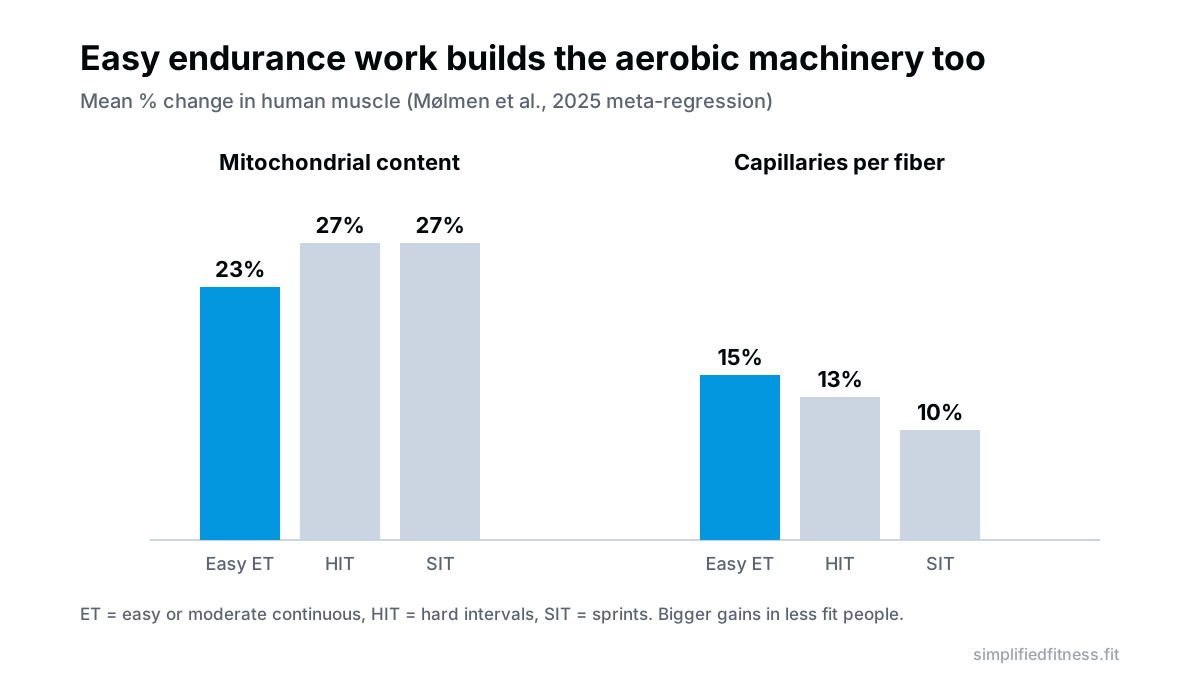
Mitochondria are the structures in muscle fibres that make energy aerobically. A 2025 systematic review and meta-regression pooled data from 5,973 participants across 353 articles on mitochondria, and 131 on capillaries (Mølmen et al., 2025). After adjusting for training frequency, number of training weeks and starting fitness, mitochondrial content rose by about 23% with low or moderate continuous endurance training, 27% with high-intensity intervals and 27% with sprint intervals. The differences between them were not statistically significant.
Two details matter here. First, higher training frequency (6 sessions per week beat 4, which beat 2) was linked to larger increases. Second, per total hour of exercise, sprint intervals were about 3.9 times more efficient than easy endurance work. So Zone 2 does build mitochondria, but it is not the time-efficient option.
More capillaries
Capillaries are the tiny blood vessels that feed muscle fibres. In the same review, capillaries per fibre rose about 15% with easy continuous work, 13% with interval training and 10% with sprints. Gains showed up mostly in the first few weeks and only in untrained to moderately trained people.
A separate meta-analysis of 57 trials (mostly sedentary people) found that continuous moderate-intensity training and high-intensity intervals raised capillarization more than low-intensity training (under 50% of VO2max) (Liu et al., 2022). So “easy” should not mean “barely moving”. And in already-trained people, no additional capillary increase was seen across training types, which is worth knowing if you are already fit.
Does Zone 2 cardio hurt muscle gains?
This is the question behind the whole topic.
An older meta-analysis of 21 studies found smaller average gains in hypertrophy, strength and power when endurance work was added, and the interference seemed to depend on mode, frequency and duration of the cardio (Wilson et al., 2012). Running, but not cycling, was linked to significant decrements in hypertrophy and strength in that analysis.
A larger, newer meta-analysis of 43 studies reached a more reassuring result. Concurrent aerobic and strength training did not compromise muscle hypertrophy or maximal strength compared with strength training alone, though explosive strength was attenuated, more so when both were done in the same session than when separated by at least 3 hours. Type of cardio (cycling vs running), weekly frequency, training status and age did not change the picture (Schumann et al., 2022).
Why the difference? The studies pooled different populations and protocols, and many participants did harder or longer cardio than a lifter would do for fitness. Another meta-analysis of 59 studies reported small interference for lower-body strength in males but not in females, and insufficient data on hypertrophy (Huiberts et al., 2024). The cautious reading: modest, easy cardio is unlikely to cost most lifters much muscle, but legs and explosive work are the places to watch.
For the long version, read our breakdown of whether cardio really kills gains.
Does Zone 2 help recovery between sets and work capacity?
You will often hear that better aerobic fitness helps you recover between sets and between sessions. The logic is plausible: more mitochondria and capillaries should mean better energy regeneration and waste clearance in the muscle.
I could not find a trial in lifters that directly tests whether Zone 2 improves rest-period recovery or total volume. So this is a reasonable hypothesis, not a proven benefit. The practical question is simply whether you feel less winded on leg day and can hit your reps on shorter rests. If yes, great. If no, you have still gained cardiovascular fitness. For this angle in more depth, see aerobic conditioning and inter-set recovery.
Why do people link Zone 2 to longevity?
The longevity interest comes from cohort data. An overview of meta-analyses covering over 20.9 million observations from 199 cohort studies found high cardiorespiratory fitness associated with lower all-cause mortality (hazard ratio 0.47 for high vs low fitness), and each 1-MET higher fitness level was associated with an 11-17% lower risk. The certainty of the evidence ranged from very low to moderate (Lang et al., 2024).
Two cautions. These are observational associations, and the studies measure fitness, not Zone 2 specifically. People with higher fitness also tend to differ in other ways. So the sensible takeaway is that building aerobic fitness is worthwhile, and Zone 2 is a gentle way to do it, not the only way.
Is Zone 2 better than HIIT for lifters?
Short answer: they do different jobs, and neither wins outright.
| Zone 2 (easy continuous) | HIIT or sprints | |
|---|---|---|
| Mitochondrial gains | Similar average rise (about 23%) | Similar (about 27%), faster per hour |
| Time needed | More hours | Fewer hours |
| Recovery cost | Lower | Higher |
| Best for | Base fitness, easy to repeat weekly | Aerobic power, time-poor weeks |
Interestingly, a meta-analysis in endurance athletes found a polarized mix (mostly easy plus some hard) was associated with larger VO2peak improvements, mainly in shorter interventions and highly trained athletes, but similar results on other measures (Silva Oliveira et al., 2024). Those are endurance athletes, not lifters, so use it as a hint, not a rule. For a direct comparison, see LISS vs HIIT for muscle preservation, and for the hard side, the Norwegian 4x4 protocol.
How to add Zone 2 to a lifting week
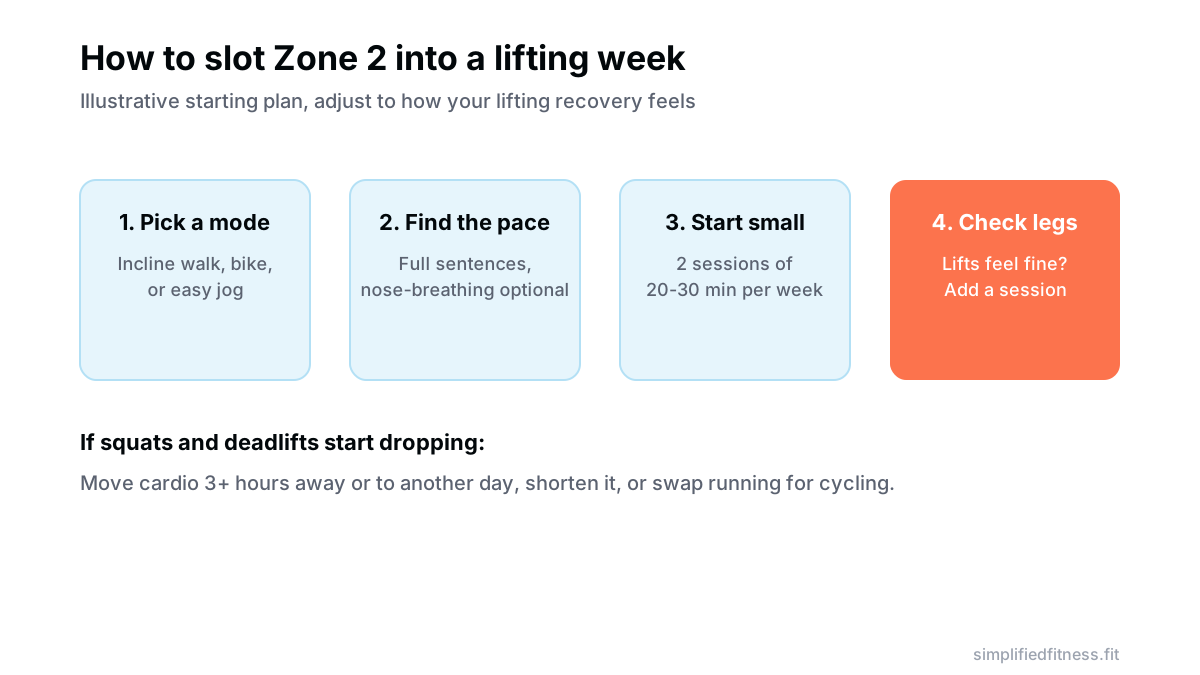
- Pick a low-impact mode. Incline treadmill walking is easy to hold steady and gentle on the legs. Cycling is another solid option; see cycling vs running for lifters.
- Dose it. Two sessions of 20-30 minutes a week is a sensible start. Build toward 2-4 sessions only if your lifting holds. This is practical guidance, not a proven optimum.
- Place it smartly. Do cardio after lifting, on a separate day, or at least 3 hours apart from leg training.
- Keep it easy. The most common mistake is drifting into Zone 3, where it feels productive but costs more recovery. If you cannot speak a full sentence, slow down.
- Indian conditions. In hot, humid weather your heart rate climbs at the same pace, so lean on the talk test and train in the morning or in an air-conditioned gym. Drink water through the session. For a minimum-dose view, see our guide to the minimum effective dose of cardio.
When to talk to a doctor
If you get chest pain, unusual breathlessness, dizziness or an irregular heartbeat during exercise, stop and see a doctor. Also check with one before starting regular cardio if you have a heart condition, high blood pressure that is not controlled, diabetes, or are taking medicines that affect heart rate. Heart rate zones from a calculator are estimates, not medical advice.
The bottom line
Zone 2 cardio for lifters is a low-stress way to build aerobic fitness. Easy continuous work raised muscle mitochondria and capillaries in the research, similar to harder training on average, though it takes more time. The best-quality evidence suggests it need not cost most lifters their muscle or maximal strength, but watch explosive strength and leg recovery. Claims about inter-set recovery and longevity are plausible, not proven for lifters.
Start with two easy sessions, keep your lifting numbers as the scoreboard, and build from there. If you need a lifting plan to pair it with, grab our free push pull legs plans.
Frequently Asked Questions
What is Zone 2 cardio?
Zone 2 is steady, easy-to-moderate aerobic exercise done at a pace where you can still hold a conversation. It sits below the point where breathing and effort climb sharply. Try a pace where you can speak in full sentences but would not want to sing.
What heart rate is Zone 2 for lifters?
It is often quoted as roughly 60-70% of max heart rate, but that range is only a rough guide and individuals vary a lot. One small lab study found that the point where people could still talk comfortably sat close to their lactate threshold, which is the top edge of easy work rather than the middle of it. Use the talk test first, stay a little below that point, and our heart rate zone calculator as a starting estimate.
Does Zone 2 cardio kill muscle gains?
Not in the data we have. A 43-study meta-analysis found no compromise of muscle hypertrophy or maximal strength when aerobic work was added to lifting, though explosive strength was attenuated. Keep total weekly volume modest and your lifting performance as the check.
How much Zone 2 cardio should a lifter do per week?
A reasonable starting point is 2 sessions of 20-30 minutes, then building toward 2-4 sessions if recovery allows. This is a practical suggestion rather than a proven optimum, since research on exact doses for lifters is limited. In meta-analytic data, more sessions per week were associated with larger mitochondrial gains, so frequency matters, but only add it if your lifts stay strong.
Does Zone 2 build mitochondria?
Yes, endurance training increases mitochondrial content in human muscle, and low or moderate continuous work did so at a similar level to higher-intensity intervals in a 2025 meta-regression. The average rise for continuous endurance training was about 23%. Most of that evidence is in untrained to moderately trained people, so expect smaller gains the fitter you already are.
Is Zone 2 better than HIIT?
Neither is clearly better for everything. Intervals were more time-efficient for mitochondrial gains in one meta-regression, while easy continuous work is gentler to recover from. Many lifters use mostly easy cardio and add one hard session only if they want more aerobic power.
Does Zone 2 improve recovery between sets?
It might, but we do not have strong lifting-specific trials to say so. The idea rests on aerobic fitness supporting how muscles regenerate energy and clear byproducts, which is plausible physiology rather than proven for set-to-set performance. Treat it as a possible bonus and judge it by your own rest times.
Can I do Zone 2 on the same day as lifting?
Yes. Lifting first and cardio after, or cardio at least a few hours apart, tends to protect lifting quality. A meta-analysis found explosive strength gains were blunted more when both were done in the same session than when they were at least 3 hours apart. Separate days or a gap is the safer choice if leg day matters to you.
What is the best Zone 2 exercise for lifters?
Incline walking, cycling and easy rowing are good because they are easy to keep steady and light on your legs. Running was linked to larger interference in an older meta-analysis, though a newer one found no difference between cycling and running. Pick the one you will actually do consistently.
How do I know I am in Zone 2 without a heart rate monitor?
Use the talk test: you should be able to say a full sentence without gasping. One small study in young, healthy adults found the talk test tracked the lactate threshold reasonably well. If you are breathing hard enough that you need short phrases, slow down.
Is Zone 2 good for longevity?
Higher cardiorespiratory fitness is strongly associated with lower all-cause mortality in cohort data, which is where the longevity interest comes from. But these are observational links and Zone 2 is not proven to be the single best route. Regular cardio of any intensity that improves your fitness is the practical target.
Can I do Zone 2 cardio in hot Indian weather?
Yes, but heat pushes your heart rate up at the same pace, so judge the effort by the talk test rather than the number. Heat also raises fluid needs. Walk on a treadmill or incline in an air-conditioned gym, or train early morning, and drink water through the session.
Do I need Zone 2 if I already do HIIT?
Not strictly. Intervals also raise mitochondrial content and fitness, and the data show similar gains from different intensities. Easy sessions are simply a lower-stress way to add volume on top of lifting.
Sources & References
Every claim above is checked against peer-reviewed research (PubMed, U.S. National Library of Medicine) or guidance from established health bodies. How we fact-check.
- Mølmen KS, et al. Effects of exercise training on mitochondrial and capillary growth in human skeletal muscle: a systematic review and meta-regression. Sports Med. 2025. PMID: 39390310
- Liu Y, et al. Effects of exercise training intensity and duration on skeletal muscle capillarization in healthy subjects: a meta-analysis. Med Sci Sports Exerc. 2022. PMID: 35522254
- Schumann M, et al. Compatibility of concurrent aerobic and strength training for skeletal muscle size and function: an updated systematic review and meta-analysis. Sports Med. 2022. PMID: 34757594
- Wilson JM, et al. Concurrent training: a meta-analysis examining interference of aerobic and resistance exercises. J Strength Cond Res. 2012. PMID: 22002517
- Huiberts RO, et al. Concurrent strength and endurance training: a systematic review and meta-analysis on the impact of sex and training status. Sports Med. 2024. PMID: 37847373
- Quinn TJ, et al. The talk test and its relationship with the ventilatory and lactate thresholds. J Sports Sci. 2011. PMID: 21774751
- Lang JJ, et al. Cardiorespiratory fitness is a strong and consistent predictor of morbidity and mortality among adults: an overview of meta-analyses representing over 20.9 million observations from 199 unique cohort studies. Br J Sports Med. 2024. PMID: 38599681
- Silva Oliveira P, et al. Comparison of polarized versus other types of endurance training intensity distribution on athletes' endurance performance: a systematic review with meta-analysis. Sports Med. 2024. PMID: 38717713

Umair Hazrami · Founder & Head Coach, Simplified Fitness
Umair Hazrami founded Simplified Fitness and the Simplified Lifter channel to cut through fitness noise. With 4+ years of consistent training and 10+ coaching clients, he writes every guide from the peer-reviewed research and links the sources so you can check them. Our editorial standards.
Educational content only, not medical advice. If you have a medical condition, are pregnant, or take medication, talk to a qualified doctor before changing your diet, supplements or training. Full disclaimer.
Keep reading
Strength & Cardio
Aerobic Conditioning and Hypertrophy: How Work Capacity Improves Inter-Set Recovery
Does better cardio help you recover between sets? See what work capacity resistance training research says, where theory outruns data, and what to do.
9 min read

Strength & Cardio
Can Cardio Cause Muscle Loss? The Calorie and Volume Thresholds Behind the Fear
Does cardio cause muscle loss? Not at normal doses. See what the meta-analyses say about deficits, protein and running volume, and how to protect your muscle.
9 min read
Strength & Cardio
Cardio During a Cut: How Much You Need and When to Stop Adding
How much cardio during cutting phase? Learn the food-first rule, a walking base, sample weekly schedules and signs you are doing too much. Every study linked.
7 min read

Strength & Cardio
Cycling vs Running for Lifters: Which Protects Muscle and Squat Strength?
Cycling vs running for lifters: Wilson's meta-analysis found running, not cycling, blunted gains. We compare it with newer reviews and give a bike plan.
8 min read