Stairmaster vs Outdoor Incline Walking: Joint Impact, Knee Stress, and Caloric Burn
Stairmaster vs incline walking for fat loss: which is easier on your knees, what research says about calorie burn, and how to pick if you lift heavy legs.
TL;DR. The short answer
- No study we found compares Stairmaster and incline walking head to head for fat loss. At matched effort (same heart rate or perceived exertion) calorie burn is likely to be similar, so pick the one you can do consistently without knee pain.
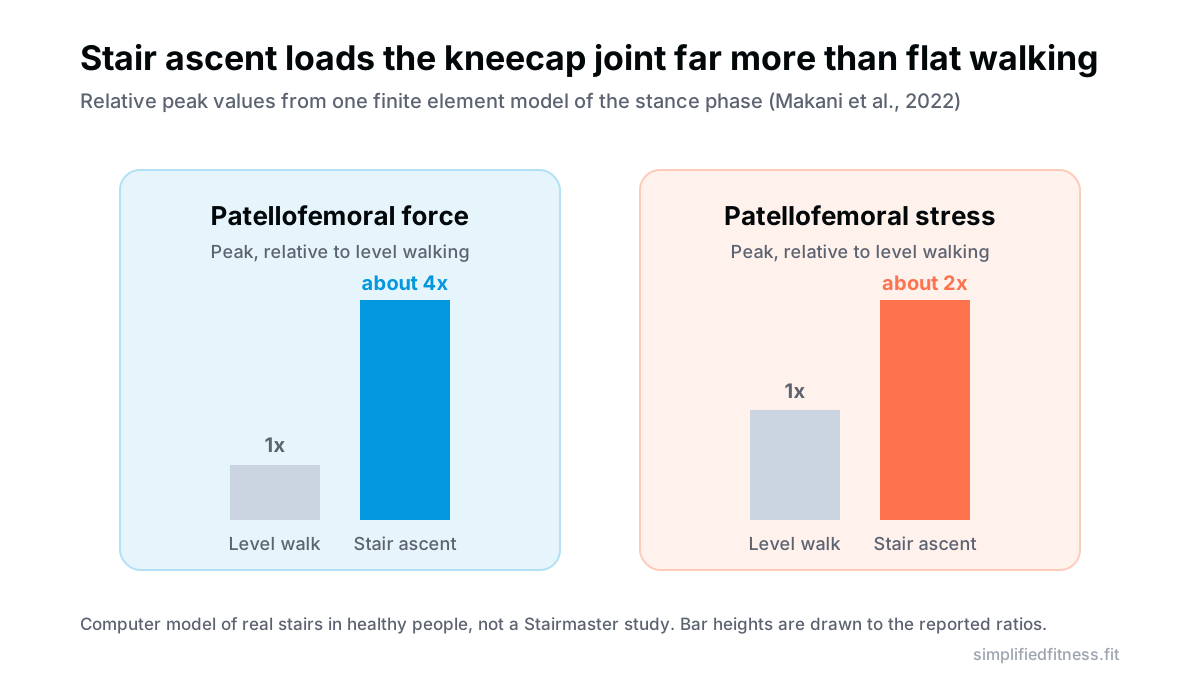
- Stair climbing loads the kneecap joint much more than flat walking. One computer model estimated about 4 times the patellofemoral force and about 2 times the stress at the peak of a stair step.
- Slow incline walking lowered peak knee extension moments by about 19% versus brisk flat walking in 12 obese adults, so it is usually the gentler first choice if you have front-of-knee pain.
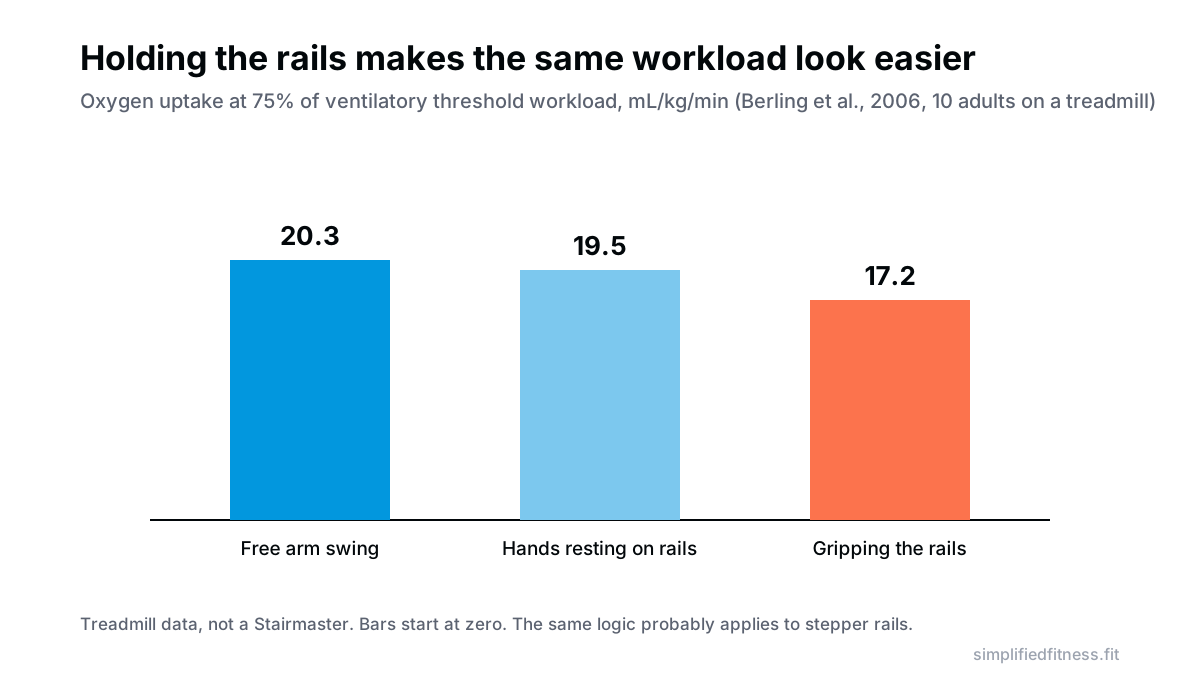
- Gripping the handrails lowers oxygen uptake at the same workload (treadmill data), which means leaning on the rails makes the calorie number on the screen less reliable.
- Sharp, swelling or giving-way knee pain, or pain on flat ground, needs a doctor or physio, not a different machine.
Part of our complete guide: Cardio and Concurrent Training: Build Endurance Without Losing Muscle (The Interference Effect)
Table of contents
Stairmaster vs incline walking is not really a calorie question. At the same effort the two are likely to burn a similar amount, and I could not find a head-to-head trial showing one beats the other for fat loss. The real difference is what each does to your knees: stairs load the kneecap joint far more than a gentle uphill walk.
So if your knees are healthy, use whichever you will actually do. If stairs make the front of your knee ache, start with incline walking. This article sits inside our guide to cardio and concurrent training for lifters, and it covers the gym-machine side of a choice that we also discuss for the treadmill alone in incline treadmill walking as lifter cardio.
Which burns more fat: Stairmaster or incline walking?
Neither has been shown to be better, and “burns more fat” is the wrong frame anyway. Fat loss over weeks comes from total energy burned across the week versus what you eat. The machine that wins is the one you can repeat three or four times a week without your knees complaining.
What does change the number is how hard you work. Energy cost goes up with body weight, speed, grade and step rate. On a StairMaster 4000PT, a 1993 study of 14 men and 14 women found energy cost rose with stepping rate, and the real METs were significantly higher than the manufacturer’s estimates at all but the lowest rate (Butts et al., 1993). That is an old machine and the console maths has probably changed. The takeaway is still useful: the number on the screen is an estimate.
One more point on intensity. Walking slowly up a moderate grade and walking fast on the flat can land at the same effort. In 12 obese adults, metabolic rates were similar across several speed and grade combinations and sat at moderate intensity, roughly 49-60% of VO2max (Ehlen et al., 2011). So you can hold the cardio dose and change the mechanical cost. That is the lever for knee-sensitive lifters.
Why does the Stairmaster stress the knee more?
Because every step is a loaded knee bend. As you step up, the knee flexes while your quads fight your body weight, and that squeezes the kneecap (patella) against the thigh bone.
A finite element model of the stance phase of stair ascent estimated a peak patellofemoral contact force of 3.1 times body weight and a peak stress of 4.83 MPa. The authors say that exceeds level walking by about fourfold for force and twofold for stress, and they also found higher peak ACL force later in the step (Makani et al., 2022). It is a simulation driven by healthy-person data on real stairs, not a Stairmaster test, so the exact numbers will not transfer to your machine and step height.
Healthy knees generally tolerate this load. The concern is a knee that already hurts. Stairs are one of the classic pain triggers in patellofemoral pain, and that pain is common: a 2018 meta-analysis of 23 studies reported an annual prevalence of 22.7% in the general population (Smith et al., 2018).
Here is a wrinkle worth knowing. A 2002 study of 10 people with patellofemoral pain and 10 without found no difference in joint stress between groups during stair climbing. The people with pain kept stress normal by climbing slower and reducing their knee extensor moment (Brechter and Powers, 2002). Small sample, but it fits what many lifters notice: pain-free people can power through steps, while a sore knee forces you into a protective, slower pattern. That is useful information, not a flaw to override.
Is incline walking easier on the knees?
Usually, yes. A more open knee angle and a slower pace mean less force through the front of the joint.
Here is the evidence, with its limits. In the obese adult study above, walking slowly up a 6 degree incline at 0.75 m/s reduced peak knee extension and adduction moments by about 19% and 26% compared with level walking at 1.50 m/s (Ehlen et al., 2011). The authors suggest this is a strategy to cut injury risk while keeping a proper cardiovascular stimulus. A separate lab study of 12 healthy older men walking at 1.34 m/s found peak knee abduction moment fell as treadmill grade rose from 0% to 20%, which may mean less load on the inner knee compartment (Higgins et al., 2025).
Both studies are small, in older or heavier groups, and measured joint moments rather than pain or long-term injury. They do not prove that incline walking prevents knee problems in a 25-year-old lifter. They do support using it first when your knees are cranky.
Stairmaster vs outdoor hills: what about real hills?
The same logic holds outdoors. Walking uphill opens the knee compared with stepping onto a high stair, while walking downhill adds braking load that the treadmill never gives you, so treat long descents with respect if your knees are sensitive. For a no-equipment option with a bit more load, see rucking as low-impact weighted walking.
If you live somewhere hot, a gym incline treadmill with a fan is usually easier to control than a noon hill in May in Hyderabad or Delhi. Keep the same effort rules and drink water.
How to use the Stairmaster without wrecking your knees
If your knees are fine and you like the machine, a few technique changes help.
Do not lean on the rails. In a 2006 study of 10 adults on a treadmill, gripping the handrails dropped oxygen uptake at a fixed workload from about 20.3 to 17.2 mL/kg/min, with resting hands in between at 19.5 (Berling et al., 2006). That is treadmill data, but the same trick applies on a stepper: you are offloading body weight and getting a lower workout than the screen claims.
Take shorter steps. A small 2008 crossover trial compared short steps with arms unsupported and full steps with arms supported on a StairMaster. The short technique reached an RPE of 13 about 105 seconds sooner, at a lower console level, and 83% of people called it harder (Marin et al., 2008). Step length and arm support were changed together, so you cannot separate them, but both point the same way: shorter steps and free arms are the harder, less-propped version. Shorter steps also keep the knee from bending as deeply, which is the part that raises kneecap load.
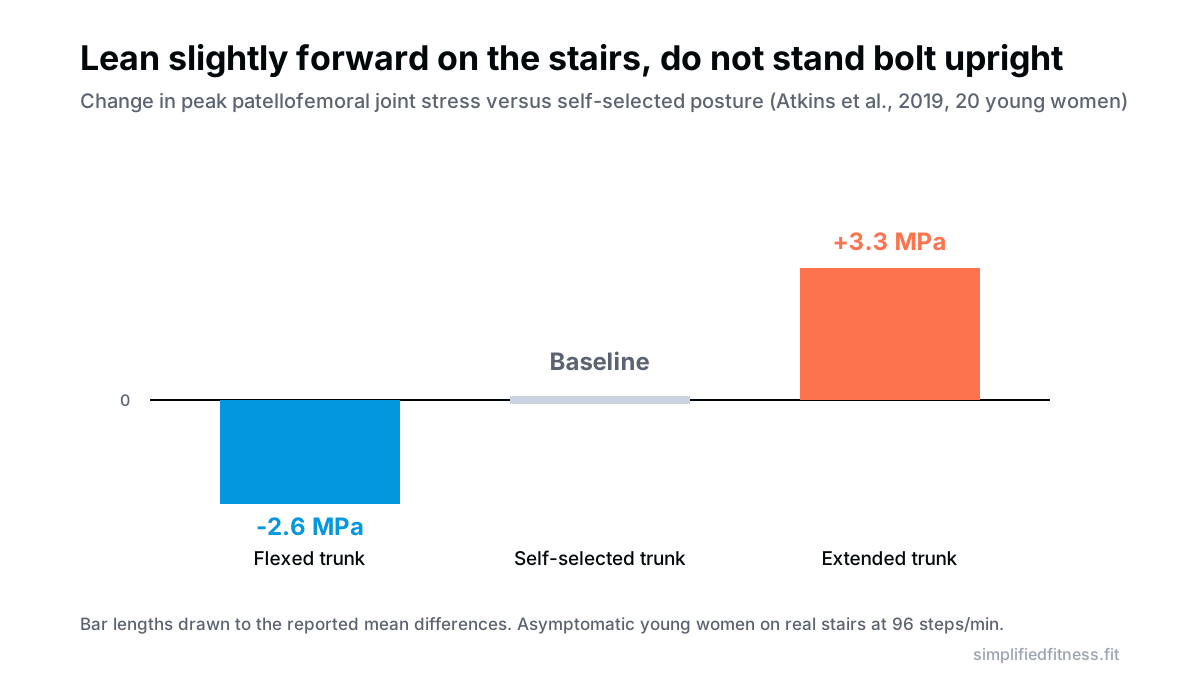
Lean from the hips, not the knees. In 20 young women on real stairs at 96 steps per minute, a more flexed trunk lowered peak patellofemoral stress by 2.6 MPa, while an extended trunk raised it by 3.3 MPa compared with their natural posture (Atkins et al., 2019). Do not hunch over the rails. A slight forward hinge with a long spine and hands light or free is enough.
Keep the whole foot on the step. Pushing through the mid-foot and heel keeps the work in the glutes and quads in a controlled way. Staying on your toes tends to turn the session into a calf and Achilles test.
A beginner-friendly Stairmaster session
- 5 minutes easy, level where you can talk freely.
- 15-20 minutes at a steady effort you could hold in conversation of short sentences.
- 3-5 minutes easy to finish.
That is a sensible starting point, not a research-proven protocol. Use our heart rate zone calculator if you want a number to anchor the effort. Longer, harder stair sessions add fatigue to the quads, so keep them away from heavy squat or leg press days. For how this fits with lifting, see LISS vs HIIT for muscle preservation.
Stairmaster vs incline walking for lifters with knee pain
Patellar tendon or kneecap pain is the situation where this choice matters most. We cannot diagnose it here, so treat what follows as general guidance and get anything persistent looked at.
A Cochrane review of 31 trials with 1690 people with patellofemoral pain found very low quality but consistent evidence that exercise therapy may reduce pain and improve function. It also said there is not enough evidence to name the best type of exercise (van der Heijden et al., 2015). In plain words: moving and strengthening usually beats resting, but nobody can say your ideal cardio machine from a trial.
Practically, for a lifter with front-of-knee irritation:
- Start with slow incline walking on a modest grade, no rails, and stay below the pain threshold.
- Add time first, then grade, then speed.
- Revisit the Stairmaster with short steps and a low level once everyday stairs feel fine.
- If pain climbs during a session, stop or drop the level. Mild awareness that settles within a day is different from sharp pain or swelling.
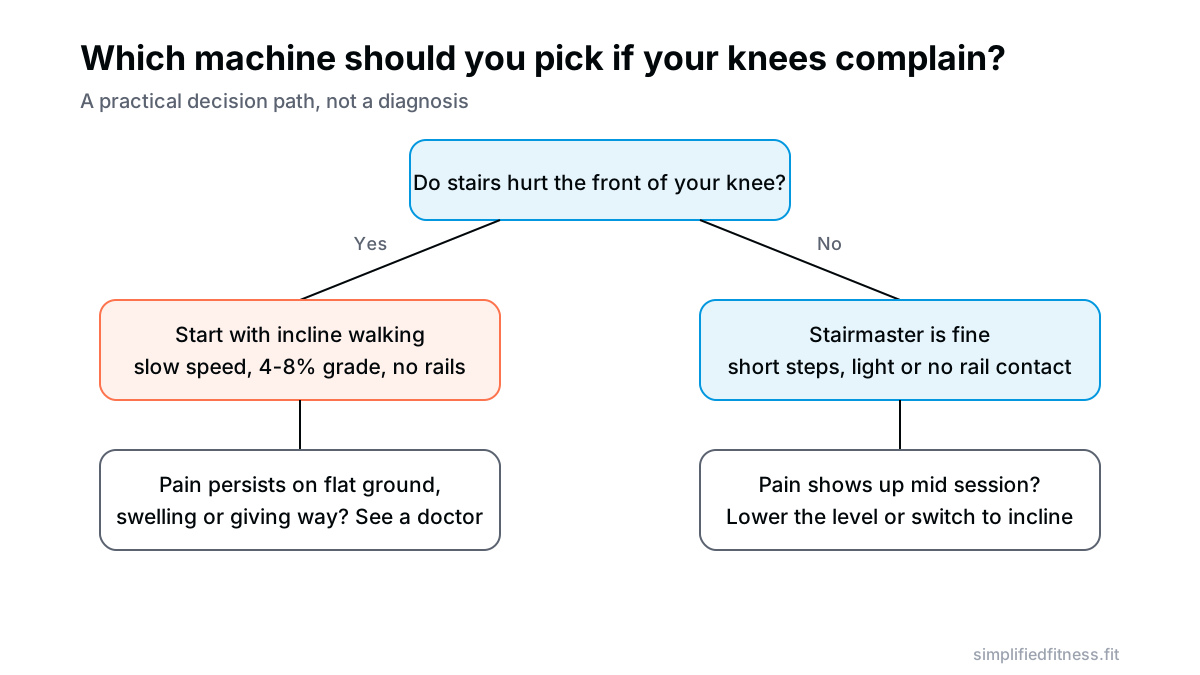
Our guides on leg-day exercise modifications for knee pain and whether squats are bad for your knees go deeper on the lifting side.
Quick comparison
| Question | Stairmaster | Incline walking |
|---|---|---|
| Calorie burn at matched effort | Likely similar, no head-to-head trial found | Likely similar |
| Kneecap load | Higher, deep knee bend each step | Lower at slow speeds and moderate grades |
| Rail dependence | Common, lowers true workload | Easy to avoid at moderate grades |
| Glute demand | Reasonable, but not a lifting substitute | Moderate, grows with grade |
| Best for | Healthy knees, short-step conditioning | Knee-sensitive lifters, long steady sessions |
| Calorie readout | Rough estimate | Rough estimate |
If you are cutting and want ways to burn more without any machine at all, daily movement matters too. See NEAT and step counts vs intense cardio.
When to see a doctor
Machine choice cannot fix a knee problem. See a doctor or physiotherapist if you have swelling, locking, giving way, night pain, pain on flat ground, or pain that does not settle within a few days of training. The same goes if you have had a knee injury or surgery. Do not push through sharp pain.
The bottom line
For most lifters, the question is not which machine burns more but which one you can do without irritating your knees. The Stairmaster loads the kneecap joint more, and many people turn it into an easier workout by leaning on the rails. Incline walking lets you hold the same cardio effort with a more open knee and is the sensible first choice if you have patellar irritation. If your knees are fine, use either, keep your hands light, and keep stair sessions away from heavy leg days.
Frequently Asked Questions
Is the Stairmaster or incline walking better for fat loss?
Neither has been shown to be better. Fat loss depends mostly on the total energy you burn across the week compared with what you eat, and the machine matters less than how hard and how often you can train. Choose the one your knees tolerate so you can repeat it three or four times a week.
Does the Stairmaster burn more calories than incline walking?
At the same perceived effort the difference is likely to be small, and we found no head-to-head trial to settle it. Calories burned track your body weight, the pace you hold and how much you lean on the rails. Compare machines at the same heart rate, not the same number on the console.
Is the Stairmaster bad for your knees?
For healthy knees it is not known to be harmful, but it does load the front of the knee more than flat walking. A 2022 model of stair ascent estimated patellofemoral forces and stresses well above level walking. If stairs already aggravate your knees, start with incline walking and build up slowly.
Why does the Stairmaster hurt the front of my knee?
Stepping up bends the knee deeply under body weight, which compresses the kneecap against the thigh bone. Quadriceps force peaks early in each step, and a tall step or an upright trunk can raise the stress further. Shorten the step, lean slightly forward from the hips and lower the level.
Is incline walking easier on the knees than the Stairmaster?
Usually yes, because the knee stays more open than on a deep step. In 12 obese adults, walking slowly up a 6 degree incline cut peak knee extension moments by about 19% compared with brisk level walking. That is lab data in one group, so treat it as a reason to try incline first, not a guarantee.
What incline should I use to get a good workout without wrecking my knees?
A moderate grade at a slow to moderate pace is a sensible start, for example 4-8% at a speed where you can still talk in short sentences. Steeper grades lowered knee abduction moment in 12 healthy older men, but they also raise effort, so build up gradually. Add grade or time before you add speed.
Should I hold the handrails on the Stairmaster?
Avoid gripping them for support. On a treadmill, gripping the rails lowered oxygen uptake and heart rate at the same workload, so you burn less than the display suggests. Use a light touch for balance only and stand tall.
Are Stairmaster calorie counts accurate?
They are rough estimates. A 1993 study of 28 adults found that real energy costs on a StairMaster 4000PT were significantly higher than the manufacturer's estimates at most stepping rates, and modern machines differ. Use the number as a trend within one machine and rely on heart rate and effort for matching sessions.
Can I do Stairmaster if I have patellar tendonitis or patellofemoral pain?
It depends on your symptoms, so get the knee assessed first. Stair climbing is a typical pain trigger in patellofemoral pain, and a Cochrane review found very low quality but consistent evidence that exercise therapy helps. A physio can tell you whether to use stairs, shorten the range or swap to incline walking for now.
Is Stairmaster good for glutes?
It can be a decent glute stimulus for cardio, but it will not replace hip thrusts or squats. In a small MRI crossover study, gluteus maximus signal rose after both short-step and full-step stepper sessions, with no difference between techniques. Treat it as conditioning that happens to use the glutes.
How long should a Stairmaster session be for a lifter?
Twenty to 30 minutes at a conversational to moderately hard effort is plenty for most lifters. Longer, harder stair sessions pile fatigue onto the quads, which may spill into your next leg day (a coaching observation, not a trial result). Keep it away from heavy squat or leg press sessions, or do it on non-leg days.
Should I do Stairmaster before or after leg day?
After, or on a separate day. Tired quads make heavy squats feel worse, and deep step-ups add knee load when you are already fatigued. This is a coaching judgement rather than a trial result. If you need to do both, keep the stair session easy.
When should I see a doctor about knee pain from cardio?
See a doctor or physiotherapist if there is swelling, locking, giving way, night pain, pain on flat ground or pain that lasts more than a few days after training. Patellofemoral pain is common, with a general-population annual prevalence of 22.7% in one meta-analysis, but other problems can look similar. Do not push through sharp pain.
Sources & References
Every claim above is checked against peer-reviewed research (PubMed, U.S. National Library of Medicine) or guidance from established health bodies. How we fact-check.
- Makani A, et al. Computational biomechanics of human knee joint in stair ascent: muscle-ligament-contact forces and comparison with level walking. Int J Numer Method Biomed Eng. 2022. PMID: 36054682
- Brechter JH, et al. Patellofemoral joint stress during stair ascent and descent in persons with and without patellofemoral pain. Gait Posture. 2002. PMID: 12297253
- Atkins LT, et al. The influence of sagittal trunk posture on the magnitude and rate of patellofemoral joint stress during stair ascent in asymptomatic females. Gait Posture. 2019. PMID: 31499406
- Ehlen KA, et al. Energetics and biomechanics of inclined treadmill walking in obese adults. Med Sci Sports Exerc. 2011. PMID: 21200344
- Higgins S, et al. The effect of incline walking on lower extremity and trunk mechanics in older adults. Sports Med Health Sci. 2025. PMID: 39649793
- Berling J, et al. The effect of handrail support on oxygen uptake during steady-state treadmill exercise. J Cardiopulm Rehabil. 2006. PMID: 17135860
- Butts NK, et al. Effect of stepping rate on energy costs during StairMaster exercise. Med Sci Sports Exerc. 1993. PMID: 8455454
- Marin R, et al. Rehabilitation implications of stepper exercise technique on exertion and hip extensor muscle activation: a small exploratory study. J Rehabil Res Dev. 2008. PMID: 18566931
- van der Heijden RA, et al. Exercise for treating patellofemoral pain syndrome. Cochrane Database Syst Rev. 2015. PMID: 25603546
- Smith BE, et al. Incidence and prevalence of patellofemoral pain: a systematic review and meta-analysis. PLoS One. 2018. PMID: 29324820

Umair Hazrami · Founder & Head Coach, Simplified Fitness
Umair Hazrami founded Simplified Fitness and the Simplified Lifter channel to cut through fitness noise. With 4+ years of consistent training and 10+ coaching clients, he writes every guide from the peer-reviewed research and links the sources so you can check them. Our editorial standards.
Educational content only, not medical advice. If you have a medical condition, are pregnant, or take medication, talk to a qualified doctor before changing your diet, supplements or training. Full disclaimer.
Keep reading
Strength & Cardio
Aerobic Conditioning and Hypertrophy: How Work Capacity Improves Inter-Set Recovery
Does better cardio help you recover between sets? See what work capacity resistance training research says, where theory outruns data, and what to do.
9 min read
Strength & Cardio
Can Cardio Cause Muscle Loss? The Calorie and Volume Thresholds Behind the Fear
Does cardio cause muscle loss? Not at normal doses. See what the meta-analyses say about deficits, protein and running volume, and how to protect your muscle.
9 min read
Strength & Cardio
Cardio During a Cut: How Much You Need and When to Stop Adding
How much cardio during cutting phase? Learn the food-first rule, a walking base, sample weekly schedules and signs you are doing too much. Every study linked.
7 min read
Strength & Cardio
Cycling vs Running for Lifters: Which Protects Muscle and Squat Strength?
Cycling vs running for lifters: Wilson's meta-analysis found running, not cycling, blunted gains. We compare it with newer reviews and give a bike plan.
8 min read