Swimming for Lifters: Shoulder Mobility, Non-Impact Conditioning, and Lat Recovery
Swimming for lifters benefits explained: low-impact cardio, shoulder-friendly strokes, what the research says on muscle gain, and how to fit 1-2 swims a week.
TL;DR. The short answer
- Swimming is a good low-impact cardio option for lifters: a 2024 meta-analysis of 2.6 million adults linked recreational swimming with a 24% lower risk of all-cause mortality and better body composition and blood lipids.
- The evidence does not show that swimming speeds up muscle recovery or 'flushes' upper-body metabolites. Treat it as easy conditioning and a change of movement, not a recovery treatment.
- A meta-analysis of 21 studies found interference with muscle gain came mainly from running, and grew with how often and how long the endurance work was. Swimming was not separately tested, so keep sessions short and easy.
- Freestyle and backstroke are the practical default for most lifters. Heavy volume, sudden jumps in laps and a stiff upper back are the real shoulder risks.
- One or two easy swims of 20-40 minutes a week, kept away from your hardest pull session, is a sensible starting dose. Watch your appetite afterwards.
Part of our complete guide: Cardio and Concurrent Training: Build Endurance Without Losing Muscle (The Interference Effect)
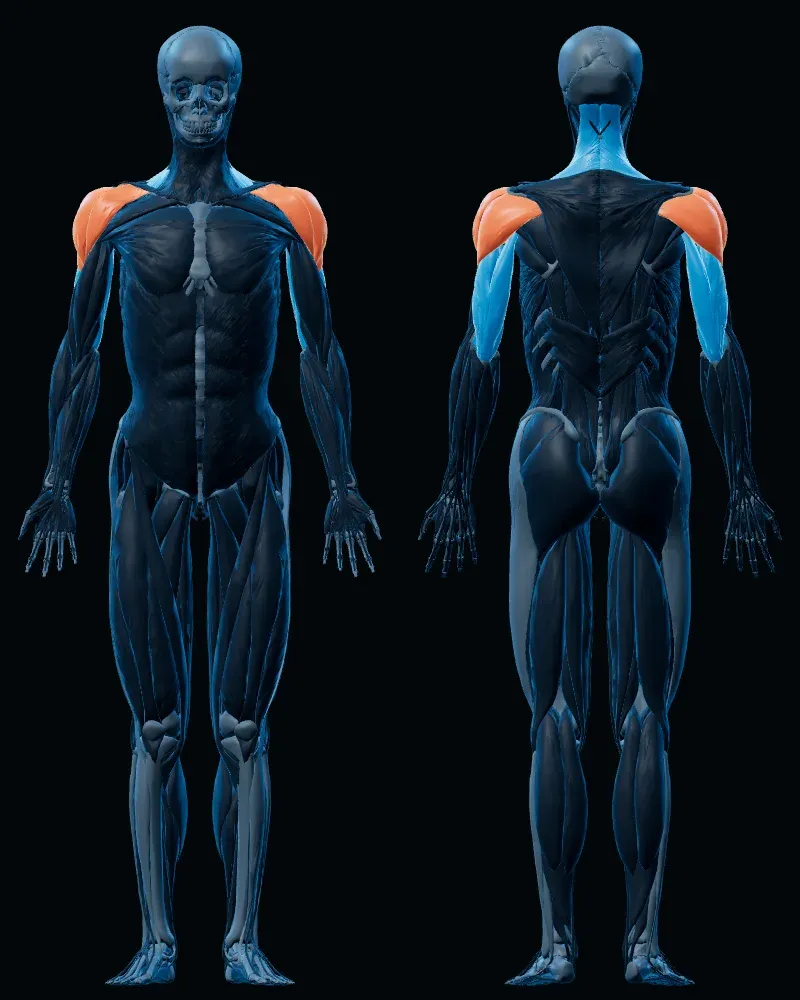
Muscles worked: shoulders
Main movers: all three heads of the deltoid
Assisting: supraspinatus, upper traps and triceps
Table of contents
Swimming for lifters has real benefits, but they are modest and mostly about conditioning, joints and variety. It gives you cardio with no pounding on your knees, ankles or lower back, and a 2024 meta-analysis links recreational swimming with a 24% lower risk of death from any cause (Oja et al., 2024). What it does not do is magically repair your lats or build bone.
This guide covers what swimming does for a lifter, which strokes make sense, how to fit it around training, and where the hype runs ahead of the evidence. It sits inside our wider guide to cardio and concurrent training, so read that first if you want the full interference picture.
Is swimming good cardio for bodybuilding?
Yes, as an easy to moderate conditioning option. The 2024 review pooled 136 papers from 76 studies, covering 2.6 million adults, and found swimming was associated with a 24% lower all-cause mortality risk (HR 0.76) and improved body composition and blood lipids (Oja et al., 2024). Running (23% lower) and cycling (21% lower) landed in the same range for mortality, so swimming is not special. It is just good.
Two cautions. These were studies of recreational participants, not lifters, and the review did not look at muscle gain. So “good for health” is solid, “good for bodybuilding” is an inference.
Where swimming earns its place is practical:
- No impact, so nothing extra for sore knees, shins or a grumbling lower back
- Easy to keep the effort low when you want it low
- Uses the upper body and trunk, a nice change from treadmill and bike
- Water keeps you cooler, which matters through an Indian summer
Will swimming hurt my muscle gains?
It can, if you do too much. The best evidence we have on interference is a 2012 meta-analysis of 21 studies. Mean hypertrophy effect sizes were 1.23 for strength training alone, 0.85 for concurrent training and 0.27 for endurance training alone (Wilson et al., 2012).
So adding endurance work was associated with less muscle growth than lifting alone. But the same analysis found that running, not cycling, drove significant drops in both hypertrophy and strength, and that the cost grew with how often and how long the endurance sessions were (Wilson et al., 2012).
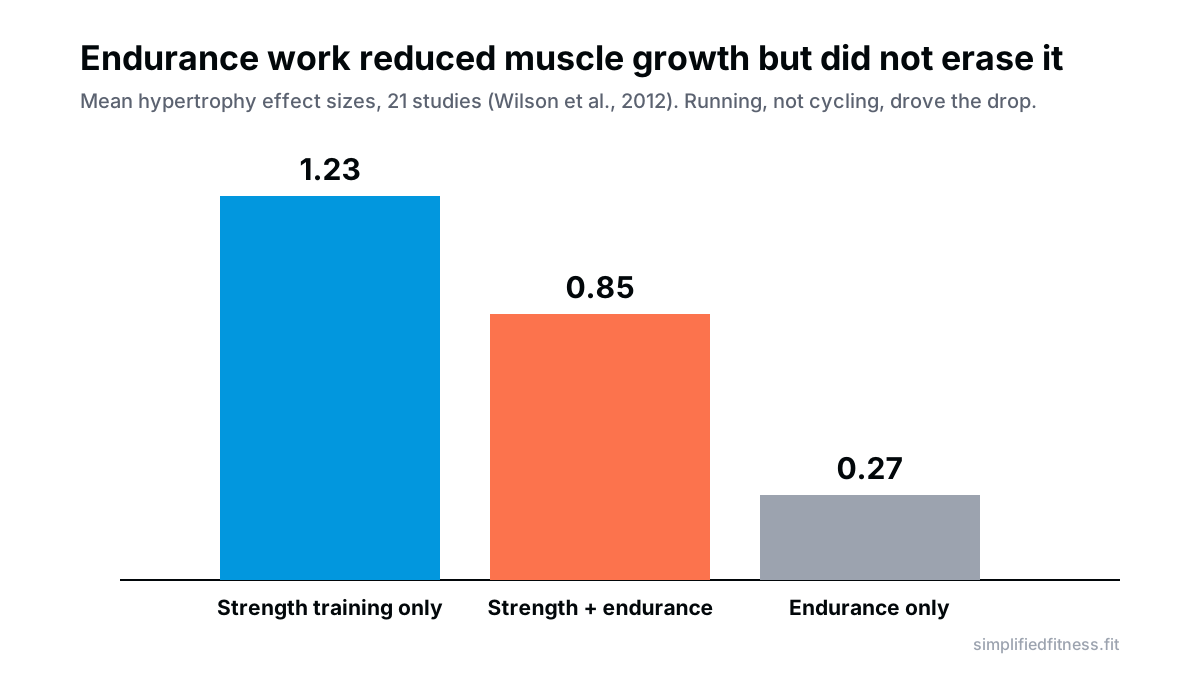
Here is the catch for this article. Swimming was not singled out in that analysis, so we cannot say whether it behaves more like cycling or running. One plausible idea is that a non-impact, low-eccentric activity is gentler on the muscles you want to grow, but that is a hypothesis, not a result.
The cautious takeaway is simple. Keep swims short, easy and infrequent, then judge by your own lifting log. If your numbers stall for several weeks after you add laps, cut back. (For the molecular side of this debate, see our explainer on the AMPK and mTOR interference effect.)
Does swimming improve shoulder mobility for lifters?
Maybe a little, and it is not proven. Many lifters have stiff upper backs and tight pecs, and the full overhead reach of freestyle and backstroke does take your shoulders and thoracic spine through a big range.
Here is the reality check. A cross-sectional study of 34 NCAA Division I swimmers found no difference in thoracic rotation between those with and without scapular dyskinesis, and no correlation between thoracic rotation and self-reported shoulder pain or dysfunction (Welbeck et al., 2019). Dyskinesis was present in 15 of the 34 swimmers, so even people who swim constantly can have shoulder movement problems.
In other words, swimming is not an automatic shoulder fix. It is a way to move through range, with water doing the loading. If your shoulders feel better after easy backstroke, great. Just do not skip controlled shoulder work in the gym, like the drills in our guide to serratus anterior anatomy and shoulder health.
Which stroke is best for lifters?
Freestyle and backstroke are the practical default. Both keep your shoulders moving through a smooth cycle, and backstroke in particular opens the chest and avoids the head-up neck position that many beginners fall into with freestyle.
What about breaststroke? You will often hear that it is hard on the shoulders and knees. That is the coaching view, and the evidence is less clear than the folklore. A 2023 systematic review of competitive swimmers found moderate evidence against an association between specialty stroke and shoulder injury or pain, along with training frequency and range of motion. The same review found moderate evidence that shoulder muscle recruitment profiles, such as increased serratus anterior activity, were associated with pain (McKenzie et al., 2023).
Where it landed:
| Stroke | Why lifters like it | Watch for |
|---|---|---|
| Freestyle | Smooth, easy to pace, good all-round conditioning | Breathing only to one side, neck strain |
| Backstroke | Chest opens up, easy to breathe, gentle on the neck | Dropping the hips, rushing the recovery arm |
| Breaststroke | Relaxed for some people, good for a change of pace | Any shoulder or knee ache. If it appears, switch strokes |
| Butterfly | Short bursts of skill work for confident swimmers | Fatigue and sloppy technique. Not a beginner stroke |
The cautious answer is that stroke choice matters less than total volume and how your shoulders feel. If a stroke makes your shoulder or knee ache, switch. Do not push through.
Does swimming help lat recovery after training?
This is the claim I would be most careful with. The idea is that gentle swimming flushes metabolites out of tired upper-body muscles and helps lats recover faster. It sounds neat. We could not find a study of swimming as a recovery tool for lifters in the research we reviewed, so we cannot say it works.
What we can say is practical. Easy movement often makes stiff, sore muscles feel looser, and many lifters like a gentle swim on a rest day for that reason. Feeling better is a legitimate reason to do it. Just do not expect it to shorten the time your lats need to repair.
Heavy pull days still need real recovery, so protect them. Do not schedule a hard swim the day before or after your biggest pull session if your lats are already your limiting factor. Our guide on recovery modalities for sore muscles covers what the evidence does support.
How do you fit swimming into a lifting week?
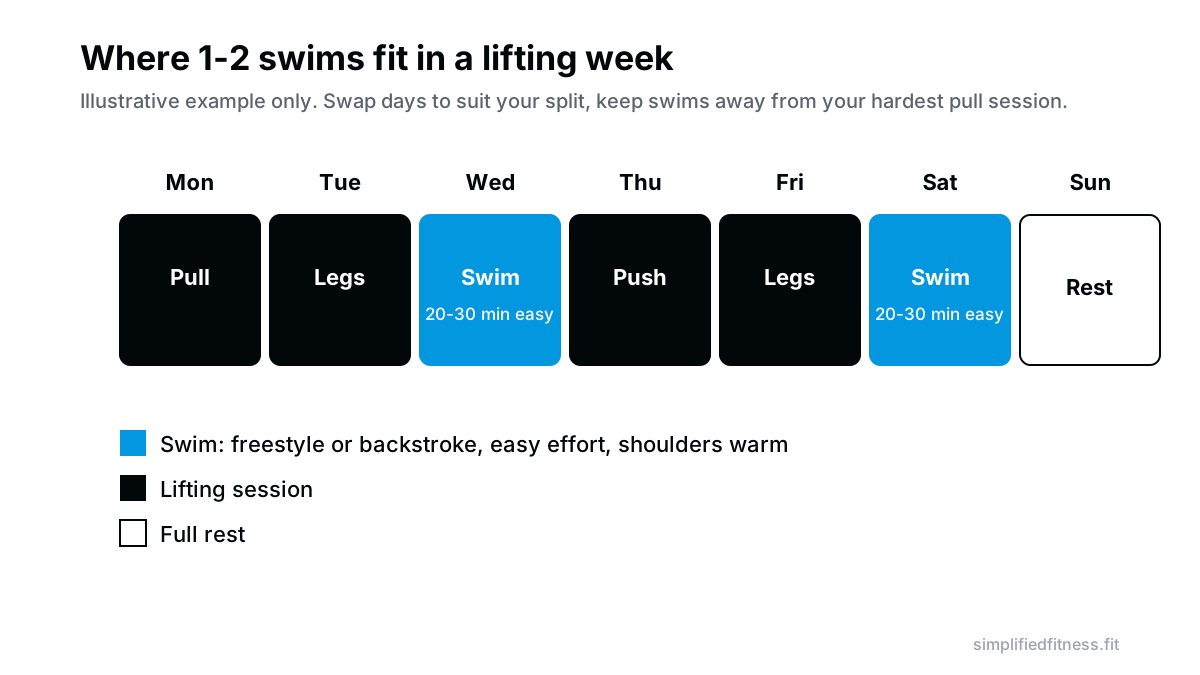
Start with one session. Add a second only if your lifting numbers and energy hold.
- Duration: 20-40 minutes of continuous easy swimming is plenty. Easy means you could chat between lengths if you wanted to.
- Placement: a separate day from lifting is cleanest. If you must combine, swim after the weights, not before.
- Avoid: a hard swim straight before leg day or the day before your heaviest pull session.
- Warm up: do a few minutes of arm circles and easy lengths before you push the pace.
If you want to pace the effort using heart rate, our heart rate zone calculator gives you target ranges, though heart rate in water can read lower than on land, so go by feel as well.
For where swimming sits next to other low-impact options, compare it with incline treadmill walking and the broader debate on LISS versus HIIT for muscle preservation.
What are the shoulder risks of swimming?
For casual lap swimmers, the risk is low. The data on shoulder pain come mostly from competitive swimmers training a lot. A systematic review of 12 studies and 1,460 swimmers found that adolescents had the highest shoulder pain rates (91.3%) and that weekly training volume and years of competitive swimming were linked with thicker supraspinatus tendons (Feijen et al., 2020). The adolescent swimmers in that review averaged about 17 hours of swim training a week.
You are not doing that. But the lesson carries over: the review advised avoiding sudden, large jumps in swim volume. For a lifter who already presses and rows heavily, going from zero to five swims a week is the same kind of spike.
The 2023 review also noted that a high acute-to-chronic workload ratio and low posterior shoulder strength endurance were linked with injury in its highest-quality study (n = 201) (McKenzie et al., 2023). The practical translation is to build volume gradually and keep training your rear delts and upper back. Rows, face pulls and reverse flys are worth keeping in your week if you swim.
If you already have shoulder pain, see a doctor or physiotherapist rather than swimming through it.
Does swimming build bone density like lifting?
No. Swimming supports the body in water, so it does not load your bones the way squats and deadlifts do. A meta-analysis of 14 studies in young adults found swimmers had bone mineral density similar to non-athletic controls at the whole body, femoral neck and lumbar spine, and lower than high-impact athletes (Gomez-Bruton et al., 2018).
That is no reason to avoid swimming. It just means swimming should complement lifting, not replace it. Your heavy squats, hip thrusts and carries are doing the bone work.
Will swimming make me hungrier?
Possibly, yes. In a randomized crossover trial, 32 young adults completed 60 minutes of hard swimming, exertion-matched cycling and a rest condition. After swimming, they ate more at an ad libitum meal (3857 kJ) than after rest (3259 kJ), and the difference was statistically significant. After cycling the rise was smaller and not significant, and swimming and cycling did not differ from each other (Thackray et al., 2020).
This was one meal, in young, healthy people, after hard exercise. It does not prove swimming wrecks a fat loss diet. But if you are cutting, plan your post-swim meal rather than wandering into the canteen. Something like dal, curd and roti, or paneer and rice, will fill you up without the guesswork. Use our calorie calculator to keep your targets honest.
Should you cold plunge after swimming?
You do not need to. The cold water idea sometimes gets mixed up with swimming, but they are different. A 7-week trial in 16 men found that cold water immersion (15 minutes at 10 degrees C) after every lifting session blunted muscle fibre growth and some anabolic signalling compared with passive recovery, while 1RM leg press gains were similar (Fyfe et al., 2019).
That does not tell us anything about swimming in a normal pool. It only suggests that if muscle size is your goal, do not make a habit of icy dips straight after lifting. A regular swim at pool temperature is a different thing.
Who should be careful with swimming?
Skip or modify swimming and talk to a doctor if you have:
- Shoulder pain that lingers beyond a few days or wakes you at night
- Numbness, tingling or arm weakness
- A recent shoulder or ear injury or surgery
- Chest pain, unusual breathlessness or fainting with exercise
- A medical condition where you were advised to avoid exertion or immersion
Swimming alone, with no lifeguard, is a safety risk if you are not a confident swimmer. Pick a supervised pool and stay within your ability.
A simple plan to start this month
- Week 1: one easy swim, 20 minutes, freestyle or backstroke, on a non-lifting day.
- Week 2: one swim of 25-30 minutes.
- Week 3: add a second short swim only if your lifts, sleep and appetite are steady.
- Week 4: keep it at 1-2 sessions, and re-check your training log.
If your presses or rows start slipping, the swim is the first thing to trim, not the lifting. For more ideas on conditioning that spares your joints, try sled pushes, rowing and air bikes.
Frequently Asked Questions
Is swimming good cardio for bodybuilding?
Yes, easy swimming is a reasonable cardio choice for lifters because it adds conditioning without ground impact. A 2024 meta-analysis linked recreational swimming with better body composition and blood lipids, though it did not test muscle gain. Start with one or two relaxed sessions a week and keep your lifting volume unchanged.
Does swimming kill muscle gains?
Not in the way people fear, but too much endurance work can blunt them. A 2012 meta-analysis found interference rose with the frequency and duration of endurance training, and running was the main problem modality. Keep swims to 1-2 easy sessions of 20-40 minutes and judge by your lifting numbers.
How often should a lifter swim?
One or two sessions a week is a sensible range for most lifters. The interference data show that more frequent and longer endurance sessions carry a larger cost to strength and size. Begin with one session, add a second only if your lifts and energy hold steady.
Is swimming good for shoulder mobility?
It can help you move your shoulders and upper back through a full range, but the evidence is thin. Research in college swimmers found no link between thoracic rotation and shoulder pain scores, so mobility is not a guaranteed fix. Use easy freestyle or backstroke as one part of your routine, alongside controlled shoulder work in the gym.
Is breaststroke bad for lifters' shoulders?
Not clearly. A systematic review of competitive swimmers found moderate evidence against a link between specialty stroke and shoulder pain, so breaststroke is not proven to be harmful. If a stroke makes your shoulder or knee ache, switch to freestyle or backstroke and see a physiotherapist if it persists.
Should I swim before or after lifting?
Swim after lifting, or on a separate day, if you want your lifting to stay the priority. Fatigue from a hard swim can cut into the quality of the next session, and a 2012 meta-analysis suggests more endurance work costs more strength. A separate day is cleanest, and an easy 20 minutes after a leg session works if time is tight.
Can swimming help with sore lats?
It may feel good, but research has not shown that swimming speeds muscle recovery. Easy movement can increase blood flow and make stiff muscles feel looser, though we cannot say it clears soreness faster. If your lats are very sore, keep the swim gentle and short.
Is swimming enough cardio for fat loss?
It can contribute, but appetite is the catch. In a randomized crossover trial of 32 adults, 60 minutes of hard swimming raised the food eaten at a free-choice meal afterwards compared with rest. Plan a protein-rich meal such as dal with paneer or curd after your swim so you are not grazing.
Does swimming build bone like lifting does?
No, swimming is not a bone-loading sport. A meta-analysis of young adults found swimmers had bone density similar to non-athletes and lower than high-impact athletes. Keep your squats, deadlifts and loaded carries for bone health.
Is swimming good in hot Indian weather?
Yes, it is one of the easier ways to train in heat, because the water keeps you cooler than a run in the sun. You can still lose fluid while swimming, and you may not notice it, so drink water around the session. Avoid swimming in very hot, crowded or poorly maintained pools if you feel unwell.
Should I do a cold plunge after swimming?
It is not needed, and it may work against muscle growth if you do it after lifting. A 7-week trial in 16 men found post-lifting cold water immersion blunted muscle fibre growth but not strength gains. A normal swim at pool temperature is not the same thing, so do not worry about it.
When should I see a doctor about shoulder pain from swimming?
See a doctor or physiotherapist if shoulder pain lingers beyond a few days, wakes you at night, causes weakness, or comes with numbness or tingling. Swimming overload is linked with shoulder pain in competitive swimmers, mainly at high volumes. Until you are assessed, drop the strokes and exercises that provoke it.
Sources & References
Every claim above is checked against peer-reviewed research (PubMed, U.S. National Library of Medicine) or guidance from established health bodies. How we fact-check.
- Wilson JM, et al. Concurrent training: a meta-analysis examining interference of aerobic and resistance exercises. J Strength Cond Res. 2012. PMID: 22002517
- Oja P, et al. Health Benefits of Different Sports: a Systematic Review and Meta-Analysis of Longitudinal and Intervention Studies Including 2.6 Million Adult Participants. Sports Med Open. 2024. PMID: 38658416
- Feijen S, et al. Swim-Training Volume and Shoulder Pain Across the Life Span of the Competitive Swimmer: A Systematic Review. J Athl Train. 2020. PMID: 31935141
- McKenzie A, et al. Shoulder pain and injury risk factors in competitive swimmers: A systematic review. Scand J Med Sci Sports. 2023. PMID: 37515375
- Welbeck AN, et al. Examining the link between thoracic rotation and scapular dyskinesis and shoulder pain amongst college swimmers. Phys Ther Sport. 2019. PMID: 31499399
- Gomez-Bruton A, et al. Swimming and peak bone mineral density: A systematic review and meta-analysis. J Sports Sci. 2018. PMID: 28394711
- Thackray AE, et al. An acute bout of swimming increases post-exercise energy intake in young healthy men and women. Appetite. 2020. PMID: 32565123
- Fyfe JJ, et al. Cold water immersion attenuates anabolic signaling and skeletal muscle fiber hypertrophy, but not strength gain, following whole-body resistance training. J Appl Physiol. 2019. PMID: 31513450

Umair Hazrami · Founder & Head Coach, Simplified Fitness
Umair Hazrami founded Simplified Fitness and the Simplified Lifter channel to cut through fitness noise. With 4+ years of consistent training and 10+ coaching clients, he writes every guide from the peer-reviewed research and links the sources so you can check them. Our editorial standards.
Educational content only, not medical advice. If you have a medical condition, are pregnant, or take medication, talk to a qualified doctor before changing your diet, supplements or training. Full disclaimer.
Keep reading
Strength & Cardio
Aerobic Conditioning and Hypertrophy: How Work Capacity Improves Inter-Set Recovery
Does better cardio help you recover between sets? See what work capacity resistance training research says, where theory outruns data, and what to do.
9 min read
Strength & Cardio
Can Cardio Cause Muscle Loss? The Calorie and Volume Thresholds Behind the Fear
Does cardio cause muscle loss? Not at normal doses. See what the meta-analyses say about deficits, protein and running volume, and how to protect your muscle.
9 min read
Strength & Cardio
Cardio During a Cut: How Much You Need and When to Stop Adding
How much cardio during cutting phase? Learn the food-first rule, a walking base, sample weekly schedules and signs you are doing too much. Every study linked.
7 min read
Strength & Cardio
Cycling vs Running for Lifters: Which Protects Muscle and Squat Strength?
Cycling vs running for lifters: Wilson's meta-analysis found running, not cycling, blunted gains. We compare it with newer reviews and give a bike plan.
8 min read