Fasted Cardio vs Fed Cardio: Does Skipping Breakfast Burn More Fat?
Fasted cardio vs fed cardio for fat loss: what the trials show on fat burn, muscle loss and cortisol, plus what to eat before a 6am session. Every study linked.
TL;DR. The short answer
- Fasted cardio raises fat burning during the session, but the controlled trials do not show more fat lost. In the best-known trial (Schoenfeld, 2014) fasted and fed groups lost similar fat over four weeks.
- Fat loss is driven by your overall calorie deficit. Small studies suggest your body burns less fat later in the day, so the extra fat burned in the session tends to get evened out.
- Fasted cardio has not been shown to cause meaningful muscle loss in a well-fed, well-trained lifter, but protein breakdown may rise when fuel is low, so a small pre-session snack is a cheap safeguard.
- Hard or long sessions usually feel and perform better after a small meal. Easy, short sessions fasted are fine if you genuinely prefer them.
- Pick whichever version you will actually do five days a week. Consistency beats timing.
Part of our complete guide: Cardio and Concurrent Training: Build Endurance Without Losing Muscle (The Interference Effect)
Table of contents
If you are setting a 6am alarm to do cardio on an empty stomach because someone told you it burns more stubborn fat, you can probably stay in bed a little longer. In the best controlled trials, fasted cardio vs fed cardio fat loss comes out about the same once calories are accounted for. Fasted exercise burns more fat during the session. It does not reliably leave you with less body fat afterwards.
This article sits inside our guide to cardio and concurrent training for lifters. Here we stay on one question: does the fed state matter for fat loss and for keeping muscle?
Does fasted cardio burn more fat?
Yes and no, and the gap between those two answers is the whole myth.
Fasted exercise does shift your fuel mix toward fat while you are moving. A 2024 trial from the University of Birmingham puts it plainly: overnight-fasted exercise acutely enhances fat oxidation compared with fed exercise, but consistent fasted training does not typically produce more body mass loss, which points to the body compensating (Podestá et al., 2024).
Think of it like a bank balance. Burning more fat on the treadmill is a withdrawal from one account. If the rest of the day you burn less fat and more carbohydrate, the total moves very little.
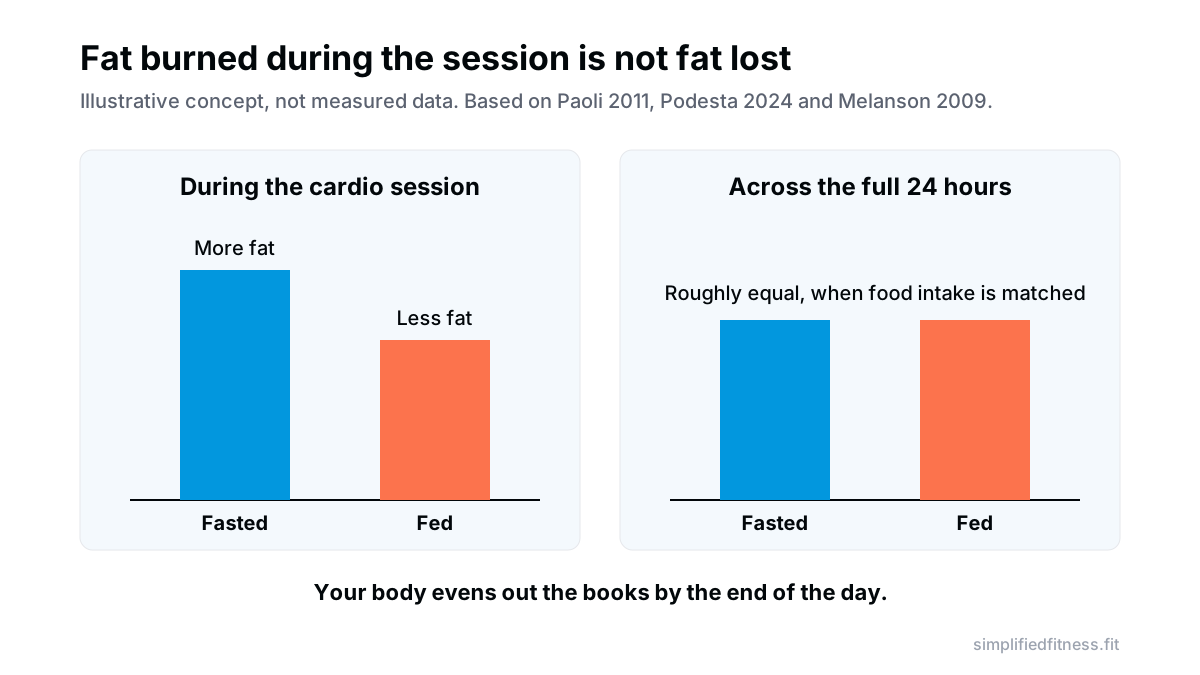
Here is one small study that shows it. Paoli and colleagues had 8 young men do the same 36 minute treadmill session fasted or after breakfast, then eat the same amount over the next 24 hours. Breakfast itself raised the respiratory exchange ratio, but 12 hours later the fed condition showed a lower RER, which indicates greater fat use, and the difference was still there at 24 hours. The authors concluded that fasting before exercise does not enhance fat use and that activity after a light meal is advisable (Paoli et al., 2011). Eight men is tiny, so treat it as a clue rather than a verdict.
A wider point comes from a controlled 24-hour study in lean, trained and obese people. When exercise was matched with enough food to stay in energy balance, 24-hour fat oxidation did not rise, and fat balance was actually more positive on the exercise day (Melanson et al., 2009). Energy balance, not the timing of one session, decided the outcome. That is the same logic behind energy balance for fat loss and recomposition.
What does the Schoenfeld fasted cardio study actually show?
This is the study most people mean by “the Schoenfeld fasted cardio study”, so here is exactly what it did.
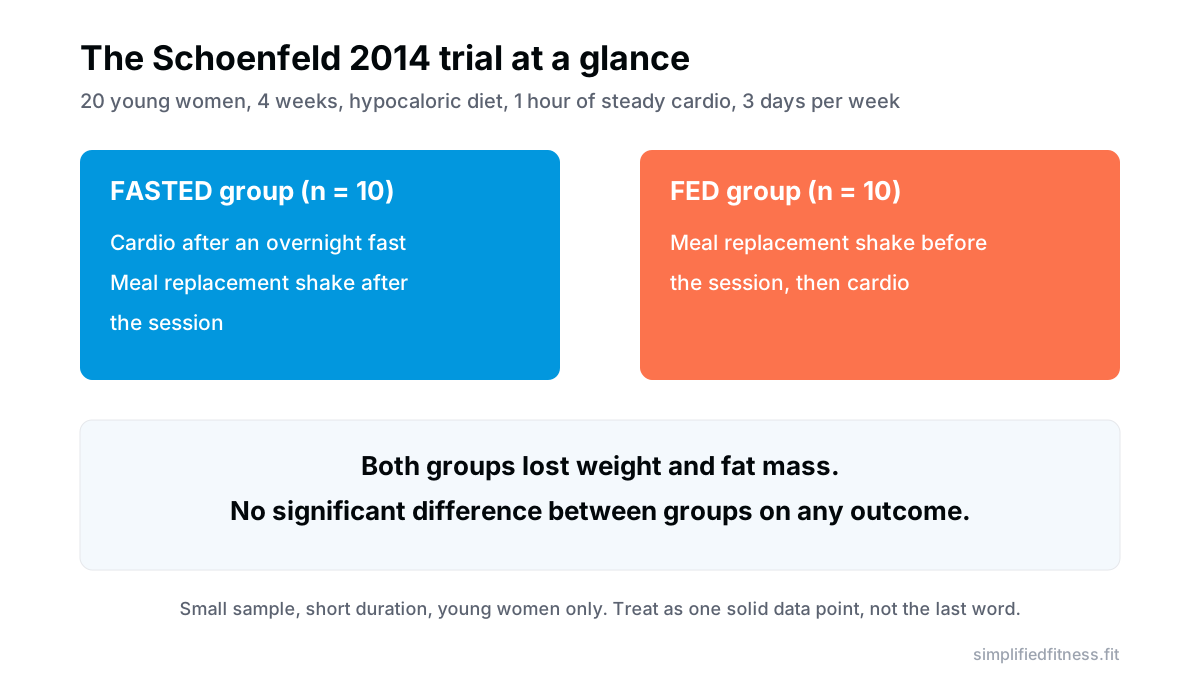
Twenty healthy young women were randomly assigned to fasted or fed training. Both groups did one hour of steady-state cardio, three days a week, for four weeks, while following a hypocaloric diet. The fed group had a meal replacement shake before training. The fasted group got the same shake after training. Both groups lost weight and fat mass, and there were no significant differences between groups on any measure (Schoenfeld et al., 2014).
One more detail from the Podestá trial is worth knowing. Twelve active adults ran for 75 minutes fasted or fed, and over the following four days there were no differences in energy intake, energy expenditure or appetite (Podestá et al., 2024). So “you will eat more later to make up for it” is not clearly supported either. The authors concluded both approaches could be used interchangeably, at least over that window.
What does that mean for the reader? Treat fasted cardio as a preference, not a fat loss hack.
Does fasted cardio cause muscle loss?
The honest answer is “probably not much in most lifters, but it is not a free lunch either.”
The worry is about fuel. When carbohydrate availability is low, the body leans more on fat, and amino acid oxidation can increase as well. In a small crossover study of 8 endurance-trained men, training with low carbohydrate availability (including a fasted morning run) raised fat oxidation during the run, but also raised phenylalanine oxidation during recovery, suggesting a greater protein requirement (Gillen et al., 2019). Note what that study was: trained endurance athletes, with a deliberately low-carbohydrate protocol, and protein held at a suboptimal level. It was not a fat loss trial in gym lifters. It shows a mechanism, not a measured loss of muscle.
On the body composition side, the fasted group in Schoenfeld’s trial did not lose more fat-free mass than the fed group, as no significant between-group differences were found on any outcome (Schoenfeld et al., 2014). That was four weeks in young women doing moderate cardio, so it cannot tell us what happens over a long, aggressive cut.
If you want a broader look at when cardio genuinely threatens muscle, see our guide on whether cardio can cause muscle loss. The short version is that big volumes and big calorie deficits are the real risk, not breakfast.
Does fasted cardio spike cortisol?
Sort of, but it matters less than the internet makes out.
In a study of 9 physically active men, 45 minutes of low intensity walking was done fasted or after a standardised meal. Cortisol stayed around its starting level after the fasted walk and fell after the fed walk, and the testosterone to cortisol ratio was higher in the fed condition. The authors concluded fasting before low intensity exercise does not seem advantageous for fat loss (Vilaça-Alves et al., 2018).
Nine men, one session. Cortisol is also a normal exercise hormone, and a short-lived rise is not damage. The practical point is smaller: if you are already underslept, dieting hard and stressed at work, adding a fasted session stacks one more stressor for no proven fat loss benefit.
Does fasting hurt performance and training quality?
It can, depending on the session.
A review of pre-exercise nutrition notes that performance is improved following pre-exercise carbohydrate for longer but not shorter duration exercise, and that there is little evidence of a boosted fat burning capacity after long-term fasted-state training (Rothschild et al., 2020).
Even the timing of breakfast can matter. In 11 highly trained cyclists, skipping breakfast and eating a matching lunch produced about 3 percent lower average power in an evening 20 km time trial, even though total calories and carbohydrate were identical (Metcalfe et al., 2021). Trained cyclists are not the same as gym lifters, but the message carries: the harder the effort, the more fuel timing starts to matter.
For lifters who want quality work, this matters in practice. If you plan to run intervals or lift after your cardio, a small meal first gives you more output per session, and more output means more calories burned and better training.
Fasted vs fed cardio: quick comparison
| Fasted cardio | Fed cardio (small meal) | |
|---|---|---|
| Fat burned during session | Higher | Lower |
| Fat lost over weeks (matched diet) | Similar in the main trial | Similar in the main trial |
| Muscle loss risk | Not shown to be higher in lifters, but amino acid oxidation may rise | Lower theoretical risk |
| Hard session quality | Can feel flat | Usually better |
| Convenience | No prep, but some people feel faint | Needs a snack and a few minutes |
| Best for | Easy, short sessions if you like it | Hard, long or lifting-adjacent sessions |
Who might still prefer fasted cardio?
Some people honestly train better on an empty stomach. If you wake up, walk for 30 minutes at a conversational pace and feel great, there is no research telling you to stop. Eating before early cardio makes some people nauseous, and that matters, because the session you tolerate is the one you repeat.
The same goes for an intermittent fasting window. If your first meal is at noon and you train at 7am, you are simply fasted, and the evidence above applies. Just land your daily protein and calories inside the window. Our guide to NEAT and daily steps vs intense cardio is worth reading too, because extra walking often beats an extra tough session for fat loss.
What to eat before morning cardio (Indian options)
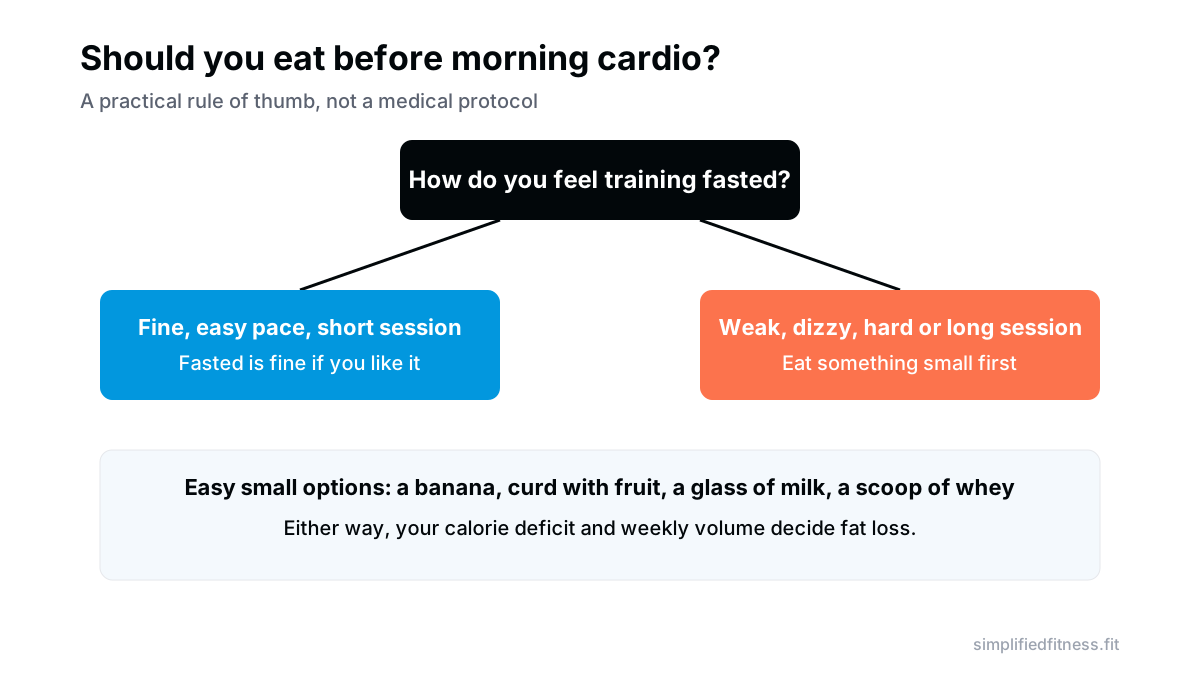
You do not need a full breakfast. Aim for something small, easy to digest and mostly carbohydrate with a little protein.
- A banana with a few soaked almonds
- A glass of milk or a small bowl of curd with fruit
- A scoop of whey in water, if milk does not sit well
- One or two dates with a glass of water
- Half a bowl of poha or a slice of toast if you have the time
If you have 20-30 minutes, eat a little. If you have 5 minutes, sip something light or take a few dates. The point is not perfection. It is giving your body a small amount of fuel so the session feels good. If you are training hard enough to need more, fuel more.
Staying hydrated matters more than people think in hot weather. Our heart rate zone calculator helps you keep easy sessions genuinely easy.
What about fasted high-intensity or interval work?
Intervals are a different animal. A trial in healthy males compared sprint interval training done fasted or after whey protein. After three weeks, training-induced increases in mitochondrial enzyme activity and exercise performance were similar across the groups, though protein before training altered some of the muscle signalling markers (Aird et al., 2021). That is a short study in a small group, so it does not give a clean winner. It does fit the broader picture that eating something before hard work does not hurt, and may help. For a deeper comparison of the formats, see LISS vs HIIT for muscle preservation.
When to see a doctor
Training on an empty stomach is not appropriate for everyone. Talk to a doctor first if you have diabetes (especially if you use insulin or tablets that can cause low blood sugar), low blood pressure, a heart condition, are pregnant, or have a history of disordered eating. Stop and eat if you feel faint, shaky or confused during a session.
The bottom line
Fasted cardio does what it says on the tin: it burns more fat during the session. What it does not do, in the controlled trials we have, is leave you with meaningfully less body fat once your food intake is matched. That is why the 6am empty-stomach routine is a preference, not a requirement.
Pick the version you can repeat. Eat a little first for hard sessions, keep your protein up, and let your calorie deficit do the work. If you want a structured weekly plan that pairs lifting with the right amount of cardio, start with our free training plans.
Frequently Asked Questions
Does fasted cardio burn more fat than fed cardio?
Only during the session itself. Fat oxidation is higher when you train fasted, but in a four-week trial of 20 women on a calorie deficit, fasted and fed groups lost similar fat mass. Choose the version that lets you train consistently.
Is fasted cardio better for losing belly fat?
There is no evidence that fasted cardio targets belly fat or any stubborn area. Fat comes off from the whole body based on your calorie deficit, not on when you ate before cardio. Keep your deficit steady and walk more.
Does fasted cardio burn muscle?
For most lifters eating enough protein, it has not been shown to cause meaningful muscle loss, though evidence is limited. Low fuel availability can raise amino acid oxidation, so hard fasted sessions may cost you some protein. A small snack before training, plus enough daily protein, covers the risk.
Does fasted cardio raise cortisol?
In one small study of nine active men, cortisol stayed near its starting level after 45 minutes of fasted walking, while it dropped after the same walk done after a meal. Cortisol rising during exercise is normal and not harmful by itself. If you are stressed or sleeping badly, eating first removes one extra stressor.
What should I eat before morning cardio?
A small, easy-to-digest snack works: a banana, a glass of milk, curd with fruit, or a scoop of whey in water. These give a little carbohydrate and protein without sitting heavy in your stomach. Eat it 20-30 minutes before, or sip something light if you have less time.
Is fasted cardio good for beginners?
It is not necessary, and beginners often feel lightheaded or train at a lower intensity when fasted. A lower-quality session burns fewer calories and is harder to stick with. Start with a small snack and take fasted sessions off the to-do list.
Can I do fasted cardio before weights?
It is not ideal if your lifting performance matters to you. Breakfast omission lowered cycling time trial power by about 3 percent in one trained group, and low fuel can reduce session quality. If you must train fasted, keep the cardio easy and eat before the lifting.
Is fasted cardio safe in hot Indian weather?
Training early before the heat builds is smart, but fasted plus heat can increase dizziness for some people. Drink water, keep the pace easy, and stop if you feel faint. Anyone with diabetes, low blood pressure or a heart condition should ask a doctor before training fasted.
How long should fasted cardio last?
If you do it, keep it to an easy 30-45 minutes at a pace where you can still talk. Studies showing no downside for fasted exercise mostly used moderate steady cardio, not hard intervals. Long or hard sessions are better supported by food.
Is fasted cardio good for the fat burning zone?
Lower intensity burns a higher share of fat, but total calories burned is what counts for fat loss. A harder session burns more total energy even if the fat percentage is lower. Use our heart rate zone calculator to set your zones and pick a pace you can repeat.
Should I do cardio fasted when cutting?
It is optional. A cut works through a sustained calorie deficit, and cardio is one tool for creating it. If a morning snack makes your sessions better and the calories fit your plan, eating first is the safer choice for lifters trying to hold onto muscle.
Does intermittent fasting change the answer?
Not really. If your eating window starts after your cardio, you are simply training fasted, and the same research applies. Hit your daily calories and protein inside your window, and decide on fed or fasted based on how your session feels.
Sources & References
Every claim above is checked against peer-reviewed research (PubMed, U.S. National Library of Medicine) or guidance from established health bodies. How we fact-check.
- Schoenfeld BJ, et al. Body composition changes associated with fasted versus non-fasted aerobic exercise. J Int Soc Sports Nutr. 2014. PMID: 25429252
- Paoli A, et al. Exercising fasting or fed to enhance fat loss? Influence of food intake on respiratory ratio and excess postexercise oxygen consumption after a bout of endurance training. Int J Sport Nutr Exerc Metab. 2011. PMID: 21411835
- Podesta DI, et al. Effects of overnight-fasted versus fed-state exercise on the components of energy balance and interstitial glucose across four days in healthy adults. Appetite. 2024. PMID: 39426734
- Melanson EL, et al. When energy balance is maintained, exercise does not induce negative fat balance in lean sedentary, obese sedentary, or lean endurance-trained individuals. J Appl Physiol. 2009. PMID: 19833807
- Gillen JB, et al. Low-carbohydrate training increases protein requirements of endurance athletes. Med Sci Sports Exerc. 2019. PMID: 31083047
- Vilaca-Alves J, et al. Cardiorespiratory, enzymatic and hormonal responses during and after walking while fasting. PLoS One. 2018. PMID: 29494664
- Rothschild JA, et al. What should I eat before exercise? Pre-exercise nutrition and the response to endurance exercise: current prospective and future directions. Nutrients. 2020. PMID: 33198277
- Metcalfe RS, et al. Omission of a carbohydrate-rich breakfast impairs evening endurance exercise performance despite complete dietary compensation at lunch. Eur J Sport Sci. 2021. PMID: 32674691
- Aird TP, et al. Divergent serum metabolomic, skeletal muscle signaling, transcriptomic, and performance adaptations to fasted versus whey protein-fed sprint interval training. Am J Physiol Endocrinol Metab. 2021. PMID: 34747202

Umair Hazrami · Founder & Head Coach, Simplified Fitness
Umair Hazrami founded Simplified Fitness and the Simplified Lifter channel to cut through fitness noise. With 4+ years of consistent training and 10+ coaching clients, he writes every guide from the peer-reviewed research and links the sources so you can check them. Our editorial standards.
Educational content only, not medical advice. If you have a medical condition, are pregnant, or take medication, talk to a qualified doctor before changing your diet, supplements or training. Full disclaimer.
Keep reading
Strength & Cardio
Aerobic Conditioning and Hypertrophy: How Work Capacity Improves Inter-Set Recovery
Does better cardio help you recover between sets? See what work capacity resistance training research says, where theory outruns data, and what to do.
9 min read
Strength & Cardio
Can Cardio Cause Muscle Loss? The Calorie and Volume Thresholds Behind the Fear
Does cardio cause muscle loss? Not at normal doses. See what the meta-analyses say about deficits, protein and running volume, and how to protect your muscle.
9 min read
Strength & Cardio
Cardio During a Cut: How Much You Need and When to Stop Adding
How much cardio during cutting phase? Learn the food-first rule, a walking base, sample weekly schedules and signs you are doing too much. Every study linked.
7 min read
Strength & Cardio
Cycling vs Running for Lifters: Which Protects Muscle and Squat Strength?
Cycling vs running for lifters: Wilson's meta-analysis found running, not cycling, blunted gains. We compare it with newer reviews and give a bike plan.
8 min read