Incline Treadmill Walking for Lifters: Settings, Science and Limits
Incline treadmill walking for lifters: the 12-3-30 settings in km/h, what lab studies show on impact and fat use, and how to fit it around leg day.
TL;DR. The short answer
- Incline treadmill walking is popular with lifters because it raises the effort of walking without the repeated impact of jogging. In a 2025 lab study, foot and lower back impact was lower during incline walking than jogging at matched energy cost.
- The classic 12-3-30 setup is a 12% incline, 3 mph (4.8 km/h) for 30 minutes. It is a ballpark, not a magic formula, and the studies behind it are small.
- There is no trial showing incline walking preserves leg size better than other cardio. The reasonable case is indirect: lower impact, lower leg fatigue risk and an easy way to add energy expenditure.
- Total weekly cardio and your calorie deficit matter more than the incline. Start with 2-3 sessions, keep them away from heavy leg days, and drop back if squat performance falls.
Part of our complete guide: Cardio and Concurrent Training: Build Endurance Without Losing Muscle (The Interference Effect)
Table of contents
Incline treadmill walking is a good default cardio for most lifters because it raises the effort of walking without the repeated impact of jogging. In small lab studies, high-incline walking produced lower foot and lower back impact than jogging, including one study that matched the two for energy cost, and the popular 12-3-30 setup (12% incline, 3 mph, 30 minutes) is easy to repeat.
The claim you will hear in gym circles goes further: that it is the cardio that “keeps your legs.” That part is a coaching habit, not a proven result. This article is part of our guide to cardio and the concurrent training interference effect, and it sticks to what the research does and does not show about incline walking for lifters.
Why do lifters like incline treadmill walking?
Three practical reasons, and only one of them is about science.
First, it is cheap on recovery. Walking has no flight phase, so you are not landing on each stride the way you do when jogging. Second, the incline gives you a way to raise the workload without raising speed, so the effort comes from climbing rather than pounding. Third, it is simple. There is no technique to learn, you can watch something or read, and you can do it at 6 am before work.
None of that makes it magic. It is a tool that lets you add some conditioning on top of lifting with relatively little fuss. If you want the wider picture of how different conditioning styles compare, our guide to LISS vs HIIT for muscle preservation covers the trade-offs.
What are the 12-3-30 settings in km/h?
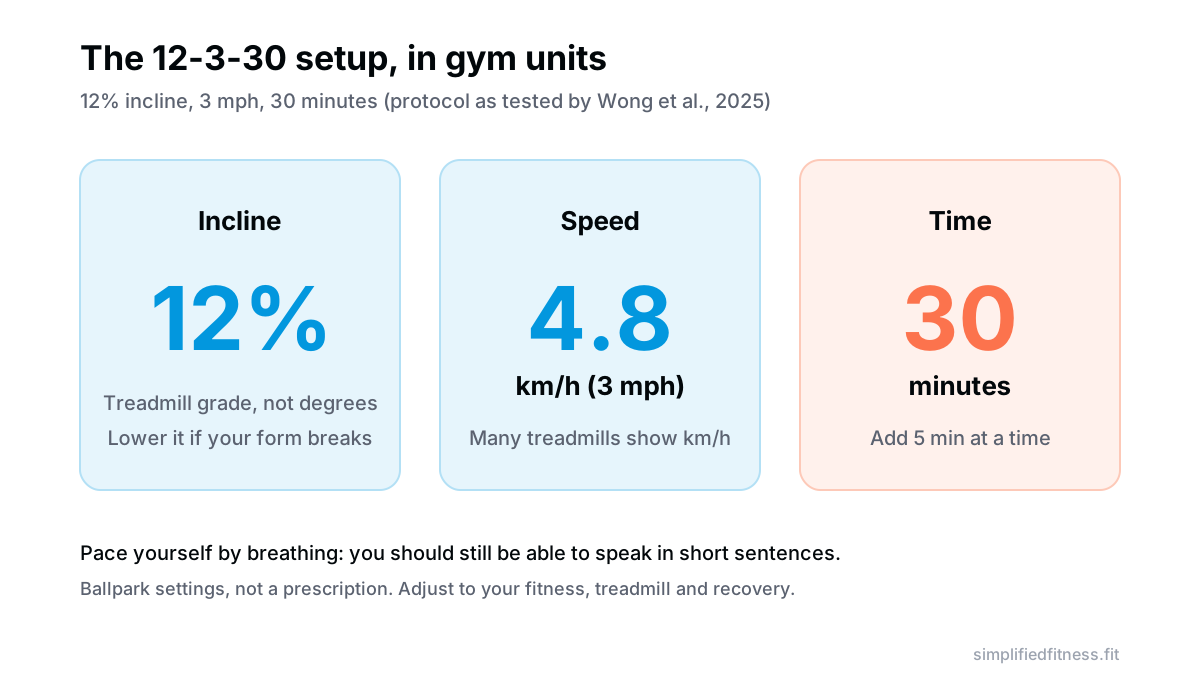
The 12-3-30 workout is exactly what it sounds like: a 12% incline, 3 mph and 30 minutes. In metric that is 4.8 km/h, which is a brisk walk on the flat. Most gym treadmills in India show km/h, so set 4.8 and 12.
A few honest notes on these numbers:
- They became popular through social media, not through a trial that picked them as optimal. The 2025 study that tested them describes a lack of peer-reviewed research on the claims (Wong et al., 2025).
- “Percent grade” is not the same as degrees. A 12% incline rises 12 cm for every 100 cm forward, roughly 7 degrees.
- Some treadmills top out below 12%, and some read the incline in levels. Check what your machine actually does before copying someone’s settings.
What does the research say about impact and leg muscles?
The best evidence we have is a handful of small, short lab studies. They are useful, but they are not training studies, so read them as mechanisms rather than proof of results.
In a 2025 study of 19 physically inactive adults, researchers matched 10 minutes of high-incline walking at a 20% grade to level jogging at the same energy cost. Jogging produced significantly higher peak accelerations at the foot and sacrum, and higher peak activation in the tibialis anterior (the shin muscle) and the vastus lateralis (a quad muscle). The authors call high-incline walking a lower-impact yet equally demanding alternative (Krieger et al., 2025).
A 2024 study of 22 adults compared 5-minute bouts of high-incline walking and low-incline jogging at a self-selected pace (not matched for energy cost) on two cushioned treadmills and also found notably lower foot and sacrum acceleration during incline walking (Kundu et al., 2024).
What about the calves and glutes? A 2016 gait-lab study of 18 healthy young men walking at 1.1 m/s on a ramp found that uphill walking increased the modelled forces in most lower limb muscles compared with level walking. Gluteus medius did not change significantly, and gluteus minimus, iliopsoas and tibialis anterior forces actually decreased. Across slopes, the quads and calves were among the main contributors to knee and ankle joint forces (Alexander et al., 2016).
Is incline walking “concentric only”?
You will often read that incline walking is “all concentric, no eccentric damage.” That is a useful rule of thumb with a caveat.
A classic treadmill study of 10 runners measured the energy cost of walking and running across slopes from steep downhill to steep uphill. It found that above roughly a 15% grade, the mechanical efficiency of walking and running approached that of concentric muscle contraction, while steep downhill matched eccentric contraction (Minetti et al., 2002).
In plain terms, on a steep treadmill incline your legs are doing mostly pushing work and very little braking work. Eccentric work, the lowering and braking phase, is what causes much of the muscle soreness after downhill running or heavy negatives. That is one reason a steady incline walk may leave your legs feeling less beat up than a run. I would still call this a reasonable inference, not a measured recovery result, because the study measured energy cost rather than soreness or lifting performance.
Does incline walking burn more fat?
This is where the claims get ahead of the data.
In the 2025 12-3-30 study, 16 people (7 women, 9 men) did 12-3-30 and a self-paced treadmill run matched for total energy expenditure. 12-3-30 took significantly longer, had a lower energy expenditure rate, a higher percentage of energy from fat, and a lower percentage from carbohydrate. The authors suggest it may suit people who want to increase fat utilization, while noting it is less time efficient (Wong et al., 2025).
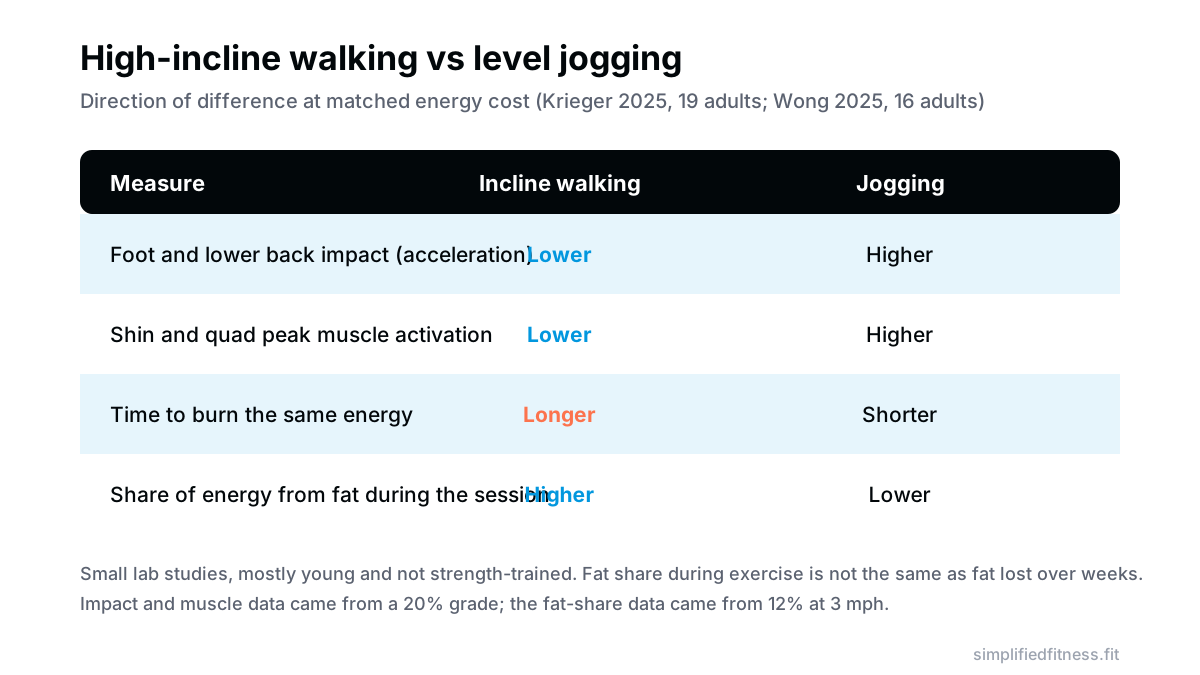
Here is the catch. The share of energy that comes from fat during a session is not the same as how much fat you lose over weeks. Fat loss follows your overall energy balance across days and weeks. If the cardio session is easy enough that you eat an extra snack afterwards, the fuel mix during the walk does not rescue the deficit. Think of the incline walk as a convenient way to add energy expenditure, not a fat-burning mode.
Will incline walking protect my leg muscle on a cut?
There is no study that tests this directly, so I will not claim it does. What we can say comes from the wider concurrent training research.
A 2012 meta-analysis of 21 studies found that lifting combined with running, but not cycling, was linked to significant decrements in hypertrophy and strength. It also found negative relationships between the frequency and duration of endurance training and gains in strength, power and hypertrophy, so interference depends on modality, frequency and duration (Wilson et al., 2012). Walking was not analysed as its own category.
A later meta-analysis of 25 studies found no significant difference in whole-muscle hypertrophy between lifting alone and lifting plus endurance training. Fibre-level growth was lower when HIIT was included, but not when only continuous endurance work was added (Monserdà-Vilaró et al., 2023).
Putting these together, a reasonable reading is that steady, low-impact cardio in modest amounts is the lower-risk option. The bigger threat to muscle on a cut is usually the diet. A 2022 meta-analysis found that energy deficits larger than roughly 500 kcal a day were linked to impaired lean mass gains from resistance training, with strength gains less affected (Murphy et al., 2022). A 500 kcal daily deficit works out to very roughly 0.5 kg of weight loss a week, so if you are losing much faster than that, easing the deficit probably helps your muscle more than choosing the right cardio. Our pieces on cardio during a cut and whether cardio can cause muscle loss go deeper on this.
How hard should it feel?
At 12-3-30 settings many people end up at a moderate effort, but it varies. A taller or fitter person will find 4.8 km/h at 12% easier than someone who is heavier or newer to cardio.
Do not rely on the settings alone. One 2024 study found that at the same speed and grade, treadmill design changed heart rate, perceived effort and muscle activation patterns (Kundu et al., 2024). So your gym’s treadmill may feel different from the one in a YouTube video.
Use two simple checks instead:
- Talk test: you can speak in short sentences but not sing.
- Heart rate: use our heart rate zone calculator to find a range, then see where you sit after 10 minutes. If you want the science behind easy aerobic work, read our Zone 2 cardio guide for lifters.
How do I progress it without hurting my lifting?
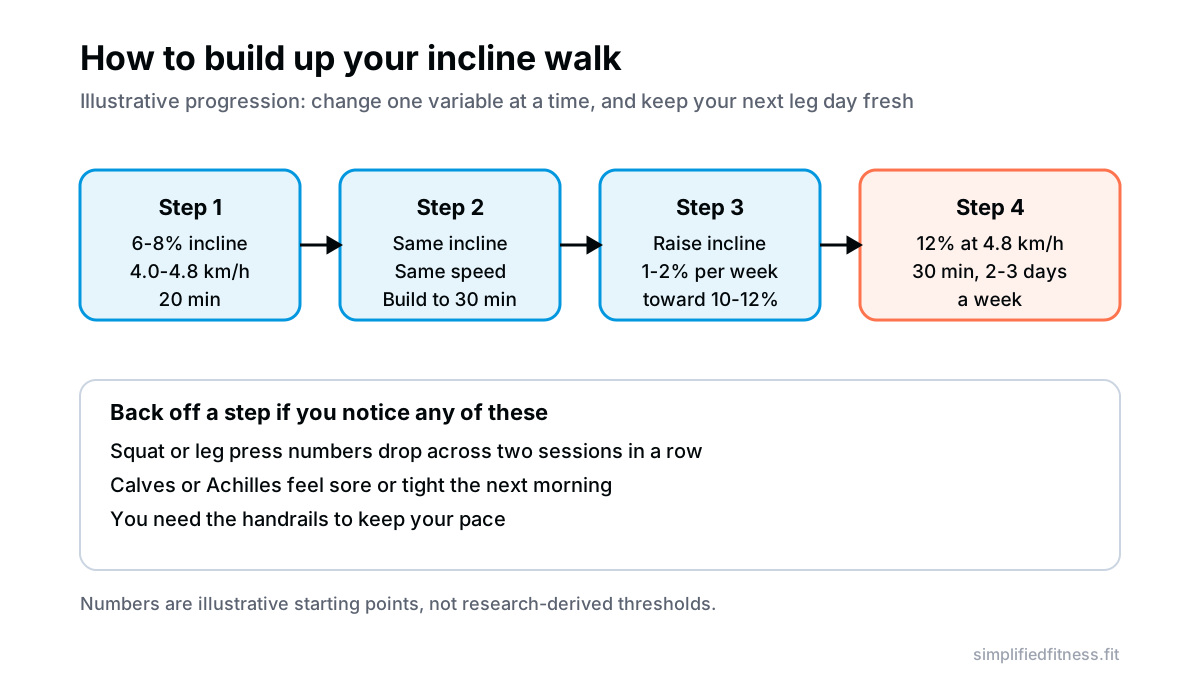
Change one thing at a time, and let your lifting tell you if you added too much. A simple path is below.
A practical way to place it in the week:
| Situation | Suggested placement | Why |
|---|---|---|
| Heavy leg day today | After lifting, 15-20 min, lower incline | Keeps your leg session fresh |
| Rest day | 25-30 min at your chosen setting | Easy to recover from |
| Upper body day | Before or after lifting | Little overlap with leg fatigue |
| Day before heavy squats or deadlifts | Short and easy, or skip | Avoid tired calves and glutes |
These are coaching rules of thumb, not trial-tested prescriptions. For the full question of sequencing, see our guide on timing cardio and weights.
Common mistakes with incline treadmill walking
- Going too steep too soon. A 15% incline at speed is a hill climb. Many people compensate by leaning forward and holding on, which defeats the point.
- Treating it as a licence to eat. A 30 minute walk often burns less than people assume. Use the calories burned calculator for a rough number before rewarding yourself.
- Doing it daily without checking recovery. More is not automatically better, and the interference research linked higher endurance frequency and duration with bigger decrements.
- Ignoring pain. Sore calves are normal early on. Sharp Achilles, knee or lower back pain is not. See a doctor or physiotherapist if it persists.
- Skipping the easy alternative. If you only have a flat treadmill or are short on time, brisk daily walking still helps. Our article on NEAT and 10,000 steps covers that approach.
Incline treadmill walking in an Indian gym
Some Indian commercial gyms have treadmills with a maximum incline of 10-12%, shared machines with time limits at peak hours, and non-AC floors in summer. Practical adjustments:
- If your treadmill caps at 10%, use 10% and walk a bit faster, or add time.
- In hot, humid gyms, expect your heart rate to run higher than it would indoors in cool air. Lower the incline, keep a water bottle at hand and stop if you feel dizzy.
- If you are cutting on a vegetarian budget, remember that cardio does not replace protein. A reasonable daily spread of dal, paneer, curd, soya chunks or eggs matters more for holding muscle than any treadmill setting. Our protein calculator can give you a target.
- For outdoor options, our comparison of Stairmaster vs outdoor incline walking covers hills and stairs.
When to see a doctor
Check with a doctor before starting if you have heart disease, high blood pressure that is not controlled, diabetes with complications, or chest pain or dizziness with exertion. Stop and get medical advice if you get chest pain, unusual breathlessness, fainting or persistent joint pain. If you have a history of Achilles, knee or lower back problems, begin with a lower incline and consider a physiotherapist’s input.
The bottom line
Incline treadmill walking is a sensible, low-impact way for lifters to add conditioning. The evidence is mostly small lab studies in young adults: lower impact than jogging at the same energy cost, a different fuel mix during the session, and a heavier load on calves and glutes than flat walking. There is no direct proof that it protects leg size, and the calorie deficit and weekly cardio volume matter more than the exact incline.
Start with 2-3 sessions of 20-30 minutes, build up gradually, keep it away from your heaviest leg sessions, and let your lifting numbers tell you whether the dose is right. If you want a plan to pair it with, our leg day plan is a good place to start.
Frequently Asked Questions
Is incline treadmill walking good for lifters?
Yes, for most healthy lifters it is a sensible choice. In a 2025 lab study, high-incline walking produced lower foot and sacrum impact than jogging at a matched energy cost, so it is likely easier on joints. Start with 2-3 sessions a week and watch how your leg training responds.
What is the 12-3-30 workout?
It is a treadmill routine of walking at a 12% incline, 3 mph (4.8 km/h), for 30 minutes. It went viral on social media, and a 2025 lab study in 16 people was one of the first to measure it properly. Treat it as a starting template and scale the incline or speed to your fitness.
Does incline walking burn fat?
It burns calories, and calories in a deficit are what cause fat loss. A 2025 study found that at matched energy expenditure, 12-3-30 used a higher share of fat than self-paced running, but that is the fuel mix during the session, not proof of more fat lost over time. Pair it with a modest calorie deficit and track your waist and weight weekly.
Does incline walking build or preserve leg muscle?
There is no good trial showing incline walking builds or specifically preserves leg muscle. Lifting heavy and eating enough protein do that job. Incline walking helps indirectly because it costs less recovery than running, so you can add cardio without wrecking your next squat session.
Is incline walking better than running for muscle gain?
It may be easier to fit around lifting, but direct comparisons are lacking. A meta-analysis found running, not cycling, was linked to bigger decrements in hypertrophy and strength when combined with lifting, and walking was not tested separately. If you want to protect leg growth, cycling or low-impact walking is a reasonable default, though walking has not been tested head to head.
How often should I do incline treadmill walking?
Two to three sessions a week of 20-30 minutes is a sensible starting range for most lifters. The same meta-analysis found that higher endurance frequency and duration were linked to larger interference with strength and hypertrophy. Add sessions only if your lifts and recovery stay stable.
What incline and speed should a beginner use?
Start at a 5-8% incline and 4.0-4.8 km/h for 15-20 minutes. Raise the incline by 1-2% each week before you add speed or time. The right setting is the one where you can keep upright posture without gripping the rails.
Should I hold the handrails on an incline treadmill?
Try not to lean on them. Holding on usually reduces how hard your legs and glutes work and can change your posture, which may lower the benefit. If you need the rails to keep pace, lower the incline or speed instead.
Is incline walking Zone 2 cardio?
It can be, but not automatically. Heart rate at the same treadmill settings differs a lot between people, and a 2024 study found the same incline and speed gave different heart rate and effort ratings on different treadmill decks. Use the talk test or a heart rate zone calculator rather than assuming 3 mph at 12% is Zone 2 for you.
Can I do incline walking on leg day?
You can, but do it after lifting, or on a separate day if your legs recover slowly. Hard cardio before squats can cost you reps through fatigue, and a long incline walk loads the calves and glutes. Keep it at 20-30 minutes and see how your next session feels.
Is incline walking safe for knees and joints?
It is lower impact than jogging, but it is not zero load. A lab model found muscle forces around the knee and ankle rise as the slope increases, so a very steep incline is a real workload for the calves and quads. If you have knee, Achilles or back pain, start low and speak to a doctor or physiotherapist if pain persists.
How many calories does the 12-3-30 workout burn?
It depends heavily on your body weight, and the studies here do not give a reliable single number for lifters. Heavier people burn more at the same settings. Use our calories burned calculator for a rough estimate and treat it as a guide, not a precise figure.
Is incline treadmill walking good for people in hot climates?
It works well indoors in an air-conditioned gym, but a non-AC gym in Indian summer can make the same session feel much harder. Heat raises heart rate and perceived effort at a given pace. Lower the incline or speed, drink water, and stop if you feel dizzy or unwell.
Sources & References
Every claim above is checked against peer-reviewed research (PubMed, U.S. National Library of Medicine) or guidance from established health bodies. How we fact-check.
- Wong MWH, et al. An exploratory study comparing the metabolic responses between the 12-3-30 treadmill workout and self-paced treadmill running. Int J Exerc Sci. 2025. PMID: 39917588
- Krieger T, et al. Accelerations and EMG differences between isocaloric high-incline walking and level-grade jogging. Int J Exerc Sci. 2025. PMID: 41079262
- Kundu R, et al. The interaction of treadmill type and incline slope on biomechanics and muscle activation during human locomotion. Int J Exerc Sci. 2024. PMID: 39807292
- Alexander N, et al. Effect of sloped walking on lower limb muscle forces. Gait Posture. 2016. PMID: 27264405
- Minetti AE, et al. Energy cost of walking and running at extreme uphill and downhill slopes. J Appl Physiol. 2002. PMID: 12183501
- Wilson JM, et al. Concurrent training: a meta-analysis examining interference of aerobic and resistance exercises. J Strength Cond Res. 2012. PMID: 22002517
- Monserda-Vilaro A, et al. Effects of concurrent resistance and endurance training using continuous or intermittent protocols on muscle hypertrophy: systematic review with meta-analysis. J Strength Cond Res. 2023. PMID: 36508686
- Murphy C, et al. Energy deficiency impairs resistance training gains in lean mass but not strength: a meta-analysis and meta-regression. Scand J Med Sci Sports. 2022. PMID: 34623696

Umair Hazrami · Founder & Head Coach, Simplified Fitness
Umair Hazrami founded Simplified Fitness and the Simplified Lifter channel to cut through fitness noise. With 4+ years of consistent training and 10+ coaching clients, he writes every guide from the peer-reviewed research and links the sources so you can check them. Our editorial standards.
Educational content only, not medical advice. If you have a medical condition, are pregnant, or take medication, talk to a qualified doctor before changing your diet, supplements or training. Full disclaimer.
Keep reading
Strength & Cardio
Aerobic Conditioning and Hypertrophy: How Work Capacity Improves Inter-Set Recovery
Does better cardio help you recover between sets? See what work capacity resistance training research says, where theory outruns data, and what to do.
9 min read
Strength & Cardio
Can Cardio Cause Muscle Loss? The Calorie and Volume Thresholds Behind the Fear
Does cardio cause muscle loss? Not at normal doses. See what the meta-analyses say about deficits, protein and running volume, and how to protect your muscle.
9 min read
Strength & Cardio
Cardio During a Cut: How Much You Need and When to Stop Adding
How much cardio during cutting phase? Learn the food-first rule, a walking base, sample weekly schedules and signs you are doing too much. Every study linked.
7 min read
Strength & Cardio
Cycling vs Running for Lifters: Which Protects Muscle and Squat Strength?
Cycling vs running for lifters: Wilson's meta-analysis found running, not cycling, blunted gains. We compare it with newer reviews and give a bike plan.
8 min read