NEAT and Fat Loss: Why 10,000 Steps Often Beats Intense Cardio
NEAT fat loss with 10000 steps a day: why walking can beat hard cardio on a cut, what the compensation studies show, and how to raise your steps.
TL;DR. The short answer
- NEAT is all the energy you burn that is not sleeping, eating or deliberate exercise: walking, fidgeting, chores, standing. It varies a lot between people and shifts with how much you eat.
- 10,000 steps is not magic, but a rough estimate of 300-500 kcal a day for many adults is a reasonable planning number. Your body weight, pace and stride change it.
- Hard cardio does not burn less than steps, but some people unconsciously move less or eat more afterwards. Studies show this compensation is real but varies widely, and the evidence is not strong enough to say walking always wins.
- Steps are easy to recover from, so they stack on top of lifting without much interference. That is the practical reason coaches use them first on a cut.
- Raise steps from your own baseline by 1,500-2,000, hold it for two weeks, and judge by your weight trend. Joint pain, chest symptoms or dizziness on walking are reasons to see a doctor.
Part of our complete guide: Cardio and Concurrent Training: Build Endurance Without Losing Muscle (The Interference Effect)
Table of contents
Your coach tells you to walk 10,000 steps instead of grinding out treadmill sprints, and it sounds like a downgrade. Usually it is not. For most lifters in a calorie deficit, NEAT fat loss with 10000 steps a day works because walking is easy to repeat daily, adds meaningful energy expenditure, and rarely costs you recovery. Harder cardio can burn more per minute, but it does not always translate into a bigger deficit by the end of the day.
This article is part of our cardio and concurrent training guide. Here we stay on one question: what does the research actually say about steps versus intense cardio on a cut, and where is the evidence weaker than gym talk suggests?
What is NEAT, and why does it matter on a cut?
NEAT is non-exercise activity thermogenesis. Levine defines it as the energy spent on everything that is not sleeping, eating or sports-like exercise: walking to work, chores, typing, fidgeting, standing (Levine, 2002). Because it is spread across all your waking hours, it can add up to a big share of your non-resting energy needs.
The striking part is how much it varies. In a classic overfeeding study, 16 non-obese volunteers ate 1,000 kcal a day above maintenance for 8 weeks. Two-thirds of the rise in daily energy expenditure came from NEAT, and changes in NEAT accounted for a 10-fold difference in fat storage between people (Levine et al., 1999). Some people unconsciously fidget and move more when they overeat. Others do not, and store fat more readily.
That was overfeeding, not dieting, and the sample was small. But the same logic works in reverse, and that is where cutting gets interesting. For the full energy-balance picture, see our breakdown of TDEE, BMR, TEF and NEAT.
How many calories does 10,000 steps actually burn?
The number you will see online is 400-500 kcal. Treat that as a rough guess, not a promise. Energy cost per step depends on your body weight, walking speed, stride length and terrain, so a 60 kg person strolling and a 95 kg person walking briskly can differ a lot.
A reasonable planning range for many adults is 300-500 kcal for 10,000 steps. If you want a personal figure, use our calories burned calculator and remember it is still an estimate.
Also, most of this is not extra energy you would not have burned anyway. You already move some during the day. What matters is the gap between your current step count and your new one. Going from 4,000 to 10,000 adds 6,000 steps, not 10,000.
Does walking 10,000 steps a day lead to fat loss?
Moderately, and mostly when combined with sensible food intake. A meta-analysis of 9 pedometer-based walking studies without a dietary intervention (307 participants, median 16 weeks) found an average weight loss of 1.27 kg, about 0.05 kg per week, with longer programs losing more (Richardson et al., 2008). That is modest, and it is exactly why steps are a support tool and not a replacement for a calorie deficit.
There is also a 2026 meta-analysis of 18 randomized trials of lifestyle weight-loss programs. The intervention groups raised steps from about 7,486 to 8,454 a day and lost about 4.4% of body weight over a mean of 7.9 months, and meta-regression linked higher step counts with keeping weight off. The authors suggest around 8,500 steps a day, and call the findings preliminary (Saadeddine et al., 2026). Notice that these programs also changed diet, so steps cannot take all the credit.
So 10,000 is a convenient target, not a threshold. If you currently average 5,000, getting to 7,500 consistently beats an all-or-nothing plan you quit in week three.
Does the cardio machine number overstate your deficit?
Often, yes. Intense cardio can feel like the efficient option because the machine shows a big calorie number. But what matters is total daily energy balance, and the body has ways to push back.
In a randomized trial, 36 sedentary adults with overweight or obesity were assigned to burn either 300 or 600 kcal per session, 5 days a week for 12 weeks (29 completed). Compared with what the exercise should have produced, they “compensated” for about 62.9% of the exercise energy in the lower group and 33.6% in the higher group, meaning body fat fell less than the arithmetic predicted. Resting metabolic rate and measured energy intake did not change, while acylated ghrelin rose and food reinforcement and GLP-1 fell. In absolute terms both groups compensated by roughly the same amount, about 950-1,000 kcal a week, so only the 3,000 kcal-a-week group lost body fat (Flack et al., 2018).
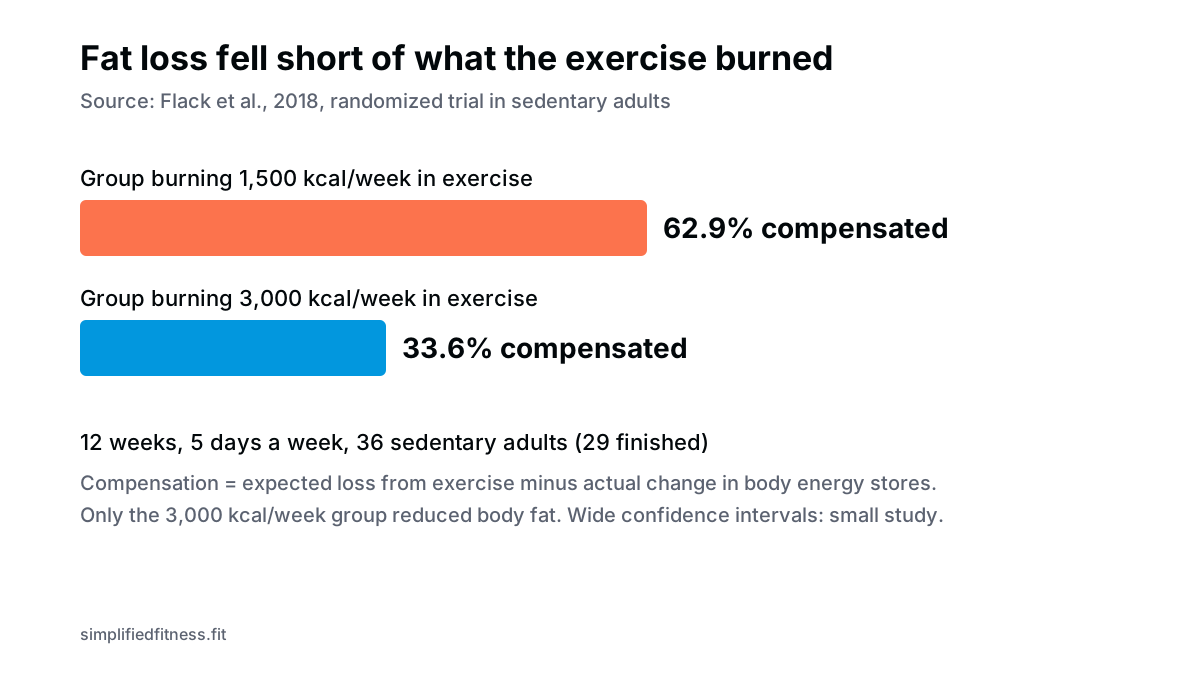
Note the limits. This was one small trial in sedentary adults, not trained lifters, and the confidence intervals were wide. It does not say where the compensation came from, and it did not compare walking with intense cardio. If anything, it shows that a bigger exercise dose can outrun compensation. So the case for steps is not that walking escapes compensation. It is that steps let you add a lot of weekly activity without paying for it in recovery.
Do people really move less after hard cardio?
The evidence is split, and it is worth being fair to both sides.
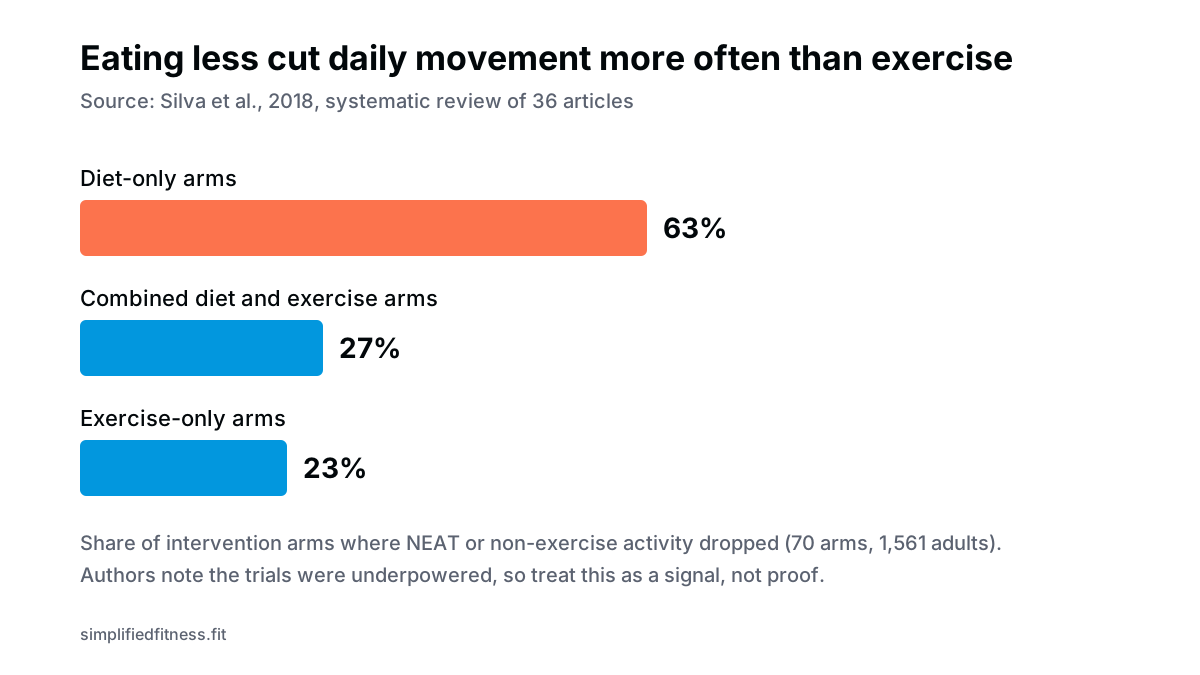
A systematic review of 36 articles (1,561 adults, 70 intervention arms) found compensation, meaning drops in NEAT or non-exercise physical activity, in 26 of 70 arms. That was 63% of diet-only arms, 27% of combined diet-and-exercise arms and 23% of exercise-only arms. Weight loss in people whose NEAT dropped was double that of people whose NEAT held, which suggests the body saves energy when the deficit is bigger. The authors still concluded the findings did not support the hypothesis that prescribed diet or exercise reduces NEAT in healthy adults, and warned that many trials were underpowered (Silva et al., 2018).
A separate review of 31 articles found that in all 7 randomized trials, prescribed exercise did not reduce non-exercise physical activity or energy expenditure in healthy adults. Again the authors flagged a lack of well-powered trials using doubly labelled water and indirect calorimetry (Washburn et al., 2014).
Why might these differ? Short studies, different populations, different measures of activity and different exercise doses. The honest takeaway is that compensation is not universal, but it happens to enough people that you should check it for yourself. Wear a step counter on cardio days and rest days for two weeks. If your steps fall by 3,000 on days you do hard cardio, that is a sign you are compensating.
The more interesting finding here is the diet arm. Eating less is where daily movement most often shrinks, which brings us to cutting.
What happens to daily movement when you diet?
Energy restriction comes with hormonal and metabolic changes that try to limit the deficit, including changes in energy expenditure, and athletes cutting for a show are not exempt (Trexler et al., 2014). One practical symptom is the “I do not feel like moving” slump that many dieters notice as a cut drags on.
In coaching terms, the most common mistake here is treating steps as optional. You are tired, hungry, and the programmed cardio is already done, so you sit. Setting a daily step floor, not a daily cardio session, protects the part of your energy output that tends to quietly erode. If your weight stalls despite good food tracking, check your steps before you slash calories. Our guide to breaking fat-loss plateaus goes deeper on that.
Steps versus intense cardio: the practical comparison
| Factor | Daily steps | Intense cardio (HIIT, hard runs) |
|---|---|---|
| Calories per minute | Lower | Higher |
| Recovery cost | Very low for most people | Can be significant |
| Joint impact | Low | Higher, especially running |
| Interference with leg training | Little expected | More likely if volume is high |
| Appetite and fatigue | Usually mild | Varies by person |
| Time needed | Spread through the day | Concentrated, 20-40 min |
| Cardiovascular fitness benefit | Modest | Larger |
The honest read: intense cardio wins on time efficiency and fitness, steps win on recovery and repeatability. Direct trials comparing the two for fat loss in trained lifters are limited, so this table reflects physiology and coaching practice more than a single proof. We compare conditioning styles in more depth in our LISS vs HIIT breakdown.
How do I raise my steps without wrecking my training?
Use a baseline-first method.
- Log your steps for 7 days without changing anything. Average them.
- Add 1,500-2,000 steps to that average and hold it for two weeks.
- Check your weekly weight trend, not a single morning reading.
- If the trend is still falling, keep going. If it stalls for 2-3 weeks, check your food honestly first, then add another 1,000 steps.
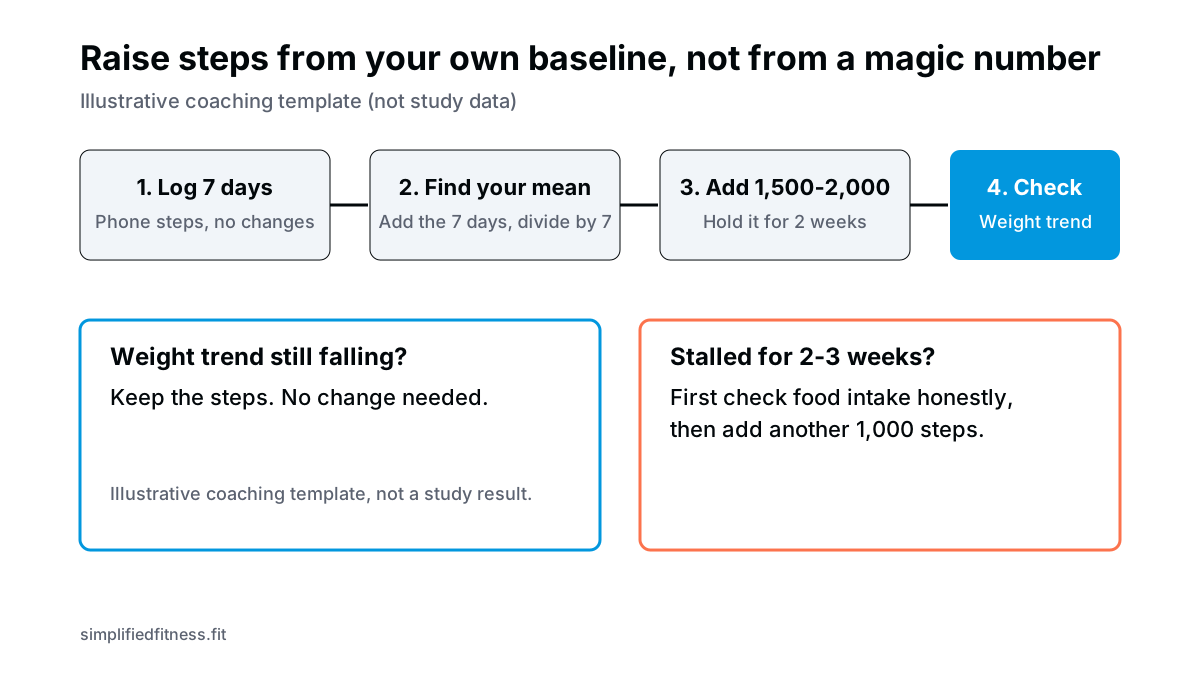
This is a coaching template, not a research-proven protocol. The numbers are a sensible starting range, and you adjust to your body.
Easy ways to find the extra steps
- Walk 10 minutes after each main meal. This also fits well with dal-chawal lunches that leave you sleepy.
- Take calls on foot, and use stairs at home or work.
- In summer heat, walk before 8 am or after sunset, or use a covered space or treadmill in the afternoon.
- Park or get off the bus a stop early.
- If you want a harder option with the same low impact, see incline treadmill walking.
Should I still do any hard cardio?
Probably some, depending on your goals. Steps do not replace the cardiovascular stimulus of harder work, and the fitness and health benefits of intense sessions are real. Our guide to cardio during a cutting phase covers how to add it without wrecking recovery.
A sensible layout for many lifters: a step floor every day, lifting 3-5 days a week, and one or two harder cardio sessions only if you enjoy them and recover well. Set your calorie target first with the calorie calculator, because steps are a small adjustment and not a fix for a food plan that does not match your goal.
When to see a doctor
Steps are low-risk for most people, but not for everyone. See a doctor before raising activity if you have known heart disease, chest pain, unexplained breathlessness, dizziness or fainting, uncontrolled diabetes, or joint problems that walking makes worse. Stop and seek medical care if you get chest discomfort, severe shortness of breath or fainting while walking. Persistent foot or shin pain that does not settle in a few days is also worth getting looked at.
What to remember
- NEAT is the energy you burn outside the gym, and it differs a lot between people.
- 10,000 steps is a rough guide for roughly 300-500 kcal, depending on body size and pace.
- Compensation after exercise and during dieting is real in some people, but studies disagree about how common it is.
- Steps are cheap on recovery, which is why they pair well with lifting.
- Start from your own baseline, add 1,500-2,000 steps, and let the weight trend guide you.
- For a full meal plan to pair with your steps, try our diet plan.
Frequently Asked Questions
Is 10,000 steps a day good for fat loss?
It can help, mainly because it raises daily energy expenditure without hard training stress. A meta-analysis of pedometer walking programs without diet changes found a modest average loss of 1.27 kg, so steps work best alongside food control. Start from your current average and add steps gradually instead of jumping straight to 10,000.
How many calories does 10,000 steps burn?
A rough planning range for many adults is 300-500 kcal, but it depends heavily on body weight, walking speed and terrain. Heavier people and faster walkers burn more per step. Use our calories burned calculator for a personal estimate and treat the result as approximate.
What is NEAT in simple words?
NEAT stands for non-exercise activity thermogenesis, the energy used for everything that is not sleeping, eating or sports-like exercise. It includes walking to work, chores, fidgeting and standing, and Levine describes it as the main part of non-resting energy needs. Tracking your steps is the easiest practical way to see your own NEAT.
Is walking better than running for fat loss?
Not in a strict calorie sense, since running burns more per minute. Walking can still be easier to sustain, easier to recover from and less likely to leave you sitting for the rest of the day. For a lifter in a deficit, that sustainability often decides which one actually gets done.
Does intense cardio make you move less the rest of the day?
Some people do compensate, but the research is mixed. A systematic review of 36 articles found NEAT or non-exercise activity dropped in 23% of exercise-only arms and 63% of diet-only arms, while a separate review of randomized trials found no reductions. Track your steps on cardio days so you can see whether you personally slump.
Does eating less lower your daily movement?
It can. The same systematic review found compensation in 63% of diet-only intervention arms, and the authors suggest bigger energy deficits may trigger energy conservation. If your steps keep drifting down on a cut, set a daily minimum and check it weekly.
Can I just walk and skip cardio entirely?
Yes, for fat loss that is a legitimate choice if you lift and manage food. Cardiovascular fitness is a separate goal that steady walking only partly covers. If heart health matters to you, see our guide to the minimum effective dose of cardio and add one or two harder sessions.
Do steps interfere with muscle gain like cardio does?
Walking is low in muscle damage and joint impact, so it is much less likely to cut into recovery than hard running or intervals. The classic interference effect is mostly discussed for high-volume, high-intensity endurance work. If your legs feel heavy before squats, cut intervals first and keep the walking.
How fast should I increase my daily steps?
Add about 1,500-2,000 steps to your weekly average and hold it for two weeks before changing anything else. That gives your weight trend time to show a signal, and it limits sore feet and shin discomfort. Treat this as a practical coaching rule rather than a research-proven dose.
What if I only get 4,000 steps because of a desk job?
You are common, and a desk job is the main reason your NEAT is low. Break the day into short walks, for example 10 minutes after each meal, a call on foot and the stairs instead of the lift. Aim to add a few thousand steps from where you are, not to hit a round number.
Is the 10,000 steps number backed by research?
It is a convenient target, not a proven threshold. A 2026 meta-analysis of lifestyle programs for obesity suggested around 8,500 steps a day was associated with keeping weight off, although the authors called their results preliminary. Pick a target you can repeat in an ordinary week.
How do I walk more in hot Indian summers?
Shift walks to early morning or after sunset, and use a mall, a covered corridor or a treadmill on the hottest afternoons. Heat adds strain, so drink water and slow down if you feel dizzy. Short 10-minute walks after meals are easier to fit into any climate.
When should I see a doctor before raising my steps?
Speak to a doctor first if you have heart disease, chest pain, breathlessness, dizziness, diabetes complications or joint problems. These can change what a safe activity level looks like. Stop and get checked if walking brings on chest discomfort or fainting.
Sources & References
Every claim above is checked against peer-reviewed research (PubMed, U.S. National Library of Medicine) or guidance from established health bodies. How we fact-check.
- Levine JA, et al. Role of nonexercise activity thermogenesis in resistance to fat gain in humans. Science. 1999. PMID: 9880251
- Levine JA. Non-exercise activity thermogenesis (NEAT). Best Pract Res Clin Endocrinol Metab. 2002. PMID: 12468415
- Silva AM, et al. What is the effect of diet and/or exercise interventions on behavioural compensation in non-exercise physical activity and related energy expenditure of free-living adults? A systematic review. Br J Nutr. 2018. PMID: 29845903
- Washburn RA, et al. Does increased prescribed exercise alter non-exercise physical activity/energy expenditure in healthy adults? A systematic review. Clin Obes. 2014. PMID: 25425128
- Flack KD, et al. Energy compensation in response to aerobic exercise training in overweight adults. Am J Physiol Regul Integr Comp Physiol. 2018. PMID: 29897822
- Richardson CR, et al. A meta-analysis of pedometer-based walking interventions and weight loss. Ann Fam Med. 2008. PMID: 18195317
- Saadeddine D, et al. Daily steps during nutritional lifestyle modification programs for obesity management: a systematic review and meta-analysis. Int J Environ Res Public Health. 2026. PMID: 42074460
- Trexler ET, et al. Metabolic adaptation to weight loss: implications for the athlete. J Int Soc Sports Nutr. 2014. PMID: 24571926

Umair Hazrami · Founder & Head Coach, Simplified Fitness
Umair Hazrami founded Simplified Fitness and the Simplified Lifter channel to cut through fitness noise. With 4+ years of consistent training and 10+ coaching clients, he writes every guide from the peer-reviewed research and links the sources so you can check them. Our editorial standards.
Educational content only, not medical advice. If you have a medical condition, are pregnant, or take medication, talk to a qualified doctor before changing your diet, supplements or training. Full disclaimer.
Keep reading

Strength & Cardio
Aerobic Conditioning and Hypertrophy: How Work Capacity Improves Inter-Set Recovery
Does better cardio help you recover between sets? See what work capacity resistance training research says, where theory outruns data, and what to do.
9 min read

Strength & Cardio
Can Cardio Cause Muscle Loss? The Calorie and Volume Thresholds Behind the Fear
Does cardio cause muscle loss? Not at normal doses. See what the meta-analyses say about deficits, protein and running volume, and how to protect your muscle.
9 min read

Strength & Cardio
Cardio During a Cut: How Much You Need and When to Stop Adding
How much cardio during cutting phase? Learn the food-first rule, a walking base, sample weekly schedules and signs you are doing too much. Every study linked.
7 min read
Strength & Cardio
Cycling vs Running for Lifters: Which Protects Muscle and Squat Strength?
Cycling vs running for lifters: Wilson's meta-analysis found running, not cycling, blunted gains. We compare it with newer reviews and give a bike plan.
8 min read