Sled Pushes, Rowing, and Air Bikes: Low-Soreness Conditioning for Lifters
Sled pushes for conditioning, plus rowers and air bikes, build brutal work capacity with little soreness. See the research, loads and sample finishers.
TL;DR. The short answer
- Sled pushes, air bikes and rowing machines are low-eccentric conditioning tools. They load the muscles mostly while shortening, so they tend to cause far less next-day soreness than running, jumping or hill descents, though none are strictly zero-eccentric.
- The soreness-causing trigger is largely unfamiliar eccentric work, not eccentric work itself. That is why these tools are handy but not magic: a new lifter on a first heavy sled day can still feel it.
- Concurrent training research on cycling versus running is mixed, but it agrees more on dose: keeping cardio moderate in volume and on separate days from lifting looks like the safer bet.
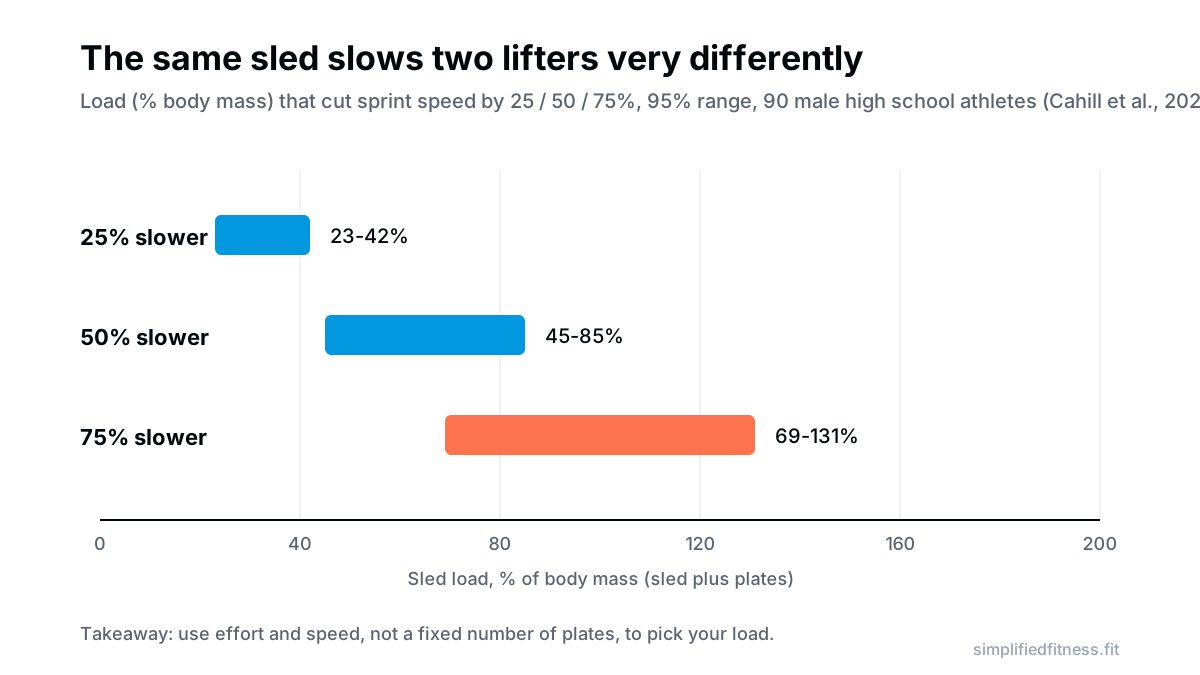
- Pick sled load by speed, not by plate count. In young athletes, the load that slows sprint speed by 50% ranged from about 45 to 85% of body mass between individuals.
- Place hard intervals on non-leg days or at least a day away from heavy squats, and use easier air bike or rower work the day after leg day.
Part of our complete guide: Cardio and Concurrent Training: Build Endurance Without Losing Muscle (The Interference Effect)
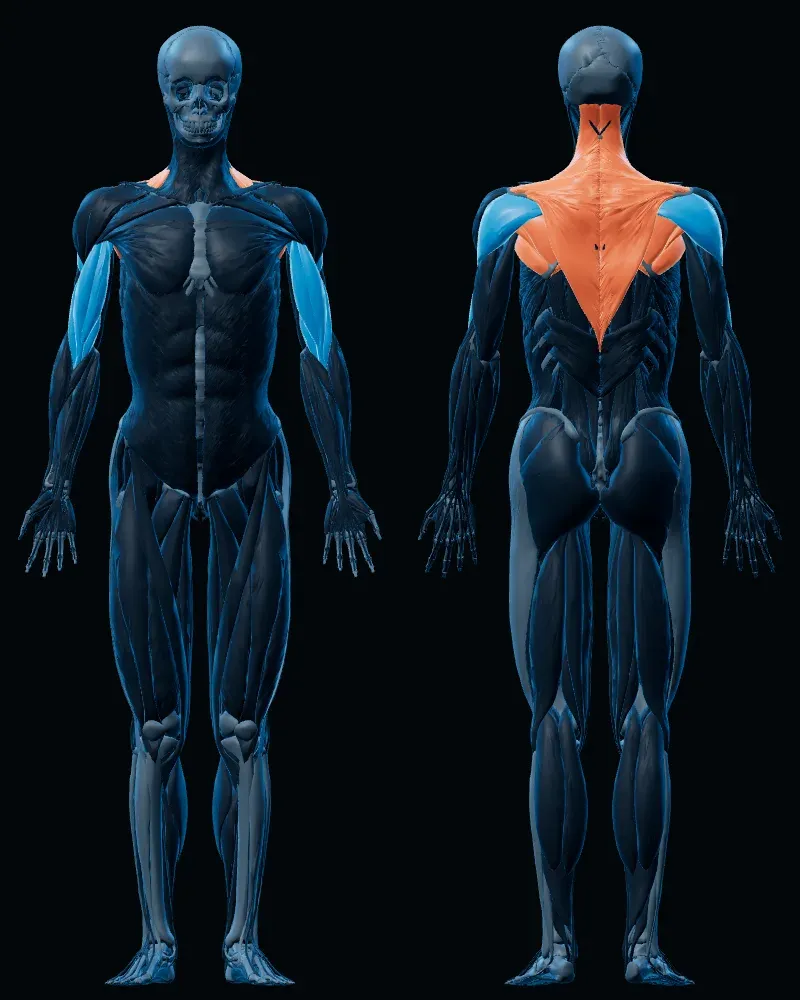
Muscles worked: upper back
Main movers: traps, rhomboids, teres major, infraspinatus and teres minor
Assisting: rear delts, biceps and brachialis
Table of contents
Sled pushes for conditioning, along with rowers and air bikes, give you a very hard workout with far less muscle soreness than running, jumping or hill work. They are not literally zero-eccentric, but the muscle mostly works as it shortens, which is the part that tends to leave you walking down stairs sideways. That makes them useful for lifters who want conditioning without wrecking the next leg session. This article sits inside our cardio and concurrent training guide.
Why do some conditioning tools leave you less sore?
Soreness after training mostly comes from eccentric contractions, where a muscle is lengthening under load. Think of lowering into a squat, a downhill run, or landing from a jump.
A 2022 trial compared eccentric-only knee extensions with a version that added concentric reps in between. Twenty people took part, and the extra concentric work did not make fatigue or damage worse, even though the second group did twice as many contractions. The authors concluded that the eccentric contractions seemed to drive the response (Ruas et al., 2022).
So the idea behind low-eccentric conditioning is sound. You can work hard on a sled, rower or air bike and accumulate lots of reps without the lengthening phase doing the damage.
Practically, that means two things. These tools let you skip a lot of the “new soreness” tax. And if you are not used to any hard conditioning, even they can make you feel it for a day or two.
What counts as non-eccentric cardio?
Here is how the main options compare. This ranking is a coaching judgement based on how the movements work, not measured data.
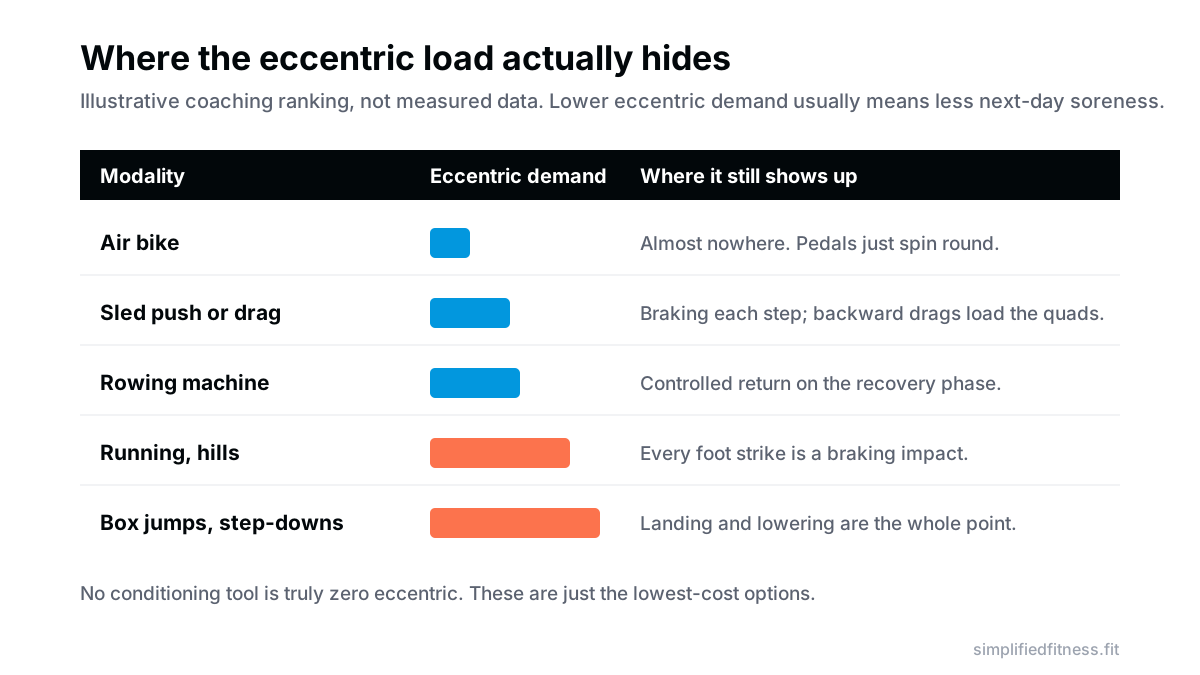
A few honest notes. A sled push involves braking at each footfall, and a backward sled drag puts the quads under a lot of tension. Rowing has a controlled return on every stroke. The air bike is the closest thing to a clean option because the pedals just turn.
If you came here from our comparison of LISS and HIIT for keeping muscle, this is the equipment layer on top of that decision.
Sled pushes for conditioning: what the research shows
Most sled research is about sprint performance in athletes, not hypertrophy or conditioning in gym lifters. I will say that up front so you can weigh what follows.
Muscle activation. Ten resistance-trained men did a 20-step maximal push with a weighted sled and a 10-rep max back squat. Quadriceps, hamstring and deep abdominal activity were similar. The sled produced about 61% greater calf (gastrocnemius) activity, and the squat produced about 75% greater lower back (erector spinae) activity (Maddigan et al., 2014). Small sample, a single session, so it describes activation, not growth.
Training effect. In an 8-week trial, 50 high school athletes trained with sled pushes at light, moderate or heavy loads, or sprinted without a sled. All resisted groups improved 5-20 m split times, the unresisted group did not, and the heavy load gave the biggest gains over short distances (Cahill et al., 2020). These were teenage athletes training for sprint speed, so it does not tell you what happens to a 35-year-old lifter’s quads.
So where does that leave us on “sled push for hypertrophy”? Honestly, undetermined. The sled is a legitimate leg-loading and conditioning tool. It is not proven to replace a hack squat or leg press for muscle growth.
How heavy should you push?
The common mistake here is chasing a number of plates someone else used on social media.
A study of 90 male high school athletes found the load that cut maximal sprint velocity by 25%, 50% and 75% varied a lot between people. The 95% ranges were 23-42%, 45-85% and 69-131% of body mass respectively (Cahill et al., 2021). Same speed drop, very different weights.
Your gym surface matters too. Rubber turf and polished concrete need very different weights for the same effort. Use the load that keeps you moving at a hard but steady pace.
A quick guide:
- Light and fast: a pace you could nearly jog. Good for repeated 20-30 m pushes.
- Moderate: you lean in and drive, but the legs still turn over.
- Heavy: short 10-15 m pushes, long rests, a slog pace. This is strength work as much as cardio.
Air bikes and rowers: the quiet workhorses
Neither of these has much research aimed at lifters specifically, so here is the reasoning rather than a claim from a trial. An air bike gives you resistance that rises with effort, so you can go from easy to all-out without changing a setting. A rower does the same with legs, trunk and back in one stroke.
What we do have evidence on is the modality question. In a meta-analysis of 21 studies, concurrent training that combined strength work with running, but not cycling, was associated with significant decrements in hypertrophy and strength. The same review linked higher frequency and longer duration of endurance work with larger interference (Wilson et al., 2012). That is correlational data across varied studies, so treat it as a lean, not a law.
A second meta-analysis of HIIT with resistance training found similar changes in hypertrophy and upper-body strength compared to lifting alone. Lower-body strength rose less with HIIT added (effect size -0.248), with a non-significant trend toward a bigger negative effect for cycling than running (Sabag et al., 2018). So the evidence is mixed on cycling and leg strength. The two reviews likely disagree partly because they pooled different studies, protocols and rest gaps between sessions, and the authors suggest longer rest between modes helps.
A small trial in 23 resistance-trained men tested about one hour a week of cardio on non-lifting days. High-intensity cycling, moderate cycling and lifting alone gave comparable squat strength and quadriceps growth (Dolan et al., 2024). That is only 23 people, five or six per group, with some authors working in the fitness industry, but it fits the practical advice: keep volume modest and give lifting its own day.
Want to see how hard you are working? Use the heart rate zone calculator to find your zones, and our cycling vs running comparison for the bigger picture.
How to protect your next squat session
The reason many lifters reach for this equipment is to keep legs fresh. A few practical rules.
- Space the hard stuff. Put your hardest sled or bike intervals on upper body days, or at least a day away from heavy squats. Our guide on timing cardio and weights covers the order question.
- Go easy the day after leg day. An easy air bike or rower session can help you feel looser, but I would not claim it speeds recovery, because that is not something these studies tested.
- Keep the heavy sled away from the day before squats. Fatigue is fatigue, even without soreness.
- Eat enough. Conditioning on top of lifting raises energy needs. Check your numbers with the calorie calculator.
- Start small. Even low-eccentric work can produce soreness when it is new.
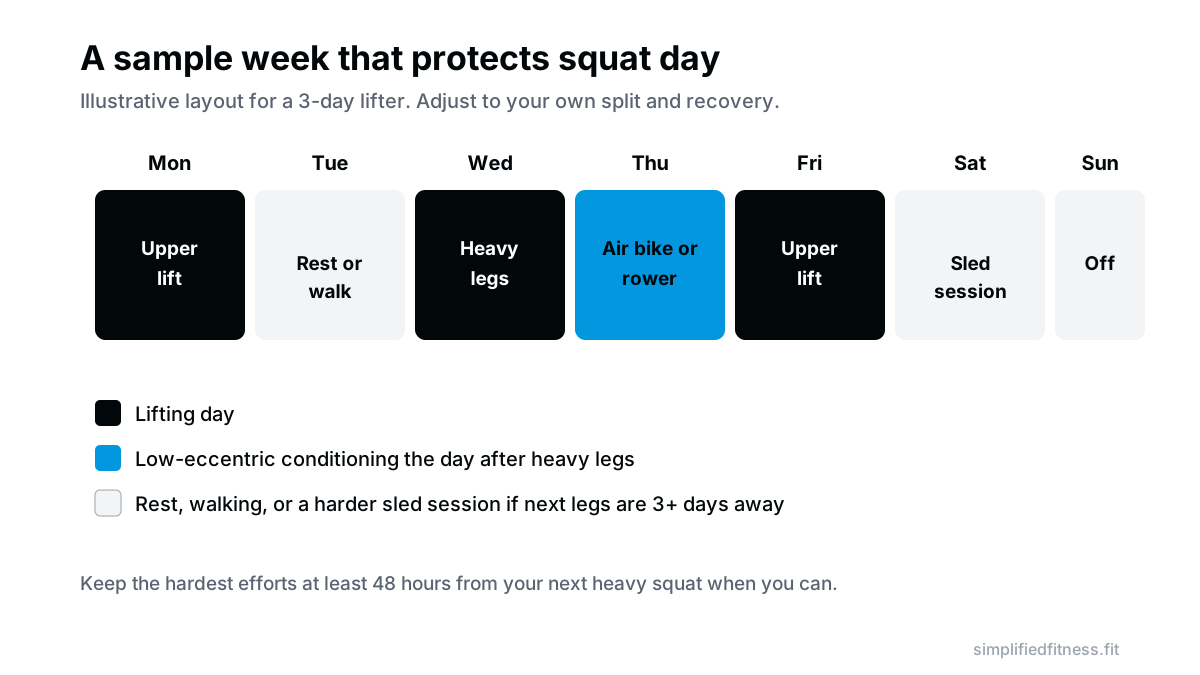
If you are building the lifting side of the week, our leg day plan is a good base.
Sample conditioning sessions
These are illustrative templates, not protocols tested in a study. Adjust to how you recover.
Sled finisher (after upper body or at the end of leg day, 12 minutes)
- 8 pushes of 15-20 m at a moderate load
- Walk back, rest 60-90 seconds
- Stop when pace drops noticeably
Air bike intervals (15 minutes)
- 6-8 rounds of 20 seconds hard
- 100 seconds easy pedalling
- Last round should look like the first
Rower repeats (20 minutes)
- 5 rounds of 250-300 m at a hard but steady pace
- 90-120 seconds easy rowing between rounds
- Keep the stroke smooth and drive with the legs first
Easy day-after-legs flush (15-20 minutes)
- Steady air bike or rower at a conversational pace
- This is not for fitness gains. It is movement.
For a longer-term view on building work capacity between sets, see our article on aerobic conditioning and inter-set recovery.
Indian gym and home options
Sleds are rare in many Indian commercial gyms, and an air bike is not a given either. A stationary bike with a high resistance setting and short all-out efforts gets you most of the way. A rower is more common in larger gyms. If you have access to an open turf or terrace area, a basic prowler-style sled costs far less than a rower, and a few plates are enough to start.
In hot weather, intervals indoors with a fan beat midday runs outside. Drink water, and stop if you feel dizzy, nauseous or unusually unwell.
Who should be careful
Hard conditioning raises your heart rate quickly. See a doctor before starting if you have a heart condition, chest pain or breathlessness with exertion, high blood pressure that is not controlled, or are returning from injury. Joint pain that is sharp, worsening, or persists after training also needs a professional opinion, not a workaround.
The bottom line
Sled pushes, air bikes and rowers are useful conditioning tools because they tend to leave you less sore than running or jumping. They are not zero-eccentric, and they do not make soreness impossible. The evidence for them in lifters is mostly indirect: sprint-focused sled trials in young athletes, a small activation study, and concurrent training reviews that point to modest dose and separate days as the sensible approach.
Pick one tool, keep sessions short, spread them away from heavy legs, and judge it by whether your lifts keep climbing. If your squat is dropping week to week, the conditioning is too much, whatever the machine.
Frequently Asked Questions
Are sled pushes good for conditioning?
Yes. A sled push lets you work hard at high heart rate with no barbell, no spinal loading and a lot less pounding than sprinting. Heavy sled work also makes the legs and calves work against resistance, and a 2014 study in trained men found similar quadriceps and hamstring activity to a 10-rep back squat. Start with short 10-20 m pushes and rest well between them.
What are non eccentric cardio exercises?
The usual picks are sled pushes, air bikes (fan bikes), rowing machines, and regular stationary bikes. These load muscle mainly as it shortens, so they cause less eccentric muscle damage than running, hill descents or plyometrics. No exercise is perfectly eccentric-free, so think of them as low-eccentric rather than zero-eccentric.
Do sled pushes cause muscle soreness?
Usually less than most other hard leg work, but they can still make you sore the first few times. A small 10-week study suggests soreness and damage markers are driven largely by being unaccustomed to the work, and muscles adapt over repeated sessions. Begin light, keep volume low in week one, and add distance gradually.
Can sled pushes build muscle?
Nobody has shown that yet. The research on sled-specific hypertrophy is thin. In the studies we have, sled work improved sprint performance rather than measured muscle size. Treat the sled as conditioning with a bit of leg work attached, not as a replacement for squats, presses and leg curls.
How heavy should I push a sled for conditioning?
Load it so you keep a hard, steady pace without grinding to a halt. In 90 young male athletes, the load that cut maximal sprint speed by 50% ranged from roughly 45 to 85% of body mass, so there is no universal number. Choose a weight where the last push is hard but your form stays clean.
Are air bikes better than regular bikes for lifters?
An air bike is not necessarily better, but it is easier to push hard on because the fan resistance rises as you pedal faster, and the arms join in. On interference, the evidence is mixed: one meta-analysis found running hurt strength and size gains more than cycling, while a HIIT-specific review saw a non-significant trend the other way for leg strength. Pick whichever you will actually use and keep sessions short.
Is a rowing machine good cardio for lifters?
Yes, with a caveat on technique. Rowing uses legs, trunk and back in one stroke and is low impact, but a sloppy stroke with a rounded back is where people get annoyed lower backs. Learn to drive with the legs first, keep the pull smooth, and begin with moderate 10-20 minute sessions.
Does cardio kill muscle gains?
Not at modest doses. A meta-analysis found that concurrent training interference depended on the type, frequency and duration of endurance work, and a 2024 trial in resistance-trained men found no interference with about one hour a week of cycling on non-lifting days. Keep cardio moderate, on separate days where possible, and keep eating enough protein and calories.
Can I do sled pushes the day before squats?
You can, but keep it easy. Low-eccentric work causes less soreness, though heavy sled pushing still fatigues the legs and could cost you reps on squats. Keep the pushes light, short and at least a day before heavy squats, or move them to after your lifting.
How often should I do sled or air bike conditioning?
One to three short sessions a week is a sensible range for most lifters. A concurrent training meta-analysis found that more frequent and longer endurance sessions were associated with larger interference, so more is not automatically better. Start with one or two sessions and add a third only if recovery and lifting performance stay good.
Is sled training safe if I have knee or back pain?
Often it is better tolerated than running or jumping, because there is no landing impact, but that depends on the cause of your pain. Pain that is sharp, worsening or lingering after training deserves a proper assessment. See a doctor or physiotherapist before pushing through it.
How do I do sled conditioning in a normal Indian gym without a sled?
Many commercial gyms in India do not have a sled, but an air bike, a rowing machine or a standard stationary bike covers the same idea. Heavy-resistance cycling intervals, or rowing sprints with full rest, give you a very hard effort with little eccentric load. If you do have a turf strip, a pushable sled with a few plates is plenty.
What is a good conditioning finisher after leg day?
A simple one is 6-8 rounds of 20 seconds hard on an air bike or rower followed by 100 seconds of easy movement. It is hard, short and does not add soreness the way hill sprints would. Stop at the point where your last round is as good as your first.
Sources & References
Every claim above is checked against peer-reviewed research (PubMed, U.S. National Library of Medicine) or guidance from established health bodies. How we fact-check.
- Wilson JM, et al. Concurrent training: a meta-analysis examining interference of aerobic and resistance exercises. J Strength Cond Res. 2012. PMID: 22002517
- Sabag A, et al. The compatibility of concurrent high intensity interval training and resistance training for muscular strength and hypertrophy: a systematic review and meta-analysis. J Sports Sci. 2018. PMID: 29658408
- Dolan C, et al. The Effect of Time-Equated Concurrent Training Programs in Resistance-Trained Men. J Hum Kinet. 2024. PMID: 38689592
- Cahill MJ, et al. Influence of resisted sled-push training on the sprint force-velocity profile of male high school athletes. Scand J Med Sci Sports. 2020. PMID: 31742795
- Cahill MJ, et al. Sled-Push Load-Velocity Profiling and Implications for Sprint Training Prescription in Young Athletes. J Strength Cond Res. 2021. PMID: 31972825
- Maddigan ME, et al. Lower-limb and trunk muscle activation with back squats and weighted sled apparatus. J Strength Cond Res. 2014. PMID: 25226330
- Ruas CV, et al. Comparison between Eccentric-Only and Coupled Concentric-Eccentric Contractions for Neuromuscular Fatigue and Muscle Damage. Med Sci Sports Exerc. 2022. PMID: 36106831
- Margaritelis NV, et al. Eccentric exercise per se does not affect muscle damage biomarkers: early and late phase adaptations. Eur J Appl Physiol. 2021. PMID: 33156414

Umair Hazrami · Founder & Head Coach, Simplified Fitness
Umair Hazrami founded Simplified Fitness and the Simplified Lifter channel to cut through fitness noise. With 4+ years of consistent training and 10+ coaching clients, he writes every guide from the peer-reviewed research and links the sources so you can check them. Our editorial standards.
Educational content only, not medical advice. If you have a medical condition, are pregnant, or take medication, talk to a qualified doctor before changing your diet, supplements or training. Full disclaimer.
Keep reading
Strength & Cardio
Aerobic Conditioning and Hypertrophy: How Work Capacity Improves Inter-Set Recovery
Does better cardio help you recover between sets? See what work capacity resistance training research says, where theory outruns data, and what to do.
9 min read
Strength & Cardio
Can Cardio Cause Muscle Loss? The Calorie and Volume Thresholds Behind the Fear
Does cardio cause muscle loss? Not at normal doses. See what the meta-analyses say about deficits, protein and running volume, and how to protect your muscle.
9 min read
Strength & Cardio
Cardio During a Cut: How Much You Need and When to Stop Adding
How much cardio during cutting phase? Learn the food-first rule, a walking base, sample weekly schedules and signs you are doing too much. Every study linked.
7 min read
Strength & Cardio
Cycling vs Running for Lifters: Which Protects Muscle and Squat Strength?
Cycling vs running for lifters: Wilson's meta-analysis found running, not cycling, blunted gains. We compare it with newer reviews and give a bike plan.
8 min read