The Molecular Interference Effect: Does AMPK Really Switch Off mTOR When You Do Cardio?
The molecular interference effect says cardio's AMPK signal blocks mTOR and muscle growth. Here is what human biopsy studies and meta-analyses actually show.

TL;DR. The short answer
- The molecular interference effect is the idea that cardio activates AMPK, which inhibits mTORC1 and so blunts the muscle-building signal from lifting. That chain is well shown in cells and rodents.
- In human biopsy studies of trained men, a bout of cycling before or after heavy leg work did not reduce mTORC1 signaling in the key studies we cover below. The tidy cell-level story does not clearly carry over to lifters.
- In real training, meta-analyses find that concurrent training often preserves whole-muscle growth. Where interference shows up, it tracks with more endurance volume, more frequent sessions and running.
- Separating cardio and lifting by a few hours may help explosive strength. There is no solid evidence that a specific 6-24 hour gap is needed to protect hypertrophy.
- Keep cardio moderate, prefer cycling or incline walking if you are guarding muscle, and eat enough protein and calories. That covers most of the practical risk.
Part of our complete guide: Cardio and Concurrent Training: Build Endurance Without Losing Muscle (The Interference Effect)
Table of contents
The molecular interference effect is the idea that cardio switches on a cell-level energy sensor called AMPK, which then dampens mTORC1, the signal that tells muscle to build protein. It is a clean story. It is also much less clear in trained humans than the gym internet makes it sound.
This page is the biology deep dive. If you want the practical programming side, start with our guide to cardio and concurrent training, then come back here for the “why”.
What is the molecular interference effect?
Your muscle cells run two broad adaptation programs. Lifting heavy loads pushes the growth program, centred on mTORC1. Endurance work pushes the energy-and-endurance program, centred on AMPK and mitochondrial building. In cells, the two programs push against each other.
The logic goes like this. Cardio drains energy inside the fibre. AMPK senses that and turns down expensive jobs like building new protein. AMPK has been shown to phosphorylate raptor, a core part of mTORC1, and to act on TSC2, another upstream brake (Gwinn et al., 2008). In that work, the raptor step was needed for mTORC1 inhibition under energy stress in cells.
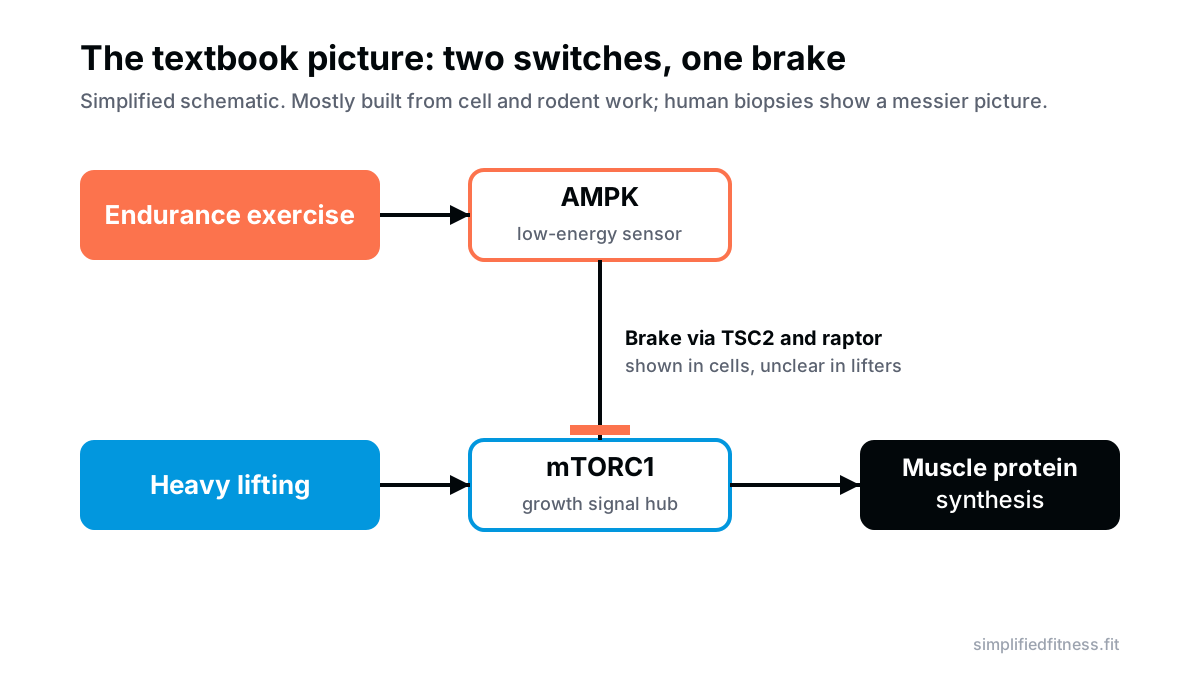
Notice the source. That raptor paper used cultured cells, not people doing leg press. A lot of the early evidence for this model came from cells and rodents, and that is the first reason to hold it loosely.
Does AMPK really block mTOR in human muscle?
This is where it gets interesting, because researchers tested exactly that with muscle biopsies.
In one study, ten moderately trained men did heavy leg press, either alone or followed by 30 minutes of cycling. Phosphorylation of mTOR rose about 2-fold and S6K1, a downstream growth marker, about 14-fold, with no difference between the two sessions (Apró et al., 2013). The authors concluded that signaling through mTORC1-S6K1 after heavy lifting was not inhibited by later endurance exercise.
A second study made it harder for the lifters. Eight trained men did interval cycling first, which raised AMPK activity, then lifted. S6K1 activity and the rest of the growth markers still rose with no difference from lifting alone (Apró et al., 2015). So AMPK was up, and mTORC1 signaling still went ahead.
Then a 2021 crossover in eight male cyclists compared lifting alone with lifting plus moderate or high-intensity cycling. The authors reported no support for a molecular interference effect under those controlled conditions, and no intensity-dependent change in AMPK (Jones et al., 2021).
A review of this literature reached a similar conclusion: human studies had not observed the molecular interference after acute concurrent exercise that could explain compromised hypertrophy (Fyfe et al., 2014).
Fair caveat: these studies are small (8 to 10 men), short-term, and measure signals a few hours after one session. A signal is not growth. Also, they do not rule out that repeated sessions over months behave differently.
If the signal is intact, why do some studies still show interference?
Good question. The 2015 study offers a clue. Cycling before lifting did not hurt S6K1, but it raised gene and protein expression of MuRF1, a marker linked to protein breakdown, which lifting alone did not (Apró et al., 2015). The authors suggested that interference may act partly by influencing protein breakdown rather than only by blocking synthesis.
That fits a broader view. Chronic interference may be less about one molecular switch and more about the program: how much endurance work, how often, and what kind. It may also come from plain fatigue that makes your lifting sessions worse.
What do the real-world training studies show?
Zoom out from the biopsy and look at the meta-analyses.
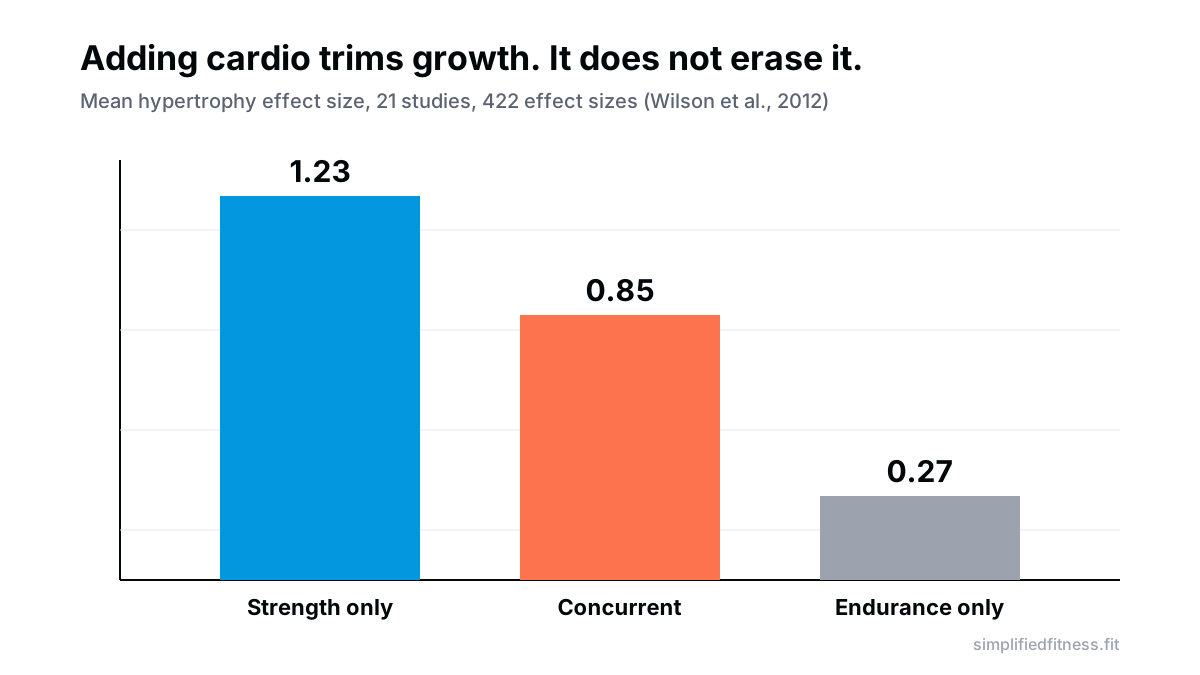
A 2012 meta-analysis of 21 studies (422 effect sizes) found mean hypertrophy effect sizes of 1.23 for strength training, 0.85 for concurrent training and 0.27 for endurance training alone (Wilson et al., 2012). Concurrent training was clearly better than endurance alone, but numerically lower than lifting alone. The same paper found that running, not cycling, was linked to decrements in hypertrophy and strength, and that higher endurance frequency and duration correlated negatively with outcomes.
A newer analysis of 43 studies in healthy adults came out more reassuring. Compared with identical lifting alone, concurrent training had a standardised mean difference of -0.01 for muscle hypertrophy (95% CI -0.16 to 0.18) and -0.06 for maximal strength, both non-significant, with a small negative effect on explosive strength (-0.28) (Schumann et al., 2022). Explosive strength was more attenuated when both were done in the same session than when sessions were at least 3 hours apart. Running versus cycling, frequency, training status and age did not significantly change the results.
The same research group then looked at individual muscle fibres across 15 studies. They found a small negative overall effect on fibre hypertrophy (SMD -0.23, 95% CI -0.46 to 0.00), and a larger negative effect on type I fibres when the aerobic work was running (SMD -0.81) but not cycling (Lundberg et al., 2022). The authors called that running finding preliminary.
So what do I do with this? A practical read
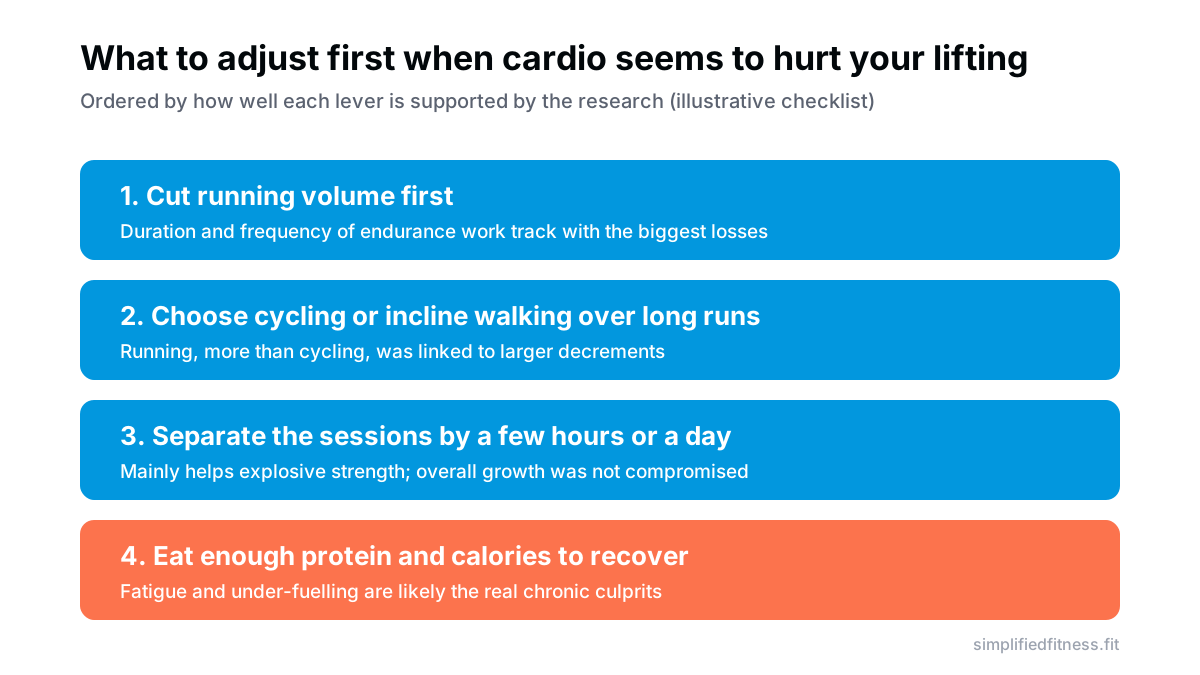
The molecular story and the training studies point the same way: the issue is dose, not the existence of cardio. Here is the plain-gym translation.
| Lever | What the evidence suggests | Practical move |
|---|---|---|
| Endurance volume | Higher frequency and duration linked to larger decrements (Wilson 2012) | Keep weekly cardio moderate and add it gradually |
| Mode | Running linked to more interference than cycling in two meta-analyses, but not in Schumann 2022 | Cycle or incline walk if growth is the priority |
| Same session or not | Explosive strength blunted more when same session, not when 3+ hours apart | Split sessions if convenient |
| Order | Similar AMPK and mTOR responses in one study of 18 trained men | Do the priority session first |
| Intensity | No intensity-dependent AMPK change in 8 cyclists | Choose what you can recover from |
The order point comes from a study of resistance-trained men comparing lifting alone, lifting then endurance, and endurance then lifting. AMPK, mTOR and related signals responded similarly, and the authors said they could not tell which sequence was most favourable (Jones et al., 2016).
A simple weekly setup for lifters who run or cycle
Most people reading this are in a gym three to five days a week and want to keep some conditioning. A sensible, hedged template:
- Lift first on days you do both, then do easy cardio.
- Use low-impact cardio (cycling, incline walking) for most of your weekly minutes. See incline treadmill walking for lifters and cycling vs running for muscle preservation.
- If you want to run longer distances, plan around it using programming concurrent training for 5K and 10K running.
- Use our heart rate zone calculator to keep easy days easy.
- Track your key lifts. If squat or bench numbers stall for several weeks while cardio rises, cut cardio first.
In an Indian context, heat matters. A 45-minute run at noon in summer adds a lot of fatigue and sweat loss. Early morning or evening, or a stationary bike indoors, gives you the cardio benefit with less recovery debt. Dal, paneer, curd, eggs and soya chunks all help you hit protein, and enough rice or roti keeps total calories from sliding.
If the interference concern is really about being in a deficit, our piece on mTOR and AMPK in calorie deficits versus surpluses goes deeper, and timing cardio and weights covers the scheduling questions in detail. The wider hypertrophy picture is in the muscle hypertrophy guide for natural lifters.
What we still do not know
Be wary of anyone who sounds certain. Biopsy studies are short and small, mostly men, and look at hours after one session. Meta-analyses mix very different programs, and many participants were not highly trained. We do not have long-term biopsy data on a lifter doing months of high-volume endurance work. And individual response varies, so some people may be more sensitive than the averages suggest.
Also: if you have a heart condition, chest pain, unexplained shortness of breath or dizziness, talk to a doctor before raising your training load. Nothing here is medical advice.
The bottom line
The molecular interference effect is a real mechanism in cells and a shaky explanation in trained humans. In practice, keep cardio moderate, favour cycling or walking if you are guarding muscle, split sessions when easy, and fuel well. For most lifters, cardio does not turn muscle growth off.
Frequently Asked Questions
What is the molecular interference effect?
It is a proposed explanation for why combining endurance and strength training can give smaller muscle gains than lifting alone. Endurance exercise activates AMPK, an energy sensor, which can suppress mTORC1, a key driver of muscle protein synthesis. Treat it as a hypothesis that is strong in cells and weak in trained humans, not as a law.
Does AMPK really block mTOR in human muscle?
In cultured cells, AMPK can phosphorylate raptor and TSC2 and so suppress mTORC1. In human biopsy studies where trained men cycled and lifted in the same session, mTORC1 signaling after lifting was not impaired. If you are worried, the practical move is to control endurance volume rather than avoid cardio.
Does cardio blunt hypertrophy?
On average, not by much. A 2022 meta-analysis of 43 studies found no meaningful difference in muscle hypertrophy between concurrent training and lifting alone, though explosive strength was slightly lower. Keep cardio dose reasonable and your gains should be fine.
Does cardio turn off muscle growth?
No. Cardio does not switch muscle growth off, and heavy lifting still triggers strong anabolic signaling even after cycling in lab studies. What it can do is add fatigue and compete for recovery, so manage total workload.
Is running worse than cycling for the interference effect?
Possibly, though the evidence is mixed. A 2012 meta-analysis found running, but not cycling, was linked to decrements in hypertrophy and strength, and a 2022 fibre-level meta-analysis found a negative effect on type I fibres with running but not cycling, while a 2022 whole-muscle meta-analysis found no difference between the two. Running is thought to add more eccentric muscle damage, though that has not been confirmed as the cause, so if growth is the priority, cycling or incline walking are lower-risk choices.
How long should I wait between cardio and weights?
There is no proven ideal gap for hypertrophy. A meta-analysis found explosive strength was blunted when training was done in the same session, but not when sessions were at least 3 hours apart. Separate them when it is easy, and do not stress if you cannot.
Should I do cardio before or after lifting?
The molecular data do not clearly favour either order. One study of resistance-trained men found similar AMPK and mTOR responses whichever order was used. Put the priority session first, so if you want strength, lift first.
Does HIIT interfere more than steady cardio?
At the molecular level, probably not. In eight male cyclists, mTOR signaling was no lower after lifting plus HIIT or moderate cycling than after lifting alone. Pick the type you can recover from.
How much cardio is too much for muscle growth?
There is no exact number, but more endurance frequency and duration tracked with smaller strength and hypertrophy outcomes in a 2012 meta-analysis. Moderate weekly volume of low-impact cardio is rarely the problem. Add cardio gradually and watch your lifting numbers.
Is the interference effect real or a myth?
It is real at the level of some cell signals and sometimes in high-volume programs, but exaggerated for typical gym-goers. Whole-muscle growth is usually preserved. The honest summary is small, conditional and tied to volume and recovery.
Does it matter if I am a beginner?
The 2022 meta-analysis found no significant difference between untrained and active participants. Beginners respond to almost any sensible program. Lift consistently and add cardio you enjoy.
Does eating enough protein help with interference?
Probably, because one proposed route of interference is greater protein breakdown and low energy availability. A human study found cycling raised the breakdown marker MuRF1 after lifting. Eating enough total calories and protein is a cheap hedge.
Should I see a doctor before combining heavy cardio and lifting?
If you have heart disease, chest pain, unexplained breathlessness, dizziness or a medical condition, speak to a doctor before raising training intensity. This article is about muscle adaptation, not medical clearance. Stop and get checked if you feel chest pain or faint.
Sources & References
Every claim above is checked against peer-reviewed research (PubMed, U.S. National Library of Medicine) or guidance from established health bodies. How we fact-check.
- Wilson JM, et al. Concurrent training: a meta-analysis examining interference of aerobic and resistance exercises. J Strength Cond Res. 2012. PMID: 22002517
- Schumann M, et al. Compatibility of concurrent aerobic and strength training for skeletal muscle size and function: an updated systematic review and meta-analysis. Sports Med. 2022. PMID: 34757594
- Lundberg TR, et al. The effects of concurrent aerobic and strength training on muscle fiber hypertrophy: a systematic review and meta-analysis. Sports Med. 2022. PMID: 35476184
- Apró W, et al. Resistance exercise induced mTORC1 signaling is not impaired by subsequent endurance exercise in human skeletal muscle. Am J Physiol Endocrinol Metab. 2013. PMID: 23632629
- Apró W, et al. Resistance exercise-induced S6K1 kinase activity is not inhibited in human skeletal muscle despite prior activation of AMPK by high-intensity interval cycling. Am J Physiol Endocrinol Metab. 2015. PMID: 25605643
- Jones TW, et al. Aerobic exercise intensity does not affect the anabolic signaling following resistance exercise in endurance athletes. Sci Rep. 2021. PMID: 34031501
- Fyfe JJ, et al. Interference between concurrent resistance and endurance exercise: molecular bases and the role of individual training variables. Sports Med. 2014. PMID: 24728927
- Gwinn DM, et al. AMPK phosphorylation of raptor mediates a metabolic checkpoint. Mol Cell. 2008. PMID: 18439900
- Jones TW, et al. Signaling responses after varying sequencing of strength and endurance training in a fed state. Int J Sports Physiol Perform. 2016. PMID: 26694228

Umair Hazrami · Founder & Head Coach, Simplified Fitness
Umair Hazrami founded Simplified Fitness and the Simplified Lifter channel to cut through fitness noise. With 4+ years of consistent training and 10+ coaching clients, he writes every guide from the peer-reviewed research and links the sources so you can check them. Our editorial standards.
Educational content only, not medical advice. If you have a medical condition, are pregnant, or take medication, talk to a qualified doctor before changing your diet, supplements or training. Full disclaimer.
Keep reading
Strength & Cardio
Aerobic Conditioning and Hypertrophy: How Work Capacity Improves Inter-Set Recovery
Does better cardio help you recover between sets? See what work capacity resistance training research says, where theory outruns data, and what to do.
9 min read
Strength & Cardio
Can Cardio Cause Muscle Loss? The Calorie and Volume Thresholds Behind the Fear
Does cardio cause muscle loss? Not at normal doses. See what the meta-analyses say about deficits, protein and running volume, and how to protect your muscle.
9 min read

Strength & Cardio
Cardio During a Cut: How Much You Need and When to Stop Adding
How much cardio during cutting phase? Learn the food-first rule, a walking base, sample weekly schedules and signs you are doing too much. Every study linked.
7 min read

Strength & Cardio
Cycling vs Running for Lifters: Which Protects Muscle and Squat Strength?
Cycling vs running for lifters: Wilson's meta-analysis found running, not cycling, blunted gains. We compare it with newer reviews and give a bike plan.
8 min read