VO2 Max Training for Lifters: The Norwegian 4x4 Protocol and Longevity
VO2 max training for lifters can start with one 40-minute session a week. See how the Norwegian 4x4 works, the longevity data and how to fit it around leg day.

TL;DR. The short answer
- VO2 max training for lifters works best as one or two hard interval sessions a week, with the Norwegian 4x4 as the best-studied template: four 4-minute efforts at 90-95% of max heart rate, separated by 3 minutes of easy movement.
- Cardiorespiratory fitness is one of the strongest predictors of long-term survival in observational data. In 122,007 treadmill-tested adults, low fitness carried an adjusted hazard ratio of 5.04 for death versus elite fitness, a bigger number than the ratios for smoking or diabetes, though it compares the extremes of a range.
- Meta-analyses show interval training raises VO2 max by a large amount in healthy adults, slightly more than steady cardio, and you do not need 10 hours a week to get it.
- Concurrent HIIT and lifting does not appear to hurt muscle growth or upper body strength, but lower body strength can take a small hit, so keep 4x4 away from heavy leg days.
- If you are over 40, have heart disease risk factors, chest pain or unexplained breathlessness, see a doctor before maximal-effort intervals.
Part of our complete guide: Cardio and Concurrent Training: Build Endurance Without Losing Muscle (The Interference Effect)
Table of contents
VO2 max training for lifters does not need to eat your week. One or two hard interval sessions, with the Norwegian 4x4 as the template, are enough to raise your aerobic ceiling in most people, and that ceiling is tied to how long you are likely to live.
This article is a cluster inside our guide to cardio, concurrent training and the interference effect. The question here is narrower: how do you build maximal aerobic capacity without ten hours of running, and without wrecking your squat?
What is VO2 max, and why should lifters care?
VO2 max is the maximum rate at which your body can take in and use oxygen during all-out effort. Heart, lungs, blood and muscle all have to cooperate, so it works as a single score for your aerobic engine.
Lifters tend to neglect it. Fair enough, bigger lifts feel more urgent. But the engine also decides how quickly your heart rate drops between sets, how you feel in set four of a leg workout, and, as we will see, something much bigger than gym performance.
The terms are loose in everyday talk. Lab VO2 max is measured with a mask. Many studies instead estimate “cardiorespiratory fitness” from treadmill performance, and the two track each other closely but are not identical.
Is VO2 max really the strongest predictor of lifespan?
It is among the strongest we have, though “the single strongest” is a claim you will see online that deserves caution.
The best-known dataset is a Cleveland Clinic cohort of 122,007 adults who had treadmill tests, followed for a median of 8.4 years. Risk of death fell steadily as fitness rose. Compared with elite performers, the lowest fitness group had an adjusted hazard ratio of 5.04 for all-cause mortality (Mandsager et al., 2018). The authors described the risk linked to reduced fitness as comparable to or greater than traditional risk factors such as coronary artery disease (1.29), smoking (1.41) and diabetes (1.40). Even the smaller step from above-average to below-average fitness carried a hazard ratio of 1.41, the same as smoking. Keep in mind the 5.04 compares the bottom quarter with the top 2.3%, a wider gap than a yes or no risk factor. The authors reported no observed upper limit of benefit.
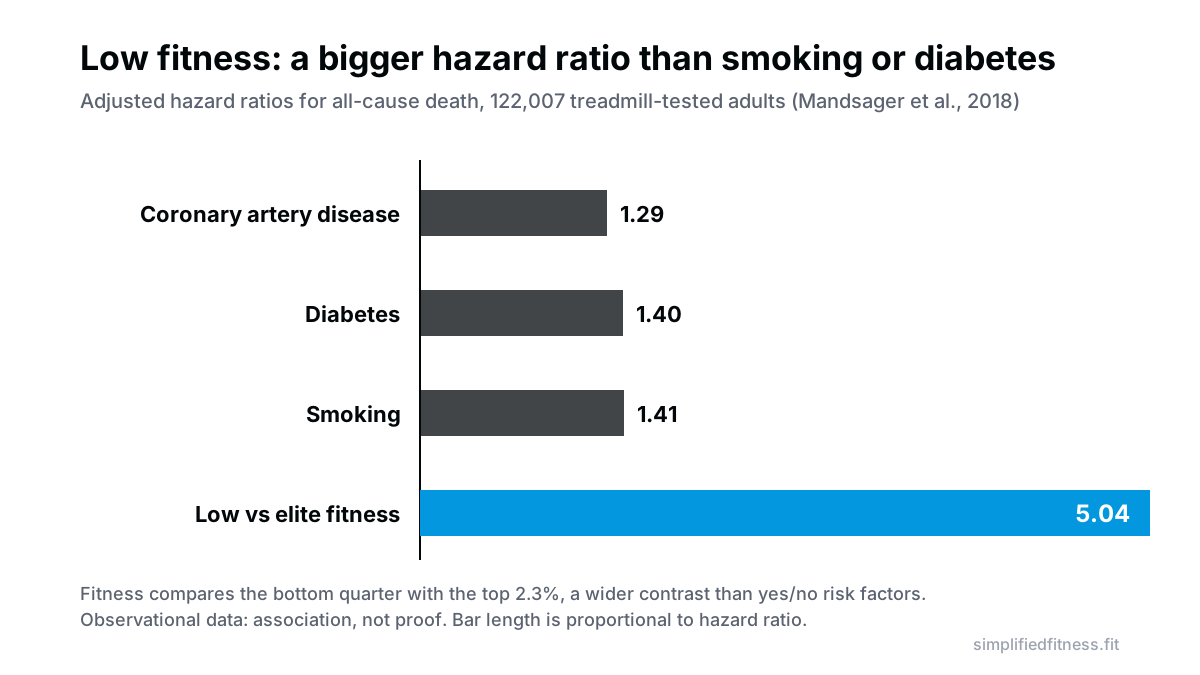
An earlier meta-analysis of 33 cohort studies (102,980 participants) found each 1-MET higher level of aerobic capacity was linked to a 13% lower risk of all-cause mortality, and a 1-MET difference corresponds to about 1 km/h of running speed (Kodama et al., 2009). The American Heart Association has gone as far as proposing fitness as a clinical vital sign, noting it may be a stronger predictor of mortality than smoking, hypertension, high cholesterol and type 2 diabetes (Ross et al., 2016).
Does lifting alone cover it?
Not fully. In 70,913 UK Biobank adults, aerobic fitness and grip strength were both independent predictors of mortality. Having both was best: the highest fitness plus highest grip strength group had a hazard ratio of 0.53 for all-cause death versus the lowest on both (Kim et al., 2018).
So the lifter’s answer is not “swap weights for cardio.” It is “keep the strength, add a small dose of hard aerobic work.” (For the strength side of the longevity argument, see lifting for longevity.)
What is the Norwegian 4x4 protocol?
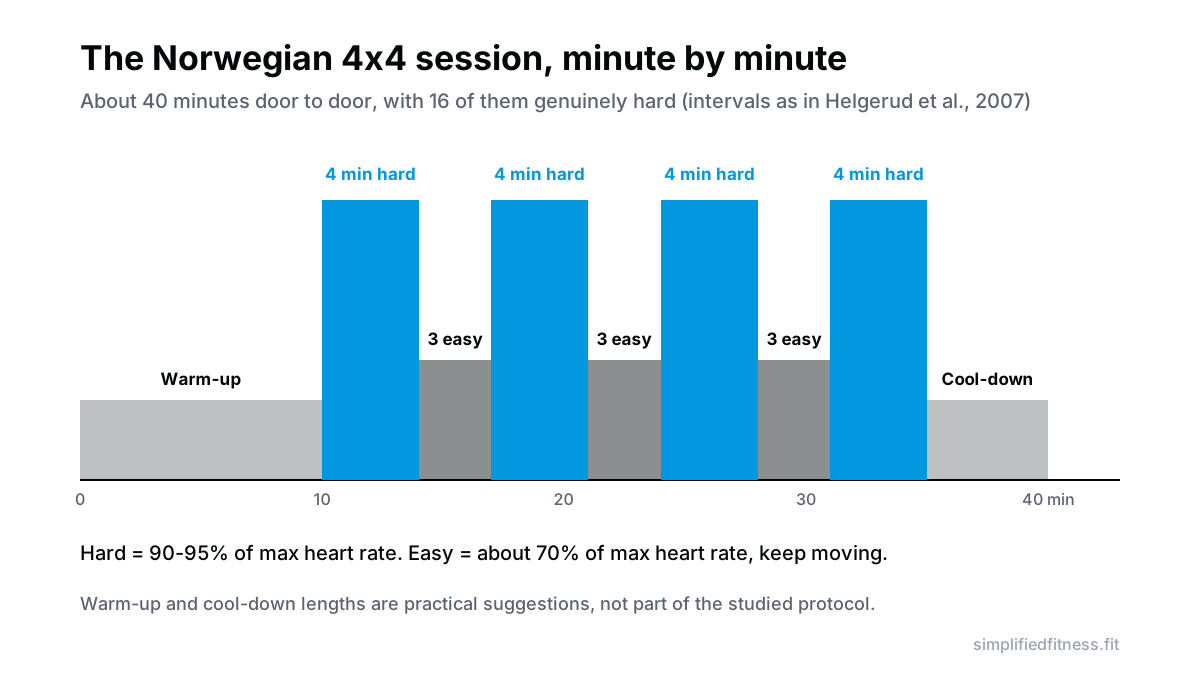
The format comes from interval research out of Norway. In a randomised trial, 40 healthy, moderately trained men did one of four programmes, matched for total work, three days a week for 8 weeks. One group did 4 x 4 minutes of running at 90-95% of max heart rate with 3 minutes of active rest at about 70% (Helgerud et al., 2007).
The result: both interval groups beat long slow distance and lactate-threshold work for improving VO2 max. The 4x4 group improved by 7.2%, the 15/15 group by 5.5%. Stroke volume, how much blood the heart pumps per beat, rose by about 10% after interval training.
The simple version:
- Warm up for about 10 minutes, ending with a couple of short pickups.
- Go hard for 4 minutes at 90-95% of max heart rate. You should be breathing too hard to talk.
- Recover for 3 minutes at about 70%. Keep moving, do not stop.
- Repeat until you have four hard intervals.
- Cool down easily for 5 minutes.
The first interval often feels too easy. That is by design: you reach the top of the zone by minute two or three, not instantly. Hit it by interval two, and stay there.
Do intervals really beat steady cardio for VO2 max?
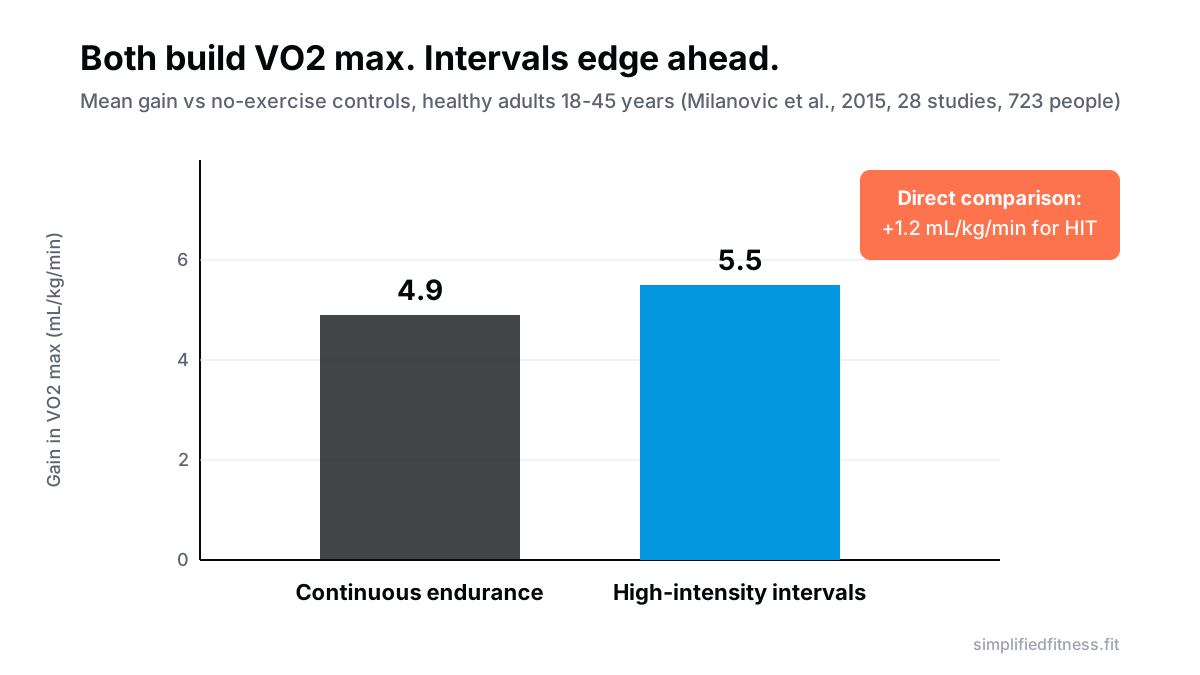
Mostly yes, by a modest margin. A meta-analysis of 28 controlled trials (723 healthy adults aged 18-45) found endurance training raised VO2 max by 4.9 mL/kg/min and high-intensity intervals by 5.5 mL/kg/min versus no-exercise controls. HIT beat endurance training directly by about 1.2 mL/kg/min, which the authors rated a possibly small benefit (Milanovic et al., 2015).
A separate meta-analysis of low-volume HIT looked at protocols with repetitions of 30-60 seconds. In active, non-athletic males the average protocol gave a likely moderate 6.2% VO2 max improvement, with 10.0% in sedentary males, and the effect in athletic males was unclear. The comparison with traditional endurance training was also unclear (Weston et al., 2014).
Another analysis of interval studies in people under 45 found an average increase of 0.51 L/min, and a subset with longer intervals showed larger changes of roughly 0.8-0.9 L/min (Bacon et al., 2013). The 4x4 format uses fairly long intervals, so it plausibly belongs in that group, though that analysis did not test it directly.
How often do you need to do it: is once a week enough?
Once a week is a fair place to start. Whether it is the best dose is less clear.
In a small 2026 trial, 45 active male university students did 4x4 HIIT once, twice or three times weekly for 6 weeks. The once-a-week group showed only a small VO2 max increase, while the two- and three-session groups improved markedly and similarly. Completion rates were 100%, 93% and 80%. The authors concluded twice weekly looked like the best balance (Zhang et al., 2026). The sample was young, male, homogeneous and the study short, so treat it as a pointer.
My practical read for lifters:
- Once a week: reasonable if your lifting volume is high or you are cutting.
- Twice a week: probably the sweet spot if recovery, sleep and food are in order.
- Three times: more than most lifters need, and it starts to compete with leg training.
Will 4x4 kill your gains?
Less than the old “cardio kills gains” line suggests, but it depends on what you do and when.
The 2012 concurrent training meta-analysis (21 studies, 422 effect sizes) found that endurance work dampened strength and hypertrophy gains most when it was frequent and long. Running, but not cycling, produced significant decrements in hypertrophy and strength (Wilson et al., 2012).
The newer HIIT-specific analysis tells a slightly different story. Compared with lifting alone, adding HIIT gave similar changes in muscle hypertrophy and upper body strength. Lower body strength rose a little less (effect size -0.248). There was a non-significant trend toward more lower body interference with cycling HIIT (-0.377) than running (-0.176), and the authors suggest longer rest between sessions may help (Sabag et al., 2018).
So the studies disagree on cycling. Wilson pooled many types of endurance work. Sabag looked only at intervals, and found a trend rather than a clear effect. Neither shows a disaster for hypertrophy. The safe reading: put hard intervals on a separate day from legs or at least several hours apart, and watch your squat.
Our liss-vs-hiit comparison and the piece on timing cardio and weights go deeper on the scheduling question.
Which machine is best: assault bike, rower or treadmill?
Pick the one that lets you hold the target heart rate for four minutes without your form falling apart.
- Assault or air bike: no impact, easy to push hard. Heart rate climbs fast, so ease in during minute one. Our guide on sleds, rowing and air bikes covers the trade-offs.
- Rowing machine: low impact, uses back and legs. A messy stroke when tired is the risk, so keep the technique crisp.
- Treadmill incline: works well if your joints tolerate running. The original 4x4 trial used running.
- Stationary bike: the easiest to control for beginners.
The “protect your joints” argument for bike or rower is sensible, though I am not aware of trials comparing injury rates among lifters across these machines, so treat it as practical logic rather than proven fact.
How do you track VO2 max gains without a lab?
You have three options, in order of accuracy:
- Lab test with gas analysis. Most accurate, costly, and rare outside big cities.
- Field or treadmill test under supervision. Good for tracking your own change.
- Wearable estimates. Convenient, with unknown error for any one person.
Use the same method each time and judge the trend over 8-12 weeks. Your heart rate at a fixed easy pace and how quickly it recovers after the fourth interval are also useful signs. Our heart rate zone calculator can set your 90-95% and 70% targets to start with.
Expect individual variation. A critical review of the research on individual responses found that most studies had no comparison group. In the data that did have one, differences between individuals in how VO2 max changed were not larger than random variation within a person over the same time (Williamson et al., 2017). In plain terms, a small gain in one test does not mean you are a “non-responder.” Test again.
A sample week for a lifter
Here is one way to place it in a four-day split:
| Day | Session | Note |
|---|---|---|
| Mon | Upper body | Normal |
| Tue | Lower body | Heavy legs |
| Wed | Rest or easy walk | Recovery |
| Thu | Upper body | Normal |
| Fri | Lower body | Heavy legs |
| Sat | 4x4 intervals | Fresh legs, 40 minutes |
| Sun | Rest | Optional Zone 2 walk |
This keeps hard intervals a full day away from the next leg day. Whether you want more total weekly cardio is covered in our article on the minimum effective dose of cardio. Pair it with a push, pull and leg plan so the lifting side stays intact.
Indian context: heat, budget and bodies
You do not need a lab membership. A gym bike or rower works, or a flat stretch of road or a stadium track if you run. In hot, humid months, train early or use an air-conditioned gym. Heat raises heart rate at the same effort, so you may see numbers that look “too high” in summer. Drink water before and after, and cut a rep if you feel dizzy or unwell.
Fuel it normally. A banana or a bowl of poha an hour before, and a protein-rich meal such as dal with roti and curd afterwards, is plenty. No gels or special supplements are needed for a 40-minute session.
When to see a doctor first
Maximal-effort intervals push your heart rate close to its ceiling. Check with a doctor before starting if you are over 40 and inactive, have high blood pressure, diabetes, a family history of early heart disease, or any history of chest pain, fainting or unusual breathlessness. Stop if you get chest pain, dizziness, palpitations that feel wrong or sudden shortness of breath.
None of this is a diagnosis, and individual cases need individual advice.
The bottom line
Lifters get the most out of VO2 max training by treating it as a small, hard, scheduled dose rather than a second job. Start with one 4x4 session on a day away from legs. Move to two if recovery allows. Retest after 8-12 weeks and adjust.
Frequently Asked Questions
What is the Norwegian 4x4 protocol?
It is an interval session of four 4-minute hard efforts at about 90-95% of your max heart rate, each followed by 3 minutes of active recovery at roughly 70%. A 2007 trial in 40 moderately trained men used exactly this format. Add a 10-minute warm-up and an easy cool-down, and the whole session takes about 40 minutes.
How often should I do 4x4 intervals as a lifter?
Once a week is a reasonable starting point, and twice a week is likely the upper end for most lifters. In a small 2026 trial of active male students, twice-weekly 4x4 sessions produced larger VO2 max gains than once weekly over 6 weeks, with good adherence. If your squat or deadlift numbers drop, go back to once a week.
Can 4x4 intervals hurt muscle growth?
Probably not much. A 2018 meta-analysis found concurrent HIIT and resistance training gave similar hypertrophy to resistance training alone. Spread the sessions apart and eat enough, and the risk is small for most lifters.
What is a good VO2 max for a gym-goer?
Targets depend on age and sex, so a single number is misleading. In the largest data set on this question, the lowest risk of death sat in the top fitness group, and risk fell steadily as fitness rose. A practical goal is simply to move up one fitness band from where you are now.
How do I measure my VO2 max?
The gold standard is a lab test with a mask that measures oxygen use during a ramped effort. Smartwatch estimates are convenient and useful for tracking your own trend, but they are approximations and can be off by a meaningful margin. Use the same device, the same conditions and look at the direction over months, not single readings.
Is the assault bike or rowing machine better than running for 4x4?
For most lifters the bike or rower is the safer pick because there is no impact and less pounding on knees and ankles. Running did show more interference with leg strength in one meta-analysis, though a later HIIT-specific analysis saw only non-significant trends for cycling. Choose the machine you can push hard on for 4 minutes without form breakdown.
How do I find 90-95% of my max heart rate?
The most accurate way is to measure your true maximum during a hard, safe effort with a heart rate monitor, ideally supervised. Formulas give rough estimates that can miss by 10 beats or more for some people. Our heart rate zone calculator gives a starting range, and you can refine it by how the last minute of each interval feels.
Do I need a heart rate monitor for 4x4?
It helps a lot, because the target zone is narrow and hard to judge by feel. Without one, aim for an effort where you can say only a few words and the final minute of each interval feels close to your limit. Intervals that are too easy are the most common reason people see no improvement.
Does VO2 max really predict how long you will live?
It predicts risk strongly in observational studies, but these cannot prove cause and effect. People with higher fitness also tend to be healthier in other ways. Still, the pattern is consistent across large cohorts, so building fitness is a sensible bet.
Can I improve VO2 max if I am already fit?
Gains are usually smaller in people who already have a high VO2 max. A meta-analysis of low-volume HIIT found the effect in athletic males was unclear, while sedentary and active non-athletes improved by moderate amounts. If you only lift, you likely sit in the group with room to improve.
Should I do 4x4 on a cut or in a calorie deficit?
It is possible, but recovery gets thinner when energy intake drops. Keep it to one session, keep protein high, and protect your heavy lifting days. If lifts stall for more than a week or two, drop the intervals first.
Who should avoid 4x4 intervals?
Anyone with known heart disease, uncontrolled high blood pressure, chest pain on exertion, fainting spells or unexplained breathlessness should speak to a doctor first. Maximal-effort work raises heart rate close to its ceiling, which is the opposite of a gentle start. If you have been inactive for years, build a base with easy cardio for several weeks before attempting hard intervals.
Sources & References
Every claim above is checked against peer-reviewed research (PubMed, U.S. National Library of Medicine) or guidance from established health bodies. How we fact-check.
- Mandsager K, et al. Association of Cardiorespiratory Fitness With Long-term Mortality Among Adults Undergoing Exercise Treadmill Testing. JAMA Netw Open. 2018. PMID: 30646252
- Kodama S, et al. Cardiorespiratory fitness as a quantitative predictor of all-cause mortality and cardiovascular events in healthy men and women: a meta-analysis. JAMA. 2009. PMID: 19454641
- Ross R, et al. Importance of Assessing Cardiorespiratory Fitness in Clinical Practice: A Case for Fitness as a Clinical Vital Sign: A Scientific Statement From the American Heart Association. Circulation. 2016. PMID: 27881567
- Helgerud J, et al. Aerobic high-intensity intervals improve VO2max more than moderate training. Med Sci Sports Exerc. 2007. PMID: 17414804
- Milanovic Z, et al. Effectiveness of High-Intensity Interval Training (HIT) and Continuous Endurance Training for VO2max Improvements: A Systematic Review and Meta-Analysis of Controlled Trials. Sports Med. 2015. PMID: 26243014
- Weston M, et al. Effects of low-volume high-intensity interval training (HIT) on fitness in adults: a meta-analysis of controlled and non-controlled trials. Sports Med. 2014. PMID: 24743927
- Bacon AP, et al. VO2max trainability and high intensity interval training in humans: a meta-analysis. PLoS One. 2013. PMID: 24066036
- Sabag A, et al. The compatibility of concurrent high intensity interval training and resistance training for muscular strength and hypertrophy: a systematic review and meta-analysis. J Sports Sci. 2018. PMID: 29658408
- Wilson JM, et al. Concurrent training: a meta-analysis examining interference of aerobic and resistance exercises. J Strength Cond Res. 2012. PMID: 22002517
- Kim Y, et al. The combination of cardiorespiratory fitness and muscle strength, and mortality risk. Eur J Epidemiol. 2018. PMID: 29594847
- Williamson PJ, et al. Inter-Individual Responses of Maximal Oxygen Uptake to Exercise Training: A Critical Review. Sports Med. 2017. PMID: 28097487
- Zhang H, et al. Study on the effects of 4 x 4 min high-intensity interval training frequency on cardiorespiratory function, metabolic indices, and exercise performance in male university students. Front Physiol. 2026. PMID: 42534295

Umair Hazrami · Founder & Head Coach, Simplified Fitness
Umair Hazrami founded Simplified Fitness and the Simplified Lifter channel to cut through fitness noise. With 4+ years of consistent training and 10+ coaching clients, he writes every guide from the peer-reviewed research and links the sources so you can check them. Our editorial standards.
Educational content only, not medical advice. If you have a medical condition, are pregnant, or take medication, talk to a qualified doctor before changing your diet, supplements or training. Full disclaimer.
Keep reading
Strength & Cardio
Aerobic Conditioning and Hypertrophy: How Work Capacity Improves Inter-Set Recovery
Does better cardio help you recover between sets? See what work capacity resistance training research says, where theory outruns data, and what to do.
9 min read
Strength & Cardio
Can Cardio Cause Muscle Loss? The Calorie and Volume Thresholds Behind the Fear
Does cardio cause muscle loss? Not at normal doses. See what the meta-analyses say about deficits, protein and running volume, and how to protect your muscle.
9 min read

Strength & Cardio
Cardio During a Cut: How Much You Need and When to Stop Adding
How much cardio during cutting phase? Learn the food-first rule, a walking base, sample weekly schedules and signs you are doing too much. Every study linked.
7 min read
Strength & Cardio
Cycling vs Running for Lifters: Which Protects Muscle and Squat Strength?
Cycling vs running for lifters: Wilson's meta-analysis found running, not cycling, blunted gains. We compare it with newer reviews and give a bike plan.
8 min read