Programming Concurrent Training: Combining 4 Days of Lifting with 5k/10k Running Goals
A running and lifting weekly program for a 5k or 10k: 4 lifting days, 2 runs, 1 rest day, a 12-week plan, run spacing and fueling, built on the research.

TL;DR. The short answer
- A workable running and lifting weekly program is 4 lifting days (upper/lower), 1 quality run, 1 easy Zone 2 run and 1 full rest day, with the hard run about 48 hours away from each leg day.
- Concurrent training costs you little on strength and size when running volume stays modest. A 2012 meta-analysis found running hurt hypertrophy and strength more than cycling, and more weekly running time meant a bigger penalty.
- If a run and a lift land on the same day, lift first. A meta-analysis found lower-body strength improved more when resistance came before endurance, with no difference in muscle size.
- Heavy strength training can help runners: meta-analyses show small to moderate improvements in running economy and moderate to large improvements in time-trial performance, so you are not wasting gym time.
- Grow the easy run from 20-30 to 30-45 minutes over a 12-week build, fuel the hard sessions with carbohydrate, and see a doctor or physio for pain that changes how you run or lasts more than a couple of weeks.
Part of our complete guide: Cardio and Concurrent Training: Build Endurance Without Losing Muscle (The Interference Effect)
Table of contents
A running and lifting weekly program that works for a 5k or 10k is four lifting days (two upper, two lower), one hard run, one easy Zone 2 run and one full rest day. Place the hard run about 48 hours away from each leg day, and you keep most of your strength and size while the running improves.
This is the race-focused version: a 12-week block aimed at a 5k or 10k. For general ways to arrange lifting and running across a week, see our hybrid training scheduling guide. If you want the mechanisms behind the “interference effect”, start with our pillar guide to cardio and concurrent training. Here we just build the calendar.
What does a running and lifting weekly program look like?
Here is the whole week on one screen. Lifting is blue, running is orange.
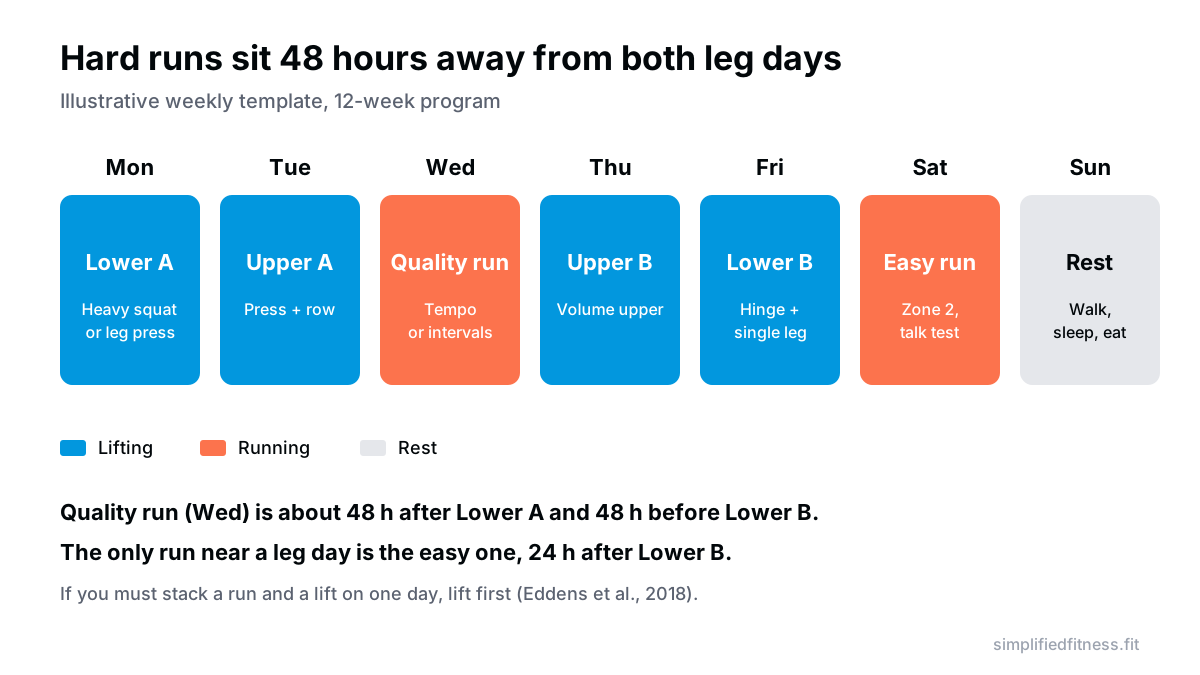
| Day | Session | What it looks like |
|---|---|---|
| Mon | Lower A | Heavy squat or leg press, hinge, calves |
| Tue | Upper A | Heavy press and row, arms |
| Wed | Quality run | Tempo or intervals (the one hard run) |
| Thu | Upper B | Higher-rep press, pulldown, shoulders |
| Fri | Lower B | Hinge, single-leg work, hamstrings |
| Sat | Easy run | Zone 2, you can talk in sentences |
| Sun | Rest | Walk if you like, otherwise do nothing |
Why this order? Monday’s lower session comes after a rest day, so your legs are fresh for the heaviest work. Wednesday’s hard run is roughly 48 hours later, and Friday’s leg day is another 48 hours after that. The easy run on Saturday is gentle enough that Monday’s squats do not suffer.
That 48-hour gap is coaching logic, not a number from a trial. The evidence below explains the logic, and you can shift a day if your own recovery asks for it.
Will running ruin my lifting gains?
Mostly no, with some fine print worth knowing.
A 2012 meta-analysis pooled 21 studies and 422 effect sizes. For hypertrophy the mean effect size was 1.23 for strength training alone, 0.85 for concurrent training and 0.27 for endurance alone. For strength it was 1.76, 1.44 and 0.78 respectively (Wilson et al., 2012).
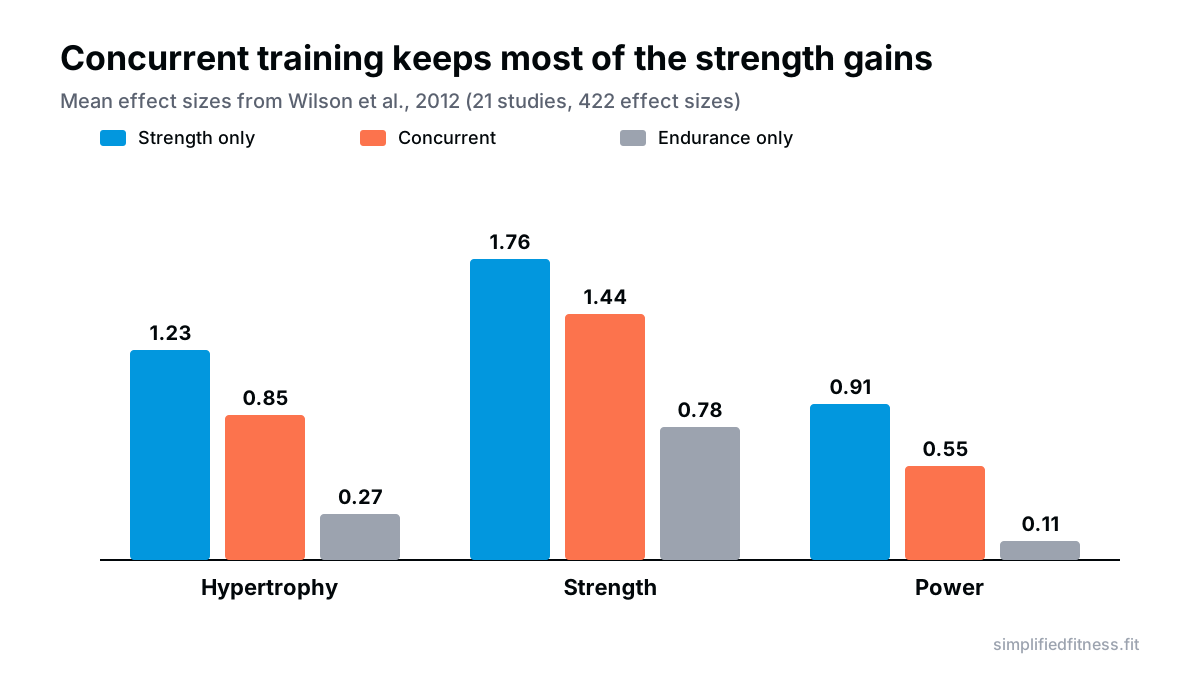
So you give up something, but concurrent training kept most of the lifting benefit. The same paper found a pattern that shapes this program: running, but not cycling, was associated with significant decrements in hypertrophy and strength. Higher frequency and longer duration of endurance work correlated with worse outcomes too (correlations of -0.26 to -0.35 for frequency, -0.29 to -0.75 for duration) (Wilson et al., 2012).
That is why this plan caps running at two sessions and keeps most of the miles easy. If cycling suits your knees and goals better, our guide to cycling vs running for lifters covers the trade.
What about at the muscle fibre level?
A 2022 meta-analysis of 15 studies looked at fibre size under the microscope. It found a small negative effect of concurrent training on overall fibre hypertrophy (standardized mean difference -0.23, 95% CI -0.46 to -0.00). For type I fibres the penalty appeared with running but not cycling (Lundberg et al., 2022).
The authors call the running-versus-cycling finding preliminary. Whole-muscle measures and fibre measures do not perfectly agree, and only 15 studies fed the analysis.
Where does that leave you? With a small, probably tolerable cost if running is a modest add-on, and a clear reason to keep volume sensible. For the molecular side, see the AMPK and mTOR explainer.
Should I run before or after lifting?
If you can, put them on separate days, which is what the calendar does. If you must stack them, lift first.
A systematic review and meta-analysis of 10 studies compared the order within a session over at least 5 weeks. Lower-body dynamic strength improved more when resistance came before endurance (a weighted mean difference of 6.91% change, 95% CI 1.96 to 11.87). There was no effect of order on lower-body muscle hypertrophy, static strength, maximal aerobic capacity or body fat (Eddens et al., 2018).
In gym terms: running first leaves your legs tired for the squats that matter. Squatting first rarely hurts a following easy run. Our article on timing cardio and weights goes deeper if your schedule forces a double.
Does lifting actually help my running?
It does, which is the part runners often miss.
A 2024 meta-analysis of strength training in middle- and long-distance runners found small improvements in running economy with high-load training (effect size -0.266) and moderate improvements with combined methods (effect size -0.426). Plyometrics helped at slower speeds (12 km/h or less). Certainty of evidence was moderate for most methods and low for combined methods (Llanos-Lagos et al., 2024).
A companion meta-analysis from the same group looked at performance. High-load training had a moderate effect on time trial and time-to-exhaustion performance, and combined methods a large one, though VO2max and sprint capacity did not change and certainty ranged from very low to moderate (Llanos-Lagos et al., 2024).
So your four lifting days are not dead weight for a runner. Heavy squats, deadlift variations and some jumping or skipping help you run more economically, meaning you use less energy at the same pace. Why that happens is still debated, so treat any mechanism you read about as a hypothesis.
The 12-week plan
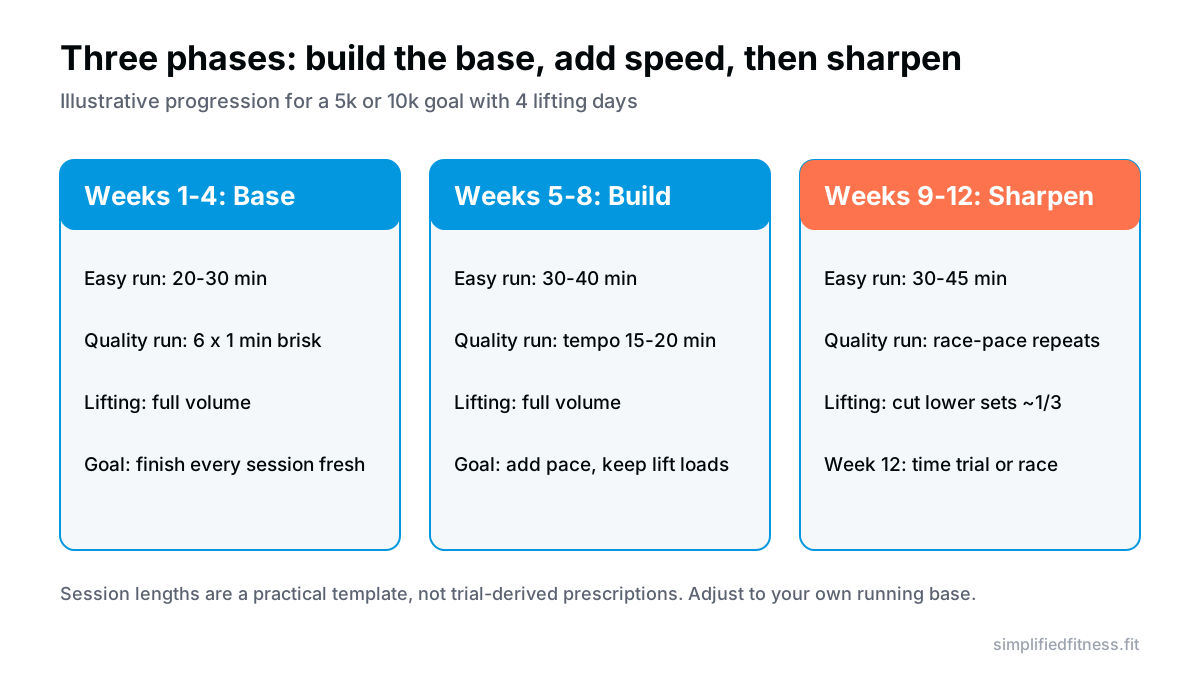
This is a practical template, not a prescription drawn from a single trial. It assumes you can already jog 20-30 minutes and have lifted for at least a few months. If not, spend 3-4 weeks on run-walk intervals first.
Weeks 1-4: base
- Easy run (Sat): 20-30 minutes at Zone 2. Use the heart rate zone calculator or the talk test.
- Quality run (Wed): after a 10-minute easy warm-up, 6 x 1 minute brisk with 90 seconds walking or jogging between.
- Lifting: your normal Upper/Lower volume, roughly 8-12 hard sets per muscle per week.
The first month is about showing up fresh. If Monday’s squat drops by more than a rep or two, your legs are not recovering from the weekend, so shorten the easy run.
Weeks 5-8: build
- Easy run: 30-40 minutes.
- Quality run: a continuous tempo of 15-20 minutes at a “comfortably hard” pace, where you can say a few words, not a sentence.
- Lifting: unchanged. Try to hold your loads.
This is the phase where most lifters feel the squeeze. Sleep and food matter more than extra sets. A bad week is a signal to repeat the week, not to push through.
Weeks 9-12: sharpen
- Easy run: 30-45 minutes.
- Quality run: race-pace repeats, such as 4 x 5 minutes for a 10k or 5 x 3 minutes for a 5k, with 2 minutes easy between.
- Lifting: cut the number of sets on lower days by about a third, and keep the weight on the bar.
- Week 12: a time trial or the race itself. Drop to one easy lower session in the final week.
Keeping the weight but cutting sets is a common strategy for preserving strength while fatigue clears. Our deload week guide explains why.
Which lifts go on which days?
If you need the full template, our 4-day upper/lower split guide has it. For this plan, the leg days look like this:
- Lower A (heavy): back squat or leg press (3-4 sets of 5-8), stiff-leg deadlift (3 sets of 6-8), calf raise (3 sets).
- Lower B (lighter, single-leg biased): split squat or single-leg extension (3 sets of 8-12), hip thrust (3 sets of 8-12), seated leg curl (3 sets).
Single-leg work and calves are worth including because they cover the tissues that running loads repeatedly. Pick one hard compound per day and stop with a rep or two in reserve. This plan is not the place for grinding out ugly reps. You can use the RIR/RPE calculator to calibrate effort.
How should I fuel for running and lifting?
Carbohydrate is what changes most when you add hard running. Sports nutrition reviews describe “high carbohydrate availability” as eating enough carbohydrate in the hours before a session, during it if it is long, and afterwards to refuel for the next one. This matters most for high-intensity training, where performance is the goal (Burke et al., 2011).
The same review suggests 30-60 g of carbohydrate an hour for longer events, and the benefit of small amounts for efforts around an hour. A 5k takes well under an hour, and most recreational 10k runners finish in about an hour or less, so you rarely need gels during a run. You do want food in the tank beforehand.
In practice:
- Before the quality run: a banana with curd, or poha, 1-2 hours before. If you run at 6 am, a banana and a small glass of milk is enough.
- Before heavy legs: a normal meal with rice or roti and dal 2-3 hours ahead.
- After the hard run or leg day: a carb and protein meal. Dal chawal with paneer or curd rice with eggs both work.
- Protein: spread across the day. Use the protein calculator for your target.
Low-carb diets get attention in endurance circles. The evidence for hard training adaptation is mixed, and Burke and colleagues note it is unclear whether “train-low” strategies improve performance in well-trained athletes (Burke et al., 2011). For a hybrid plan that includes heavy lifting, the simpler choice is to eat enough carbohydrate. Our carbohydrates and hypertrophy guide goes deeper.
How do I stay healthy and injury-free?
Running adds repetitive impact, and new runners who ramp up quickly are the people who get hurt. A few habits help.
- Raise running time gradually. If a week feels like a jump, repeat the previous week.
- Keep one run hard. A second hard run is the easiest way to blow up recovery.
- Footwear is mostly fit and comfort. We are not citing a trial showing one type of shoe prevents injury. Use a comfortable running shoe for runs and a flat, stable one for squats and deadlifts.
- Heat matters in India. Run early morning or after sunset in summer, slow down on humid days, and drink water before and after.
What about prevention exercises? A 2024 meta-analysis of 9 randomised trials (1,904 runners) found no significant difference in injury risk or rate overall with exercise-based prevention programs. A post hoc analysis of supervised programs showed lower injury risk, and most of the included studies were low quality (Wu et al., 2024).
The practical takeaway is modest. Your lifting is probably good for you, but it will not guard against a big jump in mileage. Pacing yourself will.
Is two runs a week enough?
For a recreational 5k or 10k, yes, though progress is slower than on three or four runs. An observational meta-analysis of 14 studies from six cohorts (232,149 people) found running participation was associated with 27% lower all-cause mortality, and no significant dose-response trend for frequency, duration, pace or total volume (Pedisic et al., 2020).
That is not a training study and does not prove running causes the lower risk. It does suggest that a small amount of running carries health value, which fits a plan where lifting stays the priority.
If you want a third run later, keep it short and easy, and move it to a day away from leg sessions. Our hybrid training scheduling guide covers the options, and the Zone 2 article explains the easy-run benefits.
Your next step
Put the week in your calendar before you do anything else. Run the first 4 weeks as written, log your loads and your runs, and only then think about tweaking. If a 12-week block feels like a lot, start with weeks 1-4 and decide after.
Frequently Asked Questions
Can I train for a 10k and still lift weights?
Yes, and for most recreational runners it is a good combination. Strength training in runners has been linked to better running economy and time-trial performance in meta-analyses, while two runs a week is usually enough volume to finish a 10k comfortably. Keep your four lifting days and add two runs with sensible spacing.
How many days a week should I run and lift?
Four lifting days and two runs fits in six training days with one full rest day. That structure limits how much running volume competes with your lifting recovery. If you want a third run, add a short easy one rather than another hard session.
Should I run before or after lifting?
If both happen on the same day, lift first. A meta-analysis of 10 studies found lower-body dynamic strength improved more when resistance exercise came before endurance exercise, with no difference for muscle growth or aerobic capacity. Separate days, or at least a few hours apart, is better still when your schedule allows.
Does running kill muscle gains?
Not at the modest volumes in this plan. A 2012 meta-analysis found concurrent training kept most of the hypertrophy and strength of lifting alone, but running in particular and higher frequency and duration of endurance work were associated with bigger penalties. Keep runs short and easy, eat enough protein and calories, and the cost is small for most lifters.
How far apart should leg day and a hard run be?
Aim for roughly 48 hours between a heavy leg session and a hard run, in either order. The reason is practical: sore, fatigued legs make a tempo run slower and a squat session shakier. This is coaching logic rather than a number from a trial, so shift it by a day if your recovery is different.
What is a Zone 2 run and why do I need one?
Zone 2 is an easy, conversational pace where you could speak in full sentences. It builds aerobic base with little muscular damage, so it barely interferes with your next lift. Use our heart rate zone calculator to estimate your range, or just use the talk test.
How should I eat to run and lift at the same time?
Prioritise enough total calories, protein across the day and carbohydrate around your hard sessions. Carbohydrate availability matters most for high-intensity training, as sports nutrition reviews describe, and for a 5k or 10k you rarely need fuel during the run itself. In India, a roti or rice meal with dal and curd 2-3 hours before is an easy way to get it.
Can I do this program while cutting or in a calorie deficit?
You can, but recovery gets harder, so keep the volume at the low end and protect your two lifts per body part. A deficit plus hard runs plus heavy legs is the combination where people stall or get hurt. Start the program at maintenance if you can, then cut once the habit is set.
Do I need special running shoes if I lift heavy?
Not necessarily. There is no single shoe that is proven to prevent injury, so comfortable fit and gradual mileage matter more. Use your running shoes for runs and flat, stable shoes for squats and deadlifts, because very cushioned soles can feel unstable under heavy load.
How do I avoid running injuries when I also lift?
Build running volume gradually, keep most runs easy and let the hard session be the only demanding one. A 2024 meta-analysis found exercise-based prevention programs did not reduce running injuries overall, though supervised programs looked better. Your lifting already covers general strength, so the biggest lever is not adding too much, too soon.
Will lifting make me a slower runner because I am heavier?
For most recreational runners, no. Meta-analyses in distance runners show strength training can improve running economy and performance, with little change in VO2max, so the benefit comes through efficiency. If you gain muscle quickly your pace per kilometre may feel different for a few weeks.
How long does it take to train for a 5k or 10k while lifting?
Twelve weeks is a realistic build for a lifter who can already jog 20-30 minutes. A complete beginner to running may need longer and should take walk-run intervals first. If you have any heart or joint condition, check with a doctor before ramping up.
Is running twice a week enough to improve?
For a recreational 5k or 10k, usually yes, though gains are slower than with three or four runs. An observational meta-analysis found running even once a week was associated with a lower risk of death than not running, and higher doses were not clearly better. That is association, not proof, but it shows that small amounts count.
Sources & References
Every claim above is checked against peer-reviewed research (PubMed, U.S. National Library of Medicine) or guidance from established health bodies. How we fact-check.
- Wilson JM, et al. Concurrent training: a meta-analysis examining interference of aerobic and resistance exercises. J Strength Cond Res. 2012. PMID: 22002517
- Lundberg TR, et al. The Effects of Concurrent Aerobic and Strength Training on Muscle Fiber Hypertrophy: A Systematic Review and Meta-Analysis. Sports Med. 2022. PMID: 35476184
- Eddens L, et al. The Role of Intra-Session Exercise Sequence in the Interference Effect: A Systematic Review with Meta-Analysis. Sports Med. 2018. PMID: 28917030
- Llanos-Lagos C, et al. Effect of Strength Training Programs in Middle- and Long-Distance Runners' Economy at Different Running Speeds: A Systematic Review with Meta-analysis. Sports Med. 2024. PMID: 38165636
- Llanos-Lagos C, et al. The Effect of Strength Training Methods on Middle-Distance and Long-Distance Runners' Athletic Performance: A Systematic Review with Meta-analysis. Sports Med. 2024. PMID: 38627351
- Wu H, et al. Do Exercise-Based Prevention Programs Reduce Injury in Endurance Runners? A Systematic Review and Meta-Analysis. Sports Med. 2024. PMID: 38261240
- Burke LM, et al. Carbohydrates for training and competition. J Sports Sci. 2011. PMID: 21660838
- Pedisic Z, et al. Is running associated with a lower risk of all-cause, cardiovascular and cancer mortality, and is the more the better? A systematic review and meta-analysis. Br J Sports Med. 2020. PMID: 31685526

Umair Hazrami · Founder & Head Coach, Simplified Fitness
Umair Hazrami founded Simplified Fitness and the Simplified Lifter channel to cut through fitness noise. With 4+ years of consistent training and 10+ coaching clients, he writes every guide from the peer-reviewed research and links the sources so you can check them. Our editorial standards.
Educational content only, not medical advice. If you have a medical condition, are pregnant, or take medication, talk to a qualified doctor before changing your diet, supplements or training. Full disclaimer.
Keep reading

Strength & Cardio
Aerobic Conditioning and Hypertrophy: How Work Capacity Improves Inter-Set Recovery
Does better cardio help you recover between sets? See what work capacity resistance training research says, where theory outruns data, and what to do.
9 min read

Strength & Cardio
Can Cardio Cause Muscle Loss? The Calorie and Volume Thresholds Behind the Fear
Does cardio cause muscle loss? Not at normal doses. See what the meta-analyses say about deficits, protein and running volume, and how to protect your muscle.
9 min read

Strength & Cardio
Cardio During a Cut: How Much You Need and When to Stop Adding
How much cardio during cutting phase? Learn the food-first rule, a walking base, sample weekly schedules and signs you are doing too much. Every study linked.
7 min read

Strength & Cardio
Cycling vs Running for Lifters: Which Protects Muscle and Squat Strength?
Cycling vs running for lifters: Wilson's meta-analysis found running, not cycling, blunted gains. We compare it with newer reviews and give a bike plan.
8 min read