Muscle Soreness (DOMS), Heat/Cold Modalities & Recovery Methods: What Science Actually Supports
DOMS muscle soreness recovery explained: what soreness really means, why ice baths can blunt growth, and which tools (heat, foam rolling, massage) earn a place.
TL;DR. The short answer
- Soreness (DOMS) is a poor scorecard for a workout. Damage is not what drives muscle growth, so no soreness does not mean a wasted session, and heavy soreness does not mean a great one.
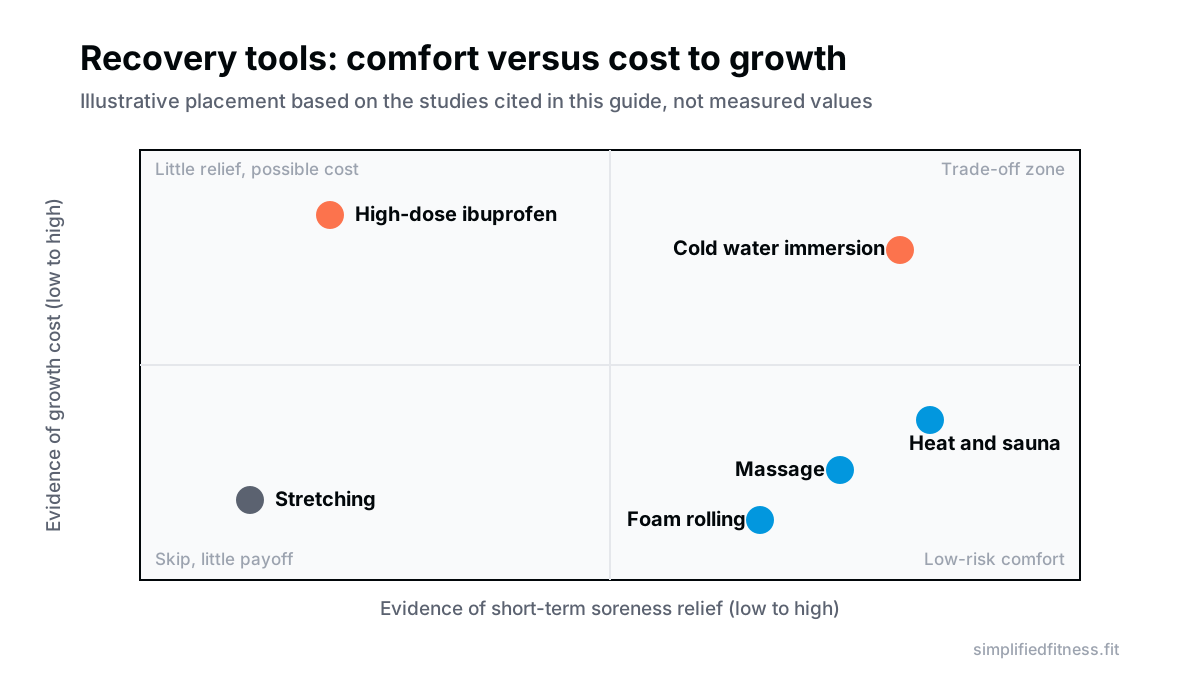
- Regular post-lifting cold water immersion reduced muscle fibre growth in two small trials in young men. If size is the goal, skip the routine ice bath after lifting.
- Heat, massage and foam rolling give small, short-term relief from soreness. They do not speed up tissue repair, so treat them as comfort tools.
- Stretching does not meaningfully reduce soreness, and maximal-dose ibuprofen (1200 mg/day) reduced strength and muscle gains in one 8-week trial.
- Soreness that is severe, one-sided with swelling, or comes with dark urine needs a doctor, not another recovery gadget.
Table of contents
DOMS muscle soreness recovery is where most lifters spend money and time they do not need to. Soreness is the ache that peaks a day or two after a hard or unfamiliar session. It is not a reliable sign of growth. And one popular fix, the post-workout ice bath, has been linked to smaller muscle gains in controlled trials.
This guide walks through what soreness actually is, why it fades, and what the research says about cold, heat, sauna, foam rolling, massage guns, stretching and painkillers. Where the evidence is thin or comes from small studies, I say so. For the bigger picture of how muscle is built, start with our complete muscle hypertrophy guide.
What is DOMS and why do muscles get sore after a workout?
Delayed onset muscle soreness is the stiffness, tenderness and weak feeling that creeps in after training you are not used to. It usually shows up the next day and can stick around for several days. Studies tend to check it at 24, 48 and 72 hours for exactly that reason.
The classic trigger is eccentric work: the lowering phase of a squat, a Romanian deadlift, a slow curl negative, or running downhill. New exercises, new rep ranges and a return from a break all do it too.
What is happening underneath? The usual explanation is microscopic disruption to muscle tissue plus the repair and inflammatory response that follows. Researchers still argue about exactly which part produces the pain, so be wary of anyone who tells you it is simply “lactic acid” or “toxins.” (Lactate is not what you feel the next day.)
Here is the part that matters for your training. Soreness tells you the stimulus was unfamiliar. That is about all it tells you.
Does muscle soreness mean muscle growth?
No. This is the most useful myth to drop.
A review of the role of muscle damage in hypertrophy by (Damas et al., 2018) laid out the case. In the first few sessions of a new program, muscle size increases are mostly explained by damage-related swelling. Later, as damage fades, muscle protein synthesis starts being directed at real growth rather than repair. The authors also point out that training that causes little damage still produces similar hypertrophy and strength gains compared with training that causes plenty. Their conclusion: muscle damage is not the process that mediates or potentiates resistance-training hypertrophy.
Put simply, you do not need to be wrecked to grow. And being sore does not prove you grew.
This matters in the gym. Lifters who judge sessions by soreness tend to do two things. They keep swapping exercises so everything stays “new” and sore, which wrecks progressive overload. Or they feel guilty on the days nothing hurts. Neither helps. If you want to see what actually drives progress, our guide on progressive overload, deloads and plateaus is a better scorecard, and the cluster article on DOMS versus muscle growth goes deeper on this exact question.
Why do I stop getting sore? The repeated bout effect
Ever notice that the leg day that crippled you in week one barely registers by week four? That is the repeated bout effect, and it is one of the most reliable findings in exercise science.
A 2023 systematic review and meta-analysis of 20 studies on multi-joint exercises found DOMS and creatine kinase (a blood marker of muscle damage) were significantly greater after the first bout than the second at 24 and 48 hours, with standardised mean differences of 0.51 to 1.23 (Doma et al., 2023). Strength and jump performance were also lower after the first bout. The results did not change with differences in intensity and volume between the two bouts. The authors concluded that one bout of commonly performed eccentric-involving exercises may protect against damage in later bouts.
So soreness fading is not a sign you have stopped growing. It is protective adaptation. Read more in the repeated bout effect explained.
The practical angle:
- Start a new exercise or program with a lighter first week.
- Keep your core lifts consistent for a block, so soreness dies down and loads can climb.
- Expect soreness to return briefly after a long layoff or a big change.
Should you train when you are still sore?
Mostly yes. If the soreness is mild to moderate and you can move through a full, controlled range, training is generally fine. A warm-up often makes the ache feel better for a while. For the full decision framework, see should you work out when sore.
Change the plan when soreness alters how you move, when you cannot hit your normal range of motion, or when the muscle feels swollen and weak. In that case, train something else or take the day off.
Two quick rules worth keeping: never grind a heavy compound set with a limp, and never treat sharp, localised or joint pain as DOMS. It is a different problem.
Do ice baths and cold plunges blunt muscle growth?
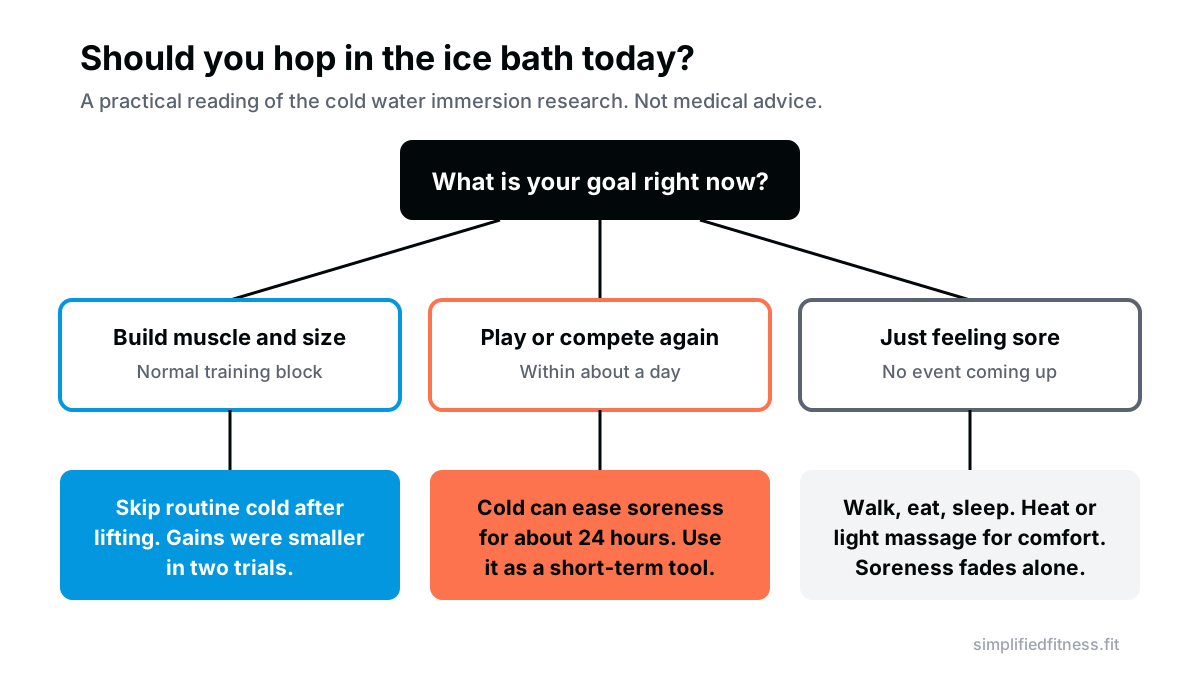
Here is the finding that makes this topic worth a pillar article. In two controlled trials, regularly sitting in cold water after lifting was linked to smaller adaptations.
Roberts et al., 2015 (the headline study). Twenty-one physically active men strength trained twice a week for 12 weeks, with either 10 minutes of cold water immersion or active recovery after each session. Strength and muscle mass increased more in the active recovery group. Type II muscle fibre cross-sectional area (+17%) and the number of myonuclei per fibre (+26%) rose with active recovery but not with cold immersion. A second study in nine active men looked at single sessions: biopsies showed satellite cell markers (NCAM and Pax7) increased more after active recovery, and phosphorylation of p70S6 kinase, a signal that regulates muscle growth, was greater too (Roberts et al., 2015). The authors recommended reconsidering cold water immersion as a regular recovery strategy.
Fyfe et al., 2019 (the replication with a twist). Sixteen men trained three days a week for 7 weeks and sat for 15 minutes at 10°C or at 23°C after each session. Improvements in 1-RM leg press were similar between groups. But type II fibre cross-sectional area growth was smaller with cold immersion, mTORC1 signalling was blunted, and a marker of protein breakdown (FOX-O1) was higher (Fyfe et al., 2019). Notably, the cold group also showed smaller increases in heat shock protein content (HSP27 and HSP72), which hints at one more way cold may change training adaptation.
Why the two studies differ, and what to take from them
Roberts found smaller strength gains with cold. Fyfe found similar leg press strength but smaller fibre growth. The designs differed (12 weeks versus 7, 10 minutes versus 15, different training programs and measures), and both studies were small groups of young men. So the honest reading is this: cold immersion consistently reduced the muscle-growth signal, and its effect on strength is less clear.
Is this “high confidence”? It is consistent across two trials plus mechanistic data, but both are small and neither included women, older adults or experienced lifters. I would call it a well-supported reason to avoid a routine habit, not proof of exactly how much size you would lose. The pillar’s deep-dive cluster covers this in detail: cold plunge and ice baths versus hypertrophy.
When cold still makes sense
Sometimes you do not care about growth this week. You care about being fresher tomorrow.
A meta-analysis of 32 randomised trials with 1,098 participants found cold therapy applied within 1 hour after exercise reduced DOMS pain within 24 hours (SMD -0.57), with no obvious effect after 24 hours (Wang et al., 2021). Cold water immersion specifically had an SMD of -0.48 within 24 hours. That is a real, short-lived effect, which fits a tournament weekend or a double session. We cover that case in cold water immersion for tournaments and athletic performance.
Does sauna or heat help recovery and muscle growth?
Heat is the mirror image. It looks comfortable and so far looks harmless for growth, but it has not been shown to build muscle either.
In a randomised crossover trial, 16 male basketball players did a heavy resistance session followed by 20 minutes of infrared sauna (about 43°C) or passive rest. Fourteen hours later the drop in countermovement jump performance was smaller after sauna, and soreness was lower with higher perceived recovery (Ahokas et al., 2023). Heart rate variability was lower right after the session but did not differ by that night.
What about over weeks? A 6-week study of 40 female team sport athletes had half of them use infrared sauna (10 minutes at 50°C) after training three times per week. Both groups improved in muscle hypertrophy and neuromuscular performance, and there were no group differences in hypertrophy measures. Jump height and peak power at one loaded jump condition improved in the sauna group, which the authors suggest might boost power production (Ahokas et al., 2025).
So the fair summary: post-exercise sauna may reduce soreness and doesn’t appear to impair hypertrophy, but there is no evidence here that it adds muscle. Both studies were short and in athletes, not general gym lifters, and infrared saunas are not the same as a hot Finnish sauna. More detail lives in our sauna and heat therapy article.
Heat vs cold for soreness itself: the 32-trial meta-analysis found no significant difference between cold and heat for pain. Heat effects were present within 24 hours and beyond, and hot packs showed the largest effect, though the authors say more high-quality studies are needed (Wang et al., 2021). Since heat has no known growth penalty, it is a sensible default when you want comfort.
Does foam rolling work for DOMS and recovery?
A little, for how it feels.
A 2019 meta-analysis of 21 studies looked at foam rolling before and after exercise. Post-exercise rolling reduced perceived muscle pain by about 6% (g = 0.47), slightly attenuated the drop in sprint (g = 0.34) and strength performance (g = 0.21), and had no meaningful effect on jump performance. The authors concluded that effects on performance and recovery are rather minor and partly negligible, and that the evidence supports foam rolling more as a warm-up than a recovery tool (Wiewelhove et al., 2019).
Notice something missing: nothing in these results says foam rolling “releases fascia” or “breaks up knots.” What the data show is a short-term shift in how sore you feel and how flexible you are. That is useful, just not magic. Our foam rolling science article covers the fascia claims.
How to use it without overthinking: roll the sore muscle for 1 to 2 minutes per area, keep the pressure tolerable, and move on. A rolled quad before squats is a decent warm-up; a rolled quad that is badly bruised and swollen is a bad idea.
Do massage guns and massage speed up recovery?
Hands-on massage has better evidence than gadgets, though the effect sizes are small.
Dupuy and colleagues pooled 99 studies and reported that active recovery, massage, compression garments, immersion, contrast water therapy and cryotherapy gave small to large decreases in DOMS, with massage the most effective for reducing DOMS and perceived fatigue (Dupuy et al., 2018). A separate review of 29 randomised studies with 1,012 participants found no evidence that massage improves strength, jump, sprint, endurance or fatigue, but small, statistically significant improvements in flexibility and DOMS (Davis et al., 2020). The two are consistent on one point: massage helps how you feel more than how you perform.
Massage guns are a different story because the research is young and small.
- In 65 active adults, a 5-minute massage gun session on the calf after strenuous exercise produced no significant effects on range of motion, strength, endurance or perceived soreness. There was even a small increase in perceived soreness up to 4 hours later, so the authors advised caution applying one right after strenuous lower body exercise (Leabeater et al., 2024).
- In 17 untrained participants after eccentric elbow exercise, one minute of percussive massage at several time points improved range of motion by about 6-8 degrees and lowered soreness scores by about 2-3 points at 24-72 hours compared with rest. It did not change isometric strength, and relief was mostly immediate and temporary (Roberts et al., 2024).
Two studies, two answers. They differ in muscle (calf versus biceps), participants (active versus untrained), session length and timing, so the sensible takeaway is that a gun is a comfort tool, not a recovery accelerator. If you own one, go gentle, keep it brief, and skip it over painful or swollen areas. See massage gun science for the full picture.
Does stretching after a workout prevent soreness?
No. Cochrane reviewed 12 studies of stretching before or after exercise, including one large trial with 2,377 participants. Post-exercise stretching lowered soreness at one day by about 1 point on a 100-point scale, and even the large trial’s statistically significant effect on peak soreness was about 4 points, which the authors called very small. Their conclusion was that stretching, before or after exercise, does not produce clinically important reductions in DOMS in healthy adults (Herbert et al., 2011). Evidence quality was low to moderate, and most studies carried a moderate or high risk of bias.
That does not make stretching bad. If you like it or want more flexibility, carry on. Just do not expect it to rescue your legs. More in the post-workout stretching soreness myth.
Is it safe to take ibuprofen for muscle soreness?
Painkillers are a medical topic, so treat this as information and not advice. Talk to a doctor or pharmacist about what is right for you, especially if you have stomach, kidney, heart or blood pressure problems.
On the muscle side, the evidence is split, and the dose seems to matter.
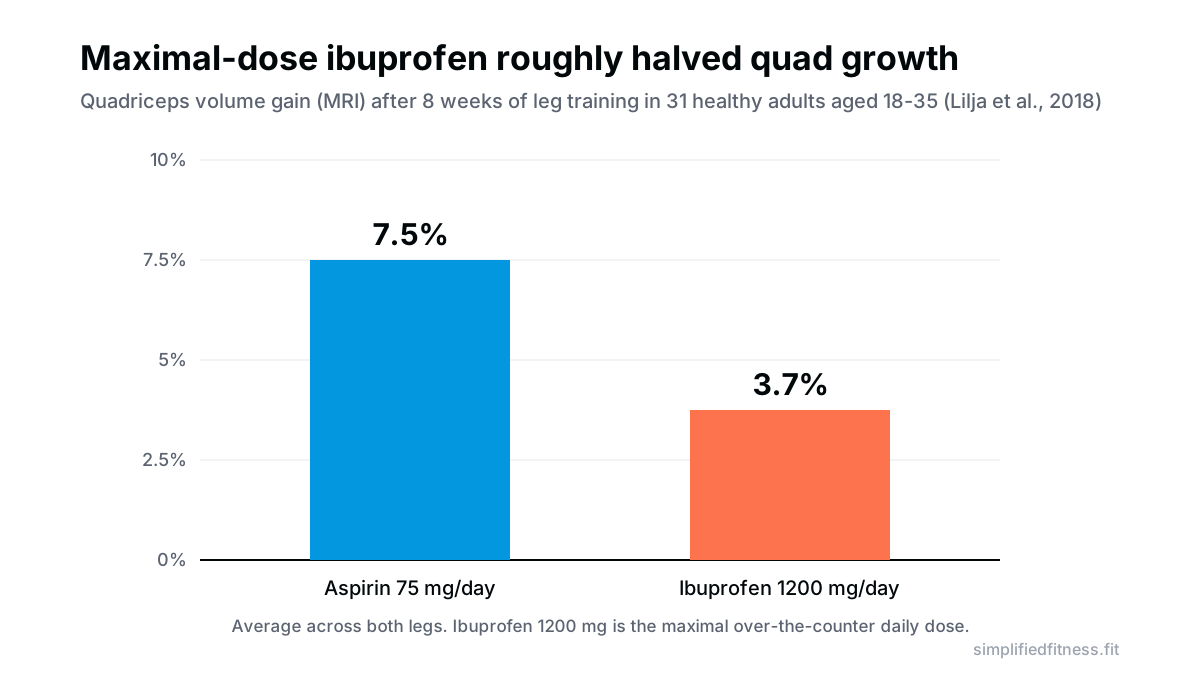
- Higher dose, longer period. In 31 healthy adults aged 18-35, the group taking 1200 mg/day of ibuprofen for 8 weeks gained about 3.7% quadriceps volume versus 7.5% for the group taking 75 mg of aspirin. Strength gains were generally greater in the aspirin group for the flywheel-trained leg, but similar between groups for the weight-stack leg. The authors advised young people trying to maximise growth to avoid excessive anti-inflammatory use (Lilja et al., 2018).
- Moderate dose, shorter. In 18 men and women who trained each arm separately for 6 weeks and took 400 mg of ibuprofen after training one arm and a placebo after training the other, muscle thickness and strength gains were the same in both arms, and soreness ratings did not differ (Krentz et al., 2008).
Why might they differ? Dose (1200 versus 400 mg), duration (8 versus 6 weeks), training method (flywheel and weight stack versus arm curls) and the comparison group (aspirin versus placebo) all differ. So the cautious takeaway: heavy, regular anti-inflammatory use looks like the risk, and it is not a way to treat ordinary soreness. Interestingly, in the moderate-dose study ibuprofen did not even reduce soreness. Read more in NSAIDs, ibuprofen and muscle gains.
What about compression, active recovery and food?
A few quick calls, with the evidence level stated.
- Compression garments. Dupuy’s meta-analysis listed compression garments among methods that lowered DOMS and perceived fatigue (Dupuy et al., 2018). Effects are small and subjective. In Indian summers, comfort may decide it. We go deeper on compression garments and on compression boots and lymphatic claims.
- Active recovery. The same meta-analysis found active recovery gave a small to large decrease in DOMS, and in the Roberts trial the active recovery group had the best adaptations (Roberts et al., 2015). An easy 20 to 30 minute walk, a cycle or a light mobility session is a good default. See gentle active recovery.
- Food and supplements. Tart cherry and omega-3 get a lot of attention, but we did not review the trials for this pillar. Our cluster on nutrition for muscle soreness covers them. The boring basics, enough protein and total calories, matter more. Use our protein calculator to set a daily target.
- Gadgets in general. Cryotherapy chambers, red light panels and similar devices are mostly unproven for soreness. We audit them in recovery gadgets under the microscope.
Quick comparison: what each tool does for soreness and growth
| Tool | Soreness relief | Muscle growth effect | Evidence quality |
|---|---|---|---|
| Cold water immersion | Short-term, within about 24 h | Smaller fibre growth in two small trials | Consistent but small, young men |
| Sauna / heat | Likely small relief | No hypertrophy difference in one trial | Limited, mostly athletes |
| Foam rolling | Small (about 6% less pain) | No known penalty | Meta-analysis, rather minor effects |
| Massage | Small (DOMS, flexibility) | No known penalty | Meta-analyses |
| Massage gun | Mixed, small, brief | No data on growth | Few, small studies |
| Stretching | No clinically important effect | No known penalty | Cochrane, low to moderate quality |
| High-dose ibuprofen | No clear soreness benefit | Blunted gains at 1200 mg/day (8 weeks) | One RCT against one with no effect |
| Active recovery | Small to large across studies | Best adaptations in cold immersion comparison | Meta-analysis plus RCT |
What actually helps you recover (and a simple plan)
The tools above shave the edge off soreness. They are not what makes you recover. Training stress is what makes you tired, so the foundation is managing it.
- Sleep first. 7 to 9 hours is the baseline. Our sleep and systemic recovery guide covers why nothing else compensates.
- Eat enough. Protein across the day, and not under-eating by too much. Dal, paneer, curd, eggs, soya chunks and chicken all work on an Indian budget.
- Ease into new work. A practical rule of thumb (not a tested protocol) is to start a new exercise at about 60 to 70% of what you think you can handle. Thanks to the repeated bout effect, later sessions should hurt less.
- Manage weekly volume. More sets are not always better. Our training volume and frequency guide and the training volume calculator help you set a sensible number.
- Walk on rest days. Easy movement is the cheapest recovery tool.
- Plan deloads. If performance sinks week after week, a lighter week is smarter than another gadget. See the deload week guide.
- Use tools for comfort only. Heat, a foam roller, a massage or a short walk. Skip routine cold plunges and routine painkillers if you are trying to grow.
If you want a structured plan that already balances volume and rest, try our free workout plans.
When to see a doctor
Normal DOMS is achy, symmetrical across the muscles you trained, and improves within about 3 to 5 days. Get medical advice promptly if you notice:
- severe pain with obvious swelling or tightness in one limb
- dark, tea-coloured or cola-coloured urine
- weakness that is out of proportion to the soreness
- soreness that gets worse after day 3 to 5 instead of better
- sharp, joint-based or pinpoint pain, numbness or tingling
These can point to an injury or to rhabdomyolysis, a condition where muscle breakdown overloads the kidneys. A case report has even described severe rhabdomyolysis in a young woman who received massage gun treatment after cycling (Chen et al., 2021). It is a single case, but heavy pressure on tender muscle is not risk-free. This guide cannot diagnose anything. When in doubt, ask a doctor.
Evidence limits and conflicts
A few honest caveats about everything above:
- The cold immersion trials are small, in young men, and over 7 to 12 weeks. We do not know how large the effect is in women, older adults or very experienced lifters.
- Roberts found smaller strength gains with cold, while Fyfe did not. The reason is not settled.
- The sauna studies are in athletes using infrared saunas, with short follow-up.
- Massage gun evidence is two small studies pointing in different directions.
- The ibuprofen trials differ on dose and design, so their results should not be forced into one story.
Where the evidence is conflicting, the pattern holds: the safest path is to use tools for comfort, avoid habits with a plausible growth penalty, and spend your effort on training, food and sleep.
The bottom line
DOMS muscle soreness recovery comes down to patience and basics. Soreness is not a progress meter. It fades through the repeated bout effect. Heat, massage, foam rolling and walking can make you more comfortable, none of them rebuild tissue faster, and regular ice baths and heavy painkiller use have evidence against them for muscle gain. Pick the cheap, low-risk options, keep your lifts progressing, and see a doctor when soreness looks wrong.
Go deeper: every guide in this topic
- Cold Plunge After Workout: Does an Ice Bath Blunt Muscle Growth?
- Ice Baths for Athletes: When Cold Water Immersion Helps at Tournaments
- Compression Boots and Lymphatic Drainage: Do They Really Speed Recovery?
- Compression Garments for Lifters: Do Tights and Sleeves Really Help Recovery?
- Deload Week Physiology: How to Deload and Not Lose Muscle
- DOMS Explained: Why Muscle Soreness Does Not Equal Muscle Growth
- Foam Rolling and Fascia: What the Science Says About Releasing Tight Muscles
- Hot vs Cold Showers After a Workout: What the Evidence Says About Recovery
- Do Massage Guns Work? What the Science Says About Percussion Therapy
- Does Ibuprofen Kill Muscle Growth? What the Human Trials Show
- Nutrition for Muscle Soreness: Does Tart Cherry, Omega-3 or Protein Help?
- How Often Should You Deload? Calendar Schedule or Listen to Your Body
- Recovery Gadgets vs Real Science: Cryotherapy, Red Light Beds and Grounding Mats Audited
- Sauna After Lifting: Heart Health Perks, Heat Shock Protein Hype and Real Recovery
- Should You Work Out When Sore? A Practical Guide to Training with DOMS
- Why Poor Sleep Makes You Feel More Sore: Sleep Loss and Pain Sensitivity
- Does Stretching Prevent Soreness? What the Cochrane Review Found
Frequently Asked Questions
What is DOMS and why does it happen?
DOMS (delayed onset muscle soreness) is the aching, stiff feeling that builds in the day or two after unfamiliar or hard training, especially exercise with a lot of lowering (eccentric) work. It is linked to microscopic muscle disruption and the repair response, although researchers still debate the exact pain mechanism. Ease back in with a lighter first session whenever you start a new movement.
How long does DOMS last?
Most DOMS fades within about 3 to 5 days, with studies commonly tracking soreness at 24, 48 and 72 hours after the damaging session. Soreness is typically worst somewhere in that 1 to 3 day window and then drops off. If pain is still climbing after 5 days or is sharp rather than achy, get it checked.
Does muscle soreness mean muscle growth?
No. A review of muscle damage and hypertrophy concluded that muscle damage is not the process that mediates or boosts resistance-training growth, and training that causes little damage still produces similar gains. Soreness mostly tells you the exercise was new or had a big eccentric component. Judge progress by whether your weights and reps climb over weeks, not by how bad the stairs feel.
Should I train if I am still sore?
Usually yes, if the soreness is mild to moderate and you can move through a normal range of motion. Training a sore muscle lightly is generally tolerated, and a repeated-bout effect means the same session hurts less next time. If soreness changes how you move or you feel weak and swollen, train a different muscle group or rest.
What is the repeated bout effect?
It is your muscles' protective adaptation: after one damaging session, the next similar session causes less soreness and less damage. A 2023 meta-analysis of 20 studies found soreness and creatine kinase were lower in the second bout at 24 and 48 hours. This is why soreness fades once a program becomes familiar, so do not switch exercises every week and chase soreness.
Do ice baths build or kill muscle growth?
Regular ice baths after lifting can work against growth. In a 12-week trial, strength and muscle mass increased more with active recovery than with 10 minutes of cold water immersion, and a 7-week trial found smaller type II fibre growth with cold immersion. If building muscle is your priority, skip routine post-workout cold plunges.
Why do ice baths blunt hypertrophy?
Cold water immersion reduced post-exercise activation of p70S6 kinase and the satellite cell response in one study, and blunted mTORC1 signalling (rps6 phosphorylation) in another, both pathways tied to muscle growth. This is mechanistic and from small groups of young men, so the exact reason is not settled. Keep cold immersion away from your regular lifting days.
Do cold plunges hurt strength gains too?
The evidence is mixed. Roberts and colleagues found smaller strength gains with cold immersion over 12 weeks, while Fyfe and colleagues found similar 1-RM leg press gains but smaller fibre growth over 7 weeks. Cold seems to hit size more reliably than strength, and both trials were small and in men only.
When is an ice bath actually worth it?
When you need to feel fresher within about a day, for example between tournament matches or a second session. A meta-analysis of 32 trials found cold applied within 1 hour of exercise reduced soreness within 24 hours but not after that. Use it sparingly for performance days, not as a habit for every gym session.
Does a sauna help muscle recovery or growth?
Sauna may take the edge off soreness but has not been shown to build muscle. A crossover trial in 16 basketball players found less soreness and a smaller drop in jump performance after an infrared sauna, while a 6-week trial in 40 female athletes found no change in hypertrophy. Use sauna for relaxation and comfort, not as a growth tool.
Does heat or cold work better for soreness?
Both reduce soreness pain in the short term and a 32-trial meta-analysis found no significant difference between them. Heat, particularly hot packs, showed effects beyond 24 hours while cold mainly helped within 24 hours. Since cold has a hypertrophy downside, heat is the safer default for comfort.
Does foam rolling reduce muscle soreness?
Slightly. A meta-analysis of 21 studies found post-exercise foam rolling reduced perceived muscle pain by about 6 percent (g = 0.47), with only small effects on performance. It is cheap and harmless, so use 5 to 10 minutes on sore areas if it feels good, but do not expect it to rebuild tissue.
Does foam rolling break up fascia or knots?
No, the studies do not show that foam rolling changes tissue structure; the benefits look like short-term changes in pain perception and flexibility. The 2019 meta-analysis called its recovery effects rather minor. Roll for comfort and a better warm-up, and keep your expectations modest.
Do massage guns help recovery?
They feel good, but the evidence is thin. A study of 65 active adults found a 5-minute massage gun session did not change strength, range of motion or soreness, while a small trial in 17 untrained participants found temporary soreness relief and a better range of motion after repeated treatments. Use one gently for comfort and avoid pressing hard into tender, swollen muscle.
Is massage better than other recovery methods?
For soreness, massage looks like one of the better options but the effect is small. A 99-study meta-analysis ranked massage as the most effective method for reducing DOMS and fatigue, while a separate 29-study meta-analysis found small improvements in DOMS and flexibility but none in strength or sprint performance. Book one if you enjoy it, since it is not essential.
Does stretching after a workout prevent soreness?
No. A Cochrane review found stretching before or after exercise does not produce clinically important reductions in DOMS in healthy adults, with post-exercise stretching lowering soreness by about 1 point on a 100-point scale. Stretch if it feels nice or you want flexibility, but do not rely on it for soreness.
Can I take ibuprofen for muscle soreness?
Occasional use is a medical decision and not unsafe by itself, but regular high doses may blunt gains. In an 8-week trial of 31 adults, 1200 mg/day of ibuprofen gave smaller quadriceps growth than 75 mg/day of aspirin (3.7% versus 7.5%), whereas a 6-week trial using 400 mg/day found no impact on growth or strength. Ask a doctor or pharmacist before using painkillers, and do not use them as a routine pre-workout habit.
Do compression garments help with soreness?
They may help a little. A 99-study meta-analysis found compression garments were among the methods that gave a small to large decrease in DOMS and helped manage perceived fatigue. In a hot Indian summer they can be uncomfortable, so only use them if you find them helpful.
Is active recovery better than complete rest?
Light movement tends to help soreness more than sitting still. Dupuy and colleagues found active recovery gave a small to large drop in DOMS across 99 studies, and the active-recovery group in the Roberts cold immersion trial gained the most. A 20 to 30 minute easy walk or cycle on rest days is a good default.
What actually speeds up recovery from soreness?
Sleep, enough food and protein, and progressively easing into new training do most of the work, with tools adding only small relief. The review on muscle damage notes growth does not depend on soreness, so recovery means being ready to train well again. Prioritise 7 to 9 hours of sleep, regular meals and a sensible weekly volume before buying gadgets.
When is muscle soreness a sign of something serious?
See a doctor if you have severe pain with marked swelling, weakness, dark or tea-coloured urine, or soreness that gets worse after 3 to 5 days. These can signal rhabdomyolysis or an injury rather than DOMS. A 2021 case report described severe rhabdomyolysis after massage gun treatment, so do not push through alarming symptoms.
Why am I not sore anymore, am I still growing?
Yes, you can still grow. The repeated bout effect means familiar training produces much less soreness, and a review concluded that damage is not what drives hypertrophy. Check that your reps or load are going up over the weeks, and add overload through weight, reps or sets.
Do hot and cold showers help recovery?
They are mild versions of heat and cold therapy, so expect comfort rather than faster repair. The cold-immersion growth findings come from 10 to 15 minute immersion in cold water, not a short shower, so a brief cool shower is unlikely to matter much. Use whichever temperature feels good and keep your focus on sleep and food.
Sources & References
Every claim above is checked against peer-reviewed research (PubMed, U.S. National Library of Medicine) or guidance from established health bodies. How we fact-check.
- Roberts LA, et al. Post-exercise cold water immersion attenuates acute anabolic signalling and long-term adaptations in muscle to strength training. J Physiol. 2015. PMID: 26174323
- Fyfe JJ, et al. Cold water immersion attenuates anabolic signaling and skeletal muscle fiber hypertrophy, but not strength gain, following whole-body resistance training. J Appl Physiol. 2019. PMID: 31513450
- Damas F, et al. The development of skeletal muscle hypertrophy through resistance training: the role of muscle damage and muscle protein synthesis. Eur J Appl Physiol. 2018. PMID: 29282529
- Doma K, et al. The repeated bout effect of multiarticular exercises on muscle damage markers and physical performances: a systematic review and meta-analyses. J Strength Cond Res. 2023. PMID: 38015738
- Wang Y, et al. Heat and cold therapy reduce pain in patients with delayed onset muscle soreness: a systematic review and meta-analysis of 32 randomized controlled trials. Phys Ther Sport. 2021. PMID: 33493991
- Dupuy O, et al. An evidence-based approach for choosing post-exercise recovery techniques to reduce markers of muscle damage, soreness, fatigue, and inflammation: a systematic review with meta-analysis. Front Physiol. 2018. PMID: 29755363
- Ahokas EK, et al. Effects of repeated use of post-exercise infrared sauna on neuromuscular performance and muscle hypertrophy. Front Sports Act Living. 2025. PMID: 40104529
- Ahokas EK, et al. A post-exercise infrared sauna session improves recovery of neuromuscular performance and muscle soreness after resistance exercise training. Biol Sport. 2023. PMID: 37398966
- Wiewelhove T, et al. A meta-analysis of the effects of foam rolling on performance and recovery. Front Physiol. 2019. PMID: 31024339
- Leabeater AJ, et al. Under the gun: percussive massage therapy and physical and perceptual recovery in active adults. J Athl Train. 2024. PMID: 37248364
- Roberts TD, et al. Effects of percussive massage treatments on symptoms associated with eccentric exercise-induced muscle damage. J Sports Sci Med. 2024. PMID: 38455428
- Davis HL, et al. Effect of sports massage on performance and recovery: a systematic review and meta-analysis. BMJ Open Sport Exerc Med. 2020. PMID: 32426160
- Herbert RD, et al. Stretching to prevent or reduce muscle soreness after exercise. Cochrane Database Syst Rev. 2011. PMID: 21735398
- Lilja M, et al. High doses of anti-inflammatory drugs compromise muscle strength and hypertrophic adaptations to resistance training in young adults. Acta Physiol. 2018. PMID: 28834248
- Chen J, et al. Rhabdomyolysis after the use of percussion massage gun: a case report. Phys Ther. 2021. PMID: 33156927
- Krentz JR, et al. The effects of ibuprofen on muscle hypertrophy, strength, and soreness during resistance training. Appl Physiol Nutr Metab. 2008. PMID: 18461099

Umair Hazrami · Founder & Head Coach, Simplified Fitness
Umair Hazrami founded Simplified Fitness and the Simplified Lifter channel to cut through fitness noise. With 4+ years of consistent training and 10+ coaching clients, he writes every guide from the peer-reviewed research and links the sources so you can check them. Our editorial standards.
Educational content only, not medical advice. If you have a medical condition, are pregnant, or take medication, talk to a qualified doctor before changing your diet, supplements or training. Full disclaimer.
Keep reading
Recovery
Active Recovery on Rest Days: Walking, Light Cycling and Mobility
Active recovery vs passive rest for lifters: what the research says about walking, light cycling and mobility, plus a 20-minute rest day routine you can copy.
7 min read
Recovery
Afternoon Caffeine Cutoff: Half-Life, Deep Sleep and Pre-Workout
Afternoon caffeine cutoff for lifters: how caffeine's half-life cuts sleep time and deep sleep even if you fall asleep fine, plus a practical cutoff by bedtime.
9 min read
Recovery
Blue Light, Melatonin and Screen Time: Do Blue-Blockers Actually Help You Sleep?
Blue light screen time melatonin suppression is real, but do blue-blocking glasses fix it? See what the trials found and the free fixes that matter more.
7 min read
Recovery
Is Your CNS Fried? CNS Fatigue vs Plain Lethargy in the Gym
Is my CNS fried from lifting? See what central fatigue really is, how fast it recovers and how to tell it from low motivation or poor sleep. Studies linked.
9 min read