Compression Garments for Lifters: Do Tights and Sleeves Really Help Recovery?
Do compression tights help recovery after lifting? Meta-analyses show small effects on soreness, swelling and strength. See what works, what doesn't, and when.

TL;DR. The short answer
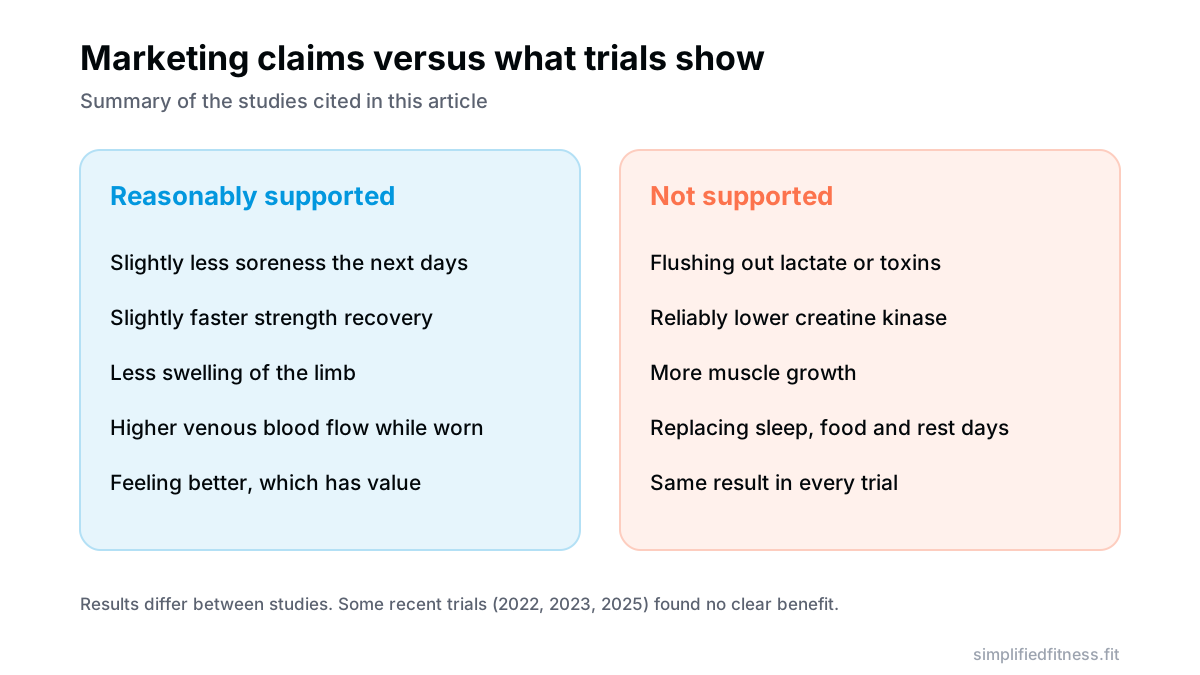
- Compression tights for recovery have small to moderate benefits in meta-analyses: slightly less soreness, slightly faster strength recovery and less limb swelling. They do not speed up muscle growth.
- A 2017 meta-analysis of 23 studies found the biggest gains for strength recovery after resistance exercise, but newer trials in trained lifters have found no clear benefit, so results are mixed.
- The 'flushes lactate and toxins' claim is not supported. Venous blood flow rises while the garment is worn, but the evidence on blood markers of muscle damage such as creatine kinase is mixed.
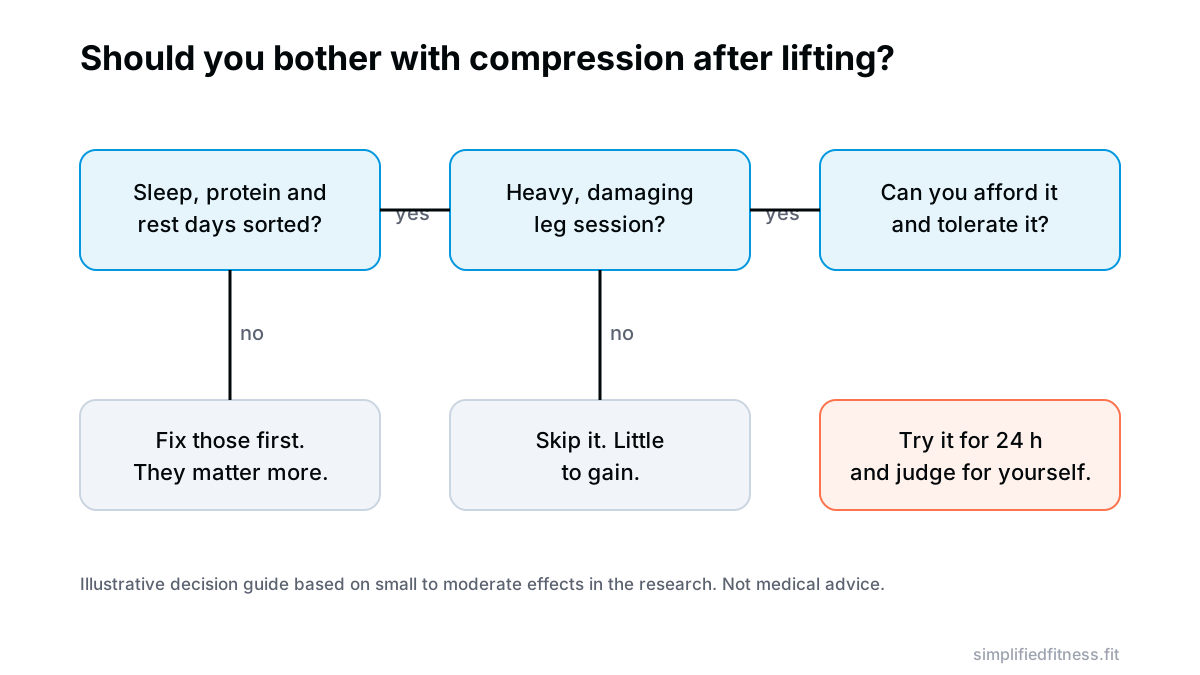
- Wearing them for several hours, up to a day, after a hard leg session is how most positive trials used them. Sleep, protein and rest days will do far more than any garment.
- Swelling in only one leg, calf pain or known circulation problems? See a doctor before using compression.
Part of our complete guide: Muscle Soreness (DOMS), Heat/Cold Modalities & Recovery Methods: What Science Actually Supports
Table of contents
Compression tights for recovery probably help a little, not a lot. Pooled data from controlled trials show small to moderate improvements in soreness, swelling and strength recovery, while newer trials in trained lifters are mixed.
That puts compression in the “nice to have” pile. Our complete guide to soreness and recovery modalities ranks the tools by what they actually deliver, and this article looks at one of them: the tight elastic gear that gets sold as a recovery shortcut.
The marketing says it boosts circulation and clears waste. The research says something quieter.
How compression garments are supposed to work
The idea is simple. An elastic garment squeezes the limb from outside, tighter at the ankle and looser toward the thigh in graded designs. That squeeze is meant to help veins push blood back toward the heart (venous return), limit fluid leaking into the tissue, and reduce how much the muscle wobbles with each step or rep.
Does the first part happen? Partly. A 2023 meta-analysis of 22 studies in healthy people found sports compression garments improved venous blood flow at rest, during exercise and in recovery, but not immediately after exercise (O’Riordan et al., 2023). The pooled effect was small (standardized mean difference about 0.3 to 0.7 depending on the subgroup).
So the physics works. Whether that blood flow changes how fast you recover is a different question.
Do compression garments reduce soreness and help recovery?
Two meta-analyses form the backbone of the pro-compression case. The first pooled 12 studies of recovery from damaging exercise and found moderate effects on soreness (Hedges’ g 0.40), strength (0.46), power (0.49) and creatine kinase (0.44) at 24, 48 or 72 hours (Hill et al., 2014).
The second pooled 23 studies in healthy participants and found small, very likely benefits overall (effect size 0.38). Strength recovery benefited most (0.62), and recovery after resistance exercise showed an effect size of 0.49, largest at more than 24 hours afterwards (Brown et al., 2017).
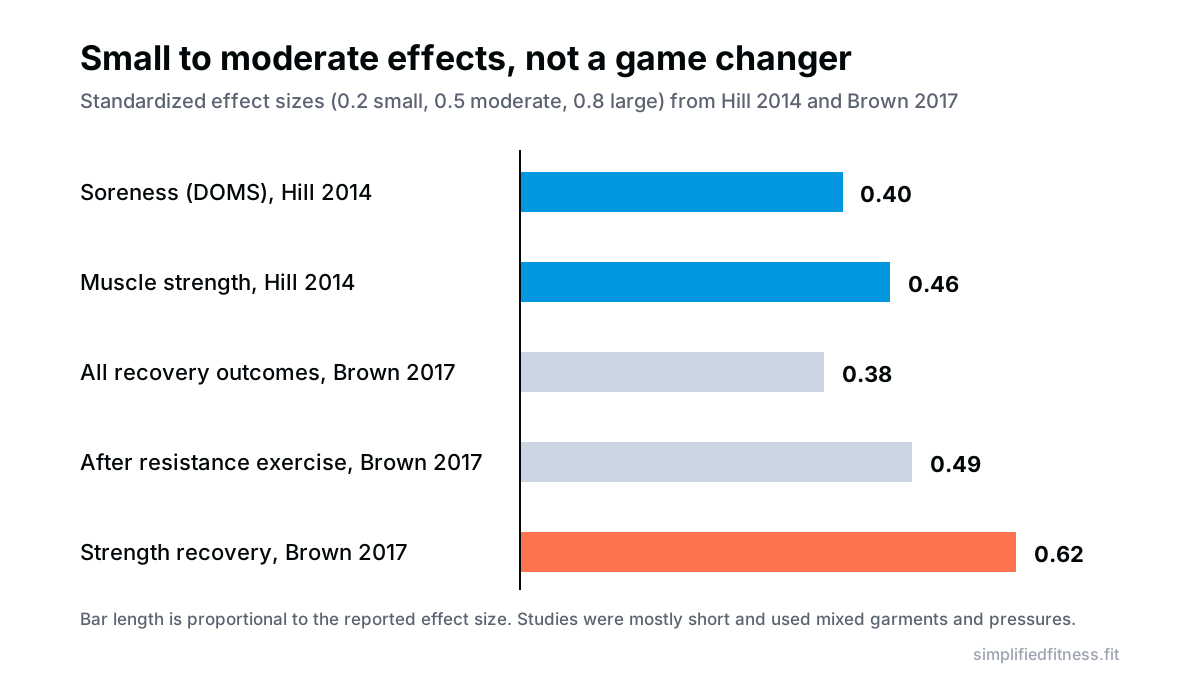
A third analysis, with heavy heterogeneity between studies, reported lower muscle swelling (SMD -0.73), better perceptual scores (-0.43) and faster recovery of strength and power, but no change in creatine kinase (Marqués-Jiménez et al., 2016). The authors said findings need corroboration.
Notice the pattern. The garments seem to help how muscles perform and feel more consistently than they move blood markers of damage: creatine kinase dropped in the 2014 analysis but did not change in the 2016 one or in the lifting trial below.
What happens in actual lifters?
Meta-analyses mix runners, cyclists and gym-goers. Here are the trials in people who lift.
Goto and Morishima (2014): nine trained men did a nine-exercise whole-body session and wore either compression garments or normal clothes for 24 hours. The compression trial showed faster recovery of chest press 1RM at 3-8 hours and better knee extension strength at 24 hours. Soreness and fatigue were lower the next morning, and arm and thigh circumference rose only in the control trial. Blood markers of damage were similar (Goto & Morishima, 2014). Very small sample, one session.
O’Riordan et al. (2022): 22 resistance-trained people did a lower-body session and wore tights for 4 hours, took a placebo tablet, or did nothing. The statistical tests found no significant differences. Effect sizes, however, favoured compression for venous return markers, performance, perceived recovery and thigh girth, and the authors concluded the benefit was not just placebo. The study was funded by a garment maker, which the authors declared (O’Riordan et al., 2022).
Leabeater et al. (2025): 20 resistance-trained participants did a leg press session and wore tights or nothing for 5 hours. Researchers found no differences in muscle protein synthesis markers, muscle blood flow, performance or perceived recovery (Leabeater et al., 2025).
Why the studies disagree
Same garments, different verdicts. A few reasons are plausible.
- Different exercise. Studies using eccentric-heavy, damaging work tend to show more benefit than a normal session.
- Different wear time. Four to five hours is not 24 hours.
- Small samples. The trials here had 9 to 34 people, so one extra or missing responder moves the result.
- Soft outcomes. Soreness and “how recovered do I feel” are subjective, and a tight garment is hard to blind.
- Funding. Some trials were funded by manufacturers. That does not make them wrong, but it is worth knowing.
A fair reading: the average effect is small and positive, individual studies bounce around it, and nobody should expect a dramatic change.
Do compression garments reduce swelling?
Probably a little. In the Goto trial, circumference stayed flat with compression and rose without it. The 2016 meta-analysis found lower muscle swelling, and the 2022 trial reported a lower thigh girth in effect-size terms (Marqués-Jiménez et al., 2016).
But swelling after hard training is partly a normal part of the repair process, not just a nuisance. Less swelling does not mean more recovered muscle fibres. It is a signal worth knowing about, not a goal.
Can compression get in the way of adaptation?
One trial deserves a mention. Brown et al. gave 34 non-resistance-trained men either medical-grade compression garments or a placebo for 72 hours after an eccentric-focused leg session, then repeated the session 14 days later. Compression did not improve recovery, and it blunted the repeated-bout effect (the protection a first hard session gives the next one) for isokinetic strength at higher speeds. The authors suggested it could be contraindicated after unaccustomed exercise in this group (Brown et al., 2023).
That is one trial in untrained men, and nobody has shown the same thing in experienced lifters. But it is a good reason not to wear tights after every single session out of habit. If you want to understand why soreness drops the second time round, see our guide to the repeated bout effect.
Should you wear compression during or after lifting?
The best-supported window is after training. Venous blood flow improved with garments on during exercise and in recovery in the 2023 meta-analysis, but there is no strong evidence that wearing tights during a lift improves your performance or growth (O’Riordan et al., 2023).
A sensible, low-risk way to test it:
- Train legs hard as normal.
- Put the tights on within an hour or two afterwards.
- Wear them for the rest of the day and, if comfortable, overnight (the 24-hour protocol in Goto’s trial).
- Compare soreness, stiffness and how your next squat session feels with a session where you skipped them.
One test on yourself will not prove anything, because soreness varies for many reasons. But if you notice nothing after two or three trials, you have your answer for free.
What about compression sleeves and socks?
Most research tested tights, socks or full-leg garments after leg-heavy or whole-body exercise. We did not find controlled evidence in the studies reviewed here that arm sleeves reduce DOMS, so if you want sleeves for your biceps day, treat any benefit as small and unproven.
Socks are the same story. They squeeze the lower leg and can improve venous return in the calf, and for a long day on your feet that may feel good. Whether they improve recovery from lifting is not established by the trials above.
Compression versus the other recovery tools
| Tool | What the evidence suggests | Cost |
|---|---|---|
| Compression tights | Small effects on soreness, swelling, strength | Moderate to high |
| Sleep (7-9 hours) | The foundation; short sleep makes soreness feel worse | Free |
| Foam rolling | Short-term soreness relief; see our foam rolling article | Low |
| Massage guns | Similar short-term effects; see our percussion guide | Moderate |
| Compression boots | Different technology; see compression boots | High |
The table is a rough guide, not a ranking from head-to-head trials.
Who should avoid compression?
Healthy people can generally wear compression garments without problems. Some should check first.
- Known or suspected peripheral artery disease, because squeezing a limb with poor arterial supply can do harm.
- Swelling, warmth or pain in one calf, which can be a blood clot. This needs urgent medical attention, not a tighter garment.
- Skin infection, open wounds or numbness in the limb.
- Heart failure or kidney disease with fluid retention. Ask your doctor.
If you do wear them, stop if you feel tingling, numbness, a pinching ring at the top edge or increasing pain.
Is it worth buying in India?
In heat and humidity, tight synthetic gear can feel like wearing a plastic bag. Look for breathable fabric, and consider wearing them in the evening in an air-conditioned room rather than during a hot commute.
On a budget, a branded pair is a poor first purchase. The same money covers a lot of dal, curd, paneer or eggs, which help recovery more. If you want something low-cost to try, a properly fitted pair of basic compression tights is a fair experiment, and a plain night’s sleep is the other. For a leg day structure worth recovering from, see our leg day plan.
The practical takeaway
Compression tights have a small, plausible, inconsistent effect. They may take the edge off next-day soreness and swelling and nudge strength recovery, mostly after hard, eccentric-heavy leg work. They do not clear lactate, cannot replace sleep or protein, and there is no evidence they build more muscle.
If you already own a pair and like them, wear them after your heaviest sessions. If you do not, spend the money elsewhere. And if you want to understand why soreness is a poor measure of a good workout anyway, read DOMS versus muscle growth.
This article is general education, not medical advice. If you have pain, one-sided swelling or circulation problems, see a doctor.
Frequently Asked Questions
Do compression tights help recovery after lifting?
They may help a little. Meta-analyses report small to moderate improvements in soreness and strength recovery, but individual trials are mixed. Try them for 24 hours after a hard leg session if you want to test them, and judge by how your next session feels.
Do compression sleeves help DOMS?
There is no good direct evidence for arm sleeves specifically in the studies reviewed here. Most research tested tights, socks or full-leg garments after leg-heavy exercise. If you try sleeves, treat any benefit as small and possibly perceptual.
Should I wear compression during or after my workout?
The best-supported use is after training, worn for several hours up to 24 hours. A meta-analysis found venous blood flow improved during and in recovery from exercise with garments on. For lifting itself, the evidence is thin, so it is optional.
Is it OK to wear compression socks after the gym?
Yes, for most healthy people it is fine. Compression increases venous blood flow while worn, and some trials found less limb swelling. Take them off if they cause numbness, tingling or pain.
How tight should compression tights be?
They should feel snug and even, never painful. The 2017 meta-analysis found the benefit was not clearly influenced by pressure, though the authors said pressure data were limited. Choose your correct size from the maker's chart rather than buying smaller for more effect.
Do compression garments flush out lactate?
No good evidence shows that. Lactate returns to normal within a short time on its own, and one meta-analysis found blood lactate was actually higher with compression. Their plausible effects are on blood flow, swelling and how you feel.
Do compression garments reduce swelling after exercise?
Probably a little. One trial in trained men found arm and thigh circumference rose in the control condition but not with compression, and a meta-analysis reported lower muscle swelling. Swelling is not the same thing as damage, so a smaller number on the tape does not guarantee faster growth.
Will compression gear make my muscles grow faster?
There is no evidence it does. A 2025 trial in resistance-trained people found no difference in muscle protein synthesis markers between compression tights and no tights. Progressive overload, protein and sleep drive growth.
Is the benefit just placebo?
Partly possible, but not entirely. One trial included a placebo tablet group and found small effects favouring compression that were not explained by placebo, though differences were not statistically significant. That study was funded by a garment maker, so read it with caution.
Can compression garments hurt my gains?
In one small trial in untrained men, compression blunted the repeated-bout effect, which is the protection your muscles build after a first hard session. That was after unaccustomed exercise, and it has not been shown in trained lifters. It is one more reason not to treat compression as a must-have.
Are compression garments worth the money in India?
For most lifters, probably not as a first purchase. Branded tights can cost many times a normal pair of gym tights, and the benefit is small. In a hot, humid climate, comfort and breathability also matter, so a good sleep schedule and a protein-rich meal are a better use of the budget.
Who should not wear compression garments?
Anyone with peripheral artery disease, a suspected blood clot, skin infection or severe swelling should check with a doctor first. Compression can be harmful when arterial circulation is poor. See a doctor urgently for swelling, warmth or pain in one calf.
How long should I wear compression tights after training?
Trials in this article tested anything from 4 hours to 72 hours. Start with the evening and overnight after a hard session and see if it feels better. There is no proven ideal duration.
Sources & References
Every claim above is checked against peer-reviewed research (PubMed, U.S. National Library of Medicine) or guidance from established health bodies. How we fact-check.
- Brown F, et al. Compression Garments and Recovery from Exercise: A Meta-Analysis. Sports Med. 2017. PMID: 28434152
- Hill J, et al. Compression garments and recovery from exercise-induced muscle damage: a meta-analysis. Br J Sports Med. 2014. PMID: 23757486
- Marqués-Jiménez D, et al. Are compression garments effective for the recovery of exercise-induced muscle damage? A systematic review with meta-analysis. Physiol Behav. 2016. PMID: 26522739
- O'Riordan SF, et al. Do Sports Compression Garments Alter Measures of Peripheral Blood Flow? A Systematic Review with Meta-Analysis. Sports Med. 2023. PMID: 36622554
- Goto K, Morishima T. Compression garment promotes muscular strength recovery after resistance exercise. Med Sci Sports Exerc. 2014. PMID: 25003778
- Brown F, et al. The effect of medical grade compression garments on the repeated-bout effect in non-resistance-trained men. Exp Physiol. 2023. PMID: 37768013
- O'Riordan SF, et al. Compression-induced improvements in post-exercise recovery are associated with enhanced blood flow, and are not due to the placebo effect. Sci Rep. 2022. PMID: 36202885
- Leabeater AJ, et al. The Acute Effects of Compression Garments on Muscle Protein Synthesis Markers, Blood Flow, Performance, and Perceived Recovery after Resistance Exercise. Med Sci Sports Exerc. 2025. PMID: 40279650

Umair Hazrami · Founder & Head Coach, Simplified Fitness
Umair Hazrami founded Simplified Fitness and the Simplified Lifter channel to cut through fitness noise. With 4+ years of consistent training and 10+ coaching clients, he writes every guide from the peer-reviewed research and links the sources so you can check them. Our editorial standards.
Educational content only, not medical advice. If you have a medical condition, are pregnant, or take medication, talk to a qualified doctor before changing your diet, supplements or training. Full disclaimer.
Keep reading
Recovery
Cold Plunge After Workout: Does an Ice Bath Blunt Muscle Growth?
Does a cold plunge after workout kill your gains? See what the lifting trials found on muscle fibre growth, strength, soreness and when cold is fine to use.
8 min read

Recovery
Ice Baths for Athletes: When Cold Water Immersion Helps at Tournaments
Ice baths for athletes can cut soreness between matches but may blunt muscle gain. See when cold water immersion is worth it and how to use it.
7 min read

Recovery
Compression Boots and Lymphatic Drainage: Do They Really Speed Recovery?
Do compression boots speed recovery or 'detox' your legs? See what pneumatic compression trials found on soreness, strength and lymph, and cheaper options.
7 min read

Recovery
Deload Week Physiology: How to Deload and Not Lose Muscle
Deload week guide: what fatigue builds up in a hard block, why one lighter week does not cost muscle, and how to deload with 50% of your sets. Studies linked.
9 min read