Compression Boots and Lymphatic Drainage: Do They Really Speed Recovery?
Do compression boots speed recovery or 'detox' your legs? See what pneumatic compression trials found on soreness, strength and lymph, and cheaper options.

TL;DR. The short answer
- Compression boots may modestly reduce how sore your legs feel after hard training, but pooled trials show only trivial to small effects on jump and strength recovery.
- No study cited here shows boots flush metabolic waste or toxins out of the body. 'Lymphatic detox' is marketing language, not a measured outcome.
- In one small crossover trial, boots between two cycling rides were followed by higher blood lactate in the second ride, not lower.
- A 10 minute easy walk and legs-up rest use the same muscle pump that boots imitate, and cost nothing. Boots are an optional comfort extra, not a requirement.
- True lymphedema is a medical condition managed by clinicians. Gym recovery boots are not a treatment for it.
Part of our complete guide: Muscle Soreness (DOMS), Heat/Cold Modalities & Recovery Methods: What Science Actually Supports
Table of contents
Compression boots recovery is a real but modest effect. Pneumatic boots may make your legs feel less sore after hard training, yet the research does not show they speed strength recovery or clear metabolic waste any better than cheaper options.
That matters because the marketing around them leans hard on words like “flush”, “detox” and “lymphatic drainage”. This article is part of our wider guide to muscle soreness and recovery modalities, and here we separate what the boots physically do from what the ads imply. For passive compression tights instead, see compression garments and muscle recovery.
What do compression boots physically do?
Sequential pneumatic compression boots (the Normatec style) are inflatable sleeves. They squeeze your foot, calf and thigh in waves, usually from the foot upward, then release. In research this is called intermittent pneumatic compression, or IPC.
The mechanical idea is simple. Squeezing the limb pushes blood and tissue fluid toward the trunk, and the release lets the limb refill.
That tells us the boots move fluid. It does not tell us that moving fluid repairs muscle faster. Those are separate questions, and most of the hype blurs them.
Do compression boots speed up recovery?
Mostly no, with one exception: how sore you feel.
The best summary is a 2024 systematic review and meta-analysis of lower-limb IPC, covering 17 studies and 319 participants. It found a trivial to small benefit for muscular function, a trivial to moderate effect on pain and soreness, and a highly variable effect on muscle damage markers (Maia et al., 2024). The authors concluded boots may mainly reduce perceived soreness.
A 2025 randomized, placebo-controlled trial shows the same pattern. Thirty-three active male university students did a hard flywheel squat protocol, then had either 30 minutes of compression at 200 mmHg or a placebo (a simulated microcurrent treatment). There were no significant differences in jumps or maximal strength at any time point. Soreness trended lower with compression, with effect sizes of 0.32 to 0.75 (Maia et al., 2025). The authors say this needs more research.
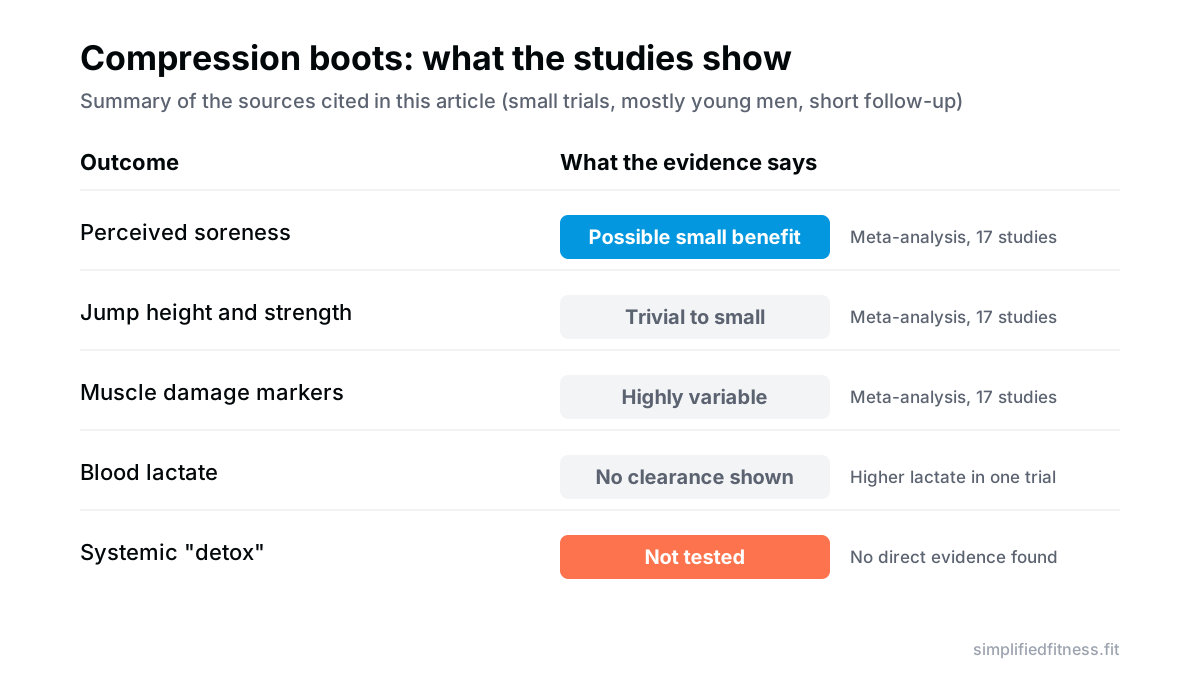
Not every trial is flat. A 2025 randomized trial in 20 untrained men used 15 minutes of compression immediately and again at 24, 48 and 72 hours after plyometrics, and found better soreness scores and muscle measurements at 48 and 72 hours (Gu et al., 2025). With only 10 people per group, untrained subjects and no blinding mentioned in the abstract, I would treat it as encouraging rather than settled.
In endurance athletes, a critically appraised review of three studies concluded that IPC might give short-term relief from soreness but did not reduce muscle damage over time (Stedge and Armstrong, 2021).
Why do trials differ? Different devices, pressures, session lengths, exercise types and soreness scales, plus small samples. A 2025 comprehensive review of boots against other recovery methods found no significant superiority or inferiority, and called the evidence too thin for a firm position (Neves et al., 2025).
Do compression boots flush lactate, toxins or waste?
No study cited here shows that.
First, lactate is generally not considered the cause of next-day soreness, and blood lactate normally falls back toward resting levels on its own after hard effort. Second, the one trial I found that looked at lactate and boots went the wrong way for the marketing. Ten healthy people did two 60 minute rides with a 30 minute rest between. Resting in boots was followed by higher blood lactate midway through the second ride (3.9 mmol/L) than resting without them (2.7 mmol/L), with no difference in heart rate (Marcello et al., 2019). Ten people is a small sample, so I would not conclude that boots are harmful. It simply fails to support a “clearance” story.
As for “toxins”, I found no trial that measured systemic detoxification from boots, and the idea does not map onto a measurable outcome. Your liver and kidneys do the clearing, not your calves.
How does lymph actually move, and does it matter after lifting?
Lymph is fluid that leaks out of capillaries into the spaces around cells (interstitial fluid), then drains through lymph vessels back to the bloodstream. Those vessels have one-way valves, and fluid is pushed along by the vessels’ own rhythmic contractions plus surrounding muscle contractions, breathing and body position, rather than by a central pump like the heart. This is standard physiology, not something these trials tested directly.
The practical point: the best-known “lymph pump” is your own calf and thigh muscles working. Boots imitate part of that action passively.
Light activity does a related job. In a study of one-leg exhaustive exercise, followed by either rest or 10 minutes of very light cycling (10 W), muscle and blood lactate were lower after 10 minutes of light-exercise recovery than after rest, with higher blood flow in that leg (Bangsbo et al., 1994). That is a small study in a lab with a specific protocol, but it supports the common-sense advice: gentle movement is a good recovery tool.
Compression boots vs a 10 minute walk
I could not find a trial that directly compares IPC with a short easy walk, so be wary of anyone who claims a winner. What we can say:
| Option | Cost | Evidence in lifters/athletes | Main plausible benefit |
|---|---|---|---|
| Easy 10 minute walk | Free | Supports light activity for lactate and blood flow (small lab study) | Feeling looser, blood flow |
| Legs up, 10-15 minutes | Free | No lifting-specific trials found | Comfort for heavy legs |
| Compression boots | High | Trivial to moderate soreness effect, trivial to small on performance | Perceived soreness |
| Boots versus other methods | n/a | Review found no significant differences | Not clearly better or worse |
For a gentle walk, you can keep the effort easy with our heart rate zone calculator. We cover this more in active recovery modalities like walking and mobility.
What about legs up the wall?
Lying with your legs raised against a wall uses gravity to help blood and fluid drain from the lower limbs. It is a popular recovery habit and many people find it makes heavy legs feel lighter.
The honest evidence status: I did not find lifting-specific trials of it. So the claim is “plausibly comfortable”, not “proven to speed recovery”. Ten to fifteen minutes on the floor after a hard leg day is free and low-risk for most people, but stop if you feel dizzy, and speak to a doctor first if you have heart, circulation or breathing problems.
Lymphedema is a different thing
This matters because the same device type appears in two very different settings.
Lymphedema is a chronic, progressive condition where the lymphatic system cannot drain fluid properly, causing persistent swelling. A 2025 systematic review and meta-analysis found that advanced pneumatic compression devices were effective as a complementary treatment to decongestive therapy in the maintenance phase, reducing limb volume and improving patient-reported outcomes (Panchik et al., 2025).
Do not borrow that result for athletic recovery. Those are patients with a diagnosis, in a supervised care plan, using medical devices. A healthy lifter with tired legs is a completely different situation.
Who should be careful?
Please check with a doctor before using any compression device if you have:
- a past or suspected blood clot (deep vein thrombosis)
- an infection, skin wound or open sore on the limb
- heart failure, kidney disease or serious circulation problems
- unexplained leg swelling, especially in one leg
Stop immediately if you notice numbness, tingling, sharp pain or colour changes.
Are compression boots worth buying?
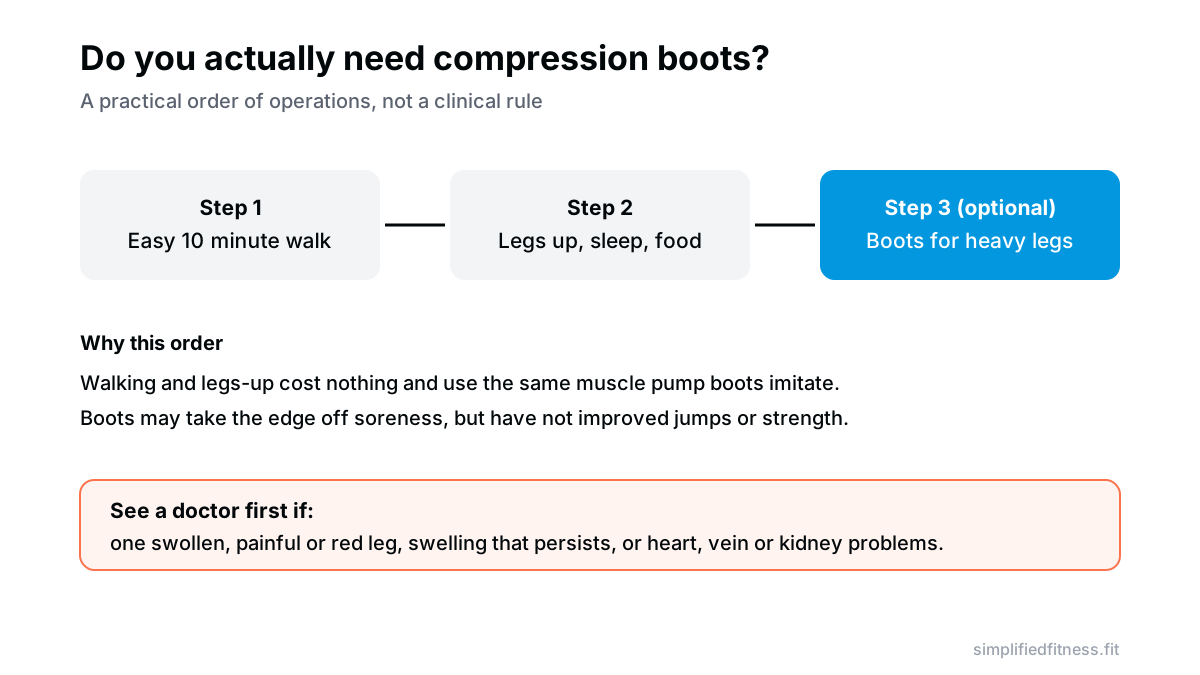
For most people in India, where a good boot system costs a lot relative to a gym membership, my view is probably not. The measured benefit is small, mostly subjective, and the free options use the same principle.
When might they make sense? If you already own them, train hard multiple times a week, and simply like how your legs feel afterwards. Subjective comfort is a legitimate reason as long as you know that is what you are paying for. Meta-analytic protocols were mostly 20 to 30 minutes at about 80 mmHg (Maia et al., 2024), so there is no need for marathon sessions.
If you are comparing other gadgets, our audit of recovery gadgets, cryotherapy and red light uses the same evidence-first lens, and the massage gun science article covers another popular option.
A simple recovery routine without boots
- Walk 10 minutes at an easy pace after the session.
- Eat a protein-containing meal within a few hours (dal, paneer, curd, eggs, chicken, soya, whatever fits your diet).
- Drink water through the day, especially in hot weather.
- Elevate your legs for 10-15 minutes if they feel heavy.
- Protect your sleep. It is the real recovery tool.
Ready to plan your week so recovery fits your training? Start with our free plans.
Frequently Asked Questions
Do compression boots actually help recovery?
They may help you feel less sore, but the evidence for faster strength or performance recovery is weak. A 2024 meta-analysis of 17 studies found trivial to small benefits for muscle function and trivial to moderate effects on soreness. If you own boots, use them for comfort, not as a replacement for sleep and food.
Do Normatec boots work for lifters?
Normatec-type devices are sequential pneumatic compression boots, and trials on them in lifters and athletes are small. A 2025 randomized trial of 33 men found no significant differences in jumps or strength, though soreness trended lower with compression. Treat them as a possible soreness aid, not a performance booster.
Do compression boots flush lactic acid or toxins?
There is no good evidence that they do. In a small trial of 10 people, boots between two rides were followed by higher blood lactate in the second ride than resting without boots. Lactate normally returns toward baseline on its own fairly quickly, so do not buy boots for this reason.
Is a 10 minute walk better than compression boots?
Probably as good for most people, though I did not find a trial that directly compares the two. Light activity speeds lactate handling in muscle and keeps blood flowing, and a review of boots versus other recovery methods found no significant differences between them. Walk first, add boots only if you like them.
How long should I use compression boots?
The most common protocols in a 2024 meta-analysis were about 20 to 30 minutes at pressures around 80 mmHg. Longer sessions have not been shown to work better. Follow your device's built-in program and stop if you feel numbness, tingling or pain.
Does legs up the wall help recovery?
It can make heavy, tired legs feel better, mainly by using gravity to help blood and fluid drain from your lower limbs. I did not find a trial testing it as a lifting recovery method, so the benefit is likely comfort. Ten to fifteen minutes after training is a free thing to try, but skip it if you have heart or breathing problems unless your doctor agrees.
What is lymphatic drainage in the gym context?
Lymph is the fluid that collects around tissues and returns to the blood through lymph vessels. Your muscle contractions and breathing help move it, which is why light movement matters. Gym 'lymphatic drainage' products borrow this idea, but they have not been shown to speed muscle repair.
Are compression boots safe?
For healthy people they are generally well tolerated, but they are not for everyone. Do not use them if you have a suspected blood clot, an infection, a painful swollen leg, or heart, vein or kidney problems, unless a doctor has said it is fine. When in doubt, ask your doctor first.
Can compression boots treat lymphedema?
Medical-grade pneumatic devices are used as part of lymphedema care, and a 2025 meta-analysis found them effective as a complementary treatment alongside decongestive therapy. That is a clinical setting with diagnosis and supervision. If you have persistent swelling, see a doctor rather than self-treating with gym boots.
Do compression boots reduce swelling after leg day?
They mechanically push fluid out of the limb, so a lighter feeling is plausible. Swelling after hard training is usually mild and temporary, and the studies here measured soreness and performance, not edema directly. Persistent or one-sided swelling needs a doctor, not a gadget.
Are compression boots worth the money in India?
For most lifters, probably not. The measured benefit is small and limited mostly to perceived soreness, while sleep, protein and enough calories matter far more. If budget is tight, spend it on food, and use walking and legs-up rest for free.
Do compression boots help DOMS?
Possibly a little. A 2025 randomized trial in 20 untrained men found lower soreness scores at 48 and 72 hours with compression, while a review of endurance athletes found short-term relief but no lasting reduction in muscle damage. Expect relief, not a cure.
Can I use compression boots before training?
There is little good evidence for a pre-workout benefit, and the research focuses on after-exercise use. The one trial of boots between rides found higher lactate in the second ride. If you want to try them, use them after training, not before a hard session.
Sources & References
Every claim above is checked against peer-reviewed research (PubMed, U.S. National Library of Medicine) or guidance from established health bodies. How we fact-check.
- Maia F, et al. Effects of lower-limb intermittent pneumatic compression on sports recovery: A systematic review and meta-analysis. Biol Sport. 2024. PMID: 39416507
- Maia F, et al. Intermittent Pneumatic Compression May Reduce Muscle Soreness but Does Not Improve Neuromuscular Function Following Exercise-Induced Muscle Damage: A Randomized Placebo-Controlled Trial. Int J Sports Physiol Perform. 2025. PMID: 40555415
- Neves RS, et al. Effects of intermittent pneumatic compression as a recovery method after exercise: A comprehensive review. J Bodyw Mov Ther. 2025. PMID: 40325678
- Stedge HL, et al. The Effects of Intermittent Pneumatic Compression on the Reduction of Exercise-Induced Muscle Damage in Endurance Athletes: A Critically Appraised Topic. J Sport Rehabil. 2021. PMID: 33418535
- Gu Z, et al. Effects of intermittent pneumatic compression on delayed onset muscle soreness and recovery of muscular fatigue. PM R. 2025. PMID: 40094188
- Marcello RT, et al. Intermittent Pneumatic Compression Boot Use Elevates Blood Lactate During Subsequent Exercise. Int J Exerc Sci. 2019. PMID: 30899344
- Bangsbo J, et al. Muscle lactate metabolism in recovery from intense exhaustive exercise: impact of light exercise. J Appl Physiol. 1994. PMID: 7836214
- Panchik D, et al. Effect of Advanced Pneumatic Compression Devices in the Treatment of Lymphedema: A Systematic Review and Meta-Analyses. Lymphology. 2025. PMID: 41406422

Umair Hazrami · Founder & Head Coach, Simplified Fitness
Umair Hazrami founded Simplified Fitness and the Simplified Lifter channel to cut through fitness noise. With 4+ years of consistent training and 10+ coaching clients, he writes every guide from the peer-reviewed research and links the sources so you can check them. Our editorial standards.
Educational content only, not medical advice. If you have a medical condition, are pregnant, or take medication, talk to a qualified doctor before changing your diet, supplements or training. Full disclaimer.
Keep reading
Recovery
Cold Plunge After Workout: Does an Ice Bath Blunt Muscle Growth?
Does a cold plunge after workout kill your gains? See what the lifting trials found on muscle fibre growth, strength, soreness and when cold is fine to use.
8 min read

Recovery
Ice Baths for Athletes: When Cold Water Immersion Helps at Tournaments
Ice baths for athletes can cut soreness between matches but may blunt muscle gain. See when cold water immersion is worth it and how to use it.
7 min read

Recovery
Compression Garments for Lifters: Do Tights and Sleeves Really Help Recovery?
Do compression tights help recovery after lifting? Meta-analyses show small effects on soreness, swelling and strength. See what works, what doesn't, and when.
8 min read

Recovery
Deload Week Physiology: How to Deload and Not Lose Muscle
Deload week guide: what fatigue builds up in a hard block, why one lighter week does not cost muscle, and how to deload with 50% of your sets. Studies linked.
9 min read