Ice Baths for Athletes: When Cold Water Immersion Helps at Tournaments
Ice baths for athletes can cut soreness between matches but may blunt muscle gain. See when cold water immersion is worth it and how to use it.
TL;DR. The short answer
- Ice baths for athletes make sense when you must perform again within about 24-48 hours, such as a multi-match tournament. Meta-analyses show less soreness, lower creatine kinase and better perceived recovery 24 hours after hard exercise.
- The same habit used after every lifting session has been linked to smaller strength and muscle gains in one 12-week trial of 21 men, so the goal decides the tool.
- Cold may help endurance performance within an hour, especially in the heat, but it may hurt sprint and jump performance in the first few hours.
- Typical research doses are water under 15 C for a short dip of roughly 10 minutes. The best protocol is not settled, so treat it as a starting point.
- Heart disease, high blood pressure, Raynaud's or circulation problems: speak to a doctor before using cold water.
Part of our complete guide: Muscle Soreness (DOMS), Heat/Cold Modalities & Recovery Methods: What Science Actually Supports
Table of contents
Ice baths for athletes are worth using when you have to perform again within a day or two and soreness is the problem. They are a poor habit when your main goal is building muscle. That split is the whole story, and it is why a cold plunge can be smart for a footballer in a three-day tournament and a bad idea for a lifter after every leg day.
This article covers the competition side. For the opposite case, where cold water gets in the way of growth, read our cold plunge and hypertrophy guide. Both sit inside our complete guide to muscle soreness and recovery modalities.
Why do athletes use ice baths during tournaments?
In a tournament you do not get to wait for adaptation. You have a match at 10 am, another tomorrow, maybe a third on day three. Building a bigger quad over 12 weeks is irrelevant. Feeling fresh and moving well tomorrow is everything.
That is the logic of acute recovery vs adaptation. Training is a stress you recover from and adapt to over weeks. Competition is a performance you need to repeat quickly. A tool that dulls soreness and swelling for a day can be useful in the second setting, even if it slightly interferes with the first.
The proposed mechanisms are simple: cold water lowers tissue temperature, reduces blood flow to the area and may dull pain signalling. Meta-analytic data also show lower creatine kinase (a marker of muscle damage) the next day. How much of this changes actual performance is less clear, and that is where the nuance lives.
What does the research say about cold water immersion for recovery?
Start with the largest recent analysis. A 2022 meta-analysis of 52 studies compared cold water immersion with passive recovery after a single hard session (Moore et al., 2022). Twenty-four hours after high-intensity exercise, cold water improved muscle soreness, perceived recovery, muscular power and serum creatine kinase. There was no significant effect on strength recovery.
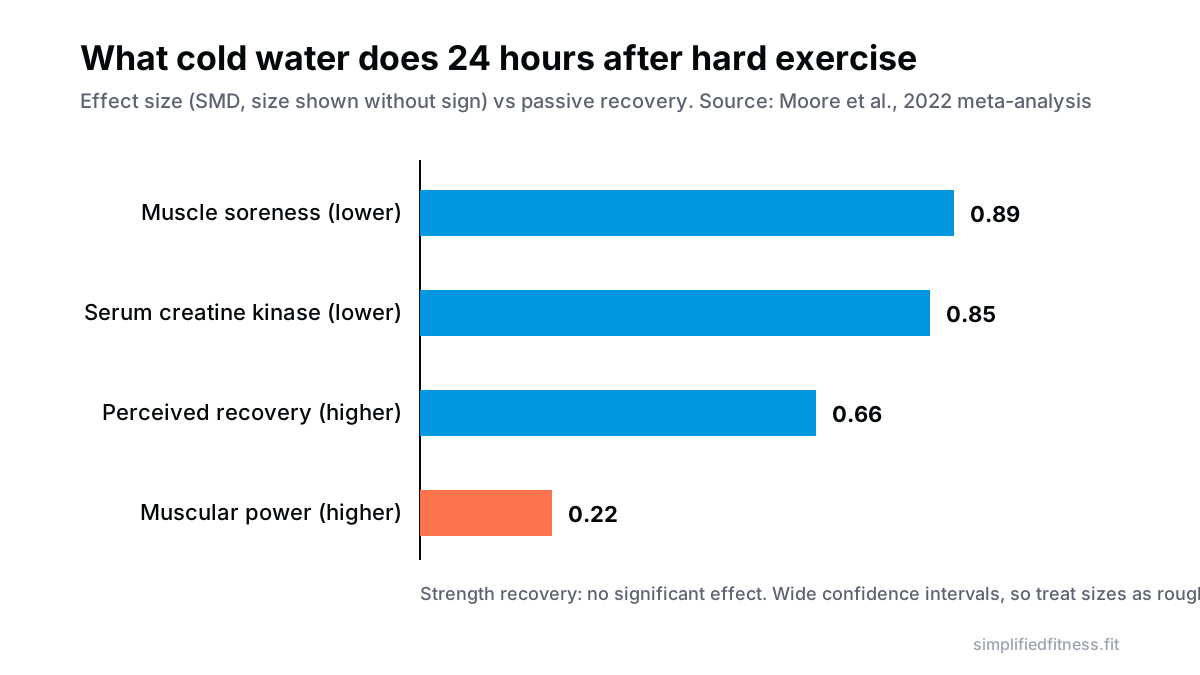
Notice the pattern. The biggest effects are on how you feel and on a blood marker. The performance effect (power) is real but small. That does not make it useless, because feeling less sore can change how hard you are willing to move, but it keeps expectations honest.
An older Cochrane review reached a similar conclusion for soreness. It pooled 17 small trials (366 participants, low study quality) and found some evidence that cold immersion reduced delayed onset muscle soreness compared with rest, while evidence for other outcomes was insufficient (Bleakley et al., 2012).
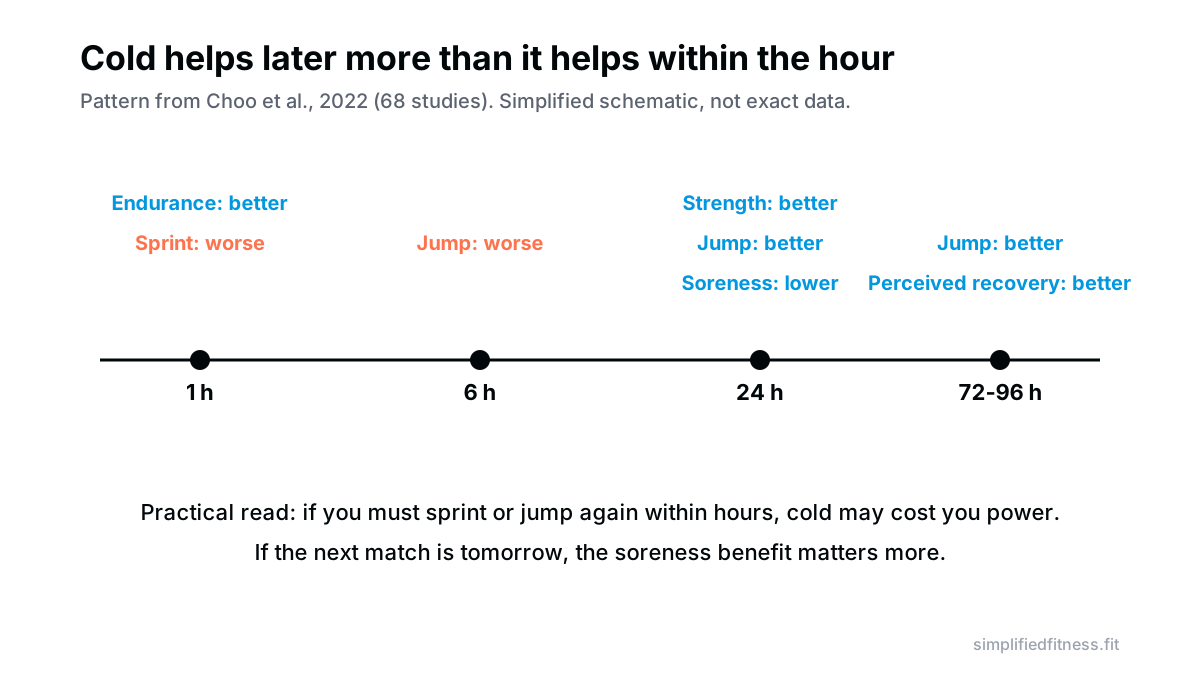
A third review of 68 studies added timing, which matters a lot for tournaments (Choo et al., 2022). Cold water improved short-term recovery of endurance performance at 1 hour, but impaired sprint performance at 1 hour and jump performance at 6 hours. Later on it improved jump and strength recovery at 24 hours, along with less soreness.
Does cold water hurt performance if I play again the same day?
It might, depending on the sport. If your next effort is a sprint, a jump or a quick change of direction within a few hours, the Choo review suggests cold can reduce that power temporarily. Endurance efforts looked different, with a benefit at 1 hour.
One small simulation study tested this directly. Fourteen recreationally active men did repeated bouts mimicking a rugby sevens tournament day, with a different recovery strategy each week (Crowther et al., 2019). No water immersion strategy beat the control for performance recovery. Relative average power after cold water was lower than control 75 minutes after the second bout. The authors did not recommend immersion over control unless athletes already used it, partly because it takes time and equipment.
The honest takeaway: the evidence for same-day, back-to-back matches is mixed and comes from small studies. Cold is not an automatic win between matches. Try it in training, not for the first time on final day.
When does cold water help most? Heat and long events
Heat is where cold earns its place. Core body temperature rises with hard exercise, and in hot conditions that rise limits performance.
In a small crossover trial, 10 male cyclists did two bouts of cycling in 35 C heat. A 5-minute cold dip (14 C) between bouts lowered rectal temperature by about 0.5 C and kept power output higher during the second time trial (about 328 W versus 288 W) (Peiffer et al., 2010). With 10 participants it is a small study, but it fits a bigger picture. The Choo review found cold water improved endurance recovery after exercise in warm conditions, but not clearly in temperate ones.
Cooling before exercise also appears to work. A meta-analysis of 22 studies found pre-cooling with cold water immersion improved endurance performance in hot conditions (effect size about 0.53) (Choo et al., 2018). That is relevant to Indian summers, when a cricket, kabaddi or football tournament can be played at 35 C or more.
A heat consensus statement is clear on priorities, though. The most important step is heat acclimatization over 1-2 weeks, plus starting well hydrated (Racinais et al., 2015). Cooling is an add-on, not a substitute. If you are unsure about your daily fluid needs, our water intake calculator gives a starting figure.
Why not just use cold water all the time?
Because adaptation is the other half of the story. In one 12-week study, 21 physically active men strength trained twice a week and spent 10 minutes in cold water or did active recovery after each session. Strength and muscle mass rose more in the active recovery group. Type II fibre size and myonuclei number increased only in that group (Roberts et al., 2015). A second part of the study (nine men, muscle biopsies) suggested cold dampened satellite cell activity and growth signalling.
This was a small study in recreationally active men, so the size of the effect in trained athletes is uncertain. Still, the direction is consistent enough that many coaches avoid routine cold plunges in strength blocks. The sensible rule: use cold in competition weeks, not in the hypertrophy phase. For more on that, see our article on DOMS vs muscle growth.
| Situation | Cold water immersion | Why |
|---|---|---|
| Multi-day tournament, next game within 24-48 h | Reasonable | Less soreness, better perceived recovery |
| Hot-weather event, repeated efforts | Reasonable | Lowers core temperature, may help endurance |
| Same-day, sprint or jump needed within hours | Test first, or skip | Power may dip in the first hours |
| Off-season strength or hypertrophy block | Avoid or keep rare | May blunt training adaptations |
| Casual gym-goer, no competition | Optional | Comfort only |
How to use cold water immersion: a practical protocol
There is no single proven protocol. These are common ranges from the research, not a prescription.
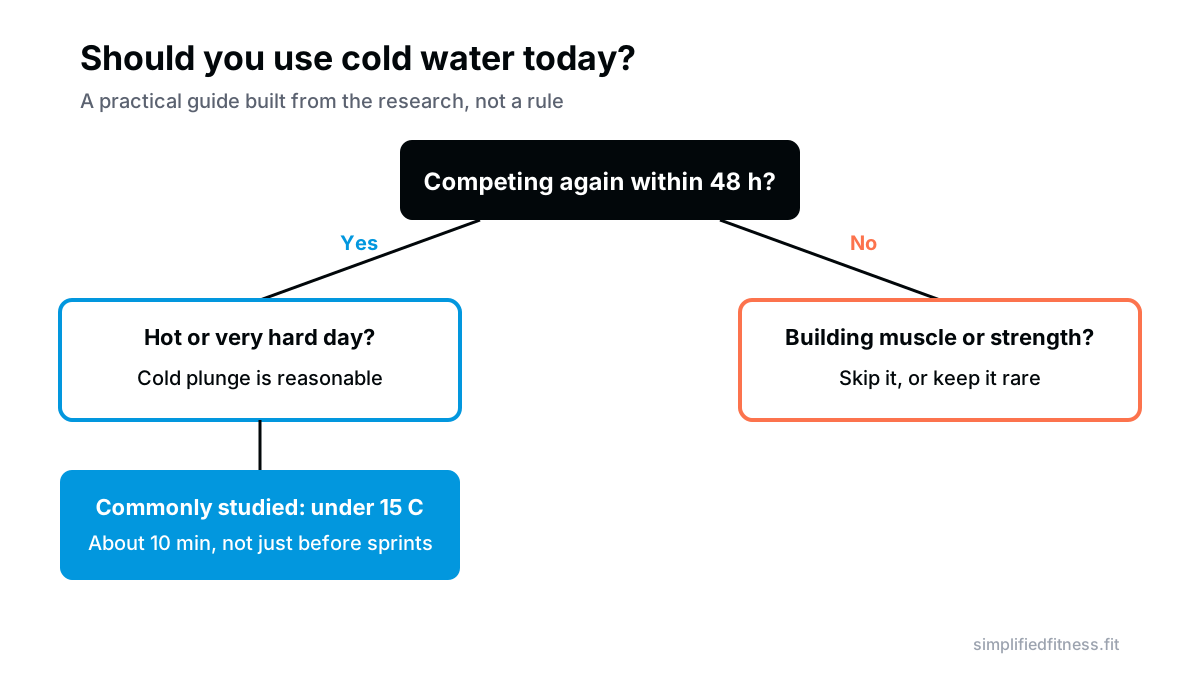
- Temperature: studies of cold water immersion usually use water below 15 C. A meta-regression found lower temperatures and shorter durations were linked to larger effects on creatine kinase after high-intensity exercise (Moore et al., 2022). You do not need near-freezing water.
- Duration: about 10 minutes is a common dose. Longer has not been shown to be better.
- Timing: soon after the match, once you have cooled down and had a drink. If you play again within hours, consider a very short dip or trial it beforehand.
- Depth: legs and hips cover the big muscles that get sore. Full body is optional.
- After: dry off, put on warm clothes and eat. Carbohydrate, protein, fluids and sleep matter more than the dip.
What else works between matches?
Cold water is not the only tool, and probably not the most important one. Sleep, carbohydrates, protein and fluids carry most of the weight. Our sleep architecture guide for athletes covers the first, and compression garments and sauna or heat therapy are other options to compare. Treat cold as the cherry on top.
Who should be careful with cold water?
Cold exposure stresses the cardiovascular system. Check with a doctor first if you have heart disease, high blood pressure, a history of fainting, Raynaud’s phenomenon or circulation problems. Get in gradually rather than jumping in, do not plunge alone, and get out if you feel dizzy, numb, short of breath or have chest discomfort. This article is not medical advice, and I am not diagnosing anyone.
The bottom line
Ice baths for athletes are a trade: less soreness and a better feeling of recovery tomorrow, at a possible cost to power in the next few hours and to long-term muscle gains if used constantly. Use them when the schedule is tight and the goal is to compete again soon. Skip them when the goal is to grow.
Want a training plan that works around your season? Start with our free training plans and build your strength phase first.
Frequently Asked Questions
Do ice baths help athletes recover between matches?
They can help how you feel and, in some cases, how you perform the next day. A 2022 meta-analysis of 52 studies found less soreness and better perceived recovery 24 hours after high-intensity exercise compared with passive rest. If your next match is within a day or two, a short cold dip is a reasonable option to try.
Should I take an ice bath on tournament day?
It depends on how soon you play again. A large review found cold water may impair sprint performance at 1 hour and jump performance at 6 hours, though it helped endurance at 1 hour and strength and jump at 24 hours. If you play again within a few hours and need explosive power, test it in training first or skip it.
Can I use a cold plunge between two matches on the same day?
Evidence is mixed. In a rugby sevens style simulation with 14 recreational men, no water immersion strategy beat the control for performance recovery, and cold immersion lowered power 75 minutes after bout two. A short dip may still help you feel fresher or cool down in heat, so judge by your own response.
How cold should an ice bath be for recovery?
Research typically uses water under 15 C. A Cochrane review defined cold water immersion as below 15 C, and a 2022 meta-regression suggested lower temperatures and shorter durations gave larger benefits for muscle damage markers. There is no proven perfect number, so start around 10-15 C rather than chasing near-freezing water.
How long should I stay in an ice bath after a match?
Around 10 minutes is a common research duration, and shorter exposures appeared to work as well or better in one meta-regression. Longer is not better and increases discomfort without proven extra benefit. Time it, get out, and dry off and warm up.
Do ice baths reduce muscle growth?
Regular use after strength training may. In a 12-week trial of 21 physically active men, cold water after each session led to smaller gains in strength and muscle mass than active recovery. If building muscle is your main goal, keep cold for competition weeks and see our guide on cold plunges and hypertrophy.
Are ice baths good for hot weather tournaments?
They can be. A 2022 review found cold water improved endurance recovery after exercise in warm conditions but not clearly in temperate ones, and a small cycling trial in 35 C heat found a 5-minute dip between bouts lowered rectal temperature and kept time-trial power higher. Pair it with shade, fluids and heat acclimatization, which experts rank as the most important step.
Is cold water better than rest, sleep or food for recovery?
No. Cold water is a small add-on, not a replacement for sleep, carbohydrates, protein and fluids. The studies compare it with passive rest, and the effects are modest. Get the basics right first, then use cold as an extra if it helps you.
Do ice baths actually reduce inflammation?
They lower some markers of muscle damage, such as serum creatine kinase, at 24 hours after high-intensity exercise in meta-analyses. But lower markers do not always mean better performance, and inflammation is also part of how muscle adapts. Use cold for short-term readiness, not as a general anti-inflammatory habit.
What is the difference between cold water immersion and a cold shower?
Immersion cools much more tissue because the water surrounds the body, and the research on recovery is based on immersion, not showers. A shower is easier and cheaper but has not been studied in the same way for tournament recovery. If you only have a shower, treat it as a comfort measure.
Can I do cold plunges as a martial artist or in a multi-day competition?
Possibly, if you fight or compete on consecutive days and soreness limits you. The evidence on soreness and next-day power supports trying it, but it comes mostly from team sport and endurance studies, not combat sports. Practice during training camp so you know how your body responds.
Who should avoid ice baths?
People with heart or circulation problems, uncontrolled high blood pressure, Raynaud's phenomenon or cold sensitivity should check with a doctor first. Sudden cold exposure can stress the cardiovascular system. Never plunge alone, and get out if you feel dizzy, numb or have chest discomfort.
What can I do if I do not have an ice bath in India?
A large tub or drum of tap water with plenty of ice can work for the legs. In summer, stored tap water is often well above 15 C, so use a cheap thermometer and add ice until you are near the studied range. Evidence is strongest for proper cold immersion, so a cool dip is a lower-cost approximation, not an exact equivalent. Keep it safe, short and supervised.
Sources & References
Every claim above is checked against peer-reviewed research (PubMed, U.S. National Library of Medicine) or guidance from established health bodies. How we fact-check.
- Moore E, et al. Impact of cold-water immersion compared with passive recovery following a single bout of strenuous exercise on athletic performance in physically active participants: a systematic review with meta-analysis and meta-regression. Sports Med. 2022. PMID: 35157264
- Choo HC, et al. The effect of cold water immersion on the recovery of physical performance revisited: a systematic review with meta-analysis. J Sports Sci. 2022. PMID: 36862831
- Bleakley C, et al. Cold-water immersion (cryotherapy) for preventing and treating muscle soreness after exercise. Cochrane Database Syst Rev. 2012. PMID: 22336838
- Roberts LA, et al. Post-exercise cold water immersion attenuates acute anabolic signalling and long-term adaptations in muscle to strength training. J Physiol. 2015. PMID: 26174323
- Peiffer JJ, et al. Effect of a 5-min cold-water immersion recovery on exercise performance in the heat. Br J Sports Med. 2010. PMID: 18539654
- Racinais S, et al. Consensus recommendations on training and competing in the heat. Scand J Med Sci Sports. 2015. PMID: 25943653
- Crowther FA, et al. Effects of various recovery strategies on repeated bouts of simulated intermittent activity. J Strength Cond Res. 2019. PMID: 31242139
- Choo HC, et al. Ergogenic effects of precooling with cold water immersion and ice ingestion: a meta-analysis. Eur J Sport Sci. 2018. PMID: 29173092

Umair Hazrami · Founder & Head Coach, Simplified Fitness
Umair Hazrami founded Simplified Fitness and the Simplified Lifter channel to cut through fitness noise. With 4+ years of consistent training and 10+ coaching clients, he writes every guide from the peer-reviewed research and links the sources so you can check them. Our editorial standards.
Educational content only, not medical advice. If you have a medical condition, are pregnant, or take medication, talk to a qualified doctor before changing your diet, supplements or training. Full disclaimer.
Keep reading
Recovery
Cold Plunge After Workout: Does an Ice Bath Blunt Muscle Growth?
Does a cold plunge after workout kill your gains? See what the lifting trials found on muscle fibre growth, strength, soreness and when cold is fine to use.
8 min read
Recovery
Compression Boots and Lymphatic Drainage: Do They Really Speed Recovery?
Do compression boots speed recovery or 'detox' your legs? See what pneumatic compression trials found on soreness, strength and lymph, and cheaper options.
7 min read

Recovery
Compression Garments for Lifters: Do Tights and Sleeves Really Help Recovery?
Do compression tights help recovery after lifting? Meta-analyses show small effects on soreness, swelling and strength. See what works, what doesn't, and when.
8 min read
Recovery
Deload Week Physiology: How to Deload and Not Lose Muscle
Deload week guide: what fatigue builds up in a hard block, why one lighter week does not cost muscle, and how to deload with 50% of your sets. Studies linked.
9 min read