Cold Plunge After Workout: Does an Ice Bath Blunt Muscle Growth?
Does a cold plunge after workout kill your gains? See what the lifting trials found on muscle fibre growth, strength, soreness and when cold is fine to use.
TL;DR. The short answer
- Regular cold water immersion straight after lifting has been linked to smaller muscle fibre growth in several small trials, and a meta-analysis of 8 studies found worse strength gains too (SMD -0.60).
- Biopsy studies show a cold plunge after lifting dampened p70S6K signalling and satellite cell activity, two steps that help drive muscle growth.
- Cold does reduce soreness for about 24 hours in a meta-analysis of 32 trials, so it trades short-term comfort for long-term growth.
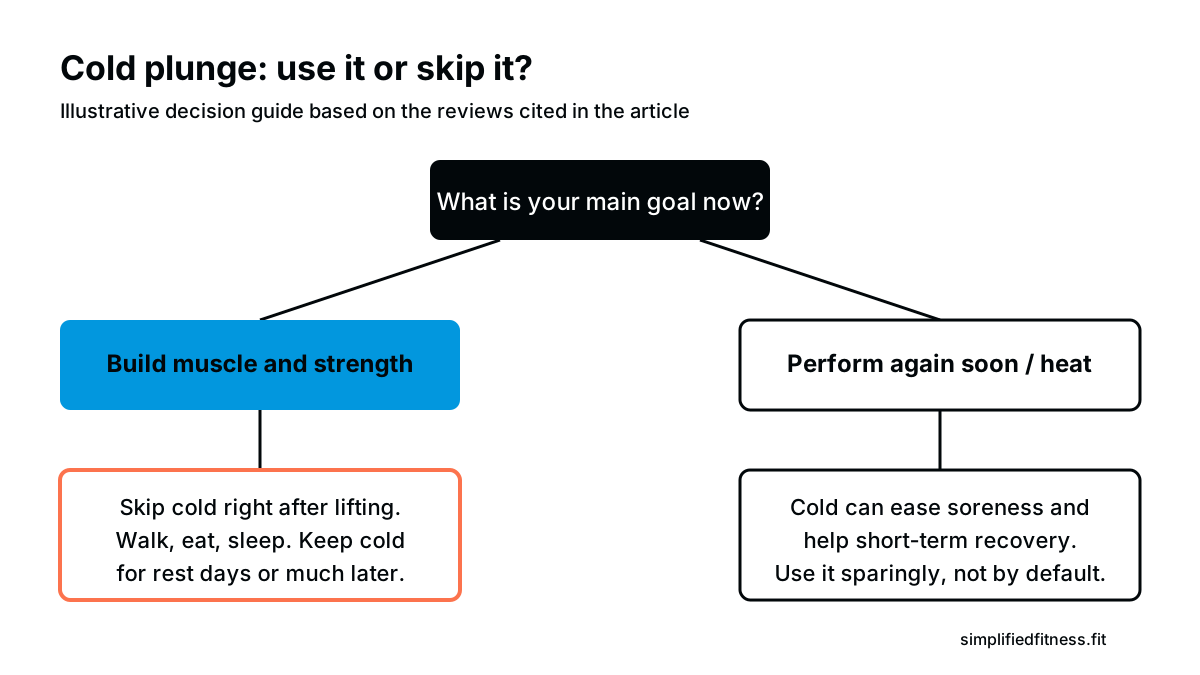
- If building muscle is your goal, skip cold right after training. No study has pinned down a perfectly safe delay, so keep it to rest days or well away from the session.
- Occasional use is very unlikely to matter. The concern is repeated use after most sessions over weeks.
Part of our complete guide: Muscle Soreness (DOMS), Heat/Cold Modalities & Recovery Methods: What Science Actually Supports
Table of contents
A cold plunge after workout sessions feels like the smart, disciplined thing to do. The research on lifters says it is probably the opposite if you are chasing muscle. In several small controlled trials, repeated cold water immersion right after resistance training blunted muscle fibre growth, and a meta-analysis also found smaller strength gains.
That does not make ice baths evil. They do reduce soreness for a day or so. But it is a trade, and most people on social media only mention one side of it. This article sits inside our wider muscle soreness and recovery modalities guide and focuses strictly on lifting adaptations.
Does a cold plunge after workout kill your gains?
It can dull them, according to the best human data we have. Not “kill”, though. That word is doing a lot of work on gym Instagram.
The study everyone cites is Roberts and colleagues from 2015. In one part, 21 physically active men strength trained for 12 weeks, 2 days a week. After each session they either sat in cold water for 10 minutes or did active recovery. Strength and muscle mass rose more in the active recovery group. Type II fibre cross-sectional area rose 17% and myonuclei per fibre rose 26% with active recovery, but not in the cold water group (Roberts et al., 2015).
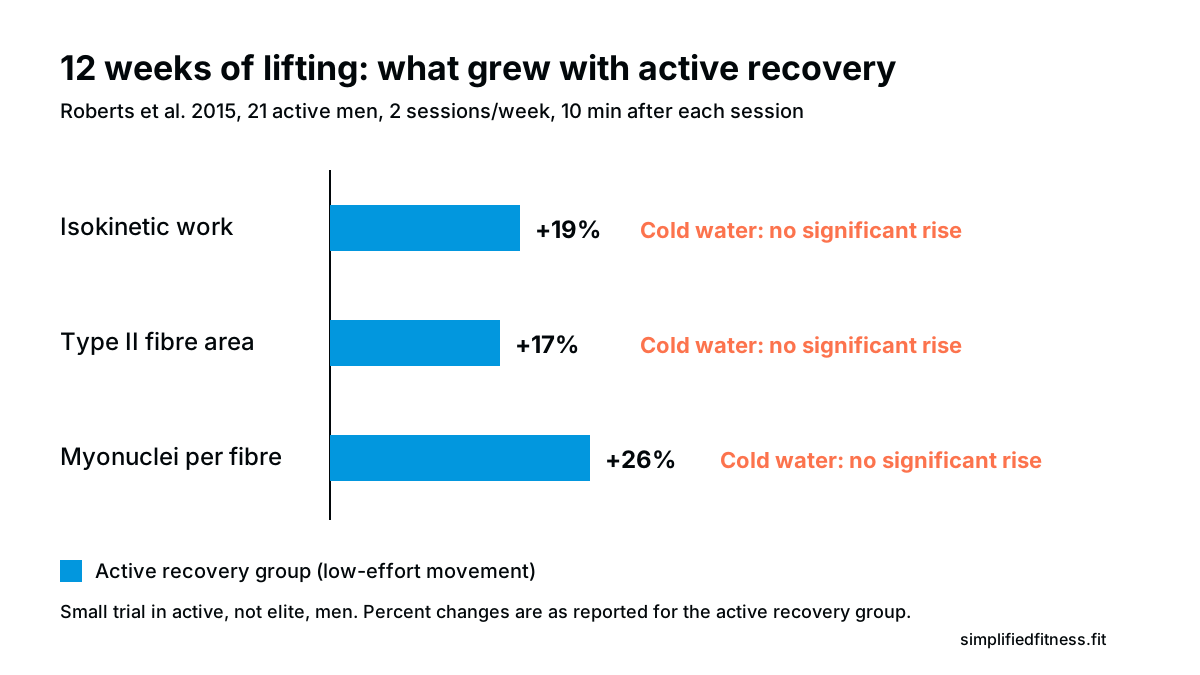
Active recovery here meant low effort movement. So the comparison is cold water against doing a gentle bit of cycling, not against something fancy.
What does cold water do inside the muscle?
Roberts ran a second, separate study with 9 active men. They did single-leg strength exercises on different days, followed by either cold water or active recovery, with muscle biopsies at 2, 24 and 48 hours. Phosphorylation of p70S6 kinase, a signal tied to muscle growth, rose in both conditions but was greater after active recovery. Satellite cell numbers (the repair cells that donate nuclei to growing fibres) were also greater after active recovery (Roberts et al., 2015). If you want the full story on those cells, see our piece on satellite cells and myonuclear addition.
Fyfe and colleagues later found something similar. Sixteen men trained 3 days a week for 7 weeks, with 15 minutes at 10 degrees C or passive recovery after each session. Type II fibre growth was attenuated with cold water, and signalling through the mTORC1 pathway (measured by rps6 phosphorylation) was blunted after training. Markers of protein breakdown were higher in the cold group (Fyfe et al., 2019).
A review of the mechanisms concludes that, although the evidence is limited, cold water appears to reduce anabolic signalling and muscle protein synthesis after resistance exercise, which may explain the poorer long-term results (Petersen and Fyfe, 2021). Notice the hedges: “appears”, “may”. Biopsies in small groups of young men are suggestive, not final.
Does cold reduce inflammation? Peake et al. (2017)
The usual pitch is that ice calms inflammation, and calmer muscles recover faster. Peake and colleagues tested this in 9 active men who did lower-body lifting, then either 10 minutes of 10 degrees C immersion or 10 minutes of easy cycling. Biopsies at 2, 24 and 48 hours showed no significant difference in inflammatory cells, cytokines, neurotrophins or heat shock proteins between the two (Peake et al., 2017).
So in that study, cold water was no better than active recovery for reducing inflammation in the muscle. And some inflammation is part of how muscle adapts, which is one reason blanket “anti-inflammatory” recovery is questionable. (Same logic applies to painkillers, which we cover in NSAIDs and muscle growth.)
What about strength? The evidence is mixed
This is where I would not oversell. Fibre size looks like the clearer casualty.
A meta-analysis of 8 controlled studies (cold at 15 degrees C or below, alongside regular training) found a harmful effect of cold water immersion with resistance training on one-rep max, isometric strength and strength endurance (overall SMD -0.60), and on ballistic performance (SMD -0.61). It found no effect on aerobic performance (Malta et al., 2021).
Yet Fyfe’s 7-week trial found leg press 1RM improvements were similar between groups, even though fibre growth was blunted (Fyfe et al., 2019). Why the difference? Possible reasons include short trial length, small samples, different training status, and different measures. Strength in the first weeks is thought to depend heavily on neural adaptation, which cold may not affect much. The cautious reading: size is at more risk than strength, but neither is helped.
An umbrella review of 15 systematic reviews in 2026 concluded that cold water immersion did not improve muscular strength and impaired strength and hypertrophic gains. It also rated the certainty of evidence as low to very low, and the methodological quality as low to critically low (Berjisian et al., 2026). Good to know before anyone claims the case is closed.
| Question | What the evidence shows | Confidence |
|---|---|---|
| Muscle fibre growth | Blunted in lifting trials with cold water | Moderate, small trials |
| Strength gains | Mixed: lower in a meta-analysis, similar in one trial | Low to moderate |
| Muscle inflammation | No better than active recovery in one biopsy study | Low (n = 9) |
| Soreness | Reduced, most clearly in the first 24 h | Low to moderate |
| Endurance adaptations | No clear harm | Low to moderate |
But it helps soreness, right?
Yes. A meta-analysis of 32 randomized trials found that cold applied within 1 hour after exercise reduced soreness pain within 24 hours, and had no clear effect beyond that. Cold water immersion specifically had a significant effect in that window. Heat therapy also reduced pain, and no significant difference was found between cold and heat (Wang et al., 2021).
The authors call for higher-quality trials. But the message is useful: if comfort is all you want, you do not need cold specifically. For that angle, see heat and sauna for recovery.
Also worth saying plainly: soreness is a poor guide to progress. Less sore does not mean more muscle. We unpack that in DOMS versus muscle growth.
How long should you wait before a cold plunge after lifting?
Honest answer: no one knows precisely. The trials that found harm applied cold right after each session. I have not seen a trial in this evidence set that tested a delay of several hours and showed it was safe, so any specific number you see online is a guess.
A reasonable cautious plan, based on how reviewers frame it:
- Best option for growth blocks: no cold after lifting. Use it on non-lifting days if you enjoy it.
- Second best: if you must, separate it from the session by as many hours as you can, and keep it short.
- Avoid: the classic “finish leg day, jump straight into 10 degrees C water” combination.
The 2021 review by Ihsan and colleagues proposes a periodised approach: use cold during competition or intensified training, while strategically avoiding the periods after training aimed at strength or hypertrophy (Ihsan et al., 2021). A 2026 umbrella review likewise supports a context-driven approach rather than routine use after all sessions (Berjisian et al., 2026). If you need cold to perform within a day or two, see our piece on cold water immersion for athletic performance.
What to do instead after lifting
Boring, and it works. Eat a proper meal with protein: dal, paneer, curd, eggs, chicken, soya, whatever your budget and diet allow. Drink water. Take a 10 minute easy walk. Sleep. You can check your daily protein target with our protein calculator, and how soon muscle protein synthesis responds is covered in our MPS timeline.
Remember, the active recovery in the Roberts trial was 10 minutes of low intensity cycling. That is the comparison cold lost to.
If soreness is truly derailing training, the better lever is usually total volume. Try the training volume calculator and ease in when you add sets, and see our free training plans.
Limits of the evidence
Be careful not to overstate any of this.
- Most trials are small: 9 to 21 people per study.
- Participants were mostly young, physically active men, not elite lifters, not older adults, not many women.
- Protocols were cold, around 10 degrees C, for 10 to 15 minutes. A cool shower is a different thing.
- Training periods were 7 to 12 weeks. Long-term effects over years are unknown.
- The 2026 umbrella review rates the overall certainty as low to very low.
So the case is not “proven forever”. It is “consistent enough that a lifter has no good reason to take the risk”.
Who should get medical advice first
Cold water immersion is a cardiovascular stress. If you have heart disease, high blood pressure, Raynaud’s, circulation problems, or have been told to avoid cold exposure, talk to your doctor before trying it. Get in slowly so the initial gasp does not catch you off guard, and do not plunge alone, after alcohol, or if you feel unwell. This article is not medical advice.
The bottom line
A cold plunge after workout sessions makes you feel less sore for about a day. In the lifting trials, doing it regularly right after training was linked to blunted muscle fibre growth, and likely some loss in strength gains too. The studies are small and the strength findings are mixed, but nothing in the evidence says ice baths build muscle.
If you want bigger muscles, skip cold after lifting, eat well, sleep, and save the ice bath for when quick recovery matters more than growth.
Frequently Asked Questions
Does a cold plunge after a workout kill your gains?
Used regularly right after lifting, it appears to blunt muscle fibre growth. In a 12-week trial, strength and muscle mass rose more with active recovery than with 10 minutes of cold water after each session. The trials are small, so treat the size of the effect as uncertain and skip the plunge after lifting if growth is your priority.
Do ice baths reduce muscle growth?
Several controlled trials and a 2021 review say they can, when used repeatedly after resistance training. The proposed mechanism is lower anabolic signalling and fewer active satellite cells. The practical fix is simple: do not make cold water a default after leg day or any hypertrophy session.
Is it bad to take an ice bath after leg day?
If you want bigger legs, it is probably a poor use of the evening. Most of the research used lower body or whole body lifting followed by cold water, and the results leaned against growth. A walk, a meal and good sleep are safer choices.
How long should I wait after lifting before a cold plunge?
Nobody has established an exact safe window. The trials that found harm used cold water immediately after each session, so spacing it by many hours, or using it on non-lifting days, is the more cautious approach. If you must use it on a lifting day, put as much time between the two as you can.
Does cold water immersion hurt strength gains?
The evidence is mixed. A meta-analysis of 8 controlled studies found lower gains in one-rep max and other strength measures with regular cold immersion, but one 7-week trial found leg press improvements were similar between groups. Fibre growth was the more consistent casualty, so strength may suffer less than size.
Does a cold plunge reduce inflammation in muscle?
Not in the one biopsy study that checked directly. After lower-body lifting, cold water was no better than active recovery at reducing inflammatory cells or cytokine expression in muscle tissue. So the claim that cold calms muscle inflammation is not well supported.
Do cold plunges help with muscle soreness?
Yes, modestly and briefly. A meta-analysis of 32 randomized trials found cold applied within 1 hour of exercise reduced soreness for up to 24 hours, with no clear effect after that. Soreness is not the same as growth, so less pain does not mean better results.
Are cold showers the same as an ice bath for muscle growth?
Probably much weaker, but there is no good trial on this. The lifting studies used 10 degrees C water immersion for 10 to 15 minutes, which cools far more tissue than a shower. If you want the cold shower feeling after training, the risk is likely small, but we cover that in a separate article.
Can I do a cold plunge if I only do cardio?
Probably, with fewer worries. Reviews report that endurance performance adaptations do not appear to be harmed by cold immersion. A meta-analysis found no effect of regular cold immersion on aerobic performance, so the downside seems specific to resistance training.
Is a cold plunge worth it for general health and mood?
This article covers only lifting adaptations, so we cannot judge broader claims. Some people simply enjoy it, and enjoyment is a fair reason to do it. Just keep it away from the hours after your hypertrophy sessions.
What should I do instead of an ice bath after lifting?
Eat a protein-rich meal, hydrate, take an easy walk and sleep well. These support the repair process rather than interfering with it. The trials that found no harm from active recovery used about 10 minutes of low-intensity cycling.
Should beginners avoid ice baths?
Beginners usually grow fastest, so there is little sense in risking that progress. Nearly all trials were in active young men, so we do not know exactly how results differ by training age. Skip the plunge after lifting and spend that effort on consistent training.
When is a cold plunge actually useful?
When you need to perform again soon, such as a tournament or a heavy training block where soreness is limiting you. Reviews describe a periodised approach, using cold during competition or intensified training rather than after muscle-building sessions. For personal comfort on a hot day, a short dip on a rest day is a sensible compromise.
Should I see a doctor before cold water immersion?
If you have heart disease, high blood pressure, circulation problems or Raynaud's, check with your doctor first. Sudden cold exposure strains the cardiovascular system and can be dangerous for some people. Never plunge alone or after drinking alcohol, and get out if you feel dizzy or numb.
Sources & References
Every claim above is checked against peer-reviewed research (PubMed, U.S. National Library of Medicine) or guidance from established health bodies. How we fact-check.
- Roberts LA, et al. Post-exercise cold water immersion attenuates acute anabolic signalling and long-term adaptations in muscle to strength training. J Physiol. 2015. PMID: 26174323
- Peake JM, et al. The effects of cold water immersion and active recovery on inflammation and cell stress responses in human skeletal muscle after resistance exercise. J Physiol. 2017. PMID: 27704555
- Fyfe JJ, et al. Cold water immersion attenuates anabolic signaling and skeletal muscle fiber hypertrophy, but not strength gain, following whole-body resistance training. J Appl Physiol. 2019. PMID: 31513450
- Malta ES, et al. The effects of regular cold-water immersion use on training-induced changes in strength and endurance performance: a systematic review with meta-analysis. Sports Med. 2021. PMID: 33146851
- Petersen AC, Fyfe JJ. Post-exercise cold water immersion effects on physiological adaptations to resistance training and the underlying mechanisms in skeletal muscle: a narrative review. Front Sports Act Living. 2021. PMID: 33898988
- Ihsan M, et al. Adaptations to post-exercise cold water immersion: friend, foe, or futile? Front Sports Act Living. 2021. PMID: 34337408
- Wang Y, et al. Heat and cold therapy reduce pain in patients with delayed onset muscle soreness: a systematic review and meta-analysis of 32 randomized controlled trials. Phys Ther Sport. 2021. PMID: 33493991
- Berjisian E, et al. Strategic application of post-exercise cold-water immersion to enhance performance recovery and adaptation: an umbrella review of 15 published systematic reviews with meta-analysis. Sports Med Open. 2026. PMID: 42816732

Umair Hazrami · Founder & Head Coach, Simplified Fitness
Umair Hazrami founded Simplified Fitness and the Simplified Lifter channel to cut through fitness noise. With 4+ years of consistent training and 10+ coaching clients, he writes every guide from the peer-reviewed research and links the sources so you can check them. Our editorial standards.
Educational content only, not medical advice. If you have a medical condition, are pregnant, or take medication, talk to a qualified doctor before changing your diet, supplements or training. Full disclaimer.
Keep reading
Recovery
Ice Baths for Athletes: When Cold Water Immersion Helps at Tournaments
Ice baths for athletes can cut soreness between matches but may blunt muscle gain. See when cold water immersion is worth it and how to use it.
7 min read
Recovery
Compression Boots and Lymphatic Drainage: Do They Really Speed Recovery?
Do compression boots speed recovery or 'detox' your legs? See what pneumatic compression trials found on soreness, strength and lymph, and cheaper options.
7 min read

Recovery
Compression Garments for Lifters: Do Tights and Sleeves Really Help Recovery?
Do compression tights help recovery after lifting? Meta-analyses show small effects on soreness, swelling and strength. See what works, what doesn't, and when.
8 min read
Recovery
Deload Week Physiology: How to Deload and Not Lose Muscle
Deload week guide: what fatigue builds up in a hard block, why one lighter week does not cost muscle, and how to deload with 50% of your sets. Studies linked.
9 min read