Active Recovery on Rest Days: Walking, Light Cycling and Mobility
Active recovery vs passive rest for lifters: what the research says about walking, light cycling and mobility, plus a 20-minute rest day routine you can copy.

TL;DR. The short answer
- Active recovery means easy movement (walking, light cycling, gentle mobility) on rest days. Evidence suggests it can modestly reduce soreness, but it is not a magic fix and the gains are small.
- A meta-analysis of 99 studies found active recovery reduced delayed onset muscle soreness (DOMS), though massage ranked as the most effective method for soreness and fatigue.
- Intensity is the whole game: stay conversational. One small trial found that cycling the day after heavy eccentric exercise may slightly worsen recovery, so too hard is worse than rest.
- A practical target is a 20-minute routine of easy walking plus mobility, roughly 110 bpm or below for many people. That number is a rule of thumb, not a research cut-off.
- Lying on the couch is still fine. Passive rest is not harmful, and sleep and food matter more than any rest day movement.
Part of our complete guide: Sleep, Circadian Timing & Systemic Recovery: How Lifters Maximize Anabolic Rest & CNS Recovery
Table of contents
Does active recovery beat passive rest? Slightly, maybe. Easy movement on rest days can modestly reduce soreness and perceived fatigue, but only if it stays genuinely easy. Go too hard and you just turn a rest day into a second workout.
This is a cluster of our wider guide to sleep, circadian timing and systemic recovery. Here we stay narrow: what should you actually do on non-lifting days, and what does the research say about active recovery vs passive rest?
What counts as active recovery?
Active recovery is low-intensity movement done between hard sessions. Walking. Light cycling. A short mobility flow. Nothing that makes you sweat through your shirt.
The idea is simple. Gentle movement raises your heart rate and blood flow a little, so blood reaches tired muscles without you creating fresh muscle damage. Passive recovery means no exercise at all.
A caution up front: much of the “blood flow clears waste” story is a mechanism argument. The human trials are smaller and messier than the gym myth suggests. Let’s look at them.
Does active recovery beat passive rest? What the studies show
The case for. A 2018 systematic review with meta-analysis pooled 99 studies on post-exercise recovery techniques. Active recovery, massage, compression garments, immersion, contrast water therapy and cryotherapy all produced small to large reductions in DOMS, while some other methods did not (Dupuy et al., 2018). The same paper concluded that massage looked like the most effective technique for DOMS and perceived fatigue. So active recovery works, but it is not the top performer.
Lactate. In 18 trained male cyclists, an active recovery at 50% of maximal oxygen uptake removed blood lactate better than passive rest at minutes 9 and 12 after a maximal effort. Combined active recovery plus massage did best at holding performance in a second 5 km test 20 minutes later (Monedero and Donne, 2000). That is a short-gap, endurance-athlete scenario. It does not map neatly onto your Wednesday off.
The case against. In a randomised crossover study, ten soccer players did 75 eccentric hamstring-type contractions on one leg, then either cycled intermittently for 12 minutes the next day or rested. Cycling raised muscle oxygenation, but it did not speed up recovery, and the authors reported possibly small detrimental effects on eccentric force, soreness and perceived recovery (Abaidia et al., 2019). Ten people, one muscle group, and interval-style cycling. Still, it is a useful warning.
The sceptical review. A 2006 review argued that after high-intensity exercise, rest alone returns blood lactate to baseline well within the usual time between athletes’ sessions, and that many soreness studies use untrained people doing large amounts of unfamiliar eccentric work. It found no substantial scientific evidence that the reviewed modalities, active recovery included, enhance between-session recovery in elite athletes (Barnett, 2006).
Why walking and easy cycling are the lowest-risk options
Think of recovery as a time course. Different tissues and systems recover on different timelines, and the cost of getting extra fatigue wrong is that your next session suffers (Skorski et al., 2019). Walking is cheap in that sense: the muscular cost is tiny, and you can do it daily.
Cycling at very low resistance is similar. Running is less ideal as a recovery tool for lifters, because of the impact and because research on concurrent training suggests that running, but not cycling, was linked with significant decrements in hypertrophy and strength in a meta-analysis of 21 studies, with interference tied to the mode, frequency and duration of endurance work (Wilson et al., 2012). We go deeper in cardio and the interference effect.
For rest day walking, a few practical points:
- Walk on flat ground or a very gentle incline.
- After a heavy leg day, a short walk often loosens stiff hips and calves.
- Early morning or late evening walks help in an Indian summer when midday heat adds its own stress.
- If you want a more structured option, see incline treadmill walking for lifters, but keep it gentle on rest days.
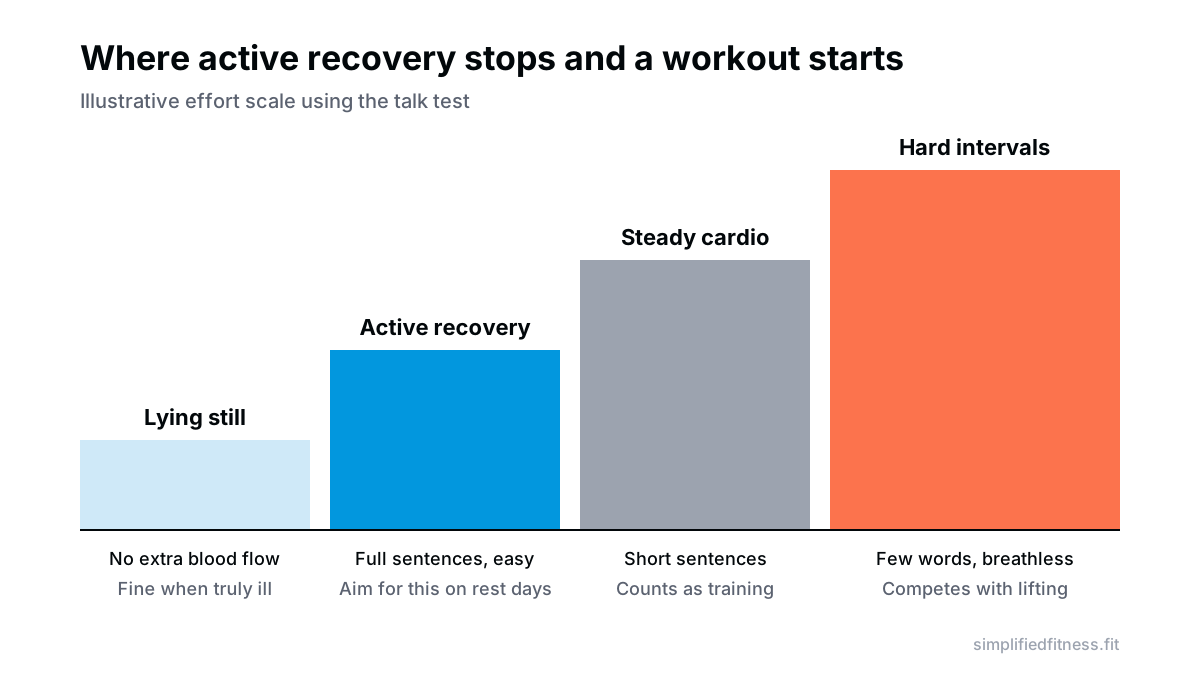
What heart rate counts as “easy”?
The brief answer many coaches give is: stay under about 110 bpm. That is a practical rule of thumb for many people, and I want to be clear that I am not aware of a research-defined cut-off for it. A 55-year-old and a 22-year-old will feel very different at 110.
The talk test is better. You should be able to speak in full sentences, breathe through your nose for most of it, and finish feeling better than you started. If you want numbers, use our heart rate zone calculator and stay in the lowest zone.
Mobility work on rest days: useful, but not a recovery drug
Gentle mobility feels good and may help your range of motion for squatting and pressing. But do not expect it to erase soreness.
A 2021 meta-analysis of 10 randomised trials (229 participants, mostly young men) compared post-exercise stretching with passive recovery and found no effect on strength recovery or on 24, 48 or 72-hour DOMS. The authors called the confidence in the evidence very low, so this is “not shown to help”, rather than “proven useless” (Afonso et al., 2021). We cover this in stretching and the post-workout soreness myth.
Foam rolling is similar. A meta-analysis of 21 studies found small effects: post-rolling reduced perceived muscle pain, while effects on performance recovery were minor, and the authors judged it more justified as a warm-up than as a recovery tool (Wiewelhove et al., 2019).
So use mobility for what it is. A few minutes of hips, thoracic spine and shoulders in a pain-free range. If you want a ready-made routine, our 7-minute dynamic warm-up works nicely.
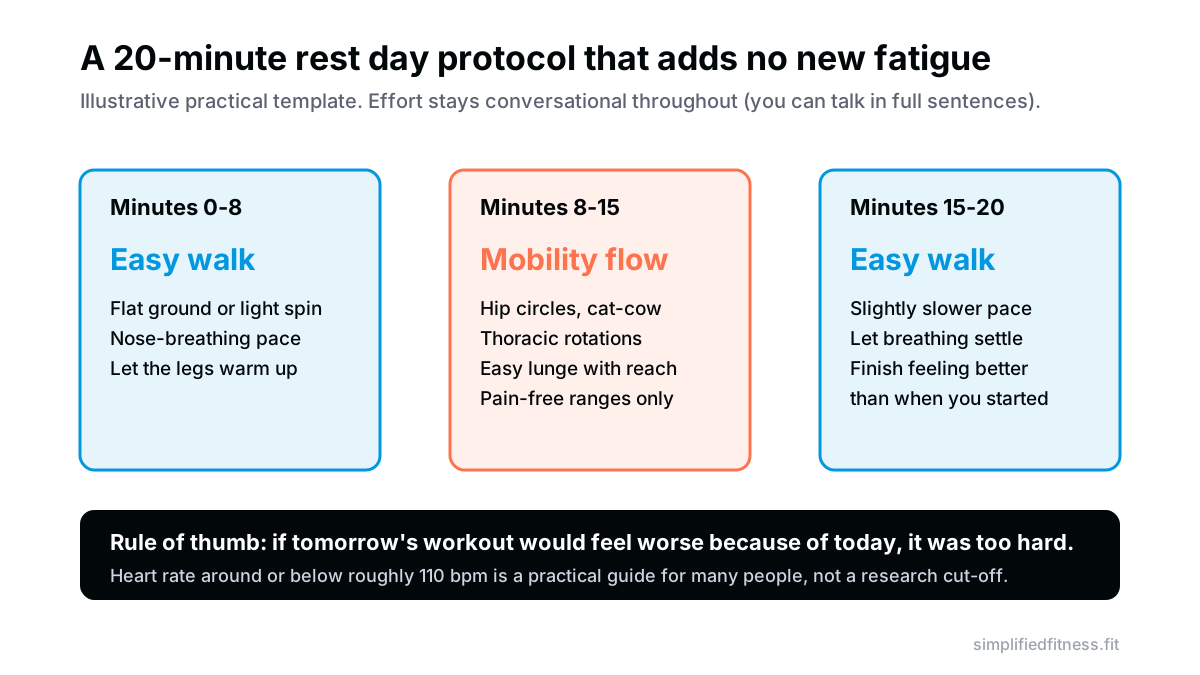
A 20-minute rest day protocol you can copy
Here is a simple structure. It is a template, not something tested in a trial.
- Minutes 0-8: easy walk, or very light spin on a bike.
- Minutes 8-15: mobility flow. Hip circles, cat-cow, thoracic rotations, a gentle lunge with an overhead reach.
- Minutes 15-20: easy walk again, a touch slower, until your breathing is completely calm.
Active recovery vs passive rest: which should you choose?
| Situation | Better pick | Why |
|---|---|---|
| Stiff after leg day, no pain | Easy walk plus mobility | Low cost, likely small DOMS benefit |
| Very sore after unfamiliar eccentric work | Gentle walk, or rest | Cycling or intervals may slightly worsen recovery in damaged muscle |
| Poor sleep, run down, feeling ill | Passive rest | Extra movement is optional when your system is already stressed |
| Cutting, want more daily movement | Walking | Burns a few more calories without hurting lifting |
| Short on time | Either | A 10-minute walk beats a perfect plan you skip |
How to fit rest day movement into your week
Placement matters more than people think. A simple pattern for a four-day lifting week is lift, lift, easy day, lift, lift, then two easy days. Put the walk on the day after your hardest leg session, when hips and calves are stiffest, not on the day before it.
If you only lift three days a week, the gaps between sessions are already natural recovery windows. You do not need to fill every one with a protocol. A daily 20-30 minute walk and a few mobility drills is plenty.
Indian context helps here. Many people already walk after dinner, and that counts. A 20-minute walk after lunch or dinner is the easiest active recovery habit to keep, costs nothing, and does not need a gym membership. In hot, humid months, walk early morning or after sunset, and drink water, because heat and dehydration add stress that has nothing to do with muscle repair.
One more thing. Do not use active recovery to punish yourself for a big meal or to “make up” for a skipped session. That mindset turns recovery into compensation, and it quietly adds fatigue. Keep it boring on purpose.
Soreness: when to stop and see a doctor
Normal DOMS is a dull, diffuse ache in the muscles you trained, and it usually peaks around 1-3 days after unfamiliar work. For more on that, see our muscle soreness and DOMS recovery guide.
Get checked by a doctor if you have severe swelling, very dark urine, sharp joint pain, soreness that keeps getting worse after several days, or chest pain or dizziness during any activity. This article is general education, not medical advice.
The bottom line
Easy movement on rest days is a sensible habit, not a miracle. The best evidence we have says active recovery can modestly reduce soreness, with massage ahead of it, and some small trials hint that going too hard backfires. Keep it conversational, keep it short, and let sleep and food carry the weight.
Want a training week that leaves room for rest? Start with our free training plans.
Frequently Asked Questions
What is the difference between active recovery and passive rest?
Active recovery is low-effort movement such as walking, easy cycling or mobility work, while passive rest is doing no exercise at all. Easy movement raises blood flow and heart rate slightly without adding meaningful muscle damage. Both are valid, so pick the one you will actually do consistently.
Is active recovery better than rest for sore muscles?
It may be slightly better, but the evidence is mixed. A 2018 meta-analysis found active recovery lowered DOMS, yet massage did better, and a small trial in soccer players found cycling the day after damaging exercise may be mildly detrimental. If you try it, keep the effort very easy and stop if soreness gets worse.
What heart rate should I keep for active recovery?
There is no official research cut-off, but staying under roughly 110 bpm works as a practical guide for many people. The aim is easy effort, so a talk test (full sentences without gasping) is more reliable than a number. Use our heart rate zone calculator to find your own zone 1 range.
How long should an active recovery session be?
Around 15-30 minutes is enough for most lifters. Longer sessions drift toward real cardio, which adds fatigue and can compete with lifting. Aim to finish feeling looser, not tired.
Is walking good for recovery on rest days?
Yes, walking is the lowest-risk option for most people. It raises blood flow gently, costs almost no recovery and adds general health benefits. Try a relaxed 20-30 minute walk, ideally outdoors after a meal.
Can I do light cycling instead of walking?
Yes, as long as it stays truly light. In one trial of trained cyclists, riding at about 50% of maximal oxygen uptake after hard efforts helped clear blood lactate faster than resting. Spin at an easy pace with low resistance and keep your quads from burning.
Does active recovery flush out lactic acid?
Easy movement does speed up blood lactate removal after very hard exercise, but lactate is not what causes soreness the next day. A review also notes that rest alone returns lactate to baseline well within normal time between training sessions. So lactate clearance is a weak reason to move on rest days.
Should I do mobility work or stretching on rest days?
Gentle mobility is fine and feels good for many people, but it is not proven to speed recovery. A meta-analysis of 10 randomised trials found no clear effect of post-exercise stretching on soreness or strength recovery versus rest, though the authors rated certainty in the evidence as very low. Treat it as a comfort and range-of-motion habit, not a recovery drug.
Will cardio on rest days hurt my muscle growth?
Easy walking or cycling is unlikely to, but harder or more frequent endurance work can. A meta-analysis found interference with strength and hypertrophy depended on the mode, frequency and duration of endurance training, with running more problematic than cycling. Keep rest day work gentle and short.
Is foam rolling good for active recovery?
Foam rolling has small effects at best. A meta-analysis of 21 studies found it modestly reduced perceived muscle pain after exercise, while effects on performance recovery were minor. It is fine as a few minutes of pre-bed or post-walk habit if you enjoy it.
How many rest days should lifters take per week?
Most lifters do well with 1-3 non-lifting days a week depending on their program and how they feel. Rest days are when training stress turns into adaptation, so they are part of the plan. Use them for easy movement, food and sleep rather than extra hard training.
When should I skip active recovery and fully rest?
Skip it when you are ill with fever, feeling dizzy, or sleeping badly and exhausted. Easy movement is optional, and rest is a legitimate choice. See a doctor if soreness is severe, comes with dark urine or swelling, or pain is sharp and lasting.
Does active recovery help me lose fat too?
It helps a little through extra daily movement, but it is not a fat loss tool on its own. Calorie intake still decides weight change. Walking is useful mostly because it is easy to repeat without hurting your lifting.
Sources & References
Every claim above is checked against peer-reviewed research (PubMed, U.S. National Library of Medicine) or guidance from established health bodies. How we fact-check.
- Dupuy O, et al. An evidence-based approach for choosing post-exercise recovery techniques to reduce markers of muscle damage, soreness, fatigue, and inflammation: a systematic review with meta-analysis. Front Physiol. 2018. PMID: 29755363
- Monedero J, et al. Effect of recovery interventions on lactate removal and subsequent performance. Int J Sports Med. 2000. PMID: 11156281
- Abaidia AE, et al. Muscle oxygenation induced by cycling exercise does not accelerate recovery kinetics following exercise-induced muscle damage in humans: a randomized cross-over study. Respir Physiol Neurobiol. 2019. PMID: 31077799
- Barnett A. Using recovery modalities between training sessions in elite athletes: does it help? Sports Med. 2006. PMID: 16937953
- Skorski S, et al. The temporal relationship between exercise, recovery processes, and changes in performance. Int J Sports Physiol Perform. 2019. PMID: 31172832
- Wilson JM, et al. Concurrent training: a meta-analysis examining interference of aerobic and resistance exercises. J Strength Cond Res. 2012. PMID: 22002517
- Afonso J, et al. The effectiveness of post-exercise stretching in short-term and delayed recovery of strength, range of motion and delayed onset muscle soreness: a systematic review and meta-analysis of randomized controlled trials. Front Physiol. 2021. PMID: 34025459
- Wiewelhove T, et al. A meta-analysis of the effects of foam rolling on performance and recovery. Front Physiol. 2019. PMID: 31024339

Umair Hazrami · Founder & Head Coach, Simplified Fitness
Umair Hazrami founded Simplified Fitness and the Simplified Lifter channel to cut through fitness noise. With 4+ years of consistent training and 10+ coaching clients, he writes every guide from the peer-reviewed research and links the sources so you can check them. Our editorial standards.
Educational content only, not medical advice. If you have a medical condition, are pregnant, or take medication, talk to a qualified doctor before changing your diet, supplements or training. Full disclaimer.
Keep reading
Recovery
Afternoon Caffeine Cutoff: Half-Life, Deep Sleep and Pre-Workout
Afternoon caffeine cutoff for lifters: how caffeine's half-life cuts sleep time and deep sleep even if you fall asleep fine, plus a practical cutoff by bedtime.
9 min read

Recovery
Blue Light, Melatonin and Screen Time: Do Blue-Blockers Actually Help You Sleep?
Blue light screen time melatonin suppression is real, but do blue-blocking glasses fix it? See what the trials found and the free fixes that matter more.
7 min read

Recovery
Is Your CNS Fried? CNS Fatigue vs Plain Lethargy in the Gym
Is my CNS fried from lifting? See what central fatigue really is, how fast it recovers and how to tell it from low motivation or poor sleep. Studies linked.
9 min read
Recovery
Circadian Rhythm and Strength: Why You Peak in the Late Afternoon
Circadian rhythm strength peak explained: why you lift more at 4-7 pm than at 7 am, what body temperature really does, and how to plan PR days.
8 min read