Why Poor Sleep Makes You Feel More Sore: Sleep Loss and Pain Sensitivity
Does lack of sleep make DOMS worse? Sleep and muscle soreness link through pain sensitivity. See what studies show and what to do before buying gadgets.
TL;DR. The short answer
- Sleep loss makes the nervous system more sensitive to pain. In a 2023 trial, one sleepless night after hard eccentric quad work lowered pressure pain thresholds more than normal sleep did, but self-rated soreness did not differ.
- A 2022 meta-analysis of 31 experimental studies found sleep deprivation lowers pain threshold and tolerance in healthy people, though the evidence for total deprivation was rated limited.
- Your muscle is not necessarily more damaged when you sleep badly. A small crossover study found strength recovery after muscle damage was not delayed by 48 hours of no sleep.
- The mechanism is mostly in pain processing: weaker descending pain inhibition, easier pain build-up, and possibly more inflammation. The opioid link is plausible but not established.
- Before buying any recovery gadget, fix sleep first. It is free, and in lab studies sleep loss consistently makes pain feel stronger.
Part of our complete guide: Muscle Soreness (DOMS), Heat/Cold Modalities & Recovery Methods: What Science Actually Supports
Table of contents
Sleep and muscle soreness are linked, but not the way most people assume. A bad night does not seem to make the muscle itself more damaged. It makes your nervous system more sensitive to the pain that damage produces, so the same leg day can feel like a worse leg day.
This is one piece of our complete guide to muscle soreness, DOMS and recovery modalities. Here we stay on one question: why do you hurt more when you are tired, and what does the research say you can do about it?
Does lack of sleep make DOMS worse?
Partly, and the details matter.
The most direct test is a 2023 study by Palsson and colleagues (Palsson et al., 2023). Thirty-six healthy adults were split into three groups: a control group, and two groups who did eccentric quadriceps exercise to cause delayed onset muscle soreness (DOMS). One DOMS group slept normally. The other had a night of sleep withdrawn. Forty-eight hours later, pressure pain thresholds had dropped in both exercise groups, but the drop was bigger in the no-sleep group compared with controls.
Now the honest bit. The self-rated DOMS score on a 6-point scale did not differ between groups, and neither did the size of the painful area produced by strong pressure on the quadriceps. So what the study actually shows is more tender tissue under pressure, not a proven jump in how sore people say they feel. It was also small (11 to 13 per group) and the authors call it a cross-sectional group comparison.
If you are new to the basics of what soreness is, start with DOMS versus muscle growth. Soreness is not a measure of how well a session worked.
What does sleep deprivation do to pain sensitivity?
Outside the gym, the evidence is broader. A 2022 systematic review and meta-analysis pooled 31 experimental studies, covering 699 healthy people and 47 with chronic pain (Chang et al., 2022). In healthy people, total sleep deprivation lowered pain threshold and tolerance (effect sizes 0.74 to 0.95), though the authors rated that evidence as limited. Partial sleep deprivation modestly raised spontaneous pain intensity (effect size 0.30, moderate evidence). Fragmented sleep increased peripheral and central sensitization (0.42 to 0.79, very limited to moderate evidence).
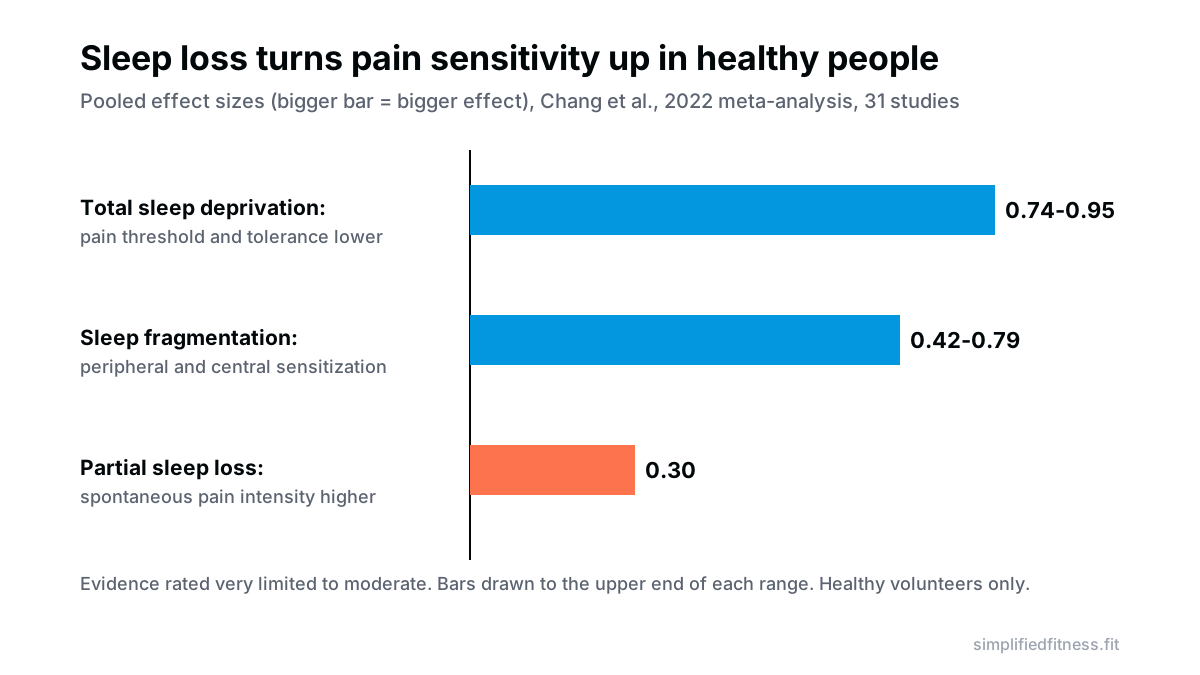
Two caveats. These were mostly short lab studies in healthy volunteers, not lifters in a training block. And for people who already live with chronic pain, the authors say the findings remain uncertain.
How does poor sleep change pain in the nervous system?
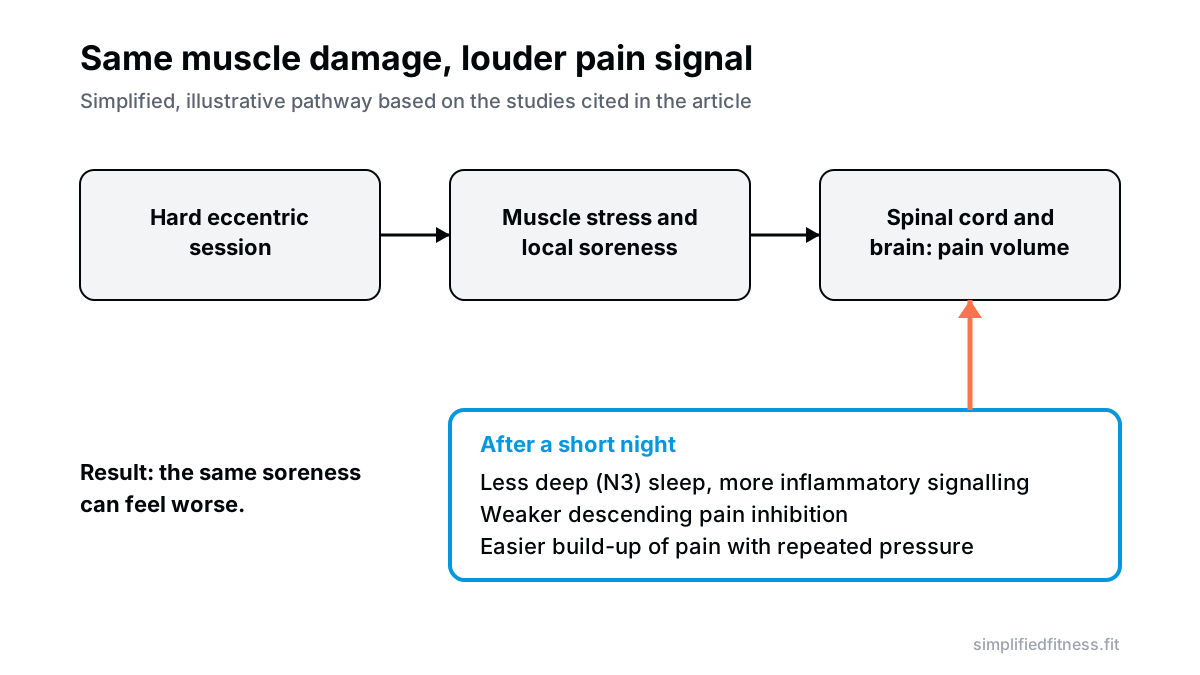
Think of pain as a volume dial, not a direct readout of tissue damage. Your muscles send signals, and your spinal cord and brain decide how loud to make them. Three things seem to change after poor sleep.
The brain’s own brake gets weaker. A 2019 study of 24 healthy participants measured them after normal sleep and after 24 hours of total sleep deprivation. Conditioned pain modulation (the “pain inhibits pain” system) was impaired, temporal summation (pain building up with repeated stimulation) was facilitated, and sensitivity to pressure and cold pain increased (Staffe et al., 2019). The authors read this as impaired descending pain pathways plus increased spinal excitability.
Inflammation may play a part. In a randomized crossover trial of 95 healthy adults, two nights of forced awakenings reduced slow wave (N3) sleep, raised inflammatory cytokine production and lowered heat pain threshold. Statistical mediation analysis suggested reduced N3 sleep and rising inflammation explained about 35% of the effect on pain threshold (Irwin et al., 2023). Mediation analysis suggests, it does not prove.
The opioid question is open. You will see claims online that sleep loss “shuts down your endogenous opioids.” The literature I checked does not show that directly. A 2013 review lists dopamine and opioid systems as targets for future research, and notes that sleep impairment may disrupt endogenous pain inhibition (Finan et al., 2013). A small study did find codeine raised heat-pain withdrawal latency in non-sleepy adults but not in naturally sleepy ones (12 people, 6 per group) (Steinmiller et al., 2010). That is consistent with sleepiness changing opioid pain control. It is not proof of the mechanism.
Does poor sleep damage muscle recovery too?
This is where the “sleep is everything” story needs trimming.
In a randomized crossover study, 10 young men did 240 eccentric knee extensions, then either stayed awake for 48 hours (with 12 hours of normal sleep afterwards) or slept normally for three nights. Voluntary strength and creatine kinase followed the same course in both conditions. Deprivation raised IL-6, IGF-1, cortisol and the cortisol to testosterone ratio, but did not delay strength recovery (Dattilo et al., 2020). Ten men, one protocol, short term.
Training performance tells a similar mixed story. A systematic review of 17 studies (quality rated moderate or weak) found a single night of total deprivation had little effect on strength during resistance exercise, while consecutive nights of restriction could reduce force output in multi-joint, but not single-joint, movements (Knowles et al., 2018). Hormonal findings were conflicting. The authors suggested that training in groups or caffeine might help offset the dip.
Put together: one bad night probably will not ruin your muscle repair, but your pain system and your compound-lift performance are the first places a sleep shortage shows up.
What about central nervous system fatigue and sleep?
“CNS fatigue” is a popular gym phrase, and it is fuzzy. A reasonable reading of the evidence above: after short sleep, drive and motivation drop, effort feels higher and discomfort feels louder. That fits the finding that inadequate sleep affects heavy compound movements more than isolation work, unless motivation is supported.
I would not claim it is a single measurable “CNS tank.” Use it as shorthand for the combined effect on perceived effort and pain.
Can a nap fix the pain sensitivity?
Possibly, a little. In a randomized crossover study of 11 healthy men, a night limited to two hours of sleep changed pain thresholds in some body areas (lower back heat pain threshold decreased, shoulder pressure pain threshold rose, and the thigh did not change). Two 30-minute naps restored the responses (Faraut et al., 2015). Note the mixed pattern: not every site got more sensitive. Small sample, all male, lab setting.
Sleep first, gadgets second
This is the point of the article. Many readers will spend thousands of rupees on percussion guns, boots or compression gear while sleeping five hours in a warm, bright room.
We cover the devices on their own pages: massage guns, compression boots and the wider recovery gadget audit. The consistent theme is modest effects, mostly on how recovered you feel. Sleep acts on pain processing itself.
A free sleep upgrade for Indian lifters
- Heat: a hot bedroom fragments sleep. A fan on a timer or a cooler room helps.
- Late dinners: a heavy dal-chawal or biryani at 11 pm can keep you awake. Eat earlier when you can.
- Evening chai or pre-workout: caffeine lingers for hours. Our caffeine dosage calculator can help you set a cut-off.
- Screens: put the phone away 30 minutes before bed.
- Consistency: the same wake time, including weekends.
For the full checklist see sleep hygiene for lifters, and for what happens inside the night, sleep architecture and slow wave sleep. The broader picture is in our sleep and circadian timing guide.
What should you do when you are sore and underslept?
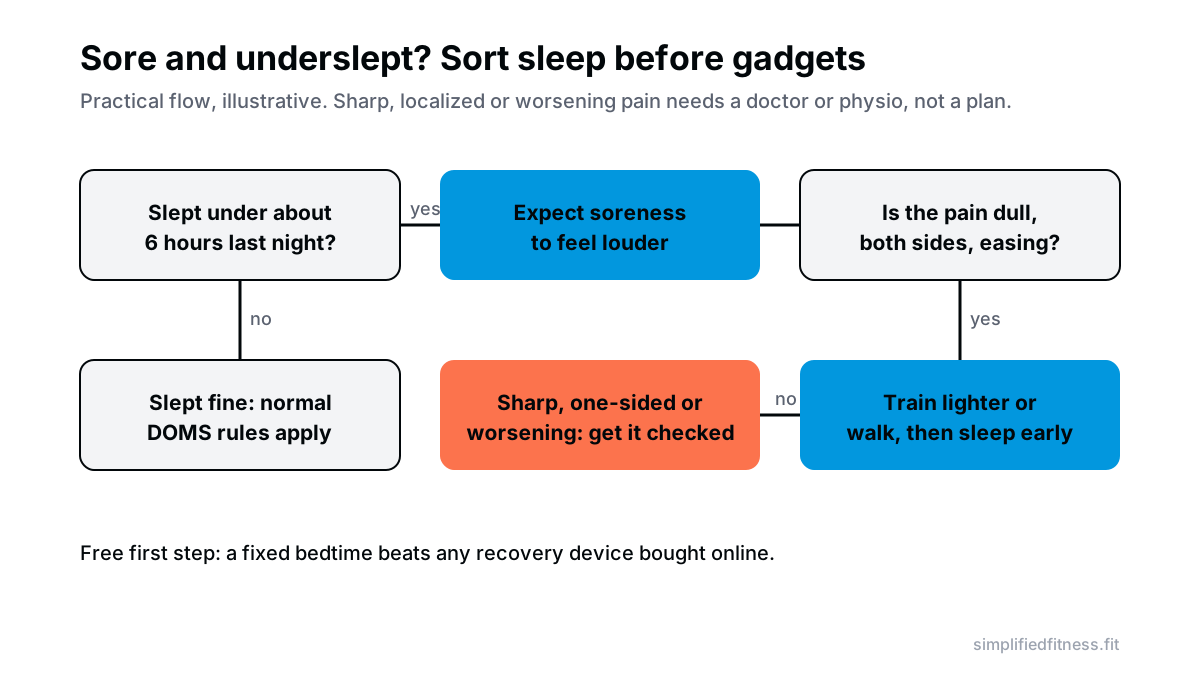
Here is a simple way to handle it.
- Check last night. As a rough rule of thumb (not a tested cut-off), under about six hours, expect soreness to feel louder than normal.
- Keep the habit, cut the load. Do the session at a lower RPE, trim a set or two, or walk. Our RIR and RPE calculator helps you keep effort honest.
- Prefer machines and simpler lifts over heavy, technical compounds if your drive is flat.
- Sleep earlier tonight. That is the recovery intervention that carries over.
- Do not chase pain. Soreness is a poor guide to training quality either way. For the training call, see should you work out when sore.
If you want a ready-made structure to scale up and down, our free push, pull and legs plans are built to flex like this.
When to see a doctor
Ordinary DOMS is a dull, achy tenderness in both sides, peaking around 24-72 hours and easing. Get medically checked if pain is sharp, one-sided, swollen or bruised, not improving after about three days, or if you notice very dark urine or severe weakness. Also speak to a doctor if poor sleep or pain persists for weeks. This article is general education, not a diagnosis.
The bottom line
Sleep loss makes you more sensitive to pain, and the research on healthy volunteers is fairly consistent on that. The evidence that it makes the muscle itself recover slower is much weaker. So a short night is a reason to expect more tenderness, adjust the plan and protect tonight’s sleep, not to panic or buy a gadget.
Fix sleep first. Then, if you still want to optimise, add one tool at a time.
Frequently Asked Questions
Does lack of sleep make DOMS worse?
It can make the area more sensitive to pressure, but the evidence on how sore it feels is thinner. In a 2023 study of 36 people, one night without sleep after eccentric quad exercise lowered pressure pain thresholds more than normal sleep, yet the soreness rating scale did not differ between groups. If you are sleep deprived, expect a tender muscle to feel touchier and plan a lighter day.
Why am I more sore when I am tired?
Poor sleep appears to turn up the volume on pain signals rather than increase muscle damage. Experimental work shows sleep loss weakens the brain's own pain-dampening system and makes repeated pain stimuli add up more easily. If you notice this pattern, treat a short night as a reason to ease the session, not as proof you trained wrong.
Does sleep deprivation increase pain sensitivity?
Yes, in healthy volunteers it generally does. A 2022 meta-analysis of 31 studies found total sleep deprivation reduced pain threshold and tolerance, though the authors rated that evidence as limited. Protecting a consistent sleep window is the simplest way to avoid this.
Does sleep deprivation delay muscle recovery?
Strength recovery looks surprisingly resilient in the short term. In one crossover study of 10 men, 48 hours of total sleep deprivation after muscle-damaging exercise did not delay recovery of voluntary strength, although hormone and inflammatory markers changed. That is a small, short study, so do not read it as permission to skimp on sleep for weeks.
What is central fatigue and does sleep affect it?
Central fatigue is the nervous system side of tiredness, where drive to the muscle and motivation drop even if the muscle itself can still produce force. A 2018 systematic review found inadequate sleep, especially several restricted nights, can reduce force in multi-joint lifts unless motivation is supported. Plan big compound lifts for days after decent sleep when you can.
Does sleep affect pain tolerance in the gym?
Probably, because the same pain-processing system is involved. Lab studies show lower pain thresholds after sleep loss, and hard sets feel harder when effort and discomfort blur together. On low-sleep days, use RPE and bar speed instead of grinding through discomfort.
How many hours of sleep do I need to recover from training?
There is no single number proven for lifters, so use general adult guidance as a starting point. Most adults need around seven hours or more, and the studies here show that sharply reduced or fragmented sleep is where pain sensitivity rises. Aim for a consistent window and judge by how you feel and perform.
Can a nap help with pain sensitivity after a bad night?
It may help. In a small randomized crossover study of 11 men, two 30-minute naps reversed the pain threshold changes caused by a night of only two hours' sleep. A short afternoon nap that does not wreck your night is worth trying.
Do painkillers work as well when I am underslept?
Possibly not. In a small study of 12 healthy adults, codeine increased heat-pain withdrawal latency in non-sleepy people but not in sleepy ones. Those people were naturally sleepy on testing rather than sleep deprived, so this is a hint, not proof. Never use that as a reason to take more of any drug; if pain needs medication, speak to a doctor or pharmacist.
Is it the sleep or the soreness that comes first?
Both directions exist, but a 2013 review concluded that sleep impairments predict pain more reliably than pain predicts poor sleep. That mostly comes from population and daily-diary studies, so it describes patterns rather than a single cause. If pain keeps you awake night after night, see a doctor or physio.
Should I train when I am sore and sleep deprived?
Usually a lighter session or a walk is the smarter choice. Sore muscles are tender after sleep loss, and strength in heavy compound lifts can dip after several short nights. Keep the plan, cut volume, and prioritise an earlier bedtime.
Do I need a recovery gadget if I sleep badly?
Fix sleep first, because it is free and the lab evidence linking it to pain sensitivity is consistent. Massage guns, compression and cold exposure have modest effects at best, and none of them replaces the pain-processing effects of a full night. Spend on a dark room, a fan or AC and a bedtime routine before any device.
When should I see a doctor about pain and poor sleep?
See a doctor if pain is sharp, one-sided, swollen, bruised, getting worse after 72 hours, or paired with dark urine. Also go if you cannot sleep for weeks. Ordinary DOMS is dull, both sides, and eases within a few days.
Sources & References
Every claim above is checked against peer-reviewed research (PubMed, U.S. National Library of Medicine) or guidance from established health bodies. How we fact-check.
- Chang JR, et al. The differential effects of sleep deprivation on pain perception in individuals with or without chronic pain: a systematic review and meta-analysis. Sleep Med Rev. 2022. PMID: 36334461
- Palsson TS, et al. Sleep deprivation increases pain sensitivity following acute muscle soreness. Sleep Med. 2023. PMID: 37423022
- Staffe AT, et al. Total sleep deprivation increases pain sensitivity, impairs conditioned pain modulation and facilitates temporal summation of pain in healthy participants. PLoS One. 2019. PMID: 31800612
- Irwin MR, et al. Sleep disruption and activation of cellular inflammation mediate heightened pain sensitivity: a randomized clinical trial. Pain. 2023. PMID: 36314570
- Dattilo M, et al. Effects of sleep deprivation on acute skeletal muscle recovery after exercise. Med Sci Sports Exerc. 2020. PMID: 31469710
- Knowles OE, et al. Inadequate sleep and muscle strength: implications for resistance training. J Sci Med Sport. 2018. PMID: 29422383
- Finan PH, Goodin BR, Smith MT. The association of sleep and pain: an update and a path forward. J Pain. 2013. PMID: 24290442
- Faraut B, et al. Napping reverses increased pain sensitivity due to sleep restriction. PLoS One. 2015. PMID: 25723495
- Steinmiller CL, et al. Differential effect of codeine on thermal nociceptive sensitivity in sleepy versus nonsleepy healthy subjects. Exp Clin Psychopharmacol. 2010. PMID: 20545392

Umair Hazrami · Founder & Head Coach, Simplified Fitness
Umair Hazrami founded Simplified Fitness and the Simplified Lifter channel to cut through fitness noise. With 4+ years of consistent training and 10+ coaching clients, he writes every guide from the peer-reviewed research and links the sources so you can check them. Our editorial standards.
Educational content only, not medical advice. If you have a medical condition, are pregnant, or take medication, talk to a qualified doctor before changing your diet, supplements or training. Full disclaimer.
Keep reading
Recovery
Cold Plunge After Workout: Does an Ice Bath Blunt Muscle Growth?
Does a cold plunge after workout kill your gains? See what the lifting trials found on muscle fibre growth, strength, soreness and when cold is fine to use.
8 min read
Recovery
Ice Baths for Athletes: When Cold Water Immersion Helps at Tournaments
Ice baths for athletes can cut soreness between matches but may blunt muscle gain. See when cold water immersion is worth it and how to use it.
7 min read
Recovery
Compression Boots and Lymphatic Drainage: Do They Really Speed Recovery?
Do compression boots speed recovery or 'detox' your legs? See what pneumatic compression trials found on soreness, strength and lymph, and cheaper options.
7 min read
Recovery
Compression Garments for Lifters: Do Tights and Sleeves Really Help Recovery?
Do compression tights help recovery after lifting? Meta-analyses show small effects on soreness, swelling and strength. See what works, what doesn't, and when.
8 min read