How Often Should You Deload? Calendar Schedule or Listen to Your Body
How often should you deload: every 4-8 weeks on a calendar, or only when markers say so? What surveys and trials show, plus a simple timing flowchart.

TL;DR. The short answer
- A proactive deload is a rest week on the calendar. A reactive deload is a rest week triggered by signs such as stalled lifts, poor sleep or aching joints. Neither has been proven better in head-to-head trials.
- Surveyed competitive strength and physique athletes deloaded about every 5.6 weeks. That is a habit, not a proven requirement, and lifters on moderate volume may not need one that often.
- In trained lifters, a full week off mid-program gave similar muscle growth but smaller strength gains in one trial. In untrained men, reduced-volume deloads made no measurable difference.
- Subjective measures like mood, sleep and perceived stress tracked training load better than most objective measures in a systematic review.
- Use two or more warning signs together, not one bad session, as your trigger. See a doctor for persistent joint pain, sharp pain or fatigue that does not lift.
Part of our complete guide: Muscle Soreness (DOMS), Heat/Cold Modalities & Recovery Methods: What Science Actually Supports
Table of contents
The honest answer to how often should you deload is that nobody has tested a best interval. You can put a rest week on the calendar (proactive) or take one when performance and recovery signs call for it (reactive). For most moderate-volume lifters, a loose 6-8 week window with a signs-based override is a sensible middle path. It sits inside our guide to muscle soreness, DOMS and recovery.
Here we only cover timing: how often, and what should trigger the week. Whether deloads prevent injury, and which style suits which experience level, is covered in proactive vs reactive deloads and injury prevention. For what a deload actually does in the body and how to run one, see deload week physiology and how to deload.
What is the difference between a proactive and a reactive deload?
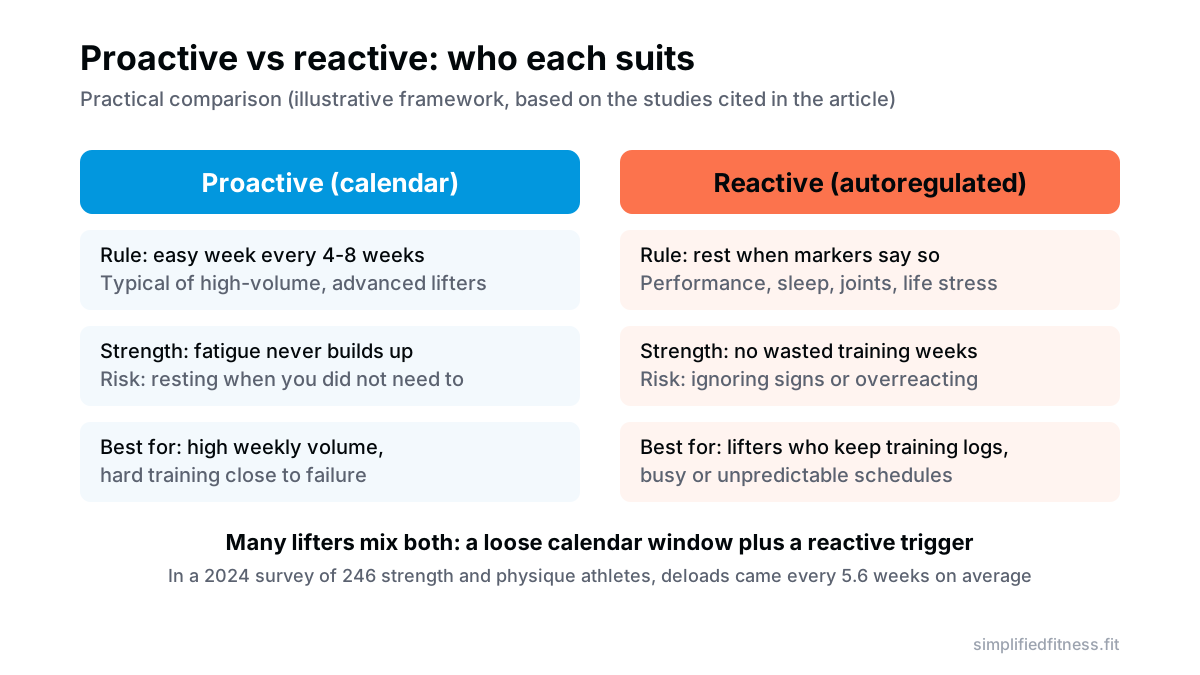
Proactive: you decide ahead of time. Every fifth week is light, no matter how you feel. Simple, and you never have to judge anything.
Reactive (autoregulated): you train as planned and pull back when markers say fatigue has built up. Autoregulation, in general, means adjusting training based on your performance or perceived capability. It has been used as a framework since the 1940s, but a 2020 review noted that research on it is limited, and that inconsistent terminology makes findings hard to combine (Greig et al., 2020).
How often should you deload? What lifters actually do
Nobody can give you a proven number. What we have is survey data on what people do.
A 2024 survey of 246 competitive strength and physique athletes (about 8 years of lifting experience on average) found that all of them deloaded. The typical deload lasted 6.4 days and came about every 5.6 weeks. Most used a pre-planned approach, sometimes combined with an autoregulated one, and also deloaded when performance stalled or when soreness and joint aches rose (Rogerson et al., 2024).
Two caveats matter. First, a survey shows what people do, not what works. Second, these are experienced competitors training hard. A lifter doing 3 sessions a week of moderate volume is in a very different spot.
Do beginners and intermediates need a deload every 4-6 weeks?
Often not that frequently. Fatigue accumulates with volume and intensity, and a beginner with moderate loads and a few hard sets per muscle builds it slowly. There is a counterpoint, though: newer lifters are worse at judging their own fatigue and rarely keep detailed logs, which is why some coaches prefer a fixed easy week for them. Both are reasoning, not trial results. A practical compromise is a cap of roughly 6-8 weeks, pulled earlier if warning signs show up. Our article on deloads by experience level goes deeper on this.
The research that exists on resting also gives a mixed picture, and the populations differ:
- Resistance-trained people: a 2024 randomized trial gave 39 young men and women a high-volume, 9-week program. One group took a full week off at the midpoint. Muscle size, endurance and power were similar between groups, but the continuous group improved lower body strength more (Coleman et al., 2024).
- Untrained men: in a 2026 within-subject trial of 19 men, one arm and one leg trained continuously while the other arm and leg had weeks 4 and 8 cut to once a week and 2 sets per exercise, using leg extensions and biceps curls. Muscle thickness and 10-rep-max gains were not meaningfully different from training continuously (Pancar et al., 2026).
Why might these differ? The designs are different: a complete week off in trained lifters versus a reduced week in untrained men, and a high-volume program versus a smaller one. Both were short trials with young participants, so they cannot tell us about older lifters or long-term outcomes. The cautious takeaway: a deload did not clearly help growth in either study, and a full week off may cost a little strength. That supports not resting automatically.
Which signs should trigger an early deload?
Subjective signals deserve more respect than most people give them. A systematic review of 56 studies found subjective and objective measures of athlete well-being generally did not correlate, and subjective measures reflected acute and chronic training load with better sensitivity and consistency than objective ones (Saw et al., 2016). That was in athletes broadly, not only lifters, but the logic carries over: how you feel is useful data.
Watch for a cluster of these, lasting more than a week. Our four-point deload checklist covers each one in detail:
- Performance: main lifts stuck or going backwards across two or more sessions, with the same warm-up and the same food and sleep.
- Effort: the same weights feel clearly harder than last week.
- Sleep: more trouble falling or staying asleep than usual.
- Joints: aches in elbows, knees or shoulders, not just muscle tiredness.
- Mood and drive: dreading sessions you normally enjoy.
- Life load: exams, deadlines, travel, night shifts or a family event.
The consensus statement on recovery frames it as a balance between training load, competition load and other life demands (Kellmann et al., 2018). Your body does not care whether the stress came from the gym or from a work deadline.
When to take a rest week: a simple decision flowchart
This is a practical framework, not a validated tool. It asks three questions and counts the “yes” answers.
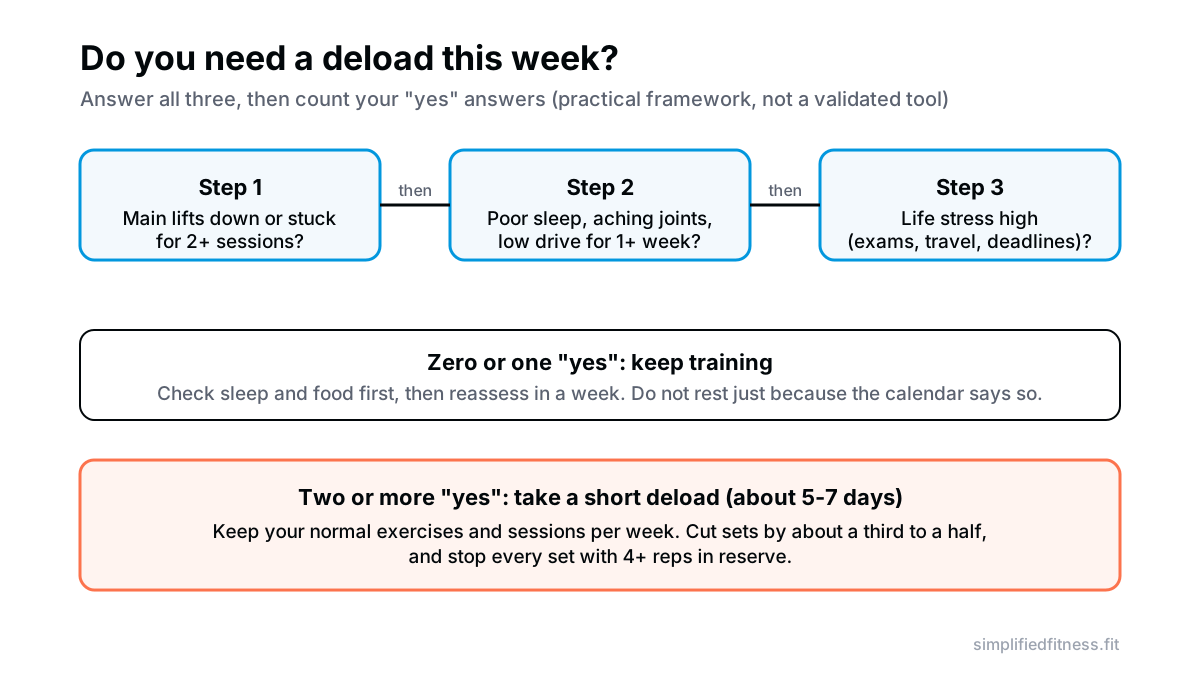
Before you count a “yes”, rule out the boring causes: eating well below maintenance, sleeping 5 hours, missing protein, or having had an illness. Fix those first. If you are unsure how much you should eat, use the calorie calculator and the protein calculator.
How to make autoregulation honest
The weakness of reactive deloads is that you are judging yourself. Some people rest at the first sign of discomfort, while others ignore everything for months. Three habits keep it honest:
- Write down your top set for 2-3 main lifts each session, with reps and effort.
- Rate sleep and mood 1-5 each morning, or just weekly. It takes ten seconds.
- Set the rule before you feel bad. “Two signs for over a week” beats deciding when you are tired and grumpy.
Rating effort with reps in reserve helps here. In a crossover study of 14 trained men on the bench press, stopping four sets at 3 reps in reserve (with a fifth set to failure) instead of taking all five sets to failure let them sustain more reps and work at a lower perceived effort, though recovery markers at 24 to 72 hours did not differ (Mangine et al., 2022). That is a small study, but it suggests that leaving reps in the tank is a way to manage fatigue without a full break. Our guide to RIR and RPE explains how to use the scale.
When does a proactive schedule make sense?
A calendar can still be the right call if:
- you train at high weekly volume and close to failure,
- you are someone who never rests unless forced,
- your schedule is predictable and you want one less decision, or
- you are peaking for a meet or event, which is a taper rather than an ordinary deload.
A 2024 survey of 204 strength and conditioning coaches found most reduced volume during tapers, competition periods, tournaments and travel, most often by 0-25% (De Marco et al., 2024). That is coaching practice, not proof of what is best, but it shows deloading is flexible and not one fixed recipe.
A middle path works for many people: pick a loose window, like every 6-8 weeks, and take it earlier if two warning signs appear, or push it later if you are progressing and feeling good. For how deloads relate to sets and rebuilding sensitivity to training, see volume resensitization and deloads and the broader progressive overload, deloads and plateaus guide.
What to do in a deload week
In the athlete survey, a typical deload kept frequency and exercise selection the same and lowered volume, load and effort (Rogerson et al., 2024). A practical version:
- Same exercises, same days.
- Cut sets by roughly a third to a half.
- Keep every set at 4 or more reps in reserve.
- Walk, sleep and eat well. Skip the new gadgets.
Run the week, then go back to normal training, adding load slowly. If you want a structure to follow, our free push pull legs plan makes the volume easy to scale down.
India-specific notes
Indian lifters often deal with long commutes, hot summers and irregular work hours. These count as life stress. A week of 40 degree heat, bad sleep and a skipped lunch can look like “overtraining” when it is mostly under-recovery. Before deloading, check that you are getting enough protein through dal, paneer, curd, eggs or soya, and enough carbohydrate from rice or roti on training days. Reactive deloads suit unpredictable schedules, such as exam season or festival weeks, better than a rigid calendar does.
When to see a doctor
A deload will not fix everything. See a doctor or physiotherapist if you have sharp or worsening joint pain, pain that wakes you at night, numbness or tingling, chest pain, unusual shortness of breath or fatigue that persists for weeks despite rest. Do not self-diagnose these as “needing a deload”. This article is general information, not medical advice.
The bottom line
There is no proven deload frequency. A calendar deload is simple but can waste training weeks. A reactive deload is efficient but needs honest tracking. For most lifters, a loose 6-8 week window works: take the lighter week earlier when two or more warning signs show up together, or a little later if you are progressing and feel good. Lifters running high volume close to failure may land nearer the 5-6 week habit reported by competitive athletes. Keep notes, rule out sleep and food first, and let the pattern, not one bad day, make the call.
Frequently Asked Questions
What is the difference between a reactive and a proactive deload?
A proactive deload is planned in advance, for example every fifth week no matter how you feel. A reactive deload is decided in the moment, based on performance and recovery signs. Many lifters combine them: a rough calendar window, with the option to pull it earlier or push it later.
How often should I deload?
There is no single proven interval. In a 2024 survey, competitive strength and physique athletes deloaded about every 5.6 weeks on average, but those are experienced lifters training hard. Beginners and lifters on moderate volume often go much longer, so let your performance guide the timing.
Do beginners need deloads?
Not often. Beginners usually train at lower volumes and loads, so fatigue builds more slowly. But beginners are also worse at judging their own fatigue, so a simple cap, such as an easier week every 6-8 weeks unless you have already taken one, is a sensible safety net. Take it earlier if clear warning signs appear.
Which signs should make me deload early?
Common signs are lifts that stall or drop over two or more sessions, worse sleep, joints that ache rather than just muscles, low motivation and unusually high life stress. One bad day is not a sign. Look for two or more signs lasting over a week.
Is a deload week a waste of time?
It can be if you do not need one. In a 2024 trial of resistance-trained people, a full week off at the midpoint of a 9-week program gave similar muscle growth but smaller lower body strength gains than training straight through. That is one study, but it shows rest is not free.
What should I do during a deload week?
Keep the same exercises and sessions per week, but cut sets and effort. In a survey of 246 strength and physique athletes, deloads cut both reps and sets while frequency stayed the same, and effort dropped through more reps in reserve. Keep the movement pattern so you do not feel rusty.
How long should a deload last?
About a week. The surveyed strength and physique athletes reported an average deload length of 6.4 days. Longer is rarely needed unless you are sick, injured or dealing with major life stress.
Can I just take a rest week when I feel tired?
Yes, and that is a reactive approach. Just check the basics first: sleep, calories, protein and stress. A week of bad sleep can make training feel awful without you needing a full deload.
What is an autoregulated deload?
It is a deload decided by your own readiness data instead of a calendar. You track performance on main lifts, perceived effort and recovery, and reduce volume when they point the same way. Autoregulation has been used since the 1940s, but research on it is still inconsistent.
Should I deload if my lifts are stuck but I feel fine?
Not automatically. Stalled lifts can come from too little progression, too little food or just a plateau, not only fatigue. If sleep and mood are fine, try adjusting load, reps or food intake for a couple of weeks before resting.
Do I need a deload before a test or competition?
That is a taper, not a standard deload. A survey of 204 strength and conditioning coaches found most reduced volume during a taper, commonly by 0-25%. Follow your coach or the plan for the specific event.
Should I deload if I feel sore or achy?
Muscle soreness alone is not a reason. Joint aches, sharp pain or pain that does not ease should be checked by a doctor or physiotherapist rather than just rested. Normal DOMS usually settles within days.
Can a deload help with stress and poor sleep?
It may make training feel more manageable by lowering one source of stress. Consensus statements describe recovery as a balance between training load and other life demands. If poor sleep continues for weeks, speak to a doctor.
Sources & References
Every claim above is checked against peer-reviewed research (PubMed, U.S. National Library of Medicine) or guidance from established health bodies. How we fact-check.
- Rogerson D, et al. Deloading Practices in Strength and Physique Sports: A Cross-sectional Survey. Sports Med Open. 2024. PMID: 38499934
- De Marco K, et al. Resistance Training Prescription During Planned Deloading Periods: A Survey of Strength and Conditioning Coaches Across Varying Sporting Codes. J Strength Cond Res. 2024. PMID: 39446750
- Coleman M, et al. Gaining more from doing less? The effects of a one-week deload period during supervised resistance training on muscular adaptations. PeerJ. 2024. PMID: 38274324
- Pancar Z, et al. Effects of deload periods in resistance training on muscle hypertrophy and strength endurance in untrained young men using a randomized within subject design. Sci Rep. 2026. PMID: 41730991
- Saw AE, et al. Monitoring the athlete training response: subjective self-reported measures trump commonly used objective measures: a systematic review. Br J Sports Med. 2016. PMID: 26423706
- Kellmann M, et al. Recovery and Performance in Sport: Consensus Statement. Int J Sports Physiol Perform. 2018. PMID: 29345524
- Greig L, et al. Autoregulation in Resistance Training: Addressing the Inconsistencies. Sports Med. 2020. PMID: 32813181
- Mangine GT, et al. Effect of the Repetitions-In-Reserve Resistance Training Strategy on Bench Press Performance, Perceived Effort, and Recovery in Trained Men. J Strength Cond Res. 2022. PMID: 34941608

Umair Hazrami · Founder & Head Coach, Simplified Fitness
Umair Hazrami founded Simplified Fitness and the Simplified Lifter channel to cut through fitness noise. With 4+ years of consistent training and 10+ coaching clients, he writes every guide from the peer-reviewed research and links the sources so you can check them. Our editorial standards.
Educational content only, not medical advice. If you have a medical condition, are pregnant, or take medication, talk to a qualified doctor before changing your diet, supplements or training. Full disclaimer.
Keep reading

Recovery
Cold Plunge After Workout: Does an Ice Bath Blunt Muscle Growth?
Does a cold plunge after workout kill your gains? See what the lifting trials found on muscle fibre growth, strength, soreness and when cold is fine to use.
8 min read

Recovery
Ice Baths for Athletes: When Cold Water Immersion Helps at Tournaments
Ice baths for athletes can cut soreness between matches but may blunt muscle gain. See when cold water immersion is worth it and how to use it.
7 min read

Recovery
Compression Boots and Lymphatic Drainage: Do They Really Speed Recovery?
Do compression boots speed recovery or 'detox' your legs? See what pneumatic compression trials found on soreness, strength and lymph, and cheaper options.
7 min read

Recovery
Compression Garments for Lifters: Do Tights and Sleeves Really Help Recovery?
Do compression tights help recovery after lifting? Meta-analyses show small effects on soreness, swelling and strength. See what works, what doesn't, and when.
8 min read