Blue Light, Melatonin and Screen Time: Do Blue-Blockers Actually Help You Sleep?
Blue light screen time melatonin suppression is real, but do blue-blocking glasses fix it? See what the trials found and the free fixes that matter more.
TL;DR. The short answer
- Light at night, especially blue-cyan light around 460 nm, suppresses melatonin and can delay your body clock. In one lab study 460 nm light suppressed melatonin about twice as much as 555 nm green light.
- Blue-blocking glasses have mixed evidence. A 2025 meta-analysis of three crossover trials (49 adults) found no significant change in actigraphy sleep, and a Cochrane review called the sleep effect uncertain.
- Night Shift or warm-tone modes alone may not be enough. In an iPad study, melatonin suppression was no different between warm and cool Night Shift settings at the same brightness.
- Total evening light, brightness and what you are doing on the screen probably matter more than blue light alone. Dimming the room and setting a screen curfew costs nothing.
- If you struggle to sleep for weeks, or feel very sleepy in the day, see a doctor rather than buying more gadgets.
Part of our complete guide: Sleep, Circadian Timing & Systemic Recovery: How Lifters Maximize Anabolic Rest & CNS Recovery
Table of contents
Light at night really does lower melatonin, and blue-cyan light is the most potent part of the spectrum. But the fix is not as simple as buying orange glasses. Blue light screen time melatonin suppression is well supported in lab studies, while the evidence that blue-blockers or night mode actually improve your sleep is mixed and low in certainty.
That matters if you train hard. Sleep is a core piece of recovery, which we cover in our complete guide to sleep, circadian timing and recovery. This article zooms in on the eye: how light talks to your body clock, what the trials on glasses and screen filters found, and which habits are worth your effort.
How does blue light affect melatonin?
Your eyes do two jobs. Rods and cones build the picture you see. A separate set of retinal ganglion cells containing a pigment called melanopsin report light levels to the master clock in your brain. These are called intrinsically photosensitive retinal ganglion cells, or ipRGCs. The human body clock is fed by these specialised photoreceptive cells, and it is exquisitely sensitive to light reaching the eye (Lockley et al., 2003).
They are most sensitive to blue-cyan light. In a classic experiment, 6.5 hours of 460 nm light caused about twice the circadian phase delay and about twice the melatonin suppression of 555 nm green light at equal photon density (Lockley et al., 2003).
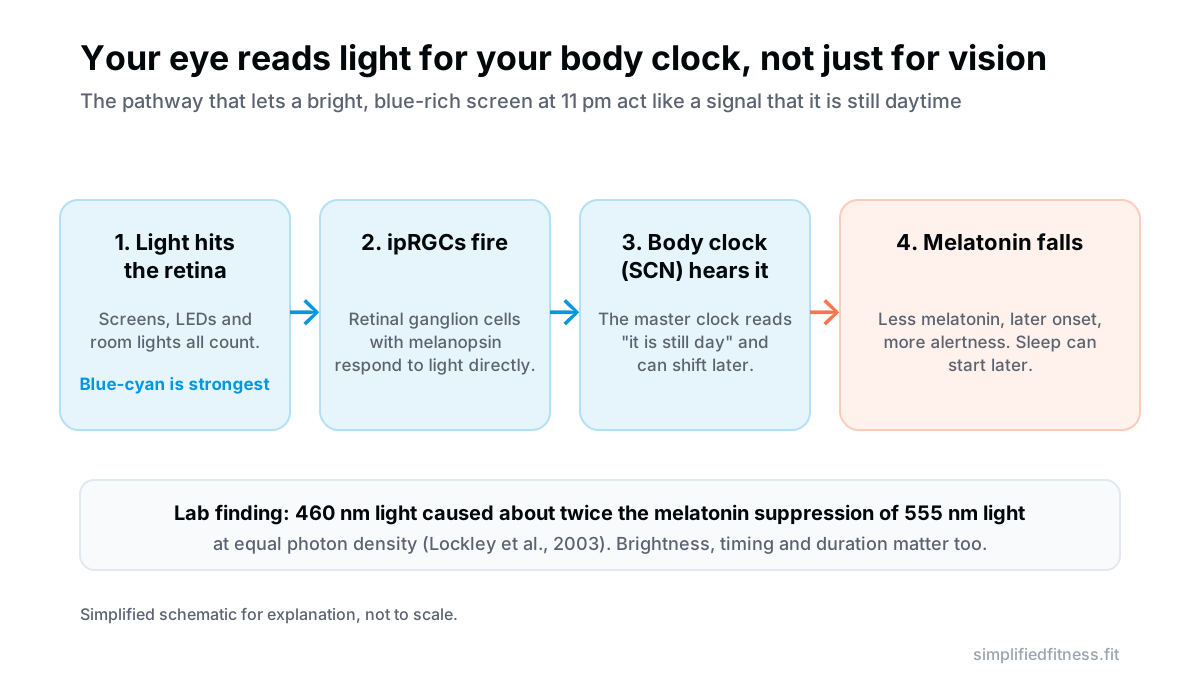
Think of it as a dimmer switch. Bright light at 9 am is useful. The same signal at 11 pm tells your brain the day is not over.
Does blue light screen time cause melatonin suppression in real life?
In the lab, yes. In your bedroom, it depends on how bright the screen is, how long you use it and how close it is to your face.
In a randomized crossover study, people who read on a light-emitting e-book device before bed took longer to fall asleep, had less evening sleepiness, lower melatonin, a later body clock and lower next-morning alertness than when they read a printed book (Chang et al., 2015). That is a controlled setting with a specific protocol, so it will not map one-to-one to your phone habits.
Here is the catch. Screens are not the only culprit. A retrospective analysis of 116 healthy 18-30 year olds living in a research unit compared room light (under 200 lux) with dim light (under 3 lux) in the hours before bed. Room light suppressed melatonin and delayed its onset in 99% of individuals, and shortened melatonin duration by about 90 minutes (Gooley et al., 2011). Overhead tube lights count too.
Do blue light blocking glasses work for sleep?
Maybe a little for some people, and the evidence is not strong enough to promise it.
Here is what the research says, study by study.
- Positive signal. In a pilot crossover trial of 15 recreational athletes, amber-lens glasses worn in the evening shortened self-reported sleep onset by about 7 minutes and improved sleep quality by 0.6 points on a 10-point scale. Actigraphy, which tracks movement, showed no significant difference (Knufinke et al., 2019).
- Pooled objective data. A 2025 meta-analysis of three double-blind crossover trials (49 adults) found non-significant changes in actigraphy sleep: sleep latency about 4.9 minutes shorter and total sleep time about 8.8 minutes longer, both with wide confidence intervals. The authors said the evidence does not support significant effects yet (Luna-Rangel et al., 2025).
- Broader Cochrane review. Across 17 trials of blue-light filtering lenses, sleep quality results were inconsistent. Three of six sleep trials reported improvement and three found no difference, and the reviewers rated the certainty as very low (Singh et al., 2023).
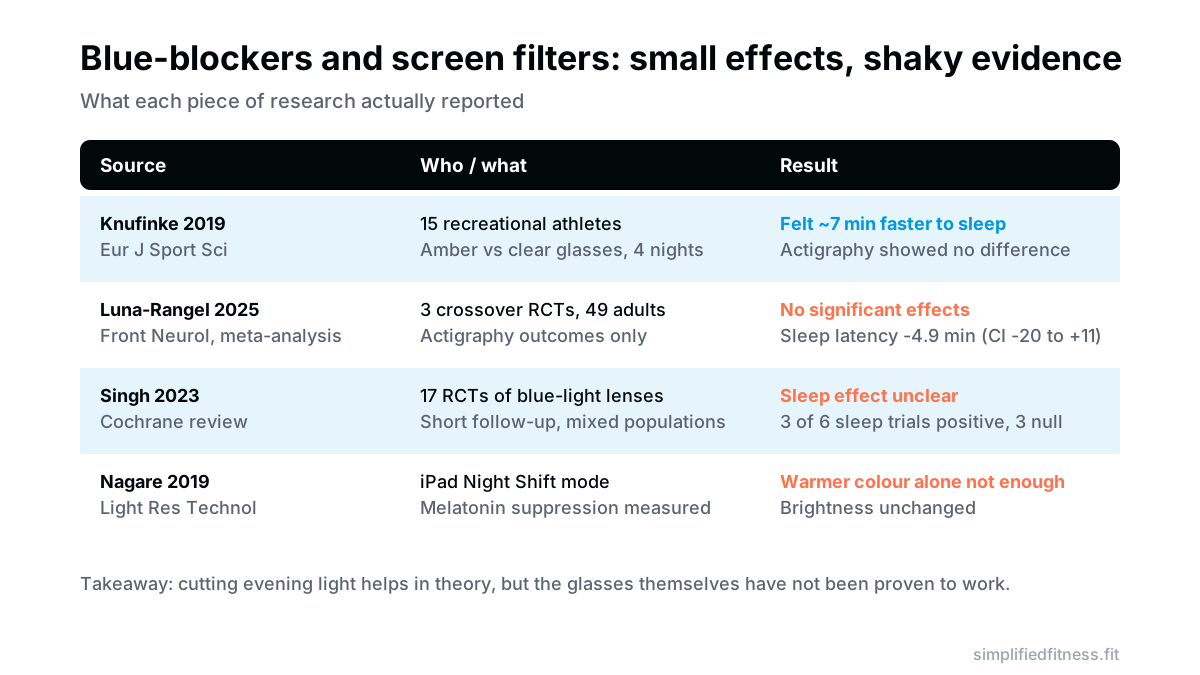
Why the mixed picture? Trials are small, short (days to a few weeks) and use different glasses, different tints and different evening routines. Many measure how people feel rather than how they sleep. Results in people with insomnia or other conditions may not apply to a healthy lifter.
The Cochrane review also looked at eye strain, since many ads claim these glasses protect your eyes. It found that blue-light filtering lenses may not reduce eye strain from computer use over a short follow-up, and no trial measured macular health (Singh et al., 2023). Rest your eyes and use good lighting instead.
Does night shift mode actually help?
Not on its own, going by one controlled test. Researchers had people use an iPad in four conditions, including two Night Shift settings with low and high colour temperature. Melatonin suppression did not differ between the two settings, and the authors concluded that changing the colour of a display without lowering brightness may be insufficient (Nagare et al., 2019).
That is one device, one study. But it fits the logic: ipRGCs respond to overall light, not just the blue slice. Warmer is better than cold, but dimmer is better than warm.
In the gym world this is like the lifter who adds a belt and straps and calls it a recovery plan. Fine accessories. They do not replace the basics.
Is blue light the real problem, or is it everything else?
Probably everything else too. A screen is bright, close to your face and mentally stimulating. Isolating the blue slice of the spectrum ignores the other three. Messages from work, a tense group chat or one more episode can keep you wired whatever colour the display is.
That is why trial results on glasses look so underwhelming. If you wear amber lenses but keep every ceiling light on at full strength and scroll until midnight, you have fixed one variable out of several. Judge any change by how long it takes you to fall asleep and how you feel at 7 am, not by what the packaging promises.
What should you do about screens and sleep?
Start with the free stuff and work your way down. Buying glasses before you have dimmed the room is doing it backwards.
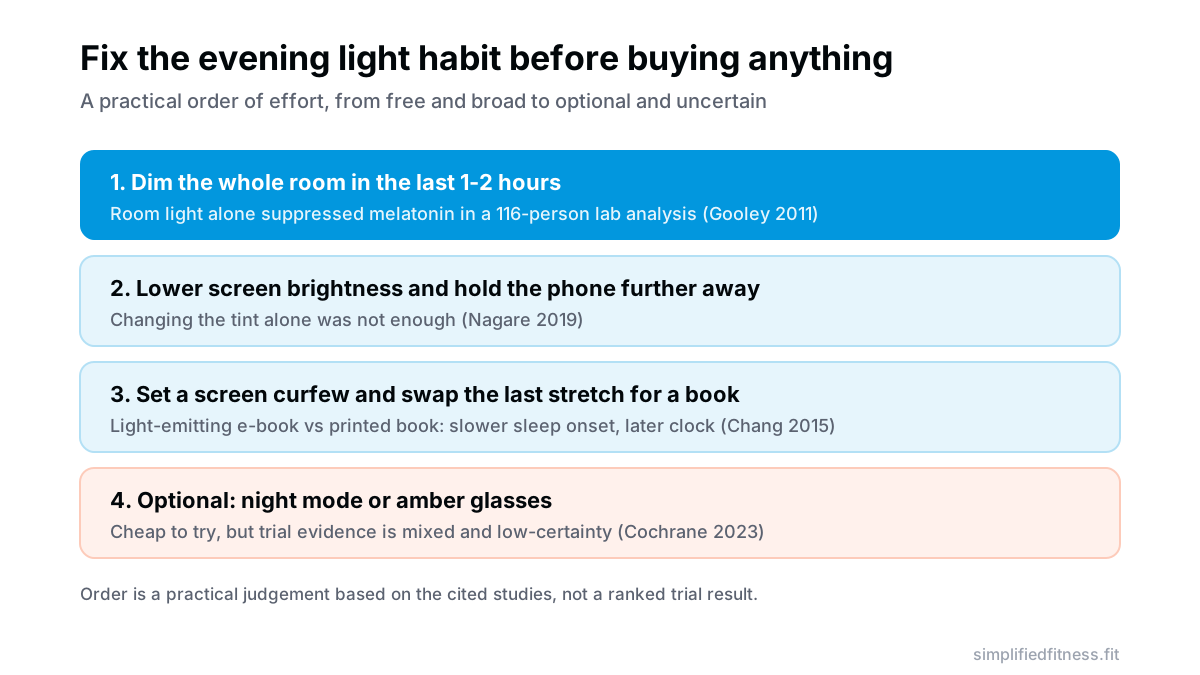
- Dim the room. In the last 1-2 hours, use lamps instead of ceiling lights. This addresses the exposure that research found suppresses melatonin even without a screen. A 2022 expert consensus on indoor lighting recommends bright light in the day and dim light in the evening and night (Brown et al., 2022).
- Turn brightness down. Use your phone’s lowest comfortable setting, and hold it further from your face.
- Set a curfew. A common practical target is 30-60 minutes screen-free before bed. There is no proven ideal number, so test for two weeks. Read a paper book or stretch instead.
- Treat night mode and amber glasses as extras. They are cheap and may help a little. Side effects in trials were infrequent, but the Cochrane review did note headache, discomfort and lower mood in some wearers, so stop if they bother you (Singh et al., 2023). Do not expect miracles.
- Keep the bedroom dark and cool. See our sleep hygiene checklist for lifters for the full routine.
What about morning light?
Light works in both directions. Bright light during the day anchors your clock, and the Brown consensus recommends higher light exposure by day (Brown et al., 2022). In the athlete pilot study, the authors suggested that adding morning and daytime light might strengthen the small effects they saw from restricting evening light (Knufinke et al., 2019). That was a suggestion, not a tested result.
Practically: step outside for a while after waking (there is no proven minimum, but 10-20 minutes is an easy habit), use sun protection suited to your climate, and open the curtains if you work indoors. In an Indian summer, early morning is the comfortable window. Evening training under bright gym lights is another source of late light, which we touch on in morning vs evening training.
Who needs extra care?
Shift workers have a harder problem, because light timing is tied to their schedule. Our shift workers lifting guide covers that. If you are thinking about melatonin tablets, read the low-dose melatonin guide first, and keep caffeine in check with the afternoon caffeine cutoff.
If your sleep does not improve after a few weeks of good light habits, or you snore loudly, wake gasping or feel very sleepy in the day, see a doctor. Those can be signs of insomnia or sleep apnea, and light hygiene will not fix them. This article is education, not a diagnosis.
If you track sleep with a wearable, remember the numbers are estimates, as we explain in the wearable recovery trackers guide.
The bottom line
Evening light, especially blue-cyan light, suppresses melatonin and can push your body clock later. That part is solid. The part that is not solid is the claim that glasses or night mode will undo it: trials show small, inconsistent benefits.
So run the cheap experiment properly. Dim the room, lower the brightness, set a screen curfew for two weeks, and see if you fall asleep faster. Then put the energy you saved into the training side, starting with our free training plans.
Frequently Asked Questions
Does blue light from your phone ruin your sleep?
It can contribute, but it is rarely the only cause. In a lab trial, reading on a light-emitting e-book device before bed delayed sleep onset, suppressed melatonin and shifted the body clock compared with a printed book. Dim your screen and stop using it 30-60 minutes before bed to see if your sleep improves.
How does blue light suppress melatonin?
Specialised retinal cells containing melanopsin send light information to the brain's master clock, which controls the pineal gland's melatonin release. These cells respond most strongly to blue-cyan light, so a bright blue-rich screen can signal daytime. Lowering brightness and avoiding screens late in the evening reduces that signal.
Do blue light blocking glasses work for sleep?
Evidence is mixed and low in certainty. A 2023 Cochrane review found inconsistent sleep results across six trials (three positive, three null), and a 2025 meta-analysis of three crossover trials found no significant effect on actigraphy sleep. If you want to try them, treat them as an optional extra on top of dimming lights and cutting screen time.
Does Night Shift or night mode reduce melatonin suppression?
Not necessarily. In one study of the iPad Night Shift mode, melatonin suppression did not differ between a low and a high colour-temperature setting when brightness stayed the same. Turn the brightness down as well, and do not rely on the warm tint alone.
How long before bed should I stop using screens?
There is no single proven cut-off. Trials usually test one to a few hours of evening light, and a common practical target is 30-60 minutes screen-free before bed. Try it for two weeks and note whether you fall asleep faster.
Is it bad to use my phone in bed?
It is not harmful for everyone, but it combines light exposure with mentally alerting content. Both can delay sleep onset in some people. If you scroll in bed, lower the brightness, hold the phone farther from your face and switch to something calm, or move the phone out of reach.
Is room lighting as bad as screens?
It can be. A lab analysis of 116 healthy adults found that evening room light under 200 lux, compared with dim light, suppressed melatonin and shortened its duration by about 90 minutes. Switching to lamps and dimming overhead lights in the last hour or two is a free, sensible step.
Does morning sunlight help sleep?
It plausibly helps by anchoring your body clock, but direct trial evidence for lifters is limited. Expert consensus recommends bright light in the day and dim light in the evening, and one pilot study in athletes suggested that more morning and daytime light might strengthen small evening-light effects. Get outdoors for a while after waking, with sun protection suited to your climate.
Does blue light affect lifters and athletes differently?
Nothing suggests lifters are uniquely sensitive. A small pilot trial in 15 recreational athletes found amber glasses improved self-reported sleep onset by about 7 minutes, but actigraphy showed no difference. Treat it as a modest, uncertain effect and focus on consistent bedtimes and a dark room.
Do blue light glasses protect my eyes?
Evidence is weak. The Cochrane review found that blue-light filtering lenses may not reduce eye strain from computer use over the short term, and effects on macular health were not measured in the trials. Regular breaks and good lighting are more reliable for tired eyes.
Should I take melatonin if my screen time keeps me up?
Fixing light habits first is simpler and cheaper. Melatonin has its own dosing and timing issues, and it does not undo a bright evening environment. Speak to a doctor if sleep trouble is persistent.
When should I see a doctor about poor sleep?
See a doctor if trouble sleeping lasts several weeks, if you snore loudly or stop breathing at night, or if you feel very sleepy during the day. These can signal conditions such as insomnia or sleep apnea that light hygiene will not fix. A clinician can assess you properly, which an article cannot.
Sources & References
Every claim above is checked against peer-reviewed research (PubMed, U.S. National Library of Medicine) or guidance from established health bodies. How we fact-check.
- Lockley SW, et al. High sensitivity of the human circadian melatonin rhythm to resetting by short wavelength light. J Clin Endocrinol Metab. 2003. PMID: 12970330
- Gooley JJ, et al. Exposure to room light before bedtime suppresses melatonin onset and shortens melatonin duration in humans. J Clin Endocrinol Metab. 2011. PMID: 21193540
- Chang AM, et al. Evening use of light-emitting eReaders negatively affects sleep, circadian timing, and next-morning alertness. Proc Natl Acad Sci U S A. 2015. PMID: 25535358
- Nagare R, et al. Does the iPad Night Shift mode reduce melatonin suppression? Light Res Technol. 2019. PMID: 31191118
- Singh S, et al. Blue-light filtering spectacle lenses for visual performance, sleep, and macular health in adults. Cochrane Database Syst Rev. 2023. PMID: 37593770
- Luna-Rangel FA, et al. Efficacy of blue-light blocking glasses on actigraphic sleep outcomes: a systematic review and meta-analysis of randomized controlled crossover trials. Front Neurol. 2025. PMID: 41341515
- Knufinke M, et al. Restricting short-wavelength light in the evening to improve sleep in recreational athletes - A pilot study. Eur J Sport Sci. 2019. PMID: 30427265
- Brown TM, et al. Recommendations for daytime, evening, and nighttime indoor light exposure to best support physiology, sleep, and wakefulness in healthy adults. PLoS Biol. 2022. PMID: 35298459

Umair Hazrami · Founder & Head Coach, Simplified Fitness
Umair Hazrami founded Simplified Fitness and the Simplified Lifter channel to cut through fitness noise. With 4+ years of consistent training and 10+ coaching clients, he writes every guide from the peer-reviewed research and links the sources so you can check them. Our editorial standards.
Educational content only, not medical advice. If you have a medical condition, are pregnant, or take medication, talk to a qualified doctor before changing your diet, supplements or training. Full disclaimer.
Keep reading
Recovery
Active Recovery on Rest Days: Walking, Light Cycling and Mobility
Active recovery vs passive rest for lifters: what the research says about walking, light cycling and mobility, plus a 20-minute rest day routine you can copy.
7 min read
Recovery
Afternoon Caffeine Cutoff: Half-Life, Deep Sleep and Pre-Workout
Afternoon caffeine cutoff for lifters: how caffeine's half-life cuts sleep time and deep sleep even if you fall asleep fine, plus a practical cutoff by bedtime.
9 min read
Recovery
Is Your CNS Fried? CNS Fatigue vs Plain Lethargy in the Gym
Is my CNS fried from lifting? See what central fatigue really is, how fast it recovers and how to tell it from low motivation or poor sleep. Studies linked.
9 min read
Recovery
Circadian Rhythm and Strength: Why You Peak in the Late Afternoon
Circadian rhythm strength peak explained: why you lift more at 4-7 pm than at 7 am, what body temperature really does, and how to plan PR days.
8 min read