Hot vs Cold Showers After a Workout: What the Evidence Says About Recovery
Hot or cold shower after workout? Trials show showers mostly change how recovered you feel, not muscle repair. See what each temperature can and cannot do.
TL;DR. The short answer
- A hot or cold shower after a workout mainly changes how recovered you feel. Small trials in athletes show better comfort and perceived recovery, but no clear gain in performance.
- Contrast therapy in tubs reduced soreness versus doing nothing in a 2013 meta-analysis, though every included trial had a high risk of bias and it was no better than other recovery methods.
- The muscle-growth warning comes from 10-15 minutes of cold-water immersion studies in lifters. A short cold shower is a different dose, and no trial has tested it for hypertrophy.
- Lactic acid is not what makes you sore two days later, so flushing it out with a contrast shower is not a real mechanism.
- Choose the temperature you enjoy. If growth is the priority, keep cold exposure short and skip the long ice bath right after lifting.
Part of our complete guide: Muscle Soreness (DOMS), Heat/Cold Modalities & Recovery Methods: What Science Actually Supports
Table of contents
Hot or cold shower after workout: which one helps? Neither has been shown to speed up muscle repair. What the research does show is that showers change how recovered you feel, and that long cold baths after lifting can blunt muscle growth. A quick shower is a different dose from a bath.
This article sits inside our complete guide to muscle soreness, DOMS and recovery modalities. Here we stay on the everyday shower. The full-body tub versions are covered in cold plunge and ice baths for hypertrophy and sauna and heat therapy.
Why a shower is not a cold plunge
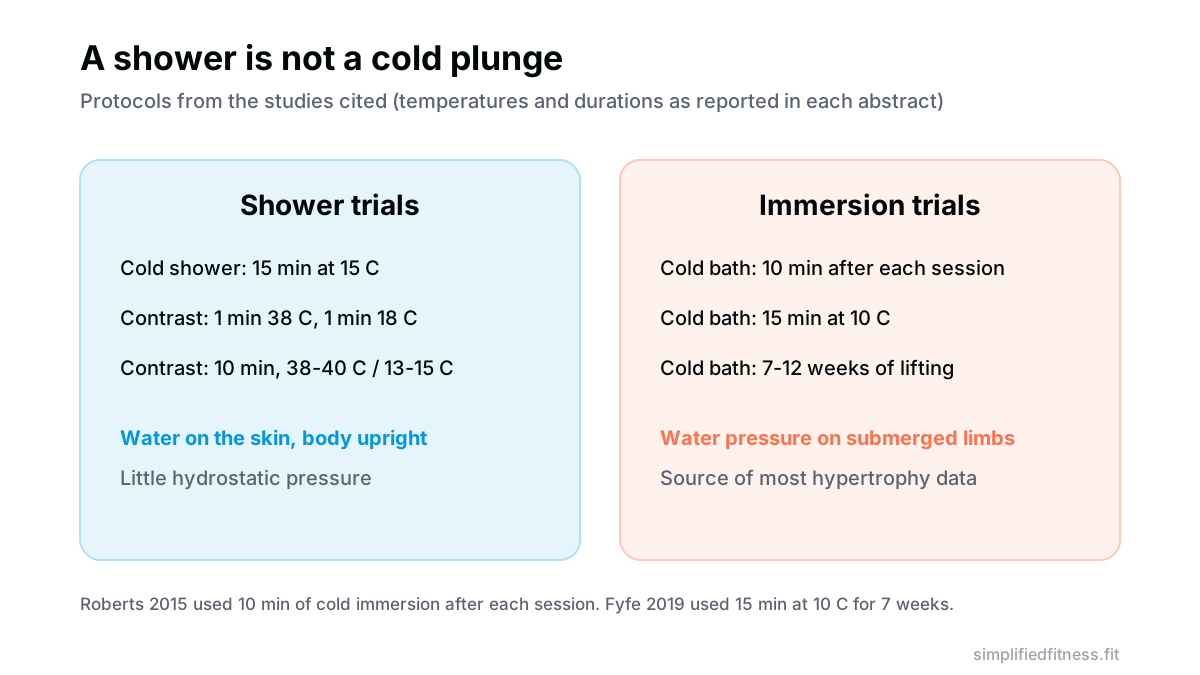
Most of the famous recovery research uses immersion: sitting in water up to the chest or hips, often at about 10-15 C, for 10-15 minutes. A shower puts water on your skin while you stand. You do not get the same water pressure on your limbs, and most people do not stay under cold water for 15 minutes.
That matters, because almost everything scary you have heard about cold water and muscle growth comes from immersion studies. Almost everything encouraging about “contrast therapy” also comes from tubs. When someone applies those results to a 3-minute shower, they are guessing.
Does a cold shower reduce muscle soreness?
Maybe slightly, and mostly for the first day. A 2021 meta-analysis pooled 32 randomized trials with 1098 participants. Cold therapy applied within one hour of exercise reduced DOMS pain within 24 hours (SMD -0.57), with no clear effect beyond 24 hours (Wang et al., 2021). Both cold-water immersion and other cold methods such as packs helped within 24 hours, and the authors singled out immersion and hot packs as the most effective options.
Note the limits. Those trials were mostly immersion and cold packs, not showers. And the authors said more high-quality studies are needed.
There is also a mixed result. A 2017 meta-analysis in team sport athletes (23 articles, 606 participants) found cold immersion helped some measures at 24 hours, such as jump and sprint outcomes, and helped perceived fatigue at 72 hours, yet neither cold immersion nor contrast therapy helped perceived muscle soreness (Higgins et al., 2017). Different athletes, different sports, different outcomes. That is a big reason why the honest answer is “small and inconsistent.”
What do showers actually do? The trials
Only a handful of trials tested real showers. All are small, so read them as hints.
Cold shower in the heat. Nine young men cycled for 45 minutes at 35 C. Afterwards they took a 15 minute shower at 15 C, or sat in a 25 C room. The cold shower gave a faster heart rate drop over the first 30 minutes and a higher comfort rating, yet core temperature and salivary cortisol were no different (Ajjimaporn et al., 2019). The authors suggested cold showers might be used to reduce cardiac stress after a routine workout in the heat.
Contrast showers in elite netball. Ten elite female players did a netball circuit and then 14 minutes of contrast water therapy, contrast showers or seated rest. Agility did not differ between conditions at any time point, but perceptions of recovery were better after both water options than after rest (Juliff et al., 2014).
Four weeks of contrast showers. In a 2026 randomized trial, 60 combat-sport athletes took 10 minute post-training showers, alternating warm (38-40 C) and cold (13-15 C) water, or a thermoneutral shower for comparison. After 4 weeks the contrast group had slightly lower resting heart rate, higher heart rate variability and better self-rated recovery. Cortisol and microvascular measures did not differ, and the gains were gone after a 2-week wash-out. The authors cautioned against claiming lasting adaptation (Hagner-Derengowska et al., 2026).
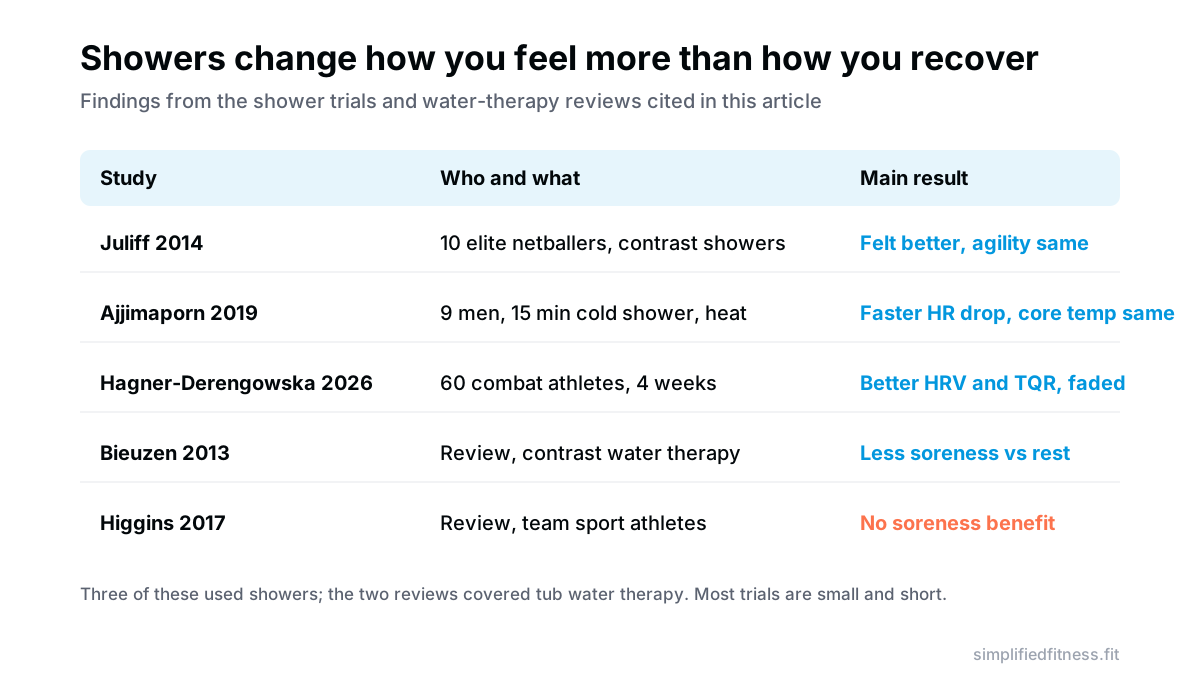
The pattern is consistent: showers improve how you feel, and the physical gains are small or not detected. That is not nothing. Feeling better can make you more willing to train again. It just is not the same as faster tissue repair.
Do contrast showers work? What the water therapy reviews say
Contrast water therapy (alternating hot and cold immersion) has been reviewed. A 2013 systematic review and meta-analysis of 18 trials found contrast therapy produced greater improvement in muscle soreness than passive recovery at every follow-up time from under 6 hours to 96 hours, and reduced strength loss as well. All the trials had a high risk of bias, and there was little evidence that contrast therapy beat other recovery methods such as cold water immersion, warm water immersion, compression, active recovery or stretching. The authors noted the effects may matter most to elite athletes (Bieuzen et al., 2013).
So here is the fair reading. Versus lying on the couch, contrast therapy looks a bit better. Versus almost any other recovery habit, it looks about the same. And those findings were in tubs, not showers.
Does a contrast shower clear lactic acid?
The idea is that alternating hot and cold “pumps” blood through muscle and flushes out lactic acid. It sounds neat, but it is a weak explanation for two reasons.
First, the soreness you feel a day or two after training (DOMS) is not caused by lactic acid. Lactate rises during hard sets and comes back down within a fairly short time, long before soreness peaks. Clearing it faster would not change how your quads feel two days later.
Second, none of the shower trials above reported lactate as a reason for any benefit. Their positive findings were about perceived recovery, heart rate and heart rate variability. If someone sells you a shower routine as “lactic acid removal,” that is marketing, not evidence.
Can a hot shower relax tight muscles?
Heat has some support for soreness. In the same 2021 DOMS meta-analysis, heat therapy reduced pain within 24 hours and beyond 24 hours, with hot packs showing the clearest effect. Cold and heat did not differ significantly from each other (Wang et al., 2021). The authors flagged the need for better trials to know which one works better.
A warm shower is a gentler version of that idea. It probably helps you feel looser and more relaxed, and there is no sign that it harms recovery. But the heat dose from a shower is lower than from a hot pack held on one muscle, so do not expect a pack-sized effect.
If you like heat, we cover longer sessions in the sauna and heat therapy article.
Does a cold shower blunt muscle growth?
This is the question that worries lifters most, so it deserves a careful answer.
Two small trials in men found that regular cold-water immersion after lifting reduced adaptation:
- In one study, 21 active men trained for 12 weeks, twice a week, with either 10 minutes of cold-water immersion or active recovery after each session. Strength and muscle mass increased more in the active recovery group, and type II fibre size and myonuclei number rose only in that group (Roberts et al., 2015).
- In another, 16 men trained 3 days a week for 7 weeks with 15 minutes at 10 C or passive recovery after each session. Leg press improvements were similar, but type II fibre growth was attenuated with cold. Authors concluded that cold immersion after training should be avoided if hypertrophy is desired (Fyfe et al., 2019).
Notice that the two studies disagree on strength. The first found smaller strength gains, the second found similar 1-RM improvement but smaller fibres. Both are small, in young men, and both used long immersion.
So what does that mean for a shower? Nobody has tested it. A reasonable, cautious reading: the bigger the cold dose (colder, longer, right after lifting, repeated every session), the more reason to worry. A 2-minute cool rinse is a much smaller dose. If you want a safe default, finish with whatever temperature you like and avoid sitting in cold water for 10-15 minutes after each lifting session. For the full immersion story, read cold plunge and ice baths for hypertrophy.
Hot vs cold shower after the gym: which should you choose?
Here is a plain comparison based on what was actually tested.
| Goal | Shower option | What the evidence supports |
|---|---|---|
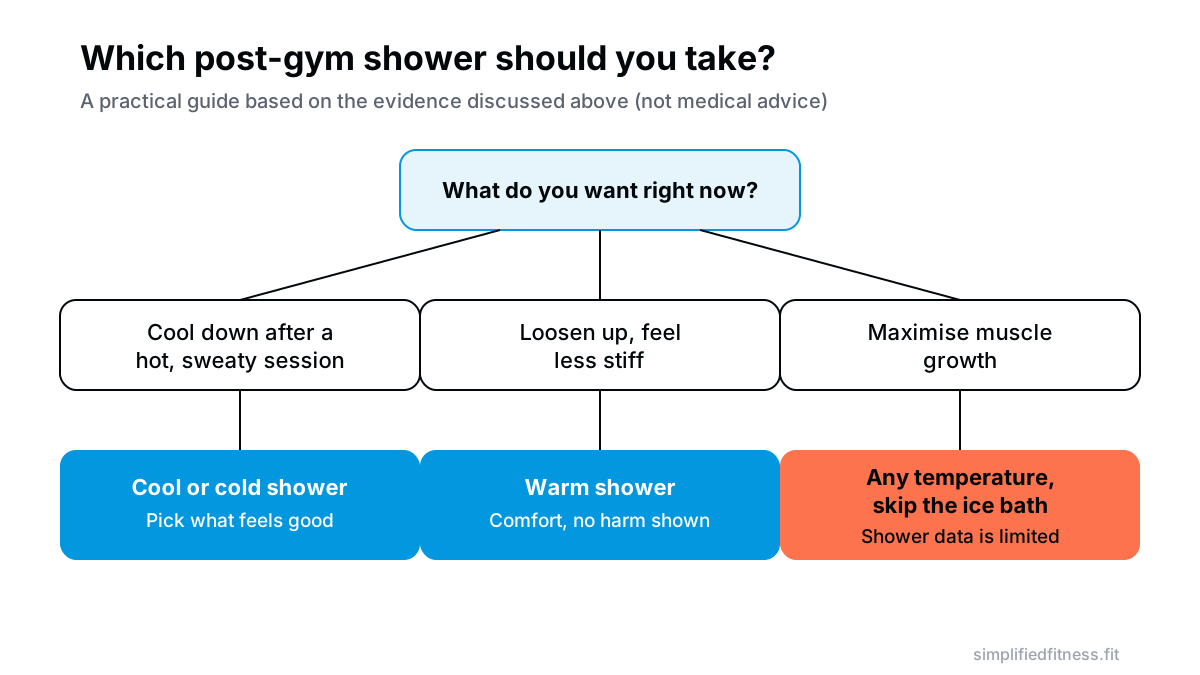
| Cool down after a hot session | Cool or cold shower | Faster heart rate drop and better comfort after exercise in the heat (small trial) |
| Feel more recovered | Cold, warm or contrast | Better perceived recovery in small trials, effect may fade |
| Less soreness | Cold or heat, tiny dose | Small short-term pain reduction, mostly from immersion and hot packs |
| Maximise hypertrophy | Any temperature, short | Avoid long cold immersion after lifting; shower effects are untested |
| Athletic performance | Contrast showers | No performance difference in the netball trial |
A practical routine for most lifters
- Let your breathing settle for a few minutes after your last set.
- Shower at a temperature you enjoy. If it is a hot Indian afternoon, cool water is a perfectly good choice.
- If you like contrast, use short blocks (30-60 seconds cold) and end on whichever you prefer.
- Do not rely on the shower for recovery. Eat enough protein, sleep, and manage volume.
That last step is where the real recovery happens. If your soreness is out of control, the fix is usually training, not water: ease in with a free push, pull, legs plan and track your weekly sets with the training volume calculator. If you are wondering whether to train while sore, read should you work out when you are sore, and for why second sessions hurt less, see the repeated bout effect.
Who should be careful
Cold water raises heart rate and blood pressure for a short time. Check with a doctor before using cold showers or contrast showers if you have heart disease, high blood pressure, Raynaud’s phenomenon, or you are pregnant. Skip them if you feel faint, dizzy, or have chest pain. Very hot showers can also cause dizziness after hard training, especially if you are dehydrated.
If soreness is severe, comes with dark urine, marked swelling or weakness, or lasts more than a week, see a doctor rather than trying more water therapy.
The bottom line
A hot or cold shower after a workout will not meaningfully speed muscle repair, and the evidence is stronger for feeling better than for recovering faster. The scare about cold water and growth is real but comes from long cold baths, not quick showers. Choose the temperature you like, keep it short and sensible, and put your effort where the evidence is strongest: sleep, protein and well-managed training volume.
Frequently Asked Questions
Is a hot or cold shower better after a workout?
Neither has been shown to be clearly better for muscle recovery. The shower trials we have mostly show that people feel better, not that muscles repair faster. Pick the temperature you enjoy, and keep cold exposure short if building muscle is your priority.
Does a cold shower reduce muscle soreness?
Possibly a little, for a short time. A meta-analysis of 32 randomized trials found cold therapy within an hour of exercise reduced soreness pain for up to 24 hours (Wang et al., 2021), but most of that data is from immersion, not showers. If you try it, treat it as a comfort tool rather than a fix.
Does a cold shower after the gym kill muscle gains?
There is no evidence that a brief cold shower does. The growth-blunting results come from 10-15 minutes of cold-water immersion after lifting, in small studies of young men. If hypertrophy is your goal, avoid long cold baths straight after training and a short cool rinse is unlikely to matter.
Does a hot shower relax tight muscles after a workout?
It can feel like it, and heat did reduce soreness pain in a 2021 meta-analysis of DOMS trials, mostly with hot packs rather than showers. Warmth increases comfort and may ease stiffness, but a shower is a weak heat dose. Use it when you want to loosen up, and treat the benefit as modest.
What are contrast showers?
Contrast showers alternate warm water (about 38-40 C) with cold water (about 13-18 C) in short blocks, for example one minute each. The idea is borrowed from contrast water therapy in tubs. In trials, athletes felt more recovered afterwards, even when performance did not change.
Do contrast showers clear lactic acid?
No trial cited here showed that contrast showers speed lactate clearance in a way that improves recovery. Lactate is not the cause of soreness that appears one to three days after training, so removing it would not fix DOMS anyway. Spend your effort on sleep, protein and sensible training volume instead.
How long should a cold shower be after exercise?
There is no tested dose for cold showers and muscle recovery. One trial used 15 minutes at 15 C after hard cycling in the heat and found a faster heart rate drop but no difference in core temperature. If you do it for comfort, a couple of minutes is a practical starting point, and stop if you feel dizzy or unwell.
Is a cold shower good after a workout in hot weather?
It can make you more comfortable. In nine young men after 45 minutes of cycling at 35 C, a 15 minute cold shower produced a faster heart rate recovery and a higher comfort rating, though core temperature and salivary cortisol did not differ from sitting in a 25 C room. In an Indian summer, a cool shower is a sensible way to settle down, and drink water as well.
Are contrast showers better than a normal shower?
They may feel better, but the evidence for a physical advantage is thin. A 4-week randomized trial in 60 combat-sport athletes found better heart rate variability and perceived recovery with contrast showers than with a thermoneutral shower, but these changes were gone two weeks after stopping. Use them if you enjoy them.
Should I shower hot or cold before bed after training?
We found no trial that tested shower temperature before bed. Cold exposure can be alerting for some people, while a warm shower is often relaxing, but that is individual. Choose whichever helps you wind down, and protect your sleep because it matters far more than water temperature.
Is it safe to take a cold shower after a hard workout?
For most healthy people a short cool or cold shower is low risk. Cold water can raise heart rate and blood pressure briefly, so people with heart disease, high blood pressure or Raynaud's should ask a doctor first. Stop if you feel faint, chest pain or numbness.
Is it better to take a shower right after training or wait?
No trial here tested shower timing, so there is no evidence-based window. In the DOMS review, cold therapy was applied within one hour of exercise. Shower when it suits you, and let your heart rate settle first if you feel light-headed.
Sources & References
Every claim above is checked against peer-reviewed research (PubMed, U.S. National Library of Medicine) or guidance from established health bodies. How we fact-check.
- Bieuzen F, et al. Contrast water therapy and exercise induced muscle damage: a systematic review and meta-analysis. PLoS One. 2013. PMID: 23626806
- Juliff LE, et al. Influence of contrast shower and water immersion on recovery in elite netballers. J Strength Cond Res. 2014. PMID: 24531433
- Ajjimaporn A, et al. Effect of cold shower on recovery from high-intensity cycling in the heat. J Strength Cond Res. 2019. PMID: 31343603
- Hagner-Derengowska M, et al. Contrast heat-cold versus thermoneutral showering in trained combat sport athletes: a randomized field trial of recovery outcomes. J Sports Sci Med. 2026. PMID: 42713556
- Roberts LA, et al. Post-exercise cold water immersion attenuates acute anabolic signalling and long-term adaptations in muscle to strength training. J Physiol. 2015. PMID: 26174323
- Fyfe JJ, et al. Cold water immersion attenuates anabolic signaling and skeletal muscle fiber hypertrophy, but not strength gain, following whole-body resistance training. J Appl Physiol. 2019. PMID: 31513450
- Wang Y, et al. Heat and cold therapy reduce pain in patients with delayed onset muscle soreness: a systematic review and meta-analysis of 32 randomized controlled trials. Phys Ther Sport. 2021. PMID: 33493991
- Higgins TR, et al. Effects of cold water immersion and contrast water therapy for recovery from team sport: a systematic review and meta-analysis. J Strength Cond Res. 2017. PMID: 27398915

Umair Hazrami · Founder & Head Coach, Simplified Fitness
Umair Hazrami founded Simplified Fitness and the Simplified Lifter channel to cut through fitness noise. With 4+ years of consistent training and 10+ coaching clients, he writes every guide from the peer-reviewed research and links the sources so you can check them. Our editorial standards.
Educational content only, not medical advice. If you have a medical condition, are pregnant, or take medication, talk to a qualified doctor before changing your diet, supplements or training. Full disclaimer.
Keep reading
Recovery
Cold Plunge After Workout: Does an Ice Bath Blunt Muscle Growth?
Does a cold plunge after workout kill your gains? See what the lifting trials found on muscle fibre growth, strength, soreness and when cold is fine to use.
8 min read
Recovery
Ice Baths for Athletes: When Cold Water Immersion Helps at Tournaments
Ice baths for athletes can cut soreness between matches but may blunt muscle gain. See when cold water immersion is worth it and how to use it.
7 min read
Recovery
Compression Boots and Lymphatic Drainage: Do They Really Speed Recovery?
Do compression boots speed recovery or 'detox' your legs? See what pneumatic compression trials found on soreness, strength and lymph, and cheaper options.
7 min read

Recovery
Compression Garments for Lifters: Do Tights and Sleeves Really Help Recovery?
Do compression tights help recovery after lifting? Meta-analyses show small effects on soreness, swelling and strength. See what works, what doesn't, and when.
8 min read