Recovery Gadgets vs Real Science: Cryotherapy, Red Light Beds and Grounding Mats Audited
Are recovery gadgets worth it? We audit cryotherapy chambers, red light beds and grounding mats against Cochrane reviews and rank them from solid to placebo.
TL;DR. The short answer
- Whole-body cryotherapy has no solid proof of benefit. A Cochrane review found only four small trials (64 people) and rated the evidence very low quality, so the chamber is not worth its price for most lifters.
- Red and near-infrared light is the most interesting gadget category, but results are mixed, devices and doses vary wildly, and the best-looking data come from small trials, often with light applied before exercise.
- Grounding (earthing) mats have no rigorous independent trials in athletes that I could find. The main review of the topic was written by advocates, so treat the claims as unproven.
- Cold water immersion has more support than cryo chambers for easing soreness, though the trials are small and low quality, and it may not be ideal if muscle growth is your goal.
- Sleep, food, sensible volume and easy movement still do far more for recovery than any gadget, and they cost almost nothing.
Part of our complete guide: Muscle Soreness (DOMS), Heat/Cold Modalities & Recovery Methods: What Science Actually Supports
Table of contents
Are recovery gadgets worth it? For most lifters, mostly no. Cryotherapy chambers have very thin evidence, red light is promising but unsettled, and grounding mats have nothing rigorous behind them.
This article is a skeptical audit of the gear that recovery clinics and Instagram biohackers love to sell. It sits inside our complete guide to muscle soreness and recovery modalities, so if you want the whole picture on soreness first, start there. Here we rank each gadget on an evidence spectrum from “reasonable” to “pure placebo.”
How to judge a recovery gadget in 60 seconds
Marketing loves a mechanism. “Reduces inflammation.” “Boosts mitochondria.” “Flushes toxins.” A plausible story is not proof.
Four questions cut through it:
- Is there a systematic review or meta-analysis, ideally Cochrane, and what did it conclude?
- How many people were studied, and were they trained lifters or a handful of young volunteers?
- Did the trial measure something that matters (soreness, strength, your next session) or only a blood marker?
- Was it tested against a placebo or sham, or just against doing nothing?
That last one matters more than people think. Soreness and “how recovered do I feel” are subjective. If you pay for a shiny treatment and expect it to work, you may feel better regardless.
Does whole body cryotherapy work? What the Cochrane review found
Whole-body cryotherapy (WBC) means standing in a chamber of extremely cold dry air, below -100 C, for two to four minutes. Clinics market it for soreness, recovery and “inflammation.”
The Cochrane review of WBC is the cleanest summary we have. It found just four laboratory randomised trials with 64 physically active, mostly young male adults (mean age 23, all but four participants male). All four compared WBC with rest or no treatment, all had features carrying a high risk of bias, and the authors rated the evidence for every outcome as “very low” quality (Costello et al., 2015).
The numbers look a bit encouraging at first. Soreness scores were lower after WBC at one hour (SMD -0.77, 95% CI -1.42 to -0.12). But at 24, 48 and 72 hours the confidence intervals stretched past zero, meaning the data were also compatible with no difference, or even a benefit for the control group.
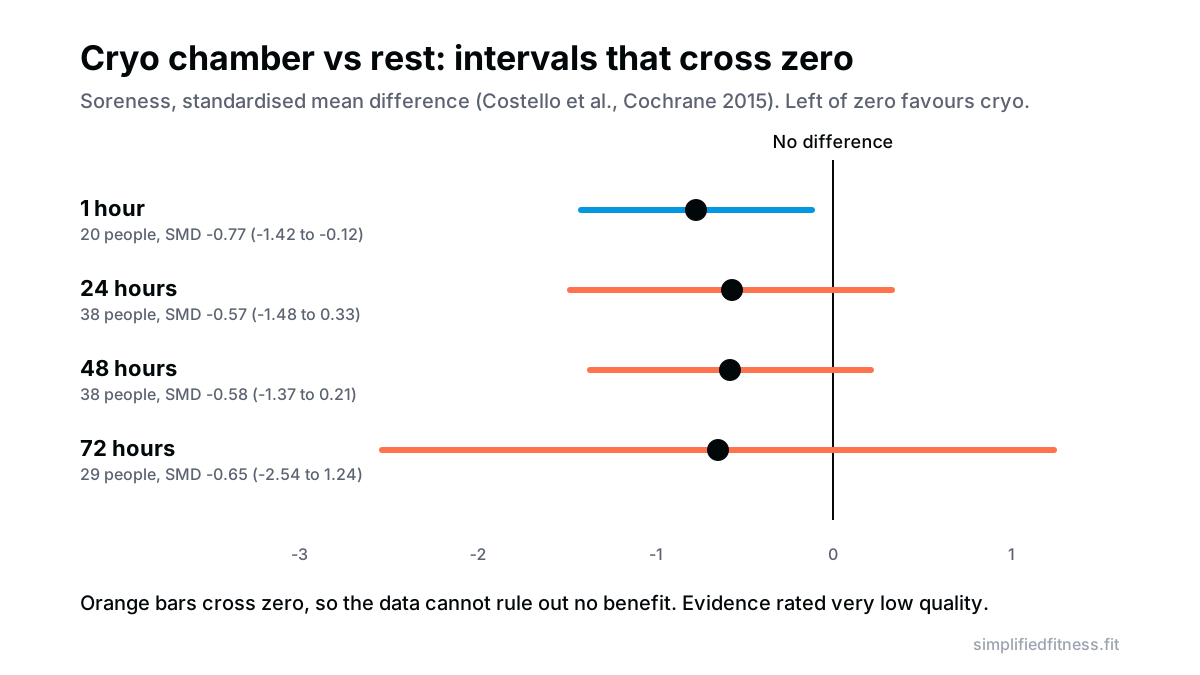
The authors’ conclusion is blunt. There is insufficient evidence to say whether WBC reduces soreness or improves subjective recovery compared with rest. There was no evidence in females or elite athletes. And because no trial actively tracked adverse events, the authors flagged extreme temperature as a potential hazard they could not rule out (Costello et al., 2015).
That review was published in 2015. Newer trials may exist, but I did not find a newer Cochrane update in my search, so treat the picture as unsettled rather than final.
Cryo chamber vs cold water: which has better evidence?
Here is the awkward part for the chamber. Plain cold water immersion (water under 15 C) has a bigger pile of evidence behind it.
A Cochrane review of 17 small trials (366 participants, low study quality) found lower muscle soreness after cold water immersion versus rest or no intervention at 24, 48, 72 and 96 hours, with results that were heterogeneous (Bleakley et al., 2012). A separate meta-analysis of 36 articles found cooling, especially cold water immersion, reduced soreness at 24, 48 and 96 hours, but found no evidence that cooling changed any objective recovery marker over 96 hours (Hohenauer et al., 2015).
Notice the pattern. Cold may make you feel less sore. It has not been shown to speed up objective recovery. Whether that matters depends on your goal, and for muscle growth specifically there is a separate debate we cover in cold plunges and hypertrophy.
The practical comparison:
| Option | Evidence for soreness | Typical limits | Cost level |
|---|---|---|---|
| Cold water immersion | Some evidence (17 small trials) | Low-quality trials, may not suit growth goals | Low |
| Whole-body cryotherapy | Insufficient (4 trials, very low quality) | Tiny samples, no safety tracking | High |
| Cold shower | Not directly studied here | Weaker cooling than immersion | Very low |
Cold water is not risk-free. Sudden immersion triggers a gasp and a spike in heart rate and blood pressure, so if you have a heart condition, high blood pressure or circulation problems, check with a doctor first, never plunge alone, and keep sessions short.
Our guide to hot versus cold showers covers the cheap end honestly, including what a bucket of cold water in a hot Indian summer can and cannot do.
Red light therapy bed for muscle recovery: promising, not settled
Red light therapy is formally called photobiomodulation (PBM). It uses red or near-infrared light to try to influence muscle tissue. Of the three headline gadgets here, this is the one where I would not call the evidence weak, just inconsistent.
Start with the optimistic side. A review of 46 studies in 1,045 participants covering PBM in healthy trained and untrained people and athletes concluded PBM can increase muscle mass gained after training and reduce inflammation and oxidative stress in muscle biopsies (Ferraresi et al., 2016). A meta-analysis of 13 acceptable-quality trials found phototherapy applied mostly before exercise increased repetitions by 5.47 and time to exhaustion by 4.12 seconds versus placebo (Leal-Junior et al., 2015).
Now the cautious side. A meta-analysis of 16 trials in 340 healthy people found PBM helped fatigue recovery, but showed no enhancement in strength and no improvement in functional capacity (Bezerra et al., 2023). Another review of 15 studies found no between-group difference in edema, range of movement or strength, and concluded low-level phototherapy may not have a substantial effect on exercise-induced muscle injury and pain, with reduced creatine kinase seen only when laser was applied before exercise (Nampo et al., 2016).
Why the disagreement? Probably because “red light” is not one thing. Trials used lasers and LEDs, wavelengths from roughly 655 to 905 nm, and wildly different power and energy per spot. Pooling them is like pooling every kind of barbell program and asking “does lifting work?”
One more head-to-head worth knowing. A small meta-analysis of four trials (66 participants) found PBM looked better than cryotherapy for strength, soreness and muscle damage markers after high-intensity exercise, but certainty was moderate to very low (Ferlito et al., 2022). That is a hint, not a verdict.
The dosing problem with consumer red light beds
The studies above mostly used clinical devices applied to a specific muscle at a measured energy dose. The most consistent results in one meta-analysis came with red or infrared wavelengths, power between 50 and 200 mW, and about 5 to 6 J per spot, applied before exercise (Leal-Junior et al., 2015).
A full-body red light bed or home panel is a different product. I could not confirm that the clinical doses in those trials translate to a consumer bed, and the review authors themselves note device and dose variation. If a seller cannot tell you wavelength, power and the dose delivered at your skin, you are guessing.
If you have skin conditions, take photosensitising medication, or have any eye concerns, check with a doctor before using one. Protect your eyes as the manufacturer advises.
Grounding mats for athletes: the myth
Grounding, or earthing, is the claim that touching the Earth’s surface electrons, barefoot or via a mat, reduces inflammation, pain and stress and speeds recovery.
I searched PubMed for rigorous evidence in athletes and found none I could verify. The most prominent review, titled to argue that integrative medicine should include earthing, was written by practitioners who promote it. It describes about 20 studies reporting physiological improvements, and its authors conclude the practice deserves clinical inclusion (Menigoz et al., 2020).
That is advocacy from the people selling the idea, not independent, large, blinded replication. It also says nothing about lifters recovering from heavy squats.
So where does this leave you? Grounding sits in the “unproven” bucket for athletes. Sleeping on an earthing sheet is not dangerous in itself, but it is cash you could have put into a better mattress, a fan, or more protein. Walking barefoot on grass is free and fine. Just do not credit it with muscle repair.
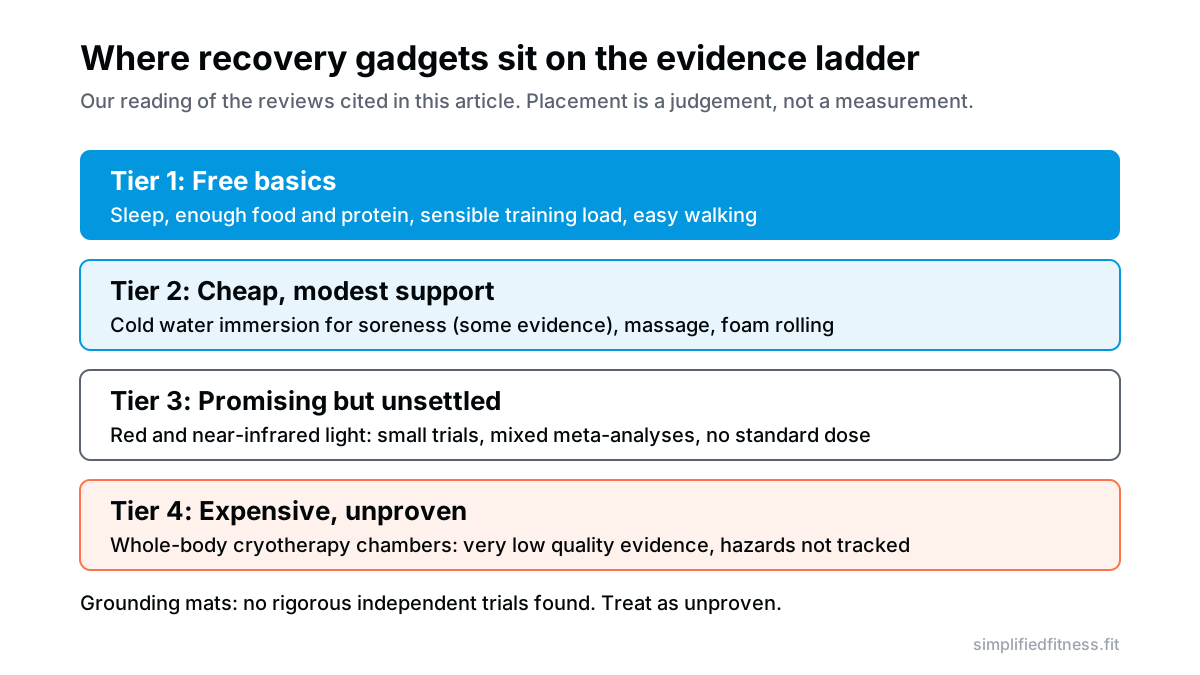
The Simplified Fitness recovery hierarchy
This is our ranking, based on the evidence above plus our other recovery guides. It is a judgement, not a law.
- Sleep. Nothing else comes close. Start with sleep timing and systemic recovery.
- Food. Enough total calories and protein. Dal, paneer, curd, eggs, soya chunks and chicken all count, and they cost far less than a chamber session.
- Training load. Volume you can actually recover from, with deloads when needed.
- Easy movement. Gentle walking and mobility on off days.
- Cheap, modest tools. Foam rolling, massage guns and compression if you like them. Evidence is modest and mostly about feeling better.
- Cold water, with caution if hypertrophy is the goal.
- Red light, only as an optional experiment once everything above is handled.
- Cryo chambers and grounding mats. Skip them.
The hierarchy is the opposite of how clinics price things. The cheapest items at the top do the most.
When a gadget might make sense
I am not saying never. If you have already nailed sleep, protein and programming, and you are curious, a cheap trial of cold water or a session with a clinically specified red light device is a low-risk experiment. Track soreness and performance in your next sessions rather than relying on feel alone.
If you are recovering from an injury, have persistent pain, swelling or numbness, or any heart or circulation condition, see a doctor or physiotherapist before using extreme cold or light devices. Do not self-treat an injury with gadgets.
The bottom line
Recovery gadgets are easy to sell because recovery is hard to measure. The better evidence points to the dull stuff: sleep, food and manageable training. Cold water has modest support for soreness, red light is an open question, and chambers and grounding mats have not earned their prices.
If you want a structure that respects recovery in the first place, try our free training plans, then use the evidence ladder above before your next purchase.
Frequently Asked Questions
Are recovery gadgets worth it?
For most lifters, no. Sleep, protein, enough total food and sensible training volume beat any gadget, and the gadgets themselves have thin or mixed evidence. If you have spare budget after those basics are sorted, cheap options like cold water or a massage ball come before expensive chambers.
Does whole body cryotherapy work for muscle recovery?
The evidence is insufficient to say. A 2015 Cochrane review pooled four small trials of 64 young, mostly male adults and rated all outcomes very low quality, with confidence intervals that included no effect. Until better trials exist, do not pay a premium for a -100 C chamber hoping it speeds up your gains.
Is whole body cryotherapy safe?
The Cochrane review noted that none of the included trials actively tracked adverse events, and it flagged extreme temperature as a potential hazard. That means safety is not well documented, not that it is proven dangerous. If you have heart conditions, circulation problems, or cold-related conditions, ask your doctor before booking a session.
Does red light therapy help muscle recovery?
It might, modestly, but the evidence is mixed. One meta-analysis found light therapy improved repetitions and time to exhaustion when applied before exercise, while another review of 15 trials found no between-group difference in strength or edema. Since devices and doses differ so much, a single purchase is a gamble.
Can red light therapy build muscle?
There is some early signal. A review of 46 studies suggested photobiomodulation may increase muscle mass gained after training, but that review mixed lasers, LEDs and many protocols. Treat it as a possible small add-on to hard training, never a replacement for it.
What is the best wavelength and dose for red light recovery?
There is no agreed standard. A 2015 meta-analysis found the most consistent results with red or infrared wavelengths, 50-200 mW power and about 5-6 J per spot, applied before exercise, but trials vary widely. A consumer panel rarely tells you its true dose at the skin, so check the manufacturer's specs before buying.
Do grounding mats work for athletes?
There is no good evidence that they do. The main review I found was authored by practitioners who promote earthing and described about 20 studies, not independent, large, blinded trials. Save your money for sleep and food.
What is earthing or grounding supposed to do?
Proponents claim that direct contact with the Earth's surface charge reduces inflammation, pain and stress and improves sleep. The mechanism is not established in mainstream exercise physiology, and I could not find rigorous independent athletic trials. Walking barefoot on grass is free and pleasant, just do not expect it to rebuild muscle.
Is a cold plunge better than a cryotherapy chamber?
Cold water immersion has the stronger evidence for soreness. A Cochrane review of 17 small trials found lower soreness at 24 to 96 hours versus rest, though quality was low. Whole-body cryotherapy had only four trials and wider uncertainty, so a bucket of cold water is the better bet per rupee.
Does cold exposure reduce muscle growth?
It may, if you use it after lifting regularly, but that question is covered by separate research on cold plunges. The soreness benefit and the growth question are different outcomes. If building muscle is the priority, keep cold exposure away from your hardest training days or use it sparingly.
What actually speeds up muscle recovery?
The unglamorous basics: enough sleep, adequate calories and protein, a training volume you can recover from, and easy movement on off days. They work by supporting repair and keeping fatigue manageable. Fix these first and only then consider gadgets.
Are infrared saunas and red light beds the same thing?
No. A red light bed delivers specific wavelengths of light, while a sauna raises your body temperature with heat. They are studied separately, and the evidence for one does not transfer to the other. Check what a clinic is actually selling before assuming.
How do I spot biohacking recovery marketing hype?
Look for claims built on tiny samples, animal data, or before-and-after testimonials with no control group. Ask whether a Cochrane review or meta-analysis exists and what it concluded. If the best evidence is a brand's own study, wait for independent replication.
Sources & References
Every claim above is checked against peer-reviewed research (PubMed, U.S. National Library of Medicine) or guidance from established health bodies. How we fact-check.
- Costello JT, et al. Whole-body cryotherapy (extreme cold air exposure) for preventing and treating muscle soreness after exercise in adults. Cochrane Database Syst Rev. 2015. PMID: 26383887
- Bleakley C, et al. Cold-water immersion (cryotherapy) for preventing and treating muscle soreness after exercise. Cochrane Database Syst Rev. 2012. PMID: 22336838
- Hohenauer E, et al. The effect of post-exercise cryotherapy on recovery characteristics: a systematic review and meta-analysis. PLoS One. 2015. PMID: 26413718
- Ferraresi C, et al. Photobiomodulation in human muscle tissue: an advantage in sports performance? J Biophotonics. 2016. PMID: 27874264
- Leal-Junior EC, et al. Effect of phototherapy (low-level laser therapy and light-emitting diode therapy) on exercise performance and markers of exercise recovery: a systematic review with meta-analysis. Lasers Med Sci. 2015. PMID: 24249354
- Bezerra LO, et al. Effects of photobiomodulation therapy on the functional performance of healthy individuals: a systematic review with meta-analysis. Lasers Med Sci. 2023. PMID: 38150056
- Nampo FK, et al. Effect of low-level phototherapy on delayed onset muscle soreness: a systematic review and meta-analysis. Lasers Med Sci. 2016. PMID: 26563953
- Ferlito JV, et al. Comparison between cryotherapy and photobiomodulation in muscle recovery: a systematic review and meta-analysis. Lasers Med Sci. 2022. PMID: 34669081
- Menigoz W, et al. Integrative and lifestyle medicine strategies should include Earthing (grounding): review of research evidence and clinical observations. Explore (NY). 2020. PMID: 31831261

Umair Hazrami · Founder & Head Coach, Simplified Fitness
Umair Hazrami founded Simplified Fitness and the Simplified Lifter channel to cut through fitness noise. With 4+ years of consistent training and 10+ coaching clients, he writes every guide from the peer-reviewed research and links the sources so you can check them. Our editorial standards.
Educational content only, not medical advice. If you have a medical condition, are pregnant, or take medication, talk to a qualified doctor before changing your diet, supplements or training. Full disclaimer.
Keep reading
Recovery
Cold Plunge After Workout: Does an Ice Bath Blunt Muscle Growth?
Does a cold plunge after workout kill your gains? See what the lifting trials found on muscle fibre growth, strength, soreness and when cold is fine to use.
8 min read
Recovery
Ice Baths for Athletes: When Cold Water Immersion Helps at Tournaments
Ice baths for athletes can cut soreness between matches but may blunt muscle gain. See when cold water immersion is worth it and how to use it.
7 min read
Recovery
Compression Boots and Lymphatic Drainage: Do They Really Speed Recovery?
Do compression boots speed recovery or 'detox' your legs? See what pneumatic compression trials found on soreness, strength and lymph, and cheaper options.
7 min read
Recovery
Compression Garments for Lifters: Do Tights and Sleeves Really Help Recovery?
Do compression tights help recovery after lifting? Meta-analyses show small effects on soreness, swelling and strength. See what works, what doesn't, and when.
8 min read