Do Massage Guns Work? What the Science Says About Percussion Therapy
Do massage guns work? Trials show short-term range of motion and brief soreness relief, but no faster muscle repair. See what to expect before you spend.
TL;DR. The short answer
- Massage guns can give a short-term boost in range of motion and some temporary soreness relief, but trials do not show that they speed up actual muscle repair.
- A 2026 meta-analysis of 12 randomized trials found no clear benefit for soreness (DOMS) or maximum strength recovery, with low to very low certainty for the few positive signals.
- Using a gun right before sprinting or jumping may slightly hurt performance in trained athletes, so keep it out of the pre-lift routine if power matters.
- A cheap foam roller gave similar short-term effects in the one head-to-head trial we found, so an expensive device is a comfort purchase, not a recovery necessity.
- Sharp pain, swelling, numbness or a suspected injury needs a doctor, not a massage gun.
Part of our complete guide: Muscle Soreness (DOMS), Heat/Cold Modalities & Recovery Methods: What Science Actually Supports
Table of contents
Do massage guns work? Partly. Trials show a short-term gain in range of motion and brief relief from soreness, but nothing showing they speed up muscle repair. This article is part of our complete guide to muscle soreness, DOMS and recovery modalities, and it stays on percussive devices only.
They feel good, and for some people that is reason enough. Just do not expect them to do the work of sleep, food and time. Below: what percussion does to your nervous system, what the trials found, and whether a Theragun or Hypervolt-style device beats a foam roller. The research is young and the trials are small, many in untrained or recreationally active young adults, so keep that in mind throughout.
What does a massage gun actually do to your muscle?
A massage gun is a motor that drives a rounded head in and out, dozens of times a second, against your muscle. You hold it on a spot, and it delivers repeated pressure and vibration.
The most likely effect is neurological, not structural. Skin, muscle and fascia are full of mechanoreceptors, sensors that report pressure and vibration to your spinal cord and brain. When those signals flood in, they compete with pain signals for attention. That idea is often called gate control: busy touch pathways can turn down how strongly pain gets through. It is a reasonable explanation for why a gun feels like it loosens you up, but it is a theory here, not something the trials below measured directly.
What it does not appear to do is rebuild tissue faster. There is no human trial evidence in this article’s sources that percussion speeds muscle protein synthesis, repairs microtears sooner, or changes how muscle grows. Muscle repair after hard training is a slow biological process, and a handheld device on the skin surface is unlikely to change its clock.
What do the clinical trials say about percussive therapy for muscle soreness?
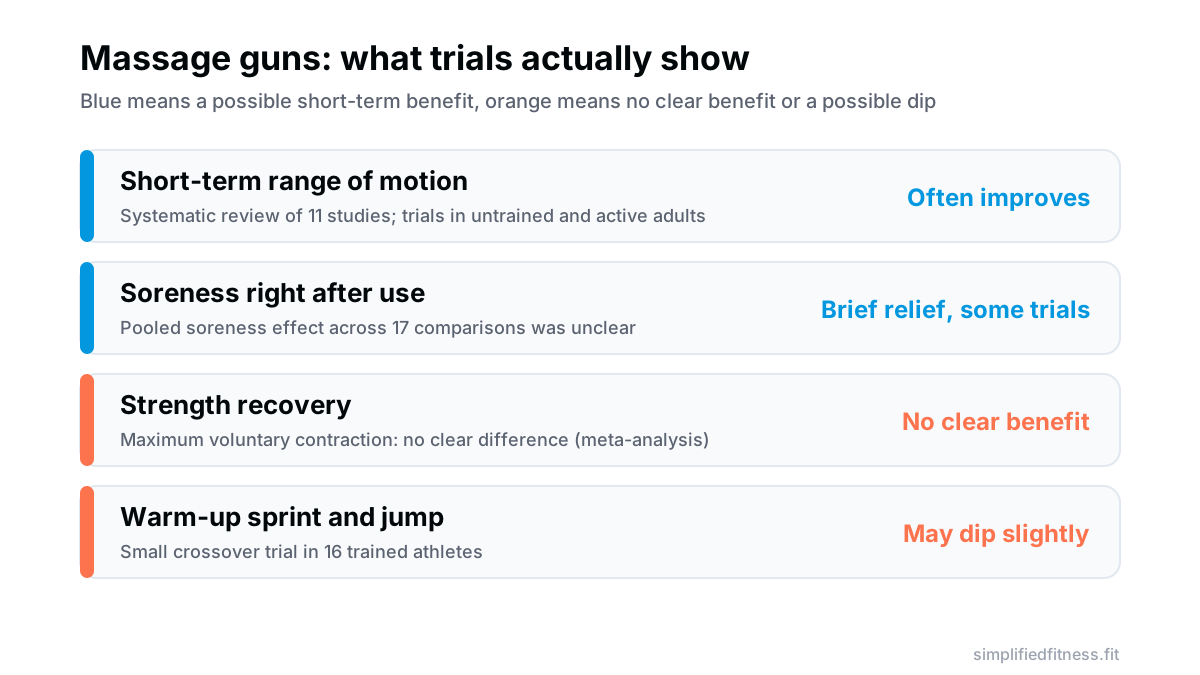
The best summary right now is a 2026 systematic review and meta-analysis of 12 randomized controlled trials on percussive therapy after exercise-induced muscle damage (Zhu et al., 2026). Here is what it found.
- Countermovement jump recovery improved versus control (g = 0.78), but the certainty of that evidence was rated low.
- Creatine kinase, a blood marker of muscle damage, was lower (g = -0.87), with very low certainty.
- Maximum voluntary contraction (how hard you can contract the muscle) did not clearly improve.
- Delayed onset muscle soreness did not clearly improve either (g = 0.14, 95% CI -0.19 to 0.48).
The authors concluded that current evidence does not support clear benefits for maximum strength recovery or soreness relief. So the honest summary is: a possible edge in explosive recovery, no convincing edge for the two things most people buy a gun for.
Where individual trials disagree
This is where it gets interesting, because single trials point in different directions.
A trial that found benefit. Seventeen untrained college-aged adults did 60 eccentric elbow flexions to create soreness. Nine got one minute of percussive massage immediately and at 24, 48 and 72 hours; eight rested. The gun group had about 6-8 degrees more elbow range of motion at 24 to 72 hours and reported soreness about 2-3 points lower on an 11-point scale when measured right after each treatment (before treatment, the groups did not differ). Strength and muscle activation did not differ (Roberts et al., 2024). The authors described the relief as immediate and temporary.
A trial that found nothing, or slightly worse. Sixty-five active young adults used a gun on one calf for 5 minutes after strenuous lower body exercise and left the other calf alone. There were no significant differences in range of motion, strength, endurance or calf swelling, and the gun leg actually reported slightly more soreness immediately and 4 hours later (Leabeater et al., 2024).
Why might they differ? The first used a 1-minute dose on the arm in untrained people who were very sore from an unfamiliar task. The second used 5 minutes on the calf, immediately post-exercise, in active people comparing legs within the same person. Muscle group, timing, dose and training status all differ. The 2026 meta-analysis also noted that longer treatment was associated with higher soreness scores, even though it was also linked to better jump recovery, and it called all its dose findings preliminary.
Practical takeaway: short, light, and not straight after a punishing session.
Does percussion therapy improve blood flow or clear metabolites?
Blood flow first. A lab study of 26 healthy, recreationally active university students applied localized vibration to the calf at different frequencies and measured popliteal artery flow. Both 38 Hz and 47 Hz raised volume flow and blood velocity, and the authors said this may support muscle recovery (Needs et al., 2023). That is an acute, short-lived effect in healthy students, and no study here shows that extra flow for a few minutes translates to faster repair.
Metabolites next. A common claim is that guns “flush lactic acid”. A 2023 systematic review of 11 massage gun studies found no differences in lactate concentration, rating of perceived exertion or contraction time (Ferreira et al., 2023). Your body clears lactate on its own, and next-day soreness is generally attributed to muscle damage and inflammation rather than lactate.
Do massage guns help before a workout?
Here the news is a little worse. In a randomized crossover trial of 16 trained athletes, researchers compared a dynamic warm-up alone with the same warm-up plus a massage gun or plus foam rolling. Both additions were associated with lower countermovement jump height and reactive strength, and the gun was linked to slower 20 m sprint time, compared with the warm-up alone. Foam rolling gave a modest ankle mobility improvement and lower perceived soreness than the warm-up alone (Ormeno and Driller, 2025).
Ferreira and colleagues reached a similar view in their review: guns could help flexibility of muscles such as the hamstrings and calves, but for strength, balance, acceleration, agility and explosive tasks there was either no improvement or a drop in performance, and they did not recommend use there (Ferreira et al., 2023).
Massage gun vs foam roller: is a Theragun worth it?
The question people actually ask is whether a gadget that costs several thousand rupees beats a roller that costs a few hundred. There is very little head-to-head research. The warm-up trial above is the only direct comparison in our sources, and it found broadly similar small effects for both tools. For a deeper look at rolling itself, see our foam rolling science and fascia myths article.
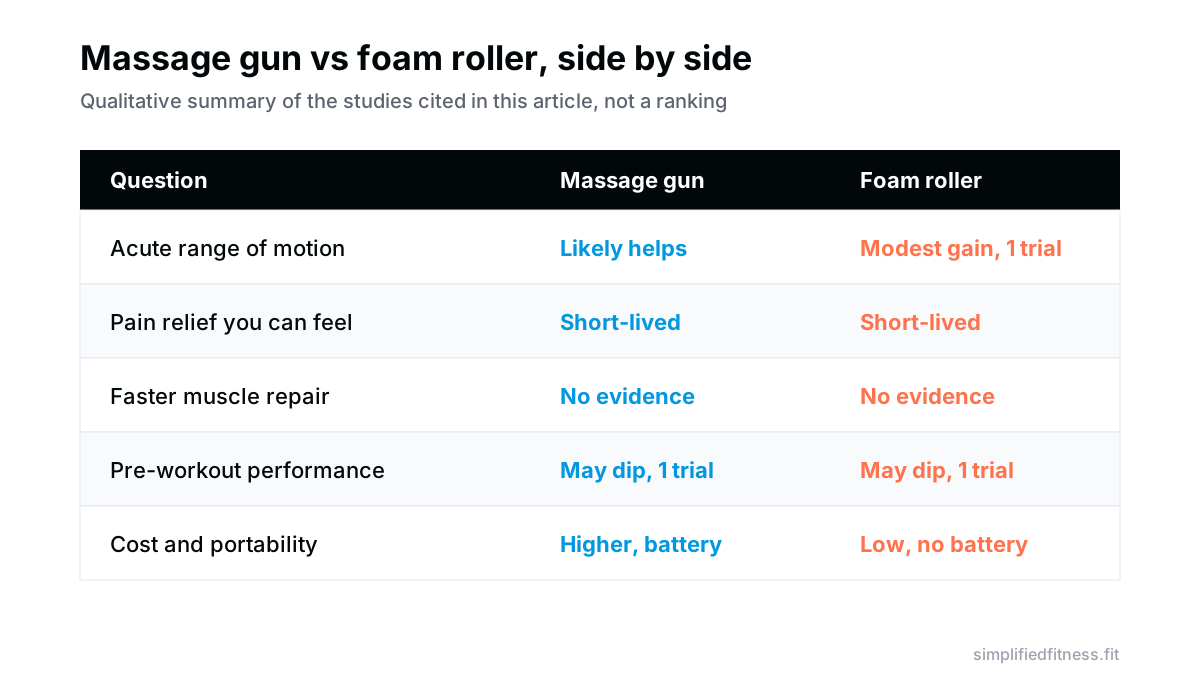
So what do you pay extra for? Mostly convenience: a gun is easier on the hands, reaches your own back and shoulders, and is quick to use between sets. A roller is cheaper, has no battery, and works during a power cut. Both are fine if you tolerate them.
If budget is tight, spend it on a good protein source (paneer, curd, dal, eggs, soya chunks) before you spend it on a device.
How does a massage gun compare with real massage?
A broader 2018 meta-analysis of 99 recovery studies found that massage was the most effective technique for reducing DOMS and perceived fatigue, and that massage and cold exposure were most effective for reducing inflammatory markers (Dupuy et al., 2018). That was manual massage, not handheld percussion, so do not read it as proof that guns work. It does suggest that touch-based recovery has some value, which fits with the gun being a convenient, cheaper stand-in for a short session.
How should you use a massage gun if you already own one?
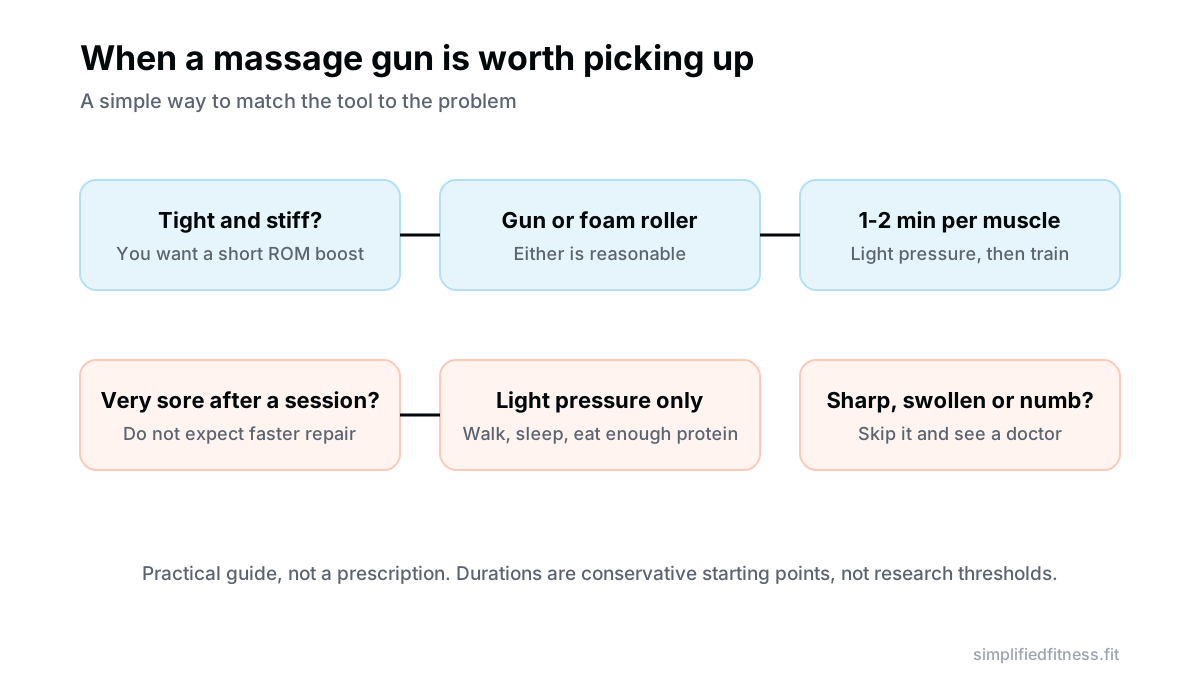
If you have one, there is no reason to throw it away. Use it for what the evidence supports: feeling looser and moving better for a little while.
- Pick a target. Tight calves, quads, glutes or upper back. Skip joints and bones.
- Go light. Let the weight of the device do the work, and keep it moving slowly.
- Keep it short. About 1-2 minutes per muscle is a reasonable start. Meta-analytic data hint that longer sessions may be worse for soreness, but the authors warn against treating any dose as a prescription.
- Time it. Better as a mobility aid before a session (briefly, then warm up) or hours later, not as a final step straight after your hardest set.
- Stop if it hurts. Pain that is sharp or gets worse is a signal to stop.
When should you avoid a massage gun or see a doctor?
Do not use a gun over bones, joints, the front of the neck, the spine, or any swollen, bruised, numb or sharply painful area. See a doctor if you have severe or one-sided calf pain or swelling, because it could be a blood clot. The same applies if you have a clotting disorder or take blood thinners, are pregnant, or have a condition such as neuropathy that dulls feeling. Pain that does not settle in a week or two, or any pain after a fall or a pop in a muscle, also needs a clinician.
What actually speeds up recovery?
The unglamorous list still wins: enough sleep, enough protein and total calories, and sensible training volume. If you are sore, it is worth reading should you work out when sore and why DOMS is not the same as muscle growth. Your muscles also get less sore as they adapt, which we cover in the repeated bout effect. For the wider gadget market, see our recovery gadgets audit.
If your protein intake is a guess, use the protein calculator to get a daily number, and plan your week with our free workout plans.
Bottom line
Massage guns are a comfort and mobility tool with modest, short-lived effects. The trials are small, mostly in young adults, and the larger meta-analytic signals carry low to very low certainty. If you like the feel and can afford it, use it lightly and briefly. If not, a foam roller, a walk and a good night’s sleep will do just as much for your recovery.
Frequently Asked Questions
Do massage guns work?
They work for a few specific, short-term things, mainly temporary gains in range of motion and a brief drop in perceived soreness. They have not been shown to speed up muscle repair or restore strength faster. Use one if it feels good and helps you move, but do not expect it to replace sleep, food and time.
Do massage guns help muscle soreness?
Only a little and only for a while. A 2026 meta-analysis of 17 soreness comparisons found no clear overall effect, although one small trial in untrained adults found that a 1-minute session gave immediate, temporary soreness relief each time it was used. If you want relief for a heavy leg day, light pressure for a minute or two per muscle is a reasonable thing to try.
Can a massage gun improve flexibility?
Short-term, often yes. A 2023 systematic review of 11 studies concluded massage guns could improve flexibility and range of motion in muscles such as the hamstrings and calves for a short time. Use it before stretching or mobility work, and do not assume the gain lasts for days.
Should I use a massage gun before a workout?
It is not a clear win. In a 2025 crossover trial of 16 trained athletes, adding a massage gun to a dynamic warm-up was linked to worse sprint time and lower jump metrics than the warm-up alone. If you need a looser joint, spend one minute on it, then follow with your normal warm-up sets.
Should I use a massage gun after a workout?
Evidence is mixed, so treat it as optional. A 5-minute application on the calves after hard exercise did not change strength or range of motion in 65 active adults and slightly increased soreness for a few hours. Waiting until later that day, or the next morning, with lighter pressure may feel better.
Is a massage gun better than a foam roller?
There is no good evidence that it is. The one head-to-head warm-up trial we found showed similar small dips in jump performance for both tools, plus a modest ankle mobility gain with foam rolling. A foam roller costs far less and needs no charging, which matters in an Indian summer power cut.
How long should I use a massage gun on one muscle?
A minute or two per muscle is a sensible starting point. A 2026 meta-analysis found that longer sessions were linked to higher soreness scores (and, oddly, to better jump recovery), though the authors say dose findings are preliminary and not prescriptive. Keep the pressure light, keep the gun moving, and stop if it hurts.
Does a massage gun increase blood flow?
Possibly, for a short time. In one lab study of 26 healthy students, vibration to the calf at 38 Hz and 47 Hz raised blood flow in the popliteal artery behind the knee. That does not prove faster recovery, because more blood flow has not been linked to faster muscle repair in these trials.
Does a massage gun flush out lactic acid?
No. Your body clears lactate on its own after exercise, and a systematic review found no difference in lactate concentration with massage guns. Soreness a day or two later is a different process, tied to muscle damage and inflammation.
Do massage guns help build muscle?
There is no evidence that they do. Muscle growth is driven by progressive training, enough protein and calories, and sleep. A gun may make a tight area feel better, which could help you train, but it is not a growth tool.
Where should I not use a massage gun?
Avoid bones, joints, the front of the neck, the spine, and any area that is swollen, bruised, numb or sharply painful. Percussion on an injured area can make it worse, and you could miss something that needs a clinician. If you have a blood clotting condition, take blood thinners, or have a suspected clot or deep vein thrombosis, ask a doctor first.
Are expensive massage guns worth it?
The trials we found used commercially available devices, and none showed that a pricier model heals muscle faster. What you pay for is quieter motors, battery life and attachments. If you already enjoy it, fine; if you are on a budget, a foam roller looks just as useful on the limited evidence we have.
Is a massage gun the same as a real massage?
Not quite. In a 2018 meta-analysis of 99 studies, manual massage was the most effective recovery technique for reducing DOMS and perceived fatigue, but that was therapist-delivered massage, not a handheld gun. A gun can copy some of the pressure, but not the skill or the feel of a good therapist.
Sources & References
Every claim above is checked against peer-reviewed research (PubMed, U.S. National Library of Medicine) or guidance from established health bodies. How we fact-check.
- Zhu Y, et al. Effects of percussive therapy dosages on recovery from acute exercise-induced muscle damage: a systematic review and meta-analysis. Chiropr Man Therap. 2026. PMID: 42286692
- Ferreira RM, et al. The Effects of Massage Guns on Performance and Recovery: A Systematic Review. J Funct Morphol Kinesiol. 2023. PMID: 37754971
- Roberts TD, et al. Effects of Percussive Massage Treatments on Symptoms Associated with Eccentric Exercise-Induced Muscle Damage. J Sports Sci Med. 2024. PMID: 38455428
- Leabeater AJ, et al. Under the Gun: Percussive Massage Therapy and Physical and Perceptual Recovery in Active Adults. J Athl Train. 2024. PMID: 37248364
- Ormeno L, et al. Does Massage Gun or Foam Roller Use During a Warm-Up Improve Performance in Trained Athletes? Sports (Basel). 2025. PMID: 41003588
- Needs D, et al. Effect of Localized Vibration Massage on Popliteal Blood Flow. J Clin Med. 2023. PMID: 36902835
- Dupuy O, et al. An Evidence-Based Approach for Choosing Post-exercise Recovery Techniques to Reduce Markers of Muscle Damage, Soreness, Fatigue, and Inflammation: A Systematic Review With Meta-Analysis. Front Physiol. 2018. PMID: 29755363

Umair Hazrami · Founder & Head Coach, Simplified Fitness
Umair Hazrami founded Simplified Fitness and the Simplified Lifter channel to cut through fitness noise. With 4+ years of consistent training and 10+ coaching clients, he writes every guide from the peer-reviewed research and links the sources so you can check them. Our editorial standards.
Educational content only, not medical advice. If you have a medical condition, are pregnant, or take medication, talk to a qualified doctor before changing your diet, supplements or training. Full disclaimer.
Keep reading
Recovery
Cold Plunge After Workout: Does an Ice Bath Blunt Muscle Growth?
Does a cold plunge after workout kill your gains? See what the lifting trials found on muscle fibre growth, strength, soreness and when cold is fine to use.
8 min read

Recovery
Ice Baths for Athletes: When Cold Water Immersion Helps at Tournaments
Ice baths for athletes can cut soreness between matches but may blunt muscle gain. See when cold water immersion is worth it and how to use it.
7 min read
Recovery
Compression Boots and Lymphatic Drainage: Do They Really Speed Recovery?
Do compression boots speed recovery or 'detox' your legs? See what pneumatic compression trials found on soreness, strength and lymph, and cheaper options.
7 min read

Recovery
Compression Garments for Lifters: Do Tights and Sleeves Really Help Recovery?
Do compression tights help recovery after lifting? Meta-analyses show small effects on soreness, swelling and strength. See what works, what doesn't, and when.
8 min read