Does Stretching Prevent Soreness? What the Cochrane Review Found
Does stretching prevent soreness? Cochrane data on 12 trials shows about 1 point out of 100. See what stretching really does and when to use it.
TL;DR. The short answer
- Stretching before or after training does not meaningfully prevent next-day soreness. The Cochrane review of 12 trials found average reductions of about 0.5 to 1 point on a 100-point scale.
- A 2021 meta-analysis of post-exercise stretching (10 trials, 229 people) also found no effect on soreness or strength recovery versus plain rest, though the data were scarce and low quality.
- Regular static stretching does what it is good at: it raises your tolerance to the stretch sensation and slightly lowers stiffness, which improves range of motion over weeks.
- Long static stretches right before heavy, maximal lifts can cause a small drop in strength. Save them for after training or a separate session.
- Stretch if you like it or need more range. Do not rely on it to fix soreness. Sleep, protein, walking and sensible progression matter more.
Part of our complete guide: Muscle Soreness (DOMS), Heat/Cold Modalities & Recovery Methods: What Science Actually Supports
Table of contents
Does stretching prevent soreness? Not in a way you would feel. The Cochrane review of 12 trials found that stretching before, after or both does not produce clinically important reductions in delayed-onset muscle soreness (DOMS) in healthy adults (Herbert et al., 2011).
That sits inside the bigger picture in our complete guide to muscle soreness and recovery. Here we stay on one question: if stretching will not spare you from tomorrow’s leg day misery, what is it actually good for, and when should a lifter bother?
Does stretching prevent soreness? What the Cochrane review found
The review pooled 12 studies of stretching done soon before or soon after exercise, with soreness converted to a common 100-point scale. One was a large field trial with 2377 participants. The other 11 were small, with 10 to 30 people in the stretching group. Every study carried a moderate or high risk of bias, and the authors rated the overall evidence as low to moderate quality (Herbert et al., 2011).
The pooled numbers are what make this myth so easy to retire:
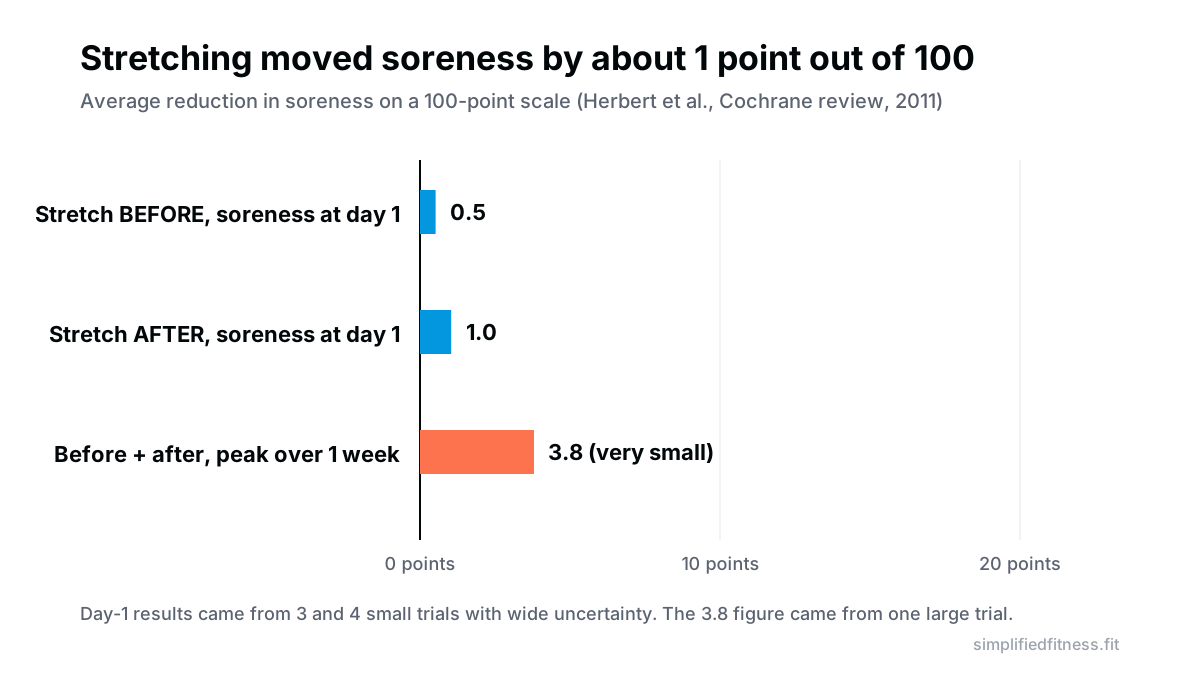
- Stretching before exercise: soreness at one day dropped by about half a point on the 100-point scale (3 studies). The confidence interval ran from roughly -11 to +10, so it could just as easily have gone either way.
- Stretching after exercise: soreness at one day dropped by about 1 point (4 studies), again with a confidence interval spanning zero.
- Before and after, large trial: peak soreness across a week fell by about 4 points. That was statistically significant, but the authors called it very small.
The authors concluded that stretching does not produce clinically important reductions in DOMS in healthy adults, and they noted a high degree of consistency across studies.
One honest caveat: the review covered healthy adults, and most trials were small and lab-based with a single stretching protocol. We cannot say what a very different routine, such as daily yoga for months, would do. We can say that the standard “stretch after your session” advice has weak support.
Does stretching after a workout reduce DOMS? The newer evidence
A fair question is whether newer research changed the picture. A 2021 meta-analysis looked only at post-exercise stretching (static, passive and PNF stretching) against passive rest or other recovery methods. It included 10 randomised trials in 229 participants, mostly young men (Afonso et al., 2021).
It found no effect of stretching on strength recovery (ES = -0.08) and no effect on soreness at 24, 48 or 72 hours versus passive recovery (effect sizes between -0.09 and -0.24, all with confidence intervals that included zero). The authors were careful, though: the data were scarce and varied, about 70% of trials had high risk of bias, and confidence in the evidence was very low. Their position was that evidence-based recommendations on stretching for recovery, either way, should be avoided for now, because the insufficient data available do not support the claims.
Read that correctly. It does not prove stretching is harmful. It says nobody has shown it helps.
An umbrella review of 29 systematic reviews on physical therapies for DOMS reached a similar spot. It found some strong evidence for cooling, cryostimulation, contrast therapy, massage, phototherapy and kinesiotaping at various time points, but called the evidence for stretching, exercises and electrical stimulation weak. It also warned that most of the underlying reviews were of low methodological quality (Wiecha et al., 2025).
Why does stretching feel like it helps?
This is where the myth survives. A good stretch feels good. Your muscles feel looser, you walk down the stairs a bit more comfortably, and it is natural to credit the stretch.
There are two likely reasons, and neither is tissue repair:
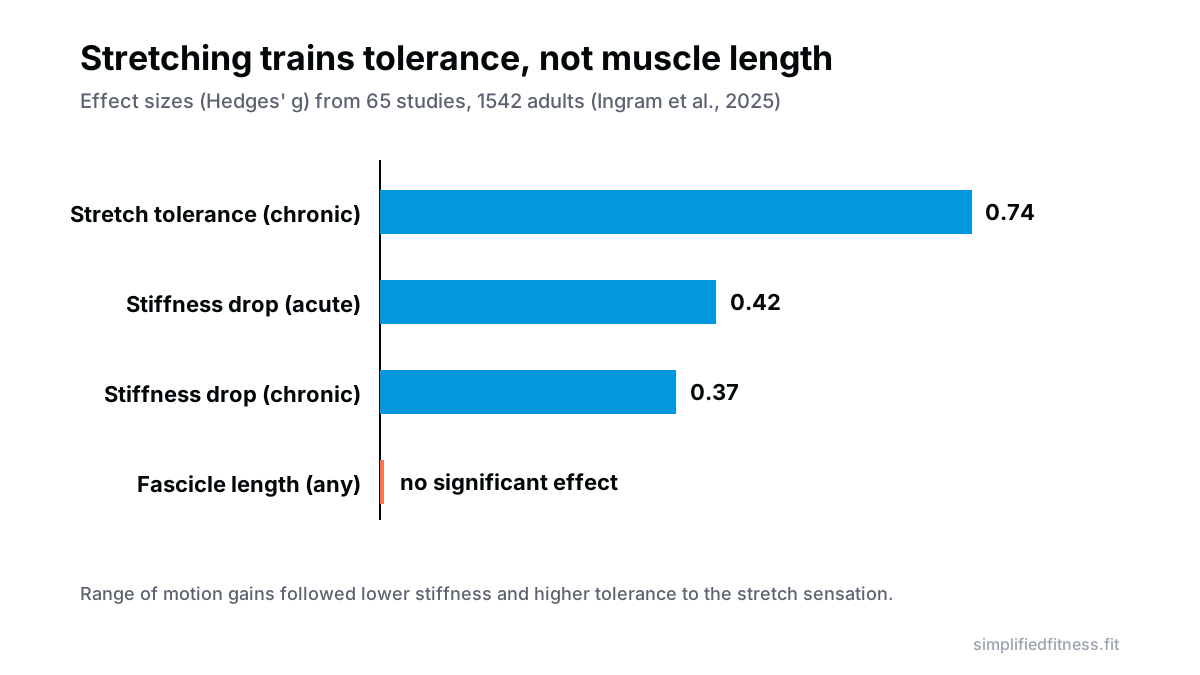
- Less stiffness, more tolerance. A 2025 meta-analysis of 65 studies (1542 adults) found that a single stretching session slightly reduced stiffness (Hedges’ g = 0.42), which fits the looser feeling right afterwards. Regular stretching over weeks also reduced stiffness (g = 0.37) and moderately increased the maximum stretch people could tolerate (g = 0.74). A single session did not raise tolerance (Ingram et al., 2025).
- Timing. DOMS usually peaks around 24-72 hours and then fades on its own. Whatever you did in that window tends to get the credit.
DOMS itself comes from the strain of unfamiliar, hard training, especially lengthening (eccentric) work. A few minutes of holding a position does not change that. If you want the full story on why soreness happens and whether it means growth, see DOMS and muscle growth.
What does static stretching actually do?
If it does not prevent soreness, why bother? Because it does something real, just not that.
The 2025 meta-analysis pooled acute and chronic effects and looked at what changes when range of motion improves (Ingram et al., 2025):
- Chronic stretching raised stretch tolerance (g = 0.74).
- Both acute and chronic stretching slightly reduced stiffness.
- Neither changed fascicle length (the length of muscle fibre bundles) significantly.
- Gains in range of motion were linked to lower stiffness and higher tolerance.
So the muscle is not getting longer in any measurable way. You tolerate the stretch better and the tissue is slightly less stiff, so you can go further. That is still useful: if your squat depth is limited by tight hips or your overhead position is limited by tight lats, regular stretching can help.
Note the limits. Most participants were young and male (71%), and many studies were short. Treat this as a good guide, not a guarantee for every body.
Should you stretch before lifting?
A separate worry is whether long static stretches before lifting hurt you. The evidence is mixed, and it is worth laying out fairly.
A 2013 meta-analysis of 104 studies found that static stretching before exercise reduced maximal strength by about 5.4% on average, with smaller effects on power (about 1.9%, not statistically significant) and explosive performance (about 2%). Effects were smallest when each stretch lasted 45 seconds or less, and the authors advised against using static stretching as the only warm-up activity (Simic et al., 2013).
A 2024 meta-analysis of 83 studies and 2012 participants came to a more nuanced view. It confirmed a small strength loss (ES = -0.21), larger with stretches of 60 seconds or more per bout (ES = -0.84), especially when testing isolated muscles. But overall athletic performance was not harmed, and jumping actually improved slightly (ES = 0.15) (Warneke and Lohmann, 2024).
Why the difference? Different datasets, stricter inclusion of controlled designs in the newer analysis, and different outcome types. Both agree on one practical point: long holds of 60 seconds or more can blunt a maximal strength effort in the stretched muscle.
For a lifter, the cautious takeaway is simple. Warm up with easy sets of your first exercise (see our 7-minute dynamic warm-up) and keep any static stretching short or leave it until after your last set.
So how does stretching compare with other recovery options?
If you want to actually do something for soreness, other methods have better backing. A 2018 meta-analysis of 99 studies found that active recovery, massage, compression garments, immersion, contrast water therapy and cryotherapy each produced small to large decreases in DOMS, while there was no change for the other methods. Massage ranked as the most effective for DOMS and perceived fatigue (Dupuy et al., 2018).
| Option | What the evidence suggests for DOMS | Practical note |
|---|---|---|
| Stretching | No meaningful effect in the Cochrane review and a 2021 meta-analysis | Fine for flexibility, skip for soreness |
| Massage | Most effective in a 2018 meta-analysis | Pricey, but a massage gun or self-massage is an option (see massage guns) |
| Active recovery | Small to large decrease in DOMS | A 20-30 minute walk or easy cycle costs nothing |
| Foam rolling | Not assessed here, see our foam rolling article | Treat it as a comfort tool |
| Cold water immersion | Reduced DOMS in the 2018 review | Mixed effects on muscle growth, covered in our ice bath article |
These are short-term effects on how sore you feel. They do not mean the method improves long-term gains, and many of the studies were small and low quality.
A cheaper, more reliable approach for most people is to reduce the cause. Add new exercises and volume gradually, and your body adapts: the repeated bout effect means the second time you do something, you get far less sore.
When should lifters actually stretch?
Stretching has a place. It is just not the one gyms tell you.
Reasonable situations:
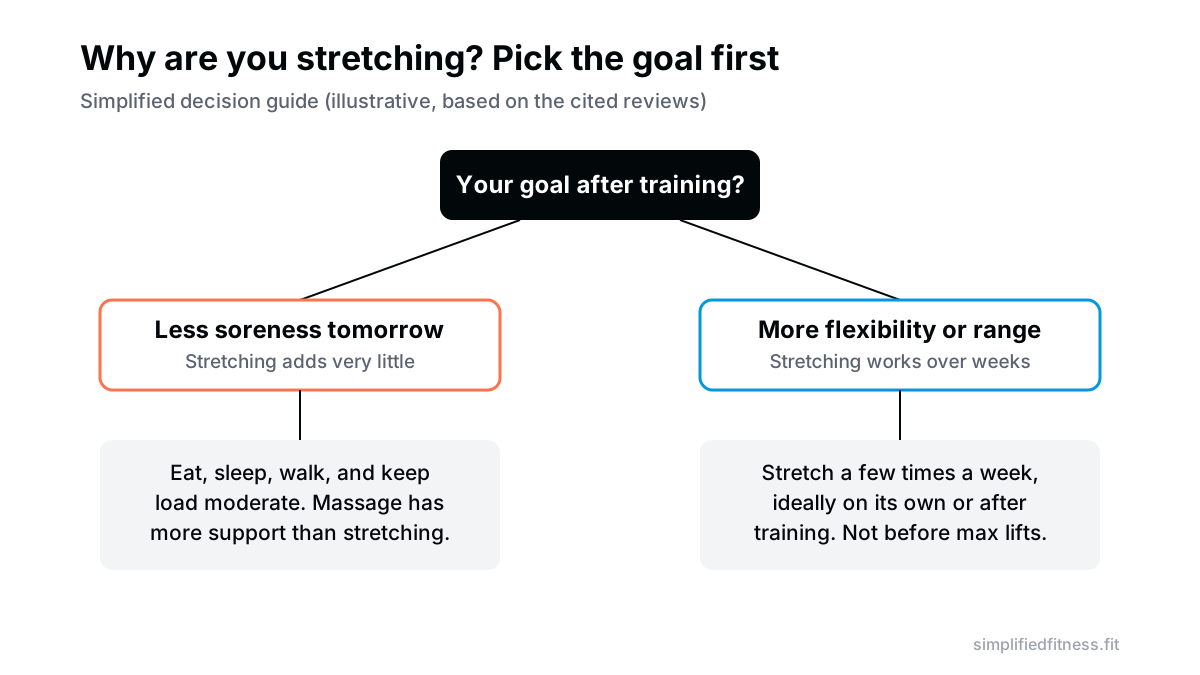
- You want more range of motion. Regular stretching raised stretch tolerance and reduced stiffness in the 2025 analysis. Two to four short sessions a week is a practical starting point (the exact dose is not firmly established).
- You find it relaxing. If a few minutes of stretching helps you wind down after training, that is a good enough reason. Just do not expect it to change tomorrow’s soreness.
- A limited position is holding back a lift. Tight ankles in the squat or tight shoulders overhead are common examples. Combine stretching with loaded full-range work.
When to skip it: right before maximal lifts if your holds are long, and as a “treatment” for sore legs. Time is better spent on a walk, a decent meal with protein (dal, paneer, curd, eggs or chicken all work) and sleep. If you are planning your week, our free training volume calculator can help you ramp sets gradually, which is the best way to keep soreness manageable. Our should you train when sore guide covers the next question you will probably have.
When to see a doctor
DOMS is normal: aching, tenderness and some stiffness in the muscles you trained, peaking in the first few days. See a doctor if you have severe pain with swelling, very dark or tea-coloured urine, soreness that is getting worse after several days, or pain in one spot rather than the whole muscle. Those can be signs of something other than ordinary DOMS, and a stretch will not fix them. This article is general information and not medical advice.
The practical takeaway
Stretching does not prevent or fix soreness, and the best data we have says the effect is about 1 point on a 100-point scale. Use it for flexibility, keep holds short before heavy lifting, and rely on gradual progression, sleep, food and light movement to manage DOMS. For the full toolkit, head back to the muscle soreness and recovery guide.
Frequently Asked Questions
Does stretching prevent soreness?
No, not in any way that you would notice. The Cochrane review of 12 trials found that stretching before or after exercise does not produce clinically important reductions in delayed-onset muscle soreness in healthy adults. Stretch for flexibility if you enjoy it, but do not expect it to spare you from leg day soreness.
Does stretching after a workout reduce DOMS?
Only by a tiny amount that is not meaningful. In the Cochrane pooled data, post-exercise stretching lowered day-one soreness by about 1 point on a 100-point scale, with a confidence interval that crossed zero. A 2021 meta-analysis found no effect at 24, 48 or 72 hours versus passive rest, so treat it as optional.
Is stretching before a workout better for soreness?
No. Pre-exercise stretching reduced day-one soreness by about half a point on a 100-point scale in the Cochrane analysis, which is effectively nothing. Long static stretches before maximal strength work may also slightly reduce force, so a warm-up with lighter sets of your first exercise is usually the better choice.
What did the Cochrane review on stretching and DOMS actually find?
It pooled 12 randomised or quasi-randomised studies and concluded that stretching, before, after or both, does not produce clinically important reductions in soreness in healthy adults. One large field trial of 2377 people found a statistically significant 4-point drop in peak soreness over a week, which the authors called very small. The overall evidence was low to moderate quality, so the honest summary is no useful effect.
Why does stretching feel like it helps sore muscles?
A single session slightly lowers muscle stiffness, so you feel looser in the moment, and weeks of regular stretching raise how much stretch you can tolerate. That is what a 2025 meta-analysis found. That feels good, but it is not the same as repairing the muscle damage that causes DOMS, so use it for comfort, not as a treatment.
What actually reduces muscle soreness?
Massage has the best support among common options, with a 2018 meta-analysis ranking it as the most effective method for reducing DOMS. Active recovery, compression garments and water immersion also showed small to large reductions in that review. For most lifters, easing into new exercises, sleeping well and light walking are the practical basics.
Does stretching make muscles longer?
Not in the sense of adding muscle length that you can measure. A 2025 meta-analysis of 65 studies found no significant change in fascicle length from acute or chronic static stretching. Range of motion improves mostly because you tolerate the stretch better and stiffness drops slightly.
Does static stretching before lifting hurt performance?
It can, mainly for maximal strength. A 2013 meta-analysis found about a 5.4% average strength drop after static stretching, with the smallest effects at 45 seconds or less per stretch. A 2024 meta-analysis found a small strength loss but no harm to jumping or sprint-type performance, so keep stretches short and do them after your heavy sets.
How long should I hold a stretch?
There is no single proven number for soreness because stretching does not reliably reduce it. For range of motion, the dose is not firmly established, and 30-60 seconds per muscle is a common starting point in practice. If you stretch before lifting, shorter holds of 45 seconds or less are linked with the smallest strength losses.
Should I stretch a sore muscle?
Gentle stretching is fine if it feels comfortable, but it will not speed up healing. Stay below pain, because aggressive stretching of already sore muscle just feels worse. If soreness is sharp, one-sided, comes with swelling or dark urine, or lasts beyond about a week, see a doctor.
Is a cool-down necessary after lifting?
Not for preventing soreness. The evidence does not show that a stretching cool-down changes how sore you feel or how fast strength returns. A few minutes of easy movement and a normal meal are a reasonable way to wind down, and nothing more is required.
Is stretching useful for building muscle or strength?
Stretching alone is not a main driver of either, and it should not replace lifting. Its clearest benefit is improved range of motion over weeks of regular practice. Full range lifts under load also train your end ranges, so many lifters get most of what they need from the gym itself.
Sources & References
Every claim above is checked against peer-reviewed research (PubMed, U.S. National Library of Medicine) or guidance from established health bodies. How we fact-check.
- Herbert RD, et al. Stretching to prevent or reduce muscle soreness after exercise. Cochrane Database Syst Rev. 2011. PMID: 21735398
- Afonso J, et al. The Effectiveness of Post-exercise Stretching in Short-Term and Delayed Recovery of Strength, Range of Motion and Delayed Onset Muscle Soreness: A Systematic Review and Meta-Analysis of Randomized Controlled Trials. Front Physiol. 2021. PMID: 34025459
- Ingram LA, et al. Mechanisms Underlying Range of Motion Improvements Following Acute and Chronic Static Stretching: A Systematic Review, Meta-analysis and Multivariate Meta-regression. Sports Med. 2025. PMID: 40180774
- Simic L, et al. Does pre-exercise static stretching inhibit maximal muscular performance? A meta-analytical review. Scand J Med Sci Sports. 2013. PMID: 22316148
- Warneke K, et al. Revisiting the stretch-induced force deficit: A systematic review with multilevel meta-analysis of acute effects. J Sport Health Sci. 2024. PMID: 38735533
- Dupuy O, et al. An Evidence-Based Approach for Choosing Post-exercise Recovery Techniques to Reduce Markers of Muscle Damage, Soreness, Fatigue, and Inflammation: A Systematic Review With Meta-Analysis. Front Physiol. 2018. PMID: 29755363
- Wiecha S, et al. Physical Therapies for Delayed-Onset Muscle Soreness: An Umbrella and Mapping Systematic Review with Meta-meta-analysis. Sports Med. 2025. PMID: 40120073

Umair Hazrami · Founder & Head Coach, Simplified Fitness
Umair Hazrami founded Simplified Fitness and the Simplified Lifter channel to cut through fitness noise. With 4+ years of consistent training and 10+ coaching clients, he writes every guide from the peer-reviewed research and links the sources so you can check them. Our editorial standards.
Educational content only, not medical advice. If you have a medical condition, are pregnant, or take medication, talk to a qualified doctor before changing your diet, supplements or training. Full disclaimer.
Keep reading
Recovery
Cold Plunge After Workout: Does an Ice Bath Blunt Muscle Growth?
Does a cold plunge after workout kill your gains? See what the lifting trials found on muscle fibre growth, strength, soreness and when cold is fine to use.
8 min read
Recovery
Ice Baths for Athletes: When Cold Water Immersion Helps at Tournaments
Ice baths for athletes can cut soreness between matches but may blunt muscle gain. See when cold water immersion is worth it and how to use it.
7 min read
Recovery
Compression Boots and Lymphatic Drainage: Do They Really Speed Recovery?
Do compression boots speed recovery or 'detox' your legs? See what pneumatic compression trials found on soreness, strength and lymph, and cheaper options.
7 min read

Recovery
Compression Garments for Lifters: Do Tights and Sleeves Really Help Recovery?
Do compression tights help recovery after lifting? Meta-analyses show small effects on soreness, swelling and strength. See what works, what doesn't, and when.
8 min read