Foam Rolling and Fascia: What the Science Says About Releasing Tight Muscles
Does foam rolling work? Meta-analyses show small, short-term flexibility and soreness gains, but no sign it breaks up fascia or scar tissue. How to use it.

TL;DR. The short answer
- Foam rolling works in a small, temporary way: meta-analyses find modest short-term flexibility gains and a little less perceived soreness, not lasting tissue change.
- There is no good evidence that a foam roller breaks up fascia, knots or scar tissue. A biomechanical model suggests it takes very large forces to deform dense fascia.
- Rolling before training does not seem to reduce strength or jump performance, so it is a safe optional warm-up add-on for 30-60 seconds per muscle.
- Rolling after training may take the edge off soreness over the next 1-3 days, but the effect is small and not consistent across studies.
- Pain that is sharp, one-sided, bruised or swollen is not a roller problem. See a doctor or physiotherapist.
Part of our complete guide: Muscle Soreness (DOMS), Heat/Cold Modalities & Recovery Methods: What Science Actually Supports
Table of contents
So, does foam rolling work? A little, and only for a short while. Meta-analyses show small, temporary gains in flexibility and a small drop in perceived soreness, with no clear harm to performance. What it does not do is break up fascia, knots or scar tissue, however much it hurts.
This guide is part of our complete guide to muscle soreness, DOMS and recovery modalities. Here we stick to the roller: what is happening under it, when to use it, and how much time it deserves.
What is foam rolling (self-myofascial release) supposed to do?
Self-myofascial release (SMR) means pressing a foam roller, ball or stick into a muscle and rolling over it slowly. The pitch is that you are “releasing” fascia, the connective tissue that wraps muscle, so the muscle moves better and hurts less.
The pitch sounds tidy. The anatomy behind it is where things fall apart.
Can foam rolling break up fascia, adhesions or scar tissue?
No good evidence says it can. The idea that a roller squashes fascia flat is a mechanical claim, so it can be tested with mechanics.
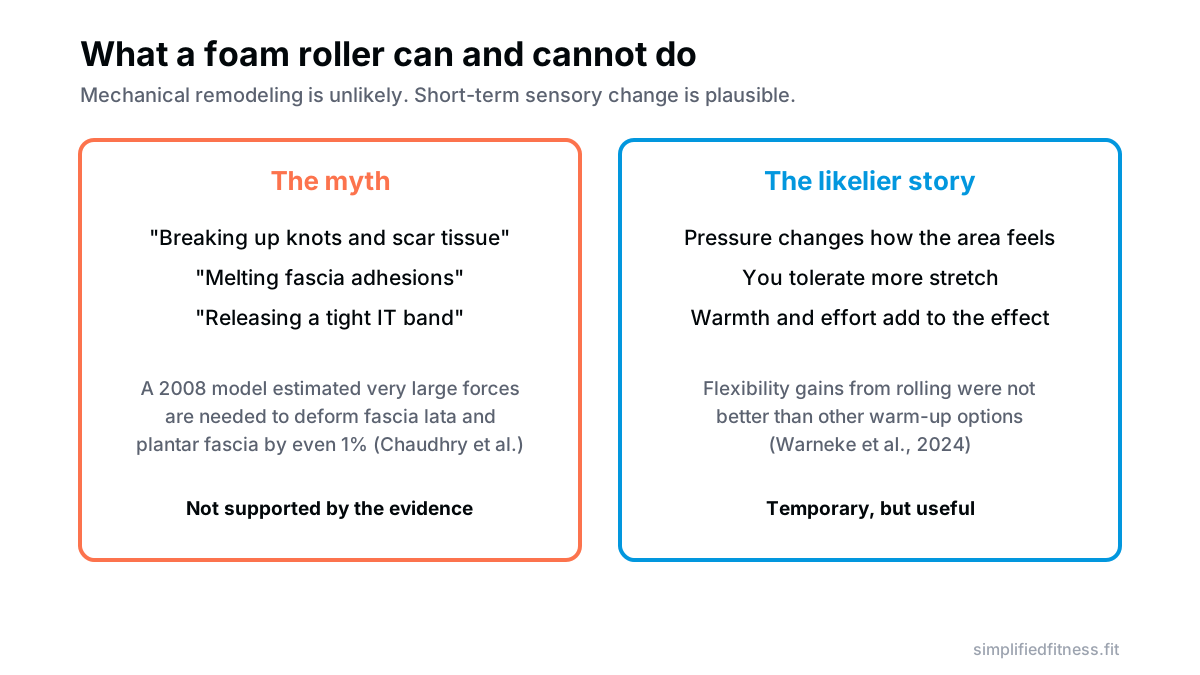
A 2008 modelling study estimated the stress needed to deform the fascia lata (the thick wrap around your thigh) and the plantar fascia under your foot. It found that very large forces, outside the normal physiologic range, are needed to produce even 1% compression and 1% shear in those tissues (Chaudhry et al., 2008). The authors concluded that the “release” sensations manual therapists feel cannot be due to deformation of those firm tissues.
That is a mathematical model of one volunteer’s tissue, not a trial of rollers. Treat it as a strong reason for doubt, not a final verdict. It suggests the pressure from lying on a roller is unlikely to be enough, though nobody has measured that directly.
So why does it feel like something releases?
The best-supported explanation is neural, not structural. Pressure on a muscle changes the signals your nervous system sends about that area. You feel looser because you tolerate more stretch, not because the tissue lengthened.
Two lines of evidence fit that story.
First, rolling does not reliably change tissue stiffness. A 2023 meta-analysis of 20 studies found no effect of foam rolling on myofascial tissue stiffness or isometric strength (knee extensor concentric torque did rise), though the authors rated the certainty as low (Glanzel et al., 2023).
Second, pain sensitivity is a mixed bag. A 2024 review found small before-after changes in pressure pain thresholds, both at the rolled spot and away from it. But when rolling was compared with a control group, there was no clear effect on local thresholds, and the authors concluded there were no consistent effects in healthy people (Habscheid et al., 2024). A before-after change without a matching control change is a warning sign that time, warmth or expectation may be doing some of the work.
Does foam rolling work for flexibility and range of motion?
For short-term range of motion, yes, a bit. The catch is that lots of other things do the same.
- Rolling vs stretching: A meta-analysis of 20 studies found no difference in range of motion between a single bout of foam rolling and a single bout of stretching, immediately or in the minutes afterwards (Konrad et al., 2022).
- Rolling vs other warm-ups: The 2024 analysis above found no significant difference in ROM compared with other interventions (Warneke et al., 2024).
- Rolling over weeks: A meta-analysis of 11 studies (290 participants, average age about 24) found a moderate effect of foam-rolling training on ROM. Programs longer than 4 weeks worked better than shorter ones, and the effect varied by muscle: hamstrings and quadriceps improved, while ankle dorsiflexion did not when rolling the calves (Konrad et al., 2022).
Put together: rolling can nudge range of motion, mostly because it lets you tolerate a deeper position. It is not special. If you hate rolling, a few minutes of easy movement gets you most of the way there. Our guide to ramping up warm-up sets covers what actually prepares a lift.
Foam rolling before or after a workout?
Both have a case. The cleanest comparison comes from a 2019 meta-analysis of 21 studies, 14 on pre-rolling and 7 on post-rolling (Wiewelhove et al., 2019).
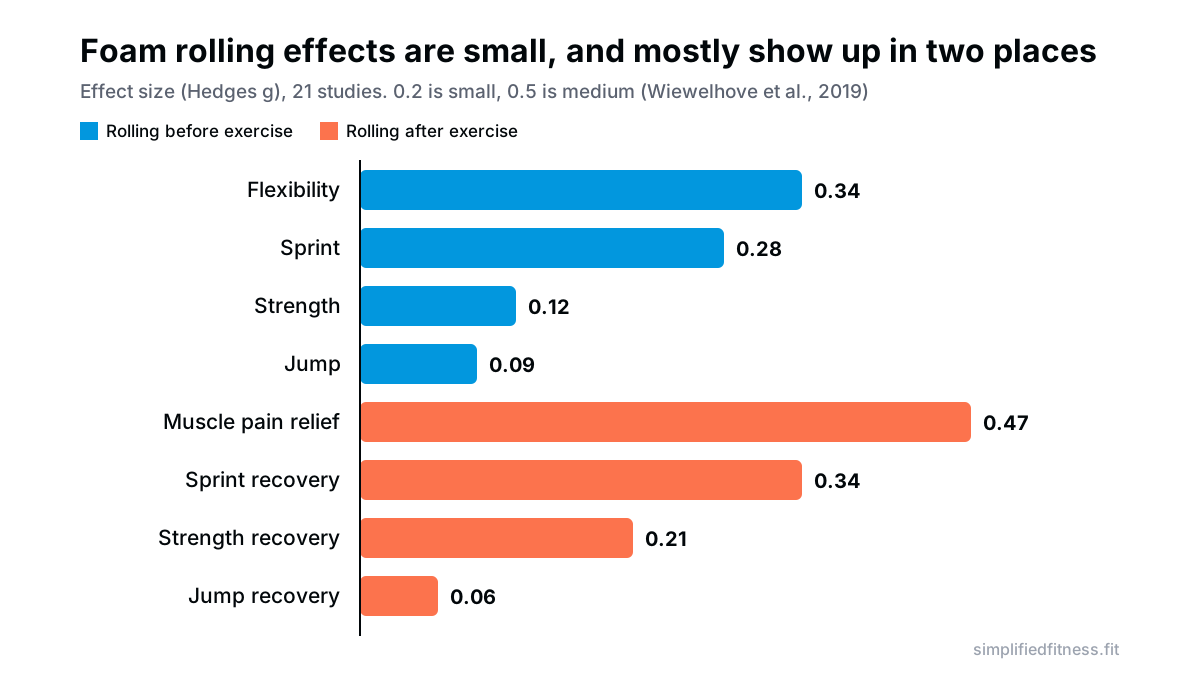
| Before exercise | After exercise | |
|---|---|---|
| Flexibility | Small gain (+4.0%, g = 0.34) | Not the main outcome |
| Sprint | Small gain (+0.7%, g = 0.28) | Slightly less decline (+3.1%, g = 0.34) |
| Strength | Negligible (+1.8%, g = 0.12) | Slightly less decline (+3.9%, g = 0.21) |
| Jump | Negligible (-1.9%, g = 0.09) | Trivial (-0.2%, g = 0.06) |
| Muscle pain | Not the main outcome | Reduced perception (+6.0%, g = 0.47) |
The authors called the overall effects “rather minor and partly negligible,” and concluded the evidence justifies foam rolling more as a warm-up activity than as a recovery tool.
Does it hurt your lifting? Not in these data. Pre-rolling had negligible effects on strength and jump, and a separate meta-analysis comparing rolling with stretching found no overall difference in performance, though some subgroups favored rolling over static stretching (Konrad et al., 2021). Static stretching right before heavy lifts is the thing worth thinking twice about. See our take on post-workout stretching and soreness.
Does a foam roller help muscle soreness?
A little. A 2024 meta-analysis pooled 16 randomized trials with 515 participants and found rolling after exercise lowered soreness ratings. Effects were small right after rolling (about -0.38 SMD on visual analogue scales) and larger at 24 and 48 hours (about -0.53 and -0.77) (Zhou et al., 2024). Results for pressure pain thresholds were less consistent, with most time points not statistically significant.
Pressure pain is what you feel; it is not muscle repair. Soreness is mostly your nervous system flagging damaged-feeling tissue, which is why a sore muscle can feel better without having recovered any faster. For what DOMS actually is, and how little it tells you about growth, see DOMS vs muscle growth. Percussive tools raise the same questions, covered in our massage gun review.
How long should you actually spend on a foam roller?
The honest answer is “not much.” Studies use anything from a few seconds to several minutes per muscle, so there is no proven dose. One analysis of rolling versus stretching hinted at better performance effects when rolling lasted longer than 60 seconds, but that came from a subgroup, so we would not build a plan on it.
A practical routine looks like this:
- Pick 1-2 muscles you are about to train (quads and glutes before squats, upper back before pressing).
- Roll slowly for 30-60 seconds each, pausing on tender spots for a few breaths.
- Use pressure you could talk through.
- Move on to your warm-up sets.
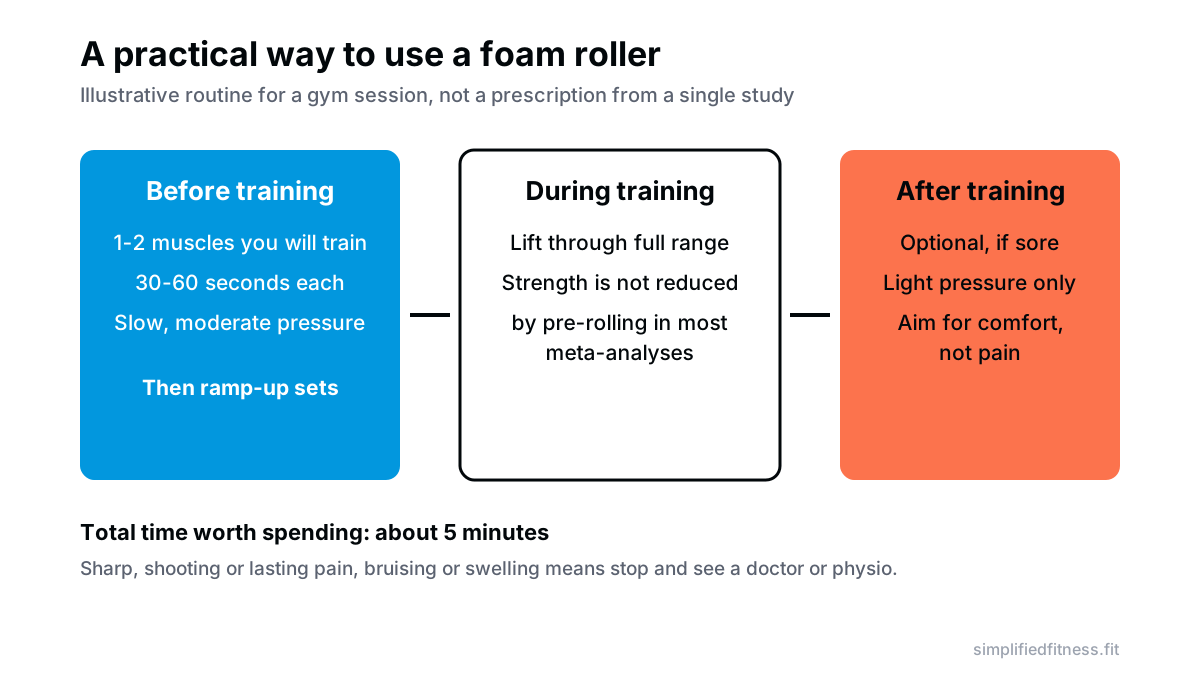
That is about five minutes. If you only have time for one thing before squats, a couple of lighter ramp-up sets will do more for your readiness than another minute on the roller. Our 7-minute dynamic warm-up is a good use of that time, and the leg day plan shows where it fits.
Who is foam rolling good for, and who should skip it?
Good fit: people who find it relaxing, who feel stiffer in hot, humid weather or after long desk days, and who want a cheap, low-effort pre-session habit. A roller costs a few hundred rupees and a rolled-up yoga mat is a workable stand-in.
Poor fit: anyone expecting it to fix a movement problem, replace sleep and food, or “release” an injury. Most studies are in healthy, young adults, so the findings may not carry over to older adults or people with pain conditions.
See a doctor or physiotherapist if you have:
- a calf that is swollen, warm or red, especially on one side (this can be a blood clot)
- sharp, shooting or numbing pain while rolling
- bruising, a lump, or pain after a recent injury
- soreness that is not improving after about a week
- a diagnosed bone, clotting or circulation condition
The bottom line
A foam roller is a tool for feeling better for an hour, not a way to remodel your fascia. The research supports small, short-lived changes in flexibility and soreness, and the anatomy argues against the dramatic claims. If you like it, roll for a few minutes and move on. If you do not, you are not missing anything essential.
Spend the saved time on what drives recovery: sleep, enough protein (use the protein calculator) and sensible training volume.
Frequently Asked Questions
Does foam rolling actually work?
Yes, but modestly and briefly. Meta-analyses find small improvements in flexibility and sprint performance when rolling before exercise, and a small reduction in perceived soreness after exercise. Treat it as an optional comfort tool, not a core part of your program.
Does foam rolling break up fascia or scar tissue?
There is no good evidence that it does. A mathematical model of fascia found that very large forces, outside the normal physiologic range, are needed to produce even 1% compression in the fascia lata and plantar fascia. Any change you feel is more likely to come from how your nervous system reads pressure, so do not expect rolling to physically remodel tissue.
Should I foam roll before or after a workout?
Either is fine, but the evidence leans slightly toward before as a warm-up add-on and after only if you are sore. A 2019 meta-analysis found pre-rolling gave small gains in flexibility and sprint, while post-rolling slightly reduced perceived pain. Pick the timing that fits your session and do not stress about it.
Does foam rolling reduce muscle soreness?
It may reduce it a little. A 2024 meta-analysis of 16 randomized trials with 515 participants found lower soreness scores after rolling, with larger effects at 24-72 hours than right away. The studies were short and the effect is small, so rolling will not erase DOMS.
Will foam rolling hurt my strength or lifting performance?
Probably not. A meta-analysis of acute effects found no changes in isometric strength, and negligible effects on jump and strength after pre-rolling. Keep it to 30-60 seconds per muscle and move on to your ramp-up sets.
How long should I foam roll each muscle?
Around 30-60 seconds per muscle is a sensible, practical range. Research protocols vary a lot, so there is no single proven dose, and a 2021 meta-analysis comparing rolling with stretching hinted at better performance effects when rolling lasted more than 60 seconds. Keep the whole session to about 5 minutes so it does not eat into your training.
Is foam rolling better than stretching?
Not in the studies so far. A 2022 meta-analysis of 20 studies found no difference in acute range of motion between a single bout of foam rolling and a single bout of stretching. Choose whichever one you will actually do.
Why does my range of motion increase after foam rolling?
The most likely explanation is a change in how much stretch you tolerate, not a change in tissue length. A 2024 meta-analysis found foam rolling and stretching were no better for ROM than other warm-up activities, which suggests general warming and sensory effects. That is why a few minutes of easy cycling can do something similar.
Can foam rolling improve flexibility long term?
Possibly, with regular use. A 2022 meta-analysis of 11 studies and 290 participants found a moderate effect on ROM, with longer programs of more than 4 weeks working better than shorter ones. Results differed by muscle, with hamstrings and quadriceps improving and calves not, so expect modest gains at best.
Is foam rolling the IT band a good idea?
It is not the best use of your time. The IT band is a thick band of connective tissue, and the same fascia model suggests rolling is unlikely to physically change it. If outer-knee or hip pain keeps coming back, get it assessed rather than rolling harder.
Does foam rolling hurt, and should it?
It can feel uncomfortable, but it should not feel sharp or alarming. Pressing as hard as you can tolerate is not shown to work better. Use moderate pressure you could breathe through, and stop if the pain is sharp, shooting or lingers.
Who should avoid foam rolling?
Anyone with a suspected blood clot, an unexplained swollen or warm calf, recent injury with bruising, or a medical condition affecting circulation or bone should check with a doctor first. Rolling over a new injury can make it worse. If pain or swelling is unexplained, get it examined instead of self-treating.
Sources & References
Every claim above is checked against peer-reviewed research (PubMed, U.S. National Library of Medicine) or guidance from established health bodies. How we fact-check.
- Wiewelhove T, et al. A Meta-Analysis of the Effects of Foam Rolling on Performance and Recovery. Front Physiol. 2019. PMID: 31024339
- Chaudhry H, et al. Three-dimensional mathematical model for deformation of human fasciae in manual therapy. J Am Osteopath Assoc. 2008. PMID: 18723456
- Glanzel MH, et al. Foam Rolling Acute Effects on Myofascial Tissue Stiffness and Muscle Strength: A Systematic Review and Meta-Analysis. J Strength Cond Res. 2023. PMID: 36227232
- Warneke K, et al. Foam rolling and stretching do not provide superior acute flexibility and stiffness improvements compared to any other warm-up intervention: A systematic review with meta-analysis. J Sport Health Sci. 2024. PMID: 38244921
- Konrad A, et al. Foam Rolling Training Effects on Range of Motion: A Systematic Review and Meta-Analysis. Sports Med. 2022. PMID: 35616852
- Konrad A, et al. A comparison of a single bout of stretching or foam rolling on range of motion in healthy adults. Eur J Appl Physiol. 2022. PMID: 35298696
- Habscheid C, et al. The effect of foam rolling on local and distant pain sensitivity assessed with pressure pain thresholds in healthy participants and musculoskeletal pain patients: A systematic review. J Bodyw Mov Ther. 2024. PMID: 39593677
- Zhou J, et al. Preventive effect of foam rolling on muscle soreness after exercise: A systematic review and meta-analysis. J Bodyw Mov Ther. 2024. PMID: 39593540
- Konrad A, et al. A Comparison of the Effects of Foam Rolling and Stretching on Physical Performance. A Systematic Review and Meta-Analysis. Front Physiol. 2021. PMID: 34658909

Umair Hazrami · Founder & Head Coach, Simplified Fitness
Umair Hazrami founded Simplified Fitness and the Simplified Lifter channel to cut through fitness noise. With 4+ years of consistent training and 10+ coaching clients, he writes every guide from the peer-reviewed research and links the sources so you can check them. Our editorial standards.
Educational content only, not medical advice. If you have a medical condition, are pregnant, or take medication, talk to a qualified doctor before changing your diet, supplements or training. Full disclaimer.
Keep reading
Recovery
Cold Plunge After Workout: Does an Ice Bath Blunt Muscle Growth?
Does a cold plunge after workout kill your gains? See what the lifting trials found on muscle fibre growth, strength, soreness and when cold is fine to use.
8 min read

Recovery
Ice Baths for Athletes: When Cold Water Immersion Helps at Tournaments
Ice baths for athletes can cut soreness between matches but may blunt muscle gain. See when cold water immersion is worth it and how to use it.
7 min read
Recovery
Compression Boots and Lymphatic Drainage: Do They Really Speed Recovery?
Do compression boots speed recovery or 'detox' your legs? See what pneumatic compression trials found on soreness, strength and lymph, and cheaper options.
7 min read

Recovery
Compression Garments for Lifters: Do Tights and Sleeves Really Help Recovery?
Do compression tights help recovery after lifting? Meta-analyses show small effects on soreness, swelling and strength. See what works, what doesn't, and when.
8 min read