Should You Work Out When Sore? A Practical Guide to Training with DOMS
Should you work out when sore? Mild DOMS is usually fine to train through. Use this simple triage to lighten, swap or rest, with the studies linked.

TL;DR. The short answer
- Mild to moderate DOMS is generally fine to train through. In one small study, repeated hard sessions after muscle damage only slightly delayed recovery.
- Sore muscles produce less force and move a bit differently, so expect weaker first sets and use a lighter load or fewer sets rather than grinding to failure.
- A short warm-up is your test. If the soreness eases and your range of motion returns, train. If it does not, swap the movement or the muscle group.
- Soreness is a poor measure of a good workout. Muscle damage was not linked to growth in one study, so you do not need to be sore to progress.
- Sharp or joint pain, swelling, a limp or very dark urine is not normal DOMS. Rest and see a doctor.
Part of our complete guide: Muscle Soreness (DOMS), Heat/Cold Modalities & Recovery Methods: What Science Actually Supports
Table of contents
Should you work out when sore? In most cases, yes, if the soreness is mild to moderate and you can move through a normal range of motion. Sore muscles produce less force and move a little differently, so the smart move is to adjust the load, the sets or the exercise rather than skip the gym or smash through it.
This is the gym-floor decision guide. For the biology of why muscles ache, our complete guide to muscle soreness, DOMS and recovery modalities covers the background. Here we stick to the practical question: what do you do on Monday when your quads still hurt from Friday?
What DOMS actually is (and why it matters for training)
Delayed onset muscle soreness shows up a day or two after unfamiliar work, especially work where the muscle lengthens under load, like the lowering part of a squat or curl. A classic review explains that untrained people become stiff and sore the day after eccentric exercise because of damage to muscle fibres, and that a second bout a week later produces much less damage (Proske and Morgan, 2001).
That tells you two useful things. Soreness is partly structural, so force output drops. And it fades fast with repetition, which we cover in the repeated bout effect.
Does training sore muscles hurt your gains?
This is the worry behind most searches for “will lifting sore hurt muscle growth”. The honest answer is that direct evidence in trained lifters is thin, so we reason from small studies.
Here is what one of them found. Twelve non-weight-trained adults damaged their elbow flexors with 30 maximal eccentric contractions. In one condition they then did 5 sets of dumbbell curls to failure on days 1, 2, 3 and 5 of recovery. Compared with doing nothing, repeating the exercise produced a slightly delayed onset of recovery, and the protective repeated bout effect was still present, though slightly reduced. The authors concluded that resistance training may be continued after eccentric damage, with a minor delay in recovery depending on the training mode (Sakamoto et al., 2009).
Notice the limits. These were untrained adults, a single arm model, and brutal damaging exercise. Treat it as reassurance, not a license to ignore your body.
On the growth side, another study followed 10 young men through 10 weeks of training with muscle biopsies. Muscle damage and protein synthesis were highest in the first week, but neither was related to hypertrophy. Protein synthesis was related to hypertrophy only later, once damage had faded (Damas et al., 2016). It is a small sample and not a direct test of training while sore, but it fits the idea that soreness is not the thing driving growth.
What soreness changes about how you lift
This is where the real risk lives. Sore muscles do not just hurt. They behave differently.
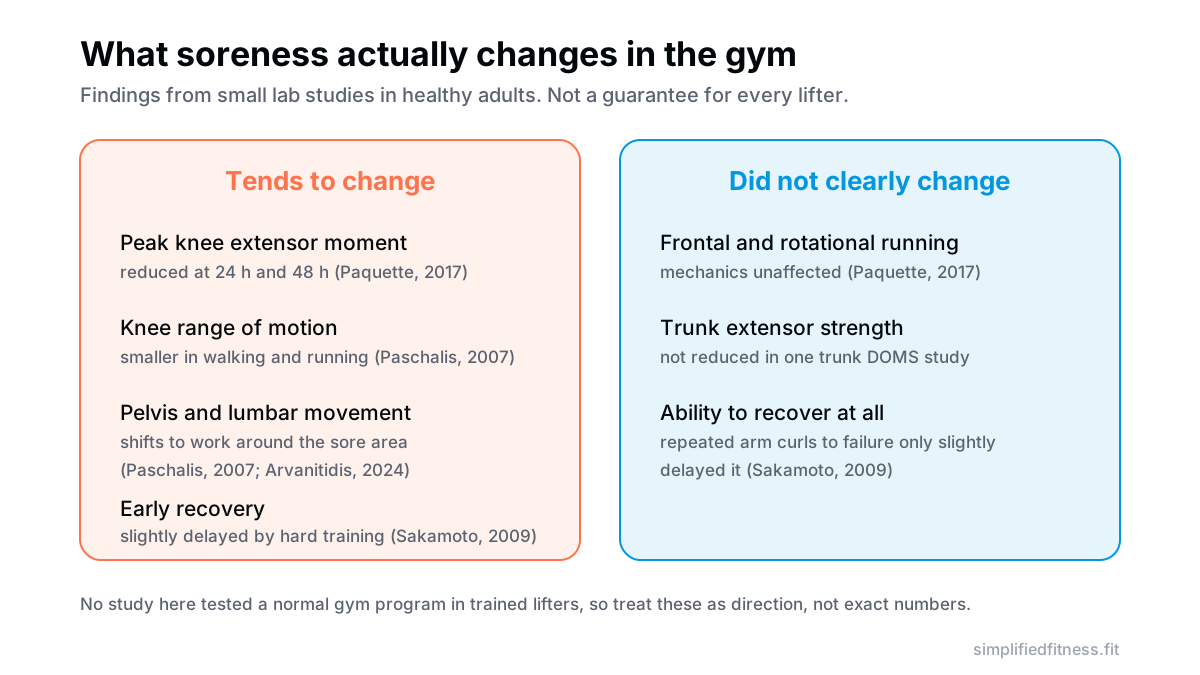
Here is what the lab data show:
- Less force and altered mechanics. In 33 healthy men with knee extensor DOMS, knee flexion range of motion was reduced at 48 hours and peak knee extensor moment was lower at 24 and 48 hours (d = 0.49 and 0.68). Frontal and transverse plane running mechanics were not affected (Paquette et al., 2017).
- Smaller knee range, different pelvis. In 10 young men, knee extensor muscle damage reduced knee range of motion during walking and running, with matching changes in pelvic tilt and rotation. The authors suggested a self-protection mechanism to prevent further damage (Paschalis et al., 2007).
- Back muscles compensate too. In 20 healthy people with trunk muscle soreness, strength was not reduced, but lumbar movement and muscle recruitment changed. The authors noted that this could alter motor performance if exposure to pain is maintained in the long term (Arvanitidis et al., 2024).
All three were small studies in healthy young adults, mostly men, using lab-induced soreness. They do not prove that lifting sore causes injuries. They do explain why a sore squat feels strange and why form is the first thing to slip.
Should you work out when sore? A three-step triage
Here is the practical protocol. Run it before you commit to heavy work.
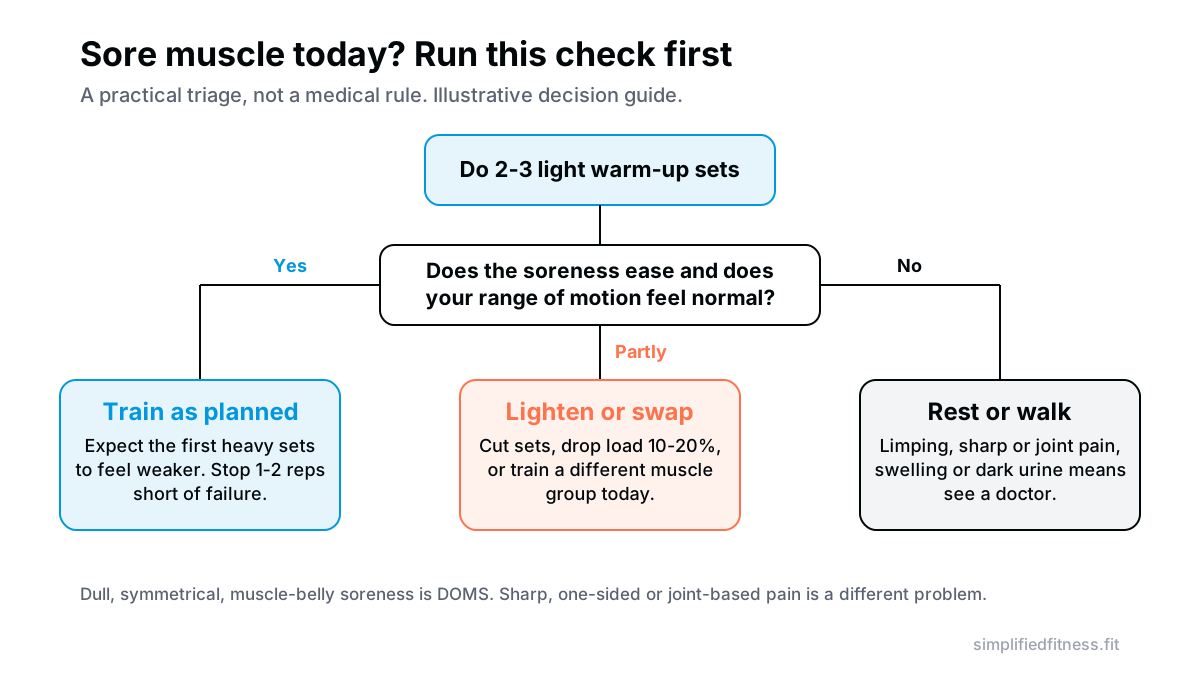
Step 1: Warm up with 2-3 light sets. Use the actual first exercise at a light load. Move through your full range.
Step 2: Read the response. Mild DOMS often feels less stiff after a few reps. That is a common practical observation, not a measured threshold, but it is a useful test.
Step 3: Choose a lane.
| What you feel | What it likely means | What to do |
|---|---|---|
| Soreness eases, full range of motion | Mild DOMS | Train as planned, leave 1-2 reps in reserve |
| Still tender, range a bit short, early sets feel weak | Moderate DOMS | Cut sets by about a third, drop load 10-20%, or swap the exercise |
| Walking is awkward, stairs hurt, you cannot reach normal depth | Severe DOMS | Rest, walk, or train a different muscle group |
| Sharp, one-sided or joint pain, swelling, a limp | Possible injury | Stop and see a doctor |
The percentages above are practical rules of thumb, not trial-tested numbers. Adjust to how you feel.
How to adjust a sore session
Pick the lever that fits the situation.
Cut volume first. Fewer sets lowers the damage you pile on and keeps technique cleaner. Dropping a third of your sets often feels better than dropping a third of your weight.
Lower the load, not the effort quality. If your first heavy set feels 10-20% worse than usual, accept it. Use the weight that gives you the same reps in reserve, not the same number on the bar.
Leave more in the tank. Reps in reserve (RIR) gives you a practical way to do this. In 29 people (15 experienced squatters and 14 novices), RIR-based RPE ratings tracked bar velocity closely, with strong inverse correlations (r = -0.88 in experienced squatters, r = -0.77 in novices) (Zourdos et al., 2016). A 2020 review also described RIR-based RPE as practical and reliable for regulating training (Helms et al., 2020). Our RIR and RPE calculator can help you set a load.
Choose stable movements. Machines and cables are easier to control than a loaded barbell when your coordination is off. A hack squat or leg press feels safer than a heavy back squat on tender legs.
Avoid new eccentric overload. Do not pick today to try slow 5-second negatives. Adding fresh eccentric stress on top of existing damage is the combination most likely to leave you sorer.
Train a different muscle group. If your legs are wrecked, an upper body session is a clean answer.
How to workout when sore: an Indian gym example
Say you did a heavy leg day on Friday and woke up Sunday unable to sit on the toilet comfortably. Monday is push day anyway, so you train chest, shoulders and triceps as normal. Wednesday is legs again, but Tuesday evening stairs still hurt. You warm up with leg press, notice depth feels short, and run 3 sets instead of 4 at about 15% lighter, stopping 2 reps from failure. By the next leg day, the same session tends to hurt less because of the repeated bout effect.
Simple, boring and effective. It also fits well with a normal Indian diet. Keep protein steady through dal, paneer, curd, eggs or soya, and eat enough overall. Use our protein calculator to check your daily target. No special soreness food is needed.
When to rest instead
Take a rest day, or a walk, when:
- soreness is severe and clearly changes how you walk, squat or move
- you feel generally flat for several sessions in a row, which may point toward needing a deload week
- you slept badly, are ill or are under heavy stress, because recovery capacity is lower
When it is not DOMS: see a doctor
DOMS is a dull, tender ache across the muscle, usually on both sides, that peaks within a few days. These signs are different and deserve medical attention:
- sharp pain, a pop or sudden pain during a lift
- pain that is one-sided, in a joint or in a tendon
- visible swelling, bruising or a lump
- very dark, tea-coloured urine, extreme weakness or unusually severe pain after a huge session
- soreness that is getting worse after a week
We cannot diagnose anything here. If any of these apply, stop training the area and get examined.
Common mistakes
Other frequent errors:
- Skipping the warm-up and judging soreness cold.
- Training to failure on sore muscles.
- Hitting new, unfamiliar eccentric-heavy work on top of existing soreness.
- Using painkillers to mask the signal, then lifting heavier than the muscle can handle. If this is a habit, read about NSAIDs and muscle growth.
- Spending the whole soreness window stretching. The idea is covered in post-workout stretching and soreness.
The bottom line
Mild to moderate DOMS is not a red flag. Warm up, see how the muscle responds, then train as planned, lighten or swap. Keep effort 1-3 reps from failure, protect your form and respect any sharp or joint pain. The research here is small and mostly in healthy young adults with lab-induced soreness, so use it as a guide and let your own signals have the final vote.
Frequently Asked Questions
Should you work out when sore?
Usually yes, if the soreness is mild to moderate and you can move through a normal range of motion. Research on damaged muscle suggests training can continue, with only a slight delay in recovery. Warm up first, lower the load or sets if needed, and stop well short of failure.
Can I workout with DOMS?
Yes, for most people with ordinary DOMS. In a small study of 12 untrained adults, repeated arm curls to failure after a damaging session only slightly delayed recovery. Use a few warm-up sets to judge how the muscle feels before committing to your working weights.
Will lifting while sore hurt muscle growth?
There is no good evidence that it does when you manage the load sensibly. In one study, the muscle damage seen early in a new program was not related to hypertrophy, while later protein synthesis was. Train sore muscles with controlled volume and keep your weekly sets on track.
Is it bad to train legs when they are sore?
Not necessarily, but sore legs change how you move. After eccentric knee extensor exercise, men showed reduced knee flexion and lower peak knee extensor moment while running, and something similar may show up in your squat. Keep the depth you can control, drop the weight 10-20%, and avoid heavy, grindy sets.
Does soreness mean the workout worked?
No. Soreness mostly reflects unfamiliar movements, especially lengthening contractions, not how much growth you triggered. As you repeat a program the same session hurts less even though you are still progressing. Judge your training by progress in reps and load over weeks.
Does being sore make you weaker in the gym?
Often a little, yes. Muscle fibres disrupted by eccentric work generate less force for a few days, and joint kinetics change. Expect your first heavy set to feel off and use RIR or RPE to autoregulate instead of chasing last week's numbers.
Can training a sore muscle cause an injury?
There is no strong evidence that it does in healthy people, but sore muscles move differently and that is a reasonable reason for caution. One study suggested these changes may be a protective adjustment. Reduce intensity, keep form tidy, and stop if pain turns sharp or sits in a joint.
How do I know if it is DOMS or an injury?
DOMS is usually a dull, tender ache across the muscle belly that shows up 1-2 days after training, often on both sides. An injury is more often sharp, sudden, one-sided or felt in a joint or tendon. If you are unsure or pain is getting worse, get it checked rather than testing it with heavy weight.
Should I rest completely when I am sore?
Not always. A full rest day makes sense when soreness is severe, your movement is clearly altered or you feel run down. Otherwise a lighter session, a different muscle group or an easy walk usually keeps your routine going.
How should I train when my whole body is sore?
Cut volume first and keep technique clean. Do about half your usual sets, leave 2-3 reps in reserve, and pick stable machine or cable movements over heavy free weights. If you feel flat for several sessions in a row, a planned deload may be the better answer.
Is it okay to do upper body when my legs are sore?
Yes. Training a different muscle group is a simple way to stay consistent while the sore area recovers. Avoid exercises that load the sore muscle heavily, such as heavy rows if your lats and lower back are very tender.
Do painkillers like ibuprofen help me train through soreness?
They may dull the pain, but that does not mean the muscle has recovered. Masking soreness can tempt you into harder work than the tissue is ready for. Read the NSAID article linked above and speak to a doctor or pharmacist if you need regular pain relief.
How long does soreness last?
For many people DOMS peaks within the first two or three days and fades over roughly a week, though it varies. Each time you repeat the same session it tends to hurt less. If soreness lasts much longer or gets worse, get it checked.
Sources & References
Every claim above is checked against peer-reviewed research (PubMed, U.S. National Library of Medicine) or guidance from established health bodies. How we fact-check.
- Sakamoto A, et al. Effects of exhaustive dumbbell exercise after isokinetic eccentric damage: recovery of static and dynamic muscle performance. J Strength Cond Res. 2009. PMID: 19910828
- Paquette MR, et al. Soreness-related changes in three-dimensional running biomechanics following eccentric knee extensor exercise. Eur J Sport Sci. 2017. PMID: 28276912
- Paschalis V, et al. The effects of muscle damage following eccentric exercise on gait biomechanics. Gait Posture. 2007. PMID: 16714113
- Arvanitidis M, et al. Eccentric exercise-induced delayed onset trunk muscle soreness alters high-density surface EMG-torque relationships and lumbar kinematics. Sci Rep. 2024. PMID: 39127797
- Proske U, et al. Muscle damage from eccentric exercise: mechanism, mechanical signs, adaptation and clinical applications. J Physiol. 2001. PMID: 11731568
- Damas F, et al. Resistance training-induced changes in integrated myofibrillar protein synthesis are related to hypertrophy only after attenuation of muscle damage. J Physiol. 2016. PMID: 27219125
- Zourdos MC, et al. Novel resistance training-specific rating of perceived exertion scale measuring repetitions in reserve. J Strength Cond Res. 2016. PMID: 26049792
- Helms ER, et al. Methods for regulating and monitoring resistance training. J Hum Kinet. 2020. PMID: 33312273

Umair Hazrami · Founder & Head Coach, Simplified Fitness
Umair Hazrami founded Simplified Fitness and the Simplified Lifter channel to cut through fitness noise. With 4+ years of consistent training and 10+ coaching clients, he writes every guide from the peer-reviewed research and links the sources so you can check them. Our editorial standards.
Educational content only, not medical advice. If you have a medical condition, are pregnant, or take medication, talk to a qualified doctor before changing your diet, supplements or training. Full disclaimer.
Keep reading
Recovery
Cold Plunge After Workout: Does an Ice Bath Blunt Muscle Growth?
Does a cold plunge after workout kill your gains? See what the lifting trials found on muscle fibre growth, strength, soreness and when cold is fine to use.
8 min read
Recovery
Ice Baths for Athletes: When Cold Water Immersion Helps at Tournaments
Ice baths for athletes can cut soreness between matches but may blunt muscle gain. See when cold water immersion is worth it and how to use it.
7 min read
Recovery
Compression Boots and Lymphatic Drainage: Do They Really Speed Recovery?
Do compression boots speed recovery or 'detox' your legs? See what pneumatic compression trials found on soreness, strength and lymph, and cheaper options.
7 min read

Recovery
Compression Garments for Lifters: Do Tights and Sleeves Really Help Recovery?
Do compression tights help recovery after lifting? Meta-analyses show small effects on soreness, swelling and strength. See what works, what doesn't, and when.
8 min read