Sauna After Lifting: Heart Health Perks, Heat Shock Protein Hype and Real Recovery
Does sauna for muscle recovery work? See what trials show on soreness, blood pressure, heat shock proteins and infrared vs traditional saunas, plus safety tips.

TL;DR. The short answer
- Sauna for muscle recovery has modest, early support: one small crossover trial found less soreness and a smaller drop in jump performance 14 hours after lifting, but it is not a proven muscle builder.
- The strongest sauna evidence is cardiovascular. Heat therapy lowered systolic blood pressure by about 4 mmHg in a meta-analysis, and frequent sauna use in Finnish men was linked to fewer deaths (observational data).
- Heat shock proteins rise after heat exposure, but a 6-week trial of post-training infrared sauna found no extra muscle growth in female team sport athletes.
- Infrared saunas run cooler and have been used in recovery trials, but no study cited here compares them directly with traditional saunas, so pick the one you will actually use.
- Drink water, keep sessions short, and talk to a doctor first if you have heart disease, low blood pressure, are pregnant or take blood pressure medicine.
Part of our complete guide: Muscle Soreness (DOMS), Heat/Cold Modalities & Recovery Methods: What Science Actually Supports
Table of contents
Does sauna for muscle recovery actually work? A little, maybe. The best lifting-specific trial found less soreness and a smaller drop in jump performance the next morning, but the evidence for growing muscle is thin, and the heart-health case for sauna is far stronger than the muscle case.
That is the honest summary. This article sits inside our guide to soreness and recovery modalities, and its job is to separate the real benefits of heat (blood vessels, blood pressure, a calmer evening) from the “heat shock proteins will make you huge” pitch you see on social media.
What does sauna do to your body?
Sitting in 80-100 degrees C air makes your skin blood vessels open up, your heart rate climb and your sweat rate spike. A Finnish sauna is usually dry heat in that range with 10-20% humidity (Laukkanen and Kunutsor, 2024).
Your heart works harder to push blood to the skin. That is a mild cardiovascular workout, though not a replacement for one. Hold that thought.
The review authors link the benefits to anti-inflammatory and circulatory effects, and say Finnish sauna has the most consistent evidence of the heat methods. Keep in mind that the authors are long-time sauna researchers and much of what they review is observational.
Is sauna good for your heart? (the strongest evidence)
This is where heat therapy earns its reputation.
A Finnish cohort followed 2,315 middle-aged men for a median of 20.7 years. Compared with men who used a sauna once a week, those who went 4-7 times a week had a hazard ratio of 0.37 for sudden cardiac death, and similar inverse links were seen for cardiovascular and all-cause mortality (Laukkanen et al., 2015). Longer sessions (over 19 minutes) showed lower sudden cardiac death risk than sessions under 11 minutes.
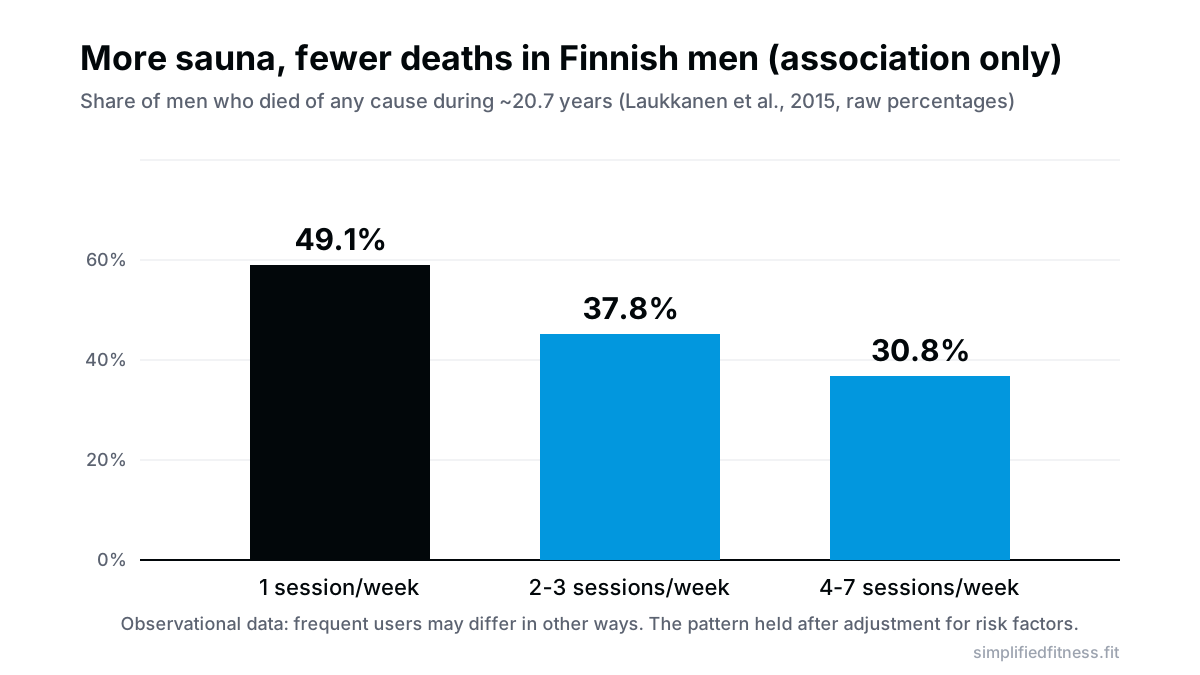
Caveat time. This is a prospective cohort, so people who sauna often may differ in fitness, income or health habits. The authors themselves say more studies are needed on mechanism. The men were Finnish, middle-aged and male, so applying it to a 24-year-old woman in Pune is a stretch.
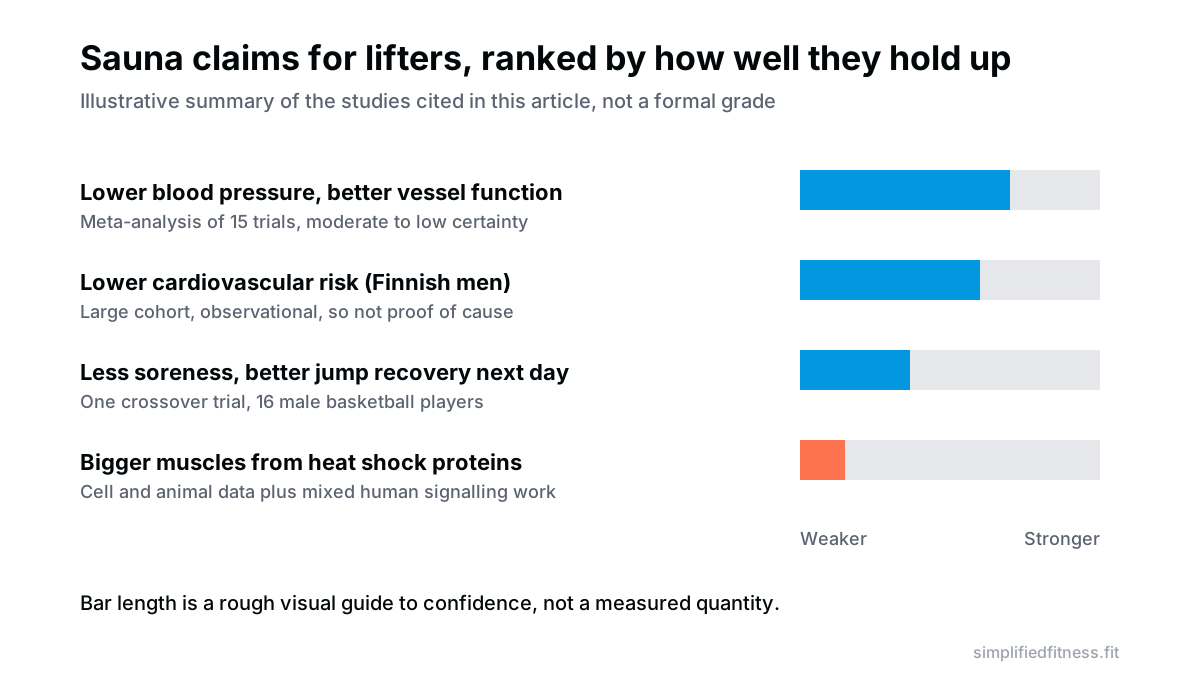
Trials help fill that gap. A 2021 systematic review and meta-analysis of 15 studies found heat therapy lowered mean arterial pressure by 5.86 mmHg, systolic pressure by 3.94 mmHg and diastolic pressure by 3.88 mmHg, and improved flow-mediated dilatation (a measure of how well arteries relax) by about 1.95 percentage points (Pizzey et al., 2021). Resting heart rate did not change. Certainty was moderate for systolic and diastolic pressure and low for the other two.
Does sauna help muscle recovery after lifting?
Now the lifting-specific question. Here the evidence is small but encouraging.
In a randomized crossover trial, 16 male basketball players did a heavy resistance and plyometric session, then either sat for 20 minutes of passive rest or 20 minutes in an infrared sauna at about 43 degrees C. Fourteen hours later, the drop in countermovement jump was smaller after the sauna, soreness was lower and perceived recovery was higher (Ahokas et al., 2023). Sprint and isometric leg press tests were also run. The abstract highlights the jump result and the soreness result.
Two honest limits. It is one study in young men on a team sport, and the soreness result is subjective. Nobody should call this settled.
The same trial checked the nervous system too. Heart rate was higher and heart rate variability lower during the sauna, but night-time heart rate and HRV did not differ afterwards. In plain words, the sauna did not seem to wreck autonomic recovery overnight. If you track HRV, that matters; there is a little more on it in our look at recovery gadgets and wearables.
Do heat shock proteins make you bigger?
Not on the evidence we have. Here is the fair version of both sides.
What supports the idea. A 2023 study in a resistance-trained population found a single session of whole-body heat stress after resistance exercise increased HSPA expression and Akt-mTOR signalling compared with resistance exercise alone. Heat alone may do something similar, but responses were notably variable, and in cultured muscle cells heat enhanced myotube growth, though less than growth factors did (Fennel et al., 2023). The authors say the mechanism and the role of HSPs remain unclear.
What cuts against it. A signalling bump is not a bigger quad. A 2022 narrative review notes the evidence is based largely on cellular and animal models, and that it is unclear whether heat is as effective in humans or meaningful next to exercise alone (Fennel et al., 2022). Then there is the 6-week trial. Forty female team sport athletes trained 2-3 times a week; half used infrared sauna (10 min, 50 degrees C) after training three times a week. Both groups improved, and there were no interaction effects for hypertrophy measures (Ahokas et al., 2025). The authors concluded sauna does not significantly impact hypertrophy, though it might boost power over time. Jump height at 15% extra load and peak power did show interaction effects, which is interesting but one trial.
Why might they differ? One measures a short-term molecular signal after a single session; the other measures actual muscle size after weeks. Signals do not always add up to growth. Different people, different heat doses, different methods.
Infrared vs traditional sauna for recovery
People ask this constantly. The answer is that nobody has settled it.
| Feature | Traditional (Finnish) | Infrared |
|---|---|---|
| Typical air temperature | About 80-100 degrees C, dry air | The lifting trials above used about 43-50 degrees C |
| Strongest evidence | Heart and mortality (observational), blood pressure (heat therapy trials) | Two small lifting studies on soreness, power and hypertrophy |
| Direct head-to-head for recovery | None cited here | None cited here |
| Practical angle | Gym or club access, higher heat tolerance needed | Easier to tolerate, more home options |
The honest read: the heart evidence comes mostly from Finnish saunas, while the lifting recovery data we cite comes from infrared. Different heat, different studies. Neither is proven better. Pick the one you will use consistently, and keep temperature comfortable.
A related question is a hot shower or steam room. If you cannot reach a sauna, see our comparison of hot vs cold showers for recovery. For the contrasting approach, our cold plunge and hypertrophy article covers why cold may behave differently.
Can sauna help endurance too?
Possibly, in a narrow way. A small 2007 crossover study had six male distance runners sit in a humid sauna at about 90 degrees C for around 31 minutes straight after training, roughly 13 times over 3 weeks. Run time to exhaustion rose 32% versus control, and plasma volume rose 7.1% (Scoon et al., 2007). The authors suggest higher blood volume as the likely reason.
Six runners. That is the headline. Take it as a hint for endurance athletes and not a guarantee for strength athletes.
Hydration, safety and when to see a doctor
Heat plus sweat equals fluid loss. This part is not optional.
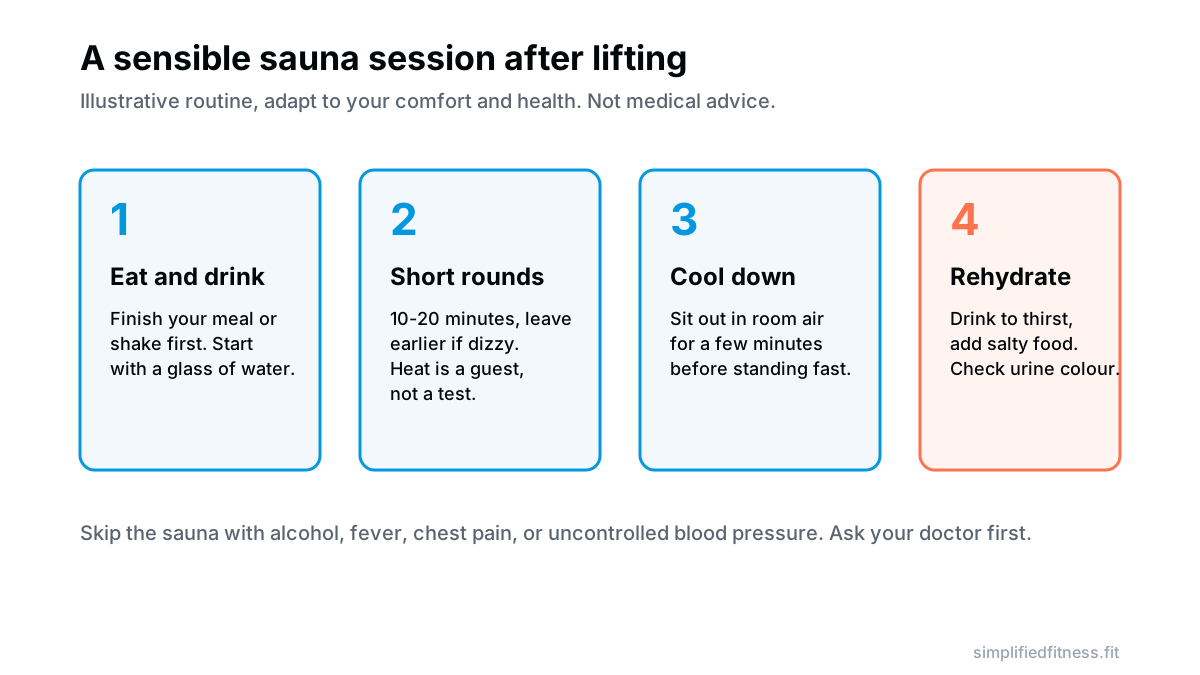
A practical routine looks like this:
- Drink a glass of water before you go in.
- Keep the first sessions to 10-15 minutes, like the trials did.
- Step out the moment you feel dizzy, nauseous or confused.
- Afterwards, drink to thirst and eat a normal meal. Dal-rice or a salted lassi covers fluid and sodium.
- Skip alcohol. It mixes badly with heat.
In India’s summer, a hot gym changing room plus a sauna is a lot of heat stress. Cut the time, not the water. Use our water intake calculator for a baseline, and read why hydration affects strength for more.
See a doctor before using a sauna if you have heart disease, chest pain, low or unstable blood pressure, a recent heart event, kidney problems, are pregnant, have a fever, or take blood pressure medicines or diuretics. Heat also dilates blood vessels and can make blood pressure drop. This article is general information, not a diagnosis.
How to fit sauna into your week
Keep the base first. Sleep is your biggest recovery lever, and our sleep and recovery guide covers it properly. Then food, then training load.
After that, a simple plan:
- Choose two or three days with hard sessions, such as legs or back.
- Finish the workout, eat, then sit in the heat for 10-20 minutes.
- Cool down, rehydrate, and note how soreness feels the next morning.
- Give it 3-4 weeks. If you notice nothing, drop it without guilt.
Not a sauna person? A hot bath offers a heat route many people already have. We cannot say it matches sauna for recovery, so treat it as a comfort option.
The bottom line
Sauna is a decent recovery habit with a strong heart-health story and a modest, early muscle-recovery story. It is not a growth hack. The best lifting trial saw less soreness and a smaller jump drop the next morning; the best hypertrophy trial saw no extra growth.
Use it if you like it, keep it short, hydrate, and keep your lifting, protein and sleep on point. If you need the training side sorted first, try our free plans.
Frequently Asked Questions
Is sauna good for muscle recovery?
It may help a little with how recovery feels. In a 2023 crossover trial of 16 male basketball players, a 20-minute infrared sauna after heavy lifting reduced soreness and attenuated the drop in jump height measured 14 hours later. The sample was small and young, so treat it as promising, not proven, and use sleep and food as the base.
Should I use a sauna before or after lifting?
After is the better-studied option. The recovery trials had people sit in the heat after training, not before. Heat before a session raises heart rate and fluid loss before you have even started, so keep sauna for the cooldown.
Does sauna help build muscle?
There is no good human evidence that it does. In a 6-week trial of 40 female team sport athletes, post-training infrared sauna three times a week did not change hypertrophy measures compared with training alone. Keep your focus on progressive overload, protein and sleep.
What are heat shock proteins and do they grow muscle?
Heat shock proteins are cell-protecting proteins that rise when tissue is stressed, including by heat. A 2023 study in resistance-trained people found heat after lifting increased HSPA expression and Akt-mTOR signalling, but signalling is not the same as visible muscle gain. Most growth data comes from cells and animals, so do not buy a sauna for gains.
Is infrared sauna better than traditional sauna for recovery?
No study cited here shows that either one is better for recovery. Traditional Finnish saunas run roughly 80-100 degrees C, while the infrared protocols in the lifting trials used about 43-50 degrees C. Choose by comfort, cost and access, then keep sessions short.
How long should I stay in a sauna after a workout?
Sessions in the trials were short: 10 minutes at 50 degrees C in one, 20 minutes at about 43 degrees C in another. Longer is not automatically better because heat adds fluid loss on top of training. Start with 10-15 minutes, step out if you feel dizzy, and build up only if you feel fine.
How often should I use a sauna?
In Finnish observational data, men who used a sauna 4-7 times a week had lower risk of cardiovascular death than those who went once a week. That is an association, not proof of cause. Two or three sessions a week is a reasonable and realistic start.
Does sauna lower blood pressure?
Probably, modestly. A 2021 meta-analysis of 15 studies found heat therapy lowered systolic pressure by about 3.9 mmHg and diastolic by about 3.9 mmHg compared with control. Most protocols ran 10-36 sessions, so it is a habit effect; check with your doctor if you take blood pressure drugs.
Can sauna make you dehydrated?
Yes, heavy sweating can leave you short on fluid, especially after a hard session in hot weather. Dehydration can leave you dizzy and weak, and it works against recovery. Drink water before and after, and add salty food like a dal and rice meal or salted lassi afterwards.
Does sauna improve cardio fitness or endurance?
Possibly for runners. A small 2007 crossover study in six male distance runners found 3 weeks of post-run sauna raised plasma volume by about 7% and run time to exhaustion by 32%. Six runners is very few, so treat it as a hint for endurance athletes, not a guarantee.
Is sauna safe for everyone?
No. People with heart disease, unstable or low blood pressure, pregnancy, fever or on certain medicines should speak to a doctor first. Heat strains the cardiovascular system by raising heart rate, and alcohol makes this riskier. If you feel chest pain, faintness or confusion, leave the heat and seek help.
Is sauna better than a cold plunge after lifting?
They do different things and neither is a must-have. Heat showed no harm to hypertrophy in the trial above, while cold is a different question. Read our cold plunge article before choosing, and do not stack both just because it looks hardcore.
Can a hot bath or steam room replace a sauna?
Possibly, but the evidence is thinner. The 2021 meta-analysis of heat therapy pooled several heating approaches, yet the lifting recovery trials used saunas, so a hot bath is unproven for soreness. A hot bath is the cheap option many people already have, so use it for comfort and keep the same short time and hydration rules.
Sources & References
Every claim above is checked against peer-reviewed research (PubMed, U.S. National Library of Medicine) or guidance from established health bodies. How we fact-check.
- Laukkanen T, et al. Association between sauna bathing and fatal cardiovascular and all-cause mortality events. JAMA Intern Med. 2015. PMID: 25705824
- Pizzey FK, et al. The effect of heat therapy on blood pressure and peripheral vascular function: a systematic review and meta-analysis. Exp Physiol. 2021. PMID: 33866630
- Fennel ZJ, et al. Effect of heat stress on heat shock protein expression and hypertrophy-related signaling in the skeletal muscle of trained individuals. Am J Physiol Regul Integr Comp Physiol. 2023. PMID: 37842742
- Fennel ZJ, et al. The heat shock connection: skeletal muscle hypertrophy and atrophy. Am J Physiol Regul Integr Comp Physiol. 2022. PMID: 35536704
- Ahokas EK, et al. A post-exercise infrared sauna session improves recovery of neuromuscular performance and muscle soreness after resistance exercise training. Biol Sport. 2023. PMID: 37398966
- Ahokas EK, et al. Effects of repeated use of post-exercise infrared sauna on neuromuscular performance and muscle hypertrophy. Front Sports Act Living. 2025. PMID: 40104529
- Scoon GS, et al. Effect of post-exercise sauna bathing on the endurance performance of competitive male runners. J Sci Med Sport. 2007. PMID: 16877041
- Laukkanen JA, et al. The multifaceted benefits of passive heat therapies for extending the healthspan: a comprehensive review with a focus on Finnish sauna. Temperature. 2024. PMID: 38577299

Umair Hazrami · Founder & Head Coach, Simplified Fitness
Umair Hazrami founded Simplified Fitness and the Simplified Lifter channel to cut through fitness noise. With 4+ years of consistent training and 10+ coaching clients, he writes every guide from the peer-reviewed research and links the sources so you can check them. Our editorial standards.
Educational content only, not medical advice. If you have a medical condition, are pregnant, or take medication, talk to a qualified doctor before changing your diet, supplements or training. Full disclaimer.
Keep reading

Recovery
Cold Plunge After Workout: Does an Ice Bath Blunt Muscle Growth?
Does a cold plunge after workout kill your gains? See what the lifting trials found on muscle fibre growth, strength, soreness and when cold is fine to use.
8 min read

Recovery
Ice Baths for Athletes: When Cold Water Immersion Helps at Tournaments
Ice baths for athletes can cut soreness between matches but may blunt muscle gain. See when cold water immersion is worth it and how to use it.
7 min read

Recovery
Compression Boots and Lymphatic Drainage: Do They Really Speed Recovery?
Do compression boots speed recovery or 'detox' your legs? See what pneumatic compression trials found on soreness, strength and lymph, and cheaper options.
7 min read

Recovery
Compression Garments for Lifters: Do Tights and Sleeves Really Help Recovery?
Do compression tights help recovery after lifting? Meta-analyses show small effects on soreness, swelling and strength. See what works, what doesn't, and when.
8 min read