Deload Week Physiology: How to Deload and Not Lose Muscle
Deload week guide: what fatigue builds up in a hard block, why one lighter week does not cost muscle, and how to deload with 50% of your sets. Studies linked.

TL;DR. The short answer
- A deload is a planned lighter week, usually about half your normal sets with the same sessions and similar loads, used to let accumulated fatigue clear while your fitness stays put.
- The fitness-fatigue model says fatigue clears faster than fitness fades, which is why performance can feel better after a lighter week. It is a performance model, so tissue-level explanations remain partly hypothesis.
- You are very unlikely to lose meaningful muscle in a 7-day deload. In one trial of trained lifters, a full week off produced the same lower-body muscle growth as training straight through, though strength gains were a little smaller.
- Reducing volume protects your gains better than stopping. In untrained men, 8 weeks of reduced training kept muscle and strength, while 8 weeks of stopping cost about 22.6% of squat strength.
- Persistent drops in performance, mood or sleep that do not improve after a deload deserve a conversation with a doctor or coach, not just more rest.
Part of our complete guide: Muscle Soreness (DOMS), Heat/Cold Modalities & Recovery Methods: What Science Actually Supports
Table of contents
A deload week is a planned lighter week of training, and for muscle it is very low risk. In the one randomized trial that took trained lifters completely out of the gym for a week, lower-body muscle growth ended up the same as in lifters who trained straight through (Coleman et al., 2024).
This deload week guide covers what a hard training block actually piles up, why a few easy days do not shrink you, and how to set one up. It sits inside our wider guide to muscle soreness and recovery modalities. For when to schedule one, see reactive vs proactive deload schedules. If you want a side-by-side of volume cuts, load cuts and time off, our deload methods comparison goes deeper, and the deload science explainer covers the training-side research in more detail.
One honest caveat up front. The deload has strong practical logic and decent indirect evidence, but direct trials are small and mixed. We will flag where the science stops and the theory starts.
What is a deload week, and what does it look like in real life?
A deload is a short, deliberate drop in training stress, then back to normal. You keep showing up. You just do less work and leave more in the tank.
Survey data gives a picture of what experienced lifters actually do. In 246 competitive strength and physique athletes, every one deloaded. The typical deload lasted about 6.4 days and showed up roughly every 5.6 weeks. Volume dropped through fewer reps per set and fewer sets, training frequency usually stayed the same, loads came down, effort was reduced by leaving more reps in reserve, and most athletes kept the same exercises (Rogerson et al., 2024).
That is a survey of what people do, not evidence that it is optimal. But it gives us a sensible template.
The physiology of a deload: the fitness-fatigue model
Here is the core idea. Every hard session does two things at once. It builds a slow-decaying positive effect (fitness) and a fast-decaying negative effect (fatigue). Your performance on any day is roughly fitness minus fatigue.
This is the Banister-style fitness-fatigue model. Early testing in eight initially untrained people on an endurance program found that a single positive “fitness” component fit everyone, while a second, negative “fatigue” component significantly improved the fit in only two of the eight (Busso et al., 1991). The authors noted that low training demands may have hidden fatigue. So the model is useful, not gospel.
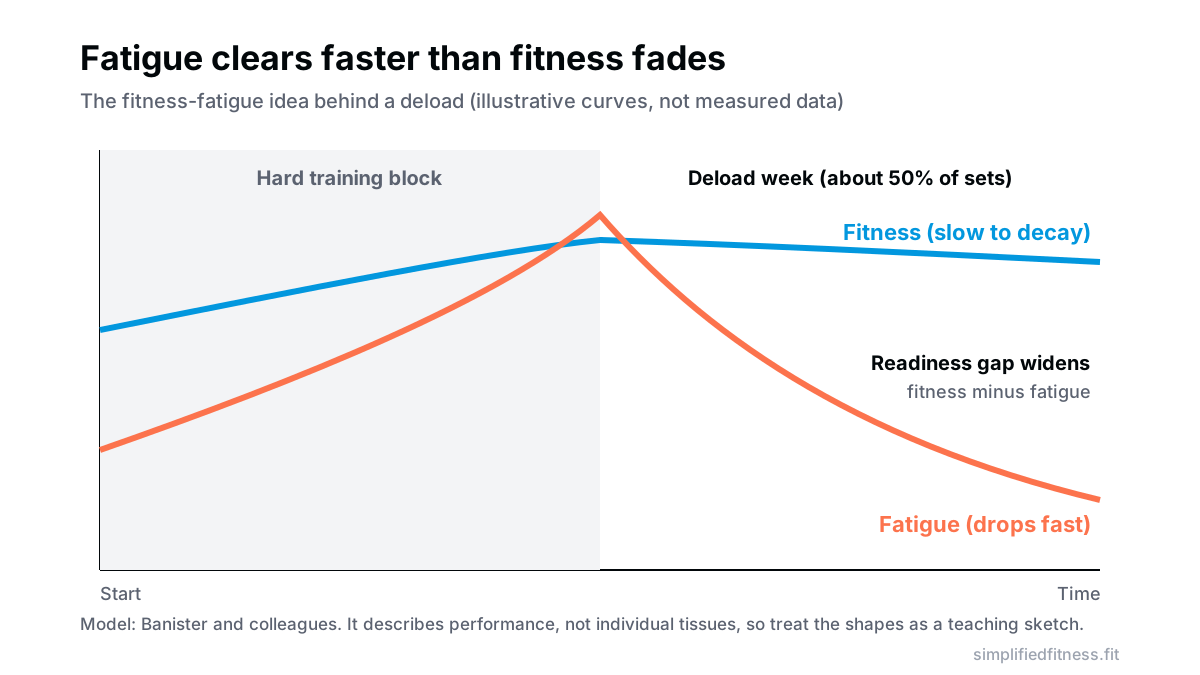
Why does this matter for you? If fatigue is hiding your fitness, a lighter week lets your real strength show. That is the textbook argument for a deload.
What actually accumulates during a hard training block?
Several things plausibly pile up. Evidence quality differs a lot between them, so here is each one with its limits.
Muscle damage and soreness. In one trial, trained college-aged men did 6 weeks of rising volume, up to 32 sets per exercise per week. Serum creatine kinase (a marker of muscle stress) and total mood disturbance were higher after the block than before, and both came back down after a deload week (Vann et al., 2021). That is real, measured fatigue clearing. It was 30 men, so it is a small signal.
Tendons and connective tissue. Tendons adapt on a different clock from muscle. In a small study of 8 people doing isometric knee extensions, muscle size and tendon stiffness only rose significantly after about 3 months of training, and during detraining they fell back to baseline within 1-2 months (Kubo et al., 2010). That tells us tissues change slowly. It does not show that a deload week repairs a sore tendon. If a joint hurts for weeks, see a physiotherapist or doctor rather than assuming a deload will fix it.
The nervous system and hormones. This is the least tested area. One study found 4 weeks of complete cessation produced only a trend toward higher resting IGF-1 in strength-trained men, and that was a month, not a week. The authors only suggest hormones such as IGF-1 may mediate part of the strength effect (Izquierdo et al., 2007). Treat “CNS fatigue” as a useful way of describing how you feel, not a measured fact in most gym settings.
Mood, sleep and motivation. These are real and easy to notice. Dragging into sessions you used to love is data.
Do you lose muscle on a deload?
Almost certainly not in any way you would notice. Three lines of evidence point the same direction.
First, the Coleman trial. Thirty-nine resistance-trained men and women did a 9-week high-volume program. One group abstained from lifting for the whole of week 5. The other trained continuously. There were no appreciable differences in lower-body muscle size, local endurance or power. The continuous group did gain more lower-body strength, and scored slightly better on a readiness-to-train questionnaire (Coleman et al., 2024).
So a full week off cost some strength progress but not size. A reduced-volume week should sit comfortably between those two.
Second, a 2026 within-person trial. Nineteen untrained young men trained each leg and arm under two conditions, continuous or with deloads at weeks 4 and 8 (once a week, 2 sets). Muscle thickness and 10-rep-max strength-endurance rose similarly in both conditions, with no significant difference between them (Pancar et al., 2026). Again, untrained people, so be cautious applying it to advanced lifters.
Third, longer reduced-training trials. Thirty-three untrained men trained for 8 weeks, then did another 8 weeks of reduced training at roughly 50-57% of the earlier volume, once or twice a week. Strength and quadriceps size were maintained. The group that stopped completely lost about 22.6% of half-squat strength and 5.4% of quadriceps cross-sectional area (Tavares et al., 2017).
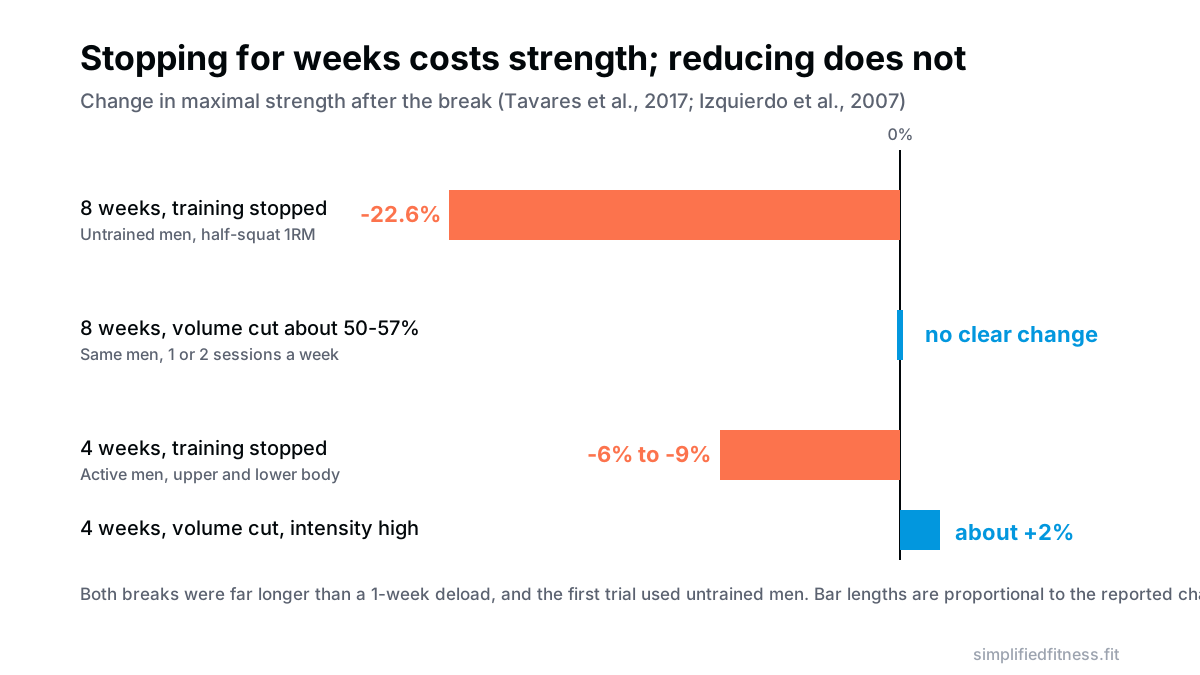
One more point from older research. Even after 32 weeks of cutting training to one-third or one-ninth of the original dose, young adults preserved the muscle growth they had built (Bickel et al., 2011). Older adults needed more, so this reassurance applies most clearly to younger people. If you are over 60, check with a coach or clinician about how much maintenance work to keep.
For the bigger picture on how little training can hold your muscle, see our guide to maintenance volume.
Does a deload actually make you grow faster?
This is where honesty matters. The popular claim is that a break “resensitizes” muscle to growth. The Coleman trial was designed around that idea, and it did not find a hypertrophy advantage. The deload group did not grow more.
So the best-supported reasons to deload are different. They are managing fatigue, protecting your joints and keeping training sustainable, rather than guaranteeing faster growth.
Another important line of evidence is tapering in athletes. A meta-analysis of 27 studies in competitive athletes found the best performance came from a 2-week taper that cut training volume progressively by 41-60% without changing intensity or frequency (Bosquet et al., 2007). Those were mostly performance outcomes in competitive athletes, not bodybuilding hypertrophy, but they support the “cut volume, keep intensity” structure.
How to deload for hypertrophy: a simple template
You do not need a complicated protocol. Use this and adjust.
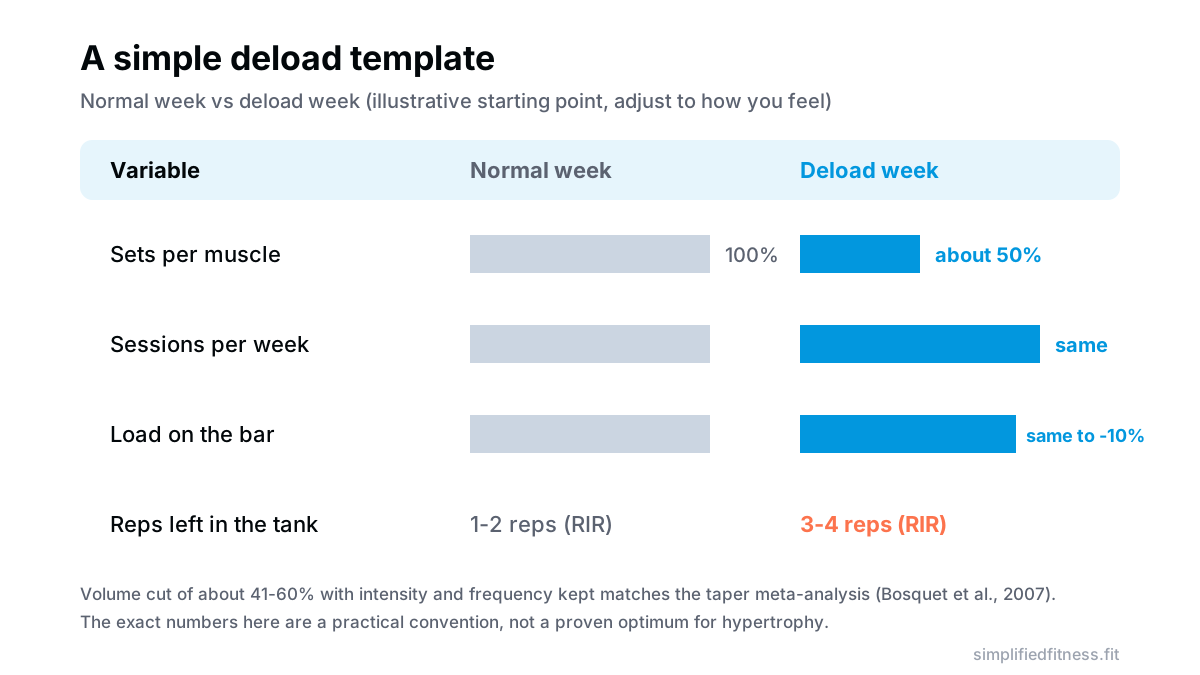
- Sets: about 50% of your normal weekly sets per muscle. If you do 16 sets of back, do 8.
- Sessions: keep the same days. It preserves the habit and the movement practice.
- Load: the same, or up to roughly 10% lighter if joints feel cranky. Surveyed athletes often lowered loads a bit, and the taper literature kept intensity, so there is room either way.
- Effort: stop 3-4 reps short of failure. Use our RIR and RPE calculator if you want numbers.
- Exercises: keep the same lifts. Learning new ones in a deload is a poor use of a recovery week.
- Length: 5-7 days, then return to normal.
To count your weekly sets before and after, our training volume calculator does the sums.
Active deload or complete rest?
Both work, and the difference seems small. In the same study that tracked mood and creatine kinase, trained men either rested completely or did about 15% of their peak training volume for a week. Muscle biopsies showed marginal molecular differences, but both approaches produced largely similar responses (Vann et al., 2021).
So pick by personality. If you hate sitting out, do the light version. If you are mentally fried or sick, take the week off.
| Approach | Best for | Watch out for |
|---|---|---|
| Half volume, same days | Most lifters, keeps routine | Temptation to push to failure |
| Very light (about 15% volume) | Heavy fatigue, sore joints | Feels too easy, still counts |
| Full week off | Illness, travel, burnout | Slight strength dip on return |
Eating and sleeping during a deload week
Do not slash calories because you are training less. A deload is a recovery week, and your body does its repair work on food and sleep. Keep protein steady, with dal, paneer, curd, eggs, chicken or soya at each meal. Keep carbohydrates from roti or rice so glycogen stays topped up. If you are in a fat-loss phase, hold your deficit rather than deepening it, and use the protein calculator to check your target.
In a hot Indian summer, sweat losses and poor sleep add to training fatigue. Water, salt with your meals and a cooler training time all help.
When a deload is not enough
A deload fixes ordinary training fatigue. It will not fix everything. If your lifts keep falling, you feel flat for weeks, your sleep is wrecked or you feel unusually low after a full lighter week, something else may be going on. That can include under-eating, illness or what coaches call non-functional overreaching. Read our guide to overreaching vs overtraining syndrome for the differences.
See a doctor if you have persistent fatigue, unexplained weight loss, chest pain, dizziness, or joint pain that lasts more than a couple of weeks. This article cannot diagnose any of those.
For how soreness itself relates to growth, see DOMS vs muscle growth, and for training on sore days, should you workout when sore.
The bottom line
A deload is a short, planned drop in training stress. The best-supported version is simple: about half your normal sets, same sessions, similar loads, 3-4 reps in reserve, for about a week.
You are very unlikely to lose muscle doing it. The evidence does not show it makes you grow faster, so think of it as insurance for your joints, mood and consistency rather than a growth hack. If you are not sure how to structure your next block, our free training plans are a good starting point.
Frequently Asked Questions
What is a deload week?
A deload week is a planned period of easier training, usually 5-7 days, where you cut volume and effort but keep training. A survey of 246 competitive strength and physique athletes found a typical deload lasted about 6.4 days and came roughly every 5.6 weeks. Treat that as a description of what people do, not proof of an ideal schedule.
Do you lose muscle on a deload week?
Very unlikely. In a trial of 39 resistance-trained men and women, one full week off at the midpoint of a 9-week program made no appreciable difference to lower-body muscle size compared with training straight through. If you keep training at half volume, you are doing even more than that, so keep your meals and protein normal.
How do I deload for hypertrophy?
Cut your weekly sets to about half, keep the same training days, keep loads similar and stop 3-4 reps short of failure. A taper meta-analysis found cutting volume by 41-60% without changing intensity or frequency worked best for performance, though that was in competitive athletes, not bodybuilders. Run it for 5-7 days and then return to your normal program.
Should I lower the weight on a deload?
You can keep it the same or drop it by up to about 10%, depending on how beaten up you feel. Heavy loads keep your nervous system practiced at producing force, while the lower set count is what reduces fatigue. If a load feels sluggish on warm-up, shave a little off rather than grinding.
How often should I deload?
There is no proven fixed interval. Surveyed athletes reported deloading about every 5-6 weeks on average, but many also deload reactively when performance stalls or joints ache. Our guide on reactive versus proactive deload schedules helps you choose between the two.
Is it better to stop training completely or reduce volume?
For most lifters, reduced training is the safer default. In untrained men, 8 weeks of stopping cost about 22.6% of half-squat strength and 5.4% of quadriceps size, while reduced training kept both. A full week off is fine for muscle size, but strength may dip slightly, as one trial in trained lifters showed.
Will I lose strength after a deload?
A little, possibly. In the 9-week trial, the group that took a week off gained slightly less lower-body strength than the continuous group. A reduced-volume week with similar loads should protect strength better than a full stop.
Do deloads really restore tendons and connective tissue?
Not proven. Tendons adapt more slowly than muscle, and one small study found tendon stiffness and muscle size both changed over months, not days. The idea that a deload week repairs tendons is plausible but untested directly, so use joint pain as a signal to adjust training and see a clinician if it persists.
Is a deload the same as a rest week with no gym?
No. A deload keeps you in the gym with lower volume, while a rest week removes training entirely. Both have been tried in studies, and in one trial active and passive recovery after a hard block produced largely similar muscle responses. Choose based on whether you want movement practice or a full mental break.
What are signs I need a deload?
Surveyed competitive athletes said they deloaded when performance stalled or when muscle soreness and joint aches built up. Coaches also watch for poor sleep and low motivation. None of these are diagnostic tests. If they continue after a deload, speak to a doctor to rule out illness, low energy intake or overtraining.
Can I deload and still eat in a calorie deficit?
Yes. Keep protein steady, for example dal, paneer, curd, eggs or soya at each meal, and avoid cutting calories further during the deload week. Your fatigue management matters more than squeezing out an extra week of training.
Is a deload necessary for beginners?
Usually not on a fixed schedule. In a 2026 trial of untrained young men, deloading at weeks 4 and 8 did not hinder muscle growth or strength-endurance, but it did not help either. Beginners tend to progress on modest volume, so a break is more often triggered by illness, travel or poor recovery.
Do I need to deload in a hot Indian summer?
Not as a rule, but heat, poor sleep and dehydration can stack on top of training fatigue. If sessions feel much harder than the numbers suggest, a lighter week is a reasonable response. Drink enough water, eat enough carbohydrate from roti or rice, and sleep as much as you can.
Sources & References
Every claim above is checked against peer-reviewed research (PubMed, U.S. National Library of Medicine) or guidance from established health bodies. How we fact-check.
- Coleman M, et al. Gaining more from doing less? The effects of a one-week deload period during supervised resistance training on muscular adaptations. PeerJ. 2024. PMID: 38274324
- Pancar Z, et al. Effects of deload periods in resistance training on muscle hypertrophy and strength endurance in untrained young men using a randomized within subject design. Sci Rep. 2026. PMID: 41730991
- Rogerson D, et al. Deloading practices in strength and physique sports: a cross-sectional survey. Sports Med Open. 2024. PMID: 38499934
- Vann CG, et al. Molecular differences in skeletal muscle after 1 week of active vs. passive recovery from high-volume resistance training. J Strength Cond Res. 2021. PMID: 34138821
- Tavares LD, et al. Effects of different strength training frequencies during reduced training period on strength and muscle cross-sectional area. Eur J Sport Sci. 2017. PMID: 28316261
- Bosquet L, et al. Effects of tapering on performance: a meta-analysis. Med Sci Sports Exerc. 2007. PMID: 17762369
- Izquierdo M, et al. Detraining and tapering effects on hormonal responses and strength performance. J Strength Cond Res. 2007. PMID: 17685721
- Bickel CS, et al. Exercise dosing to retain resistance training adaptations in young and older adults. Med Sci Sports Exerc. 2011. PMID: 21131862
- Busso T, et al. Adequacy of a systems structure in the modeling of training effects on performance. J Appl Physiol. 1991. PMID: 1761506
- Kubo K, et al. Time course of changes in muscle and tendon properties during strength training and detraining. J Strength Cond Res. 2010. PMID: 19996769

Umair Hazrami · Founder & Head Coach, Simplified Fitness
Umair Hazrami founded Simplified Fitness and the Simplified Lifter channel to cut through fitness noise. With 4+ years of consistent training and 10+ coaching clients, he writes every guide from the peer-reviewed research and links the sources so you can check them. Our editorial standards.
Educational content only, not medical advice. If you have a medical condition, are pregnant, or take medication, talk to a qualified doctor before changing your diet, supplements or training. Full disclaimer.
Keep reading

Recovery
Cold Plunge After Workout: Does an Ice Bath Blunt Muscle Growth?
Does a cold plunge after workout kill your gains? See what the lifting trials found on muscle fibre growth, strength, soreness and when cold is fine to use.
8 min read

Recovery
Ice Baths for Athletes: When Cold Water Immersion Helps at Tournaments
Ice baths for athletes can cut soreness between matches but may blunt muscle gain. See when cold water immersion is worth it and how to use it.
7 min read

Recovery
Compression Boots and Lymphatic Drainage: Do They Really Speed Recovery?
Do compression boots speed recovery or 'detox' your legs? See what pneumatic compression trials found on soreness, strength and lymph, and cheaper options.
7 min read

Recovery
Compression Garments for Lifters: Do Tights and Sleeves Really Help Recovery?
Do compression tights help recovery after lifting? Meta-analyses show small effects on soreness, swelling and strength. See what works, what doesn't, and when.
8 min read