Is Your CNS Fried? CNS Fatigue vs Plain Lethargy in the Gym
Is my CNS fried from lifting? See what central fatigue really is, how fast it recovers and how to tell it from low motivation or poor sleep. Studies linked.

TL;DR. The short answer
- True central nervous system (CNS) fatigue is a temporary drop in how fully your brain and spinal cord can activate your muscles. After brief maximal efforts the central part typically recovers within about 2 minutes.
- In ten athletes after heavy squats, fatigue took up to 72 hours to resolve, but the authors concluded it was not primarily caused by reduced CNS function.
- Feeling lazy, flat or sore after deadlifts is not proof of a 'fried CNS'. Poor sleep, under-eating, stress and accumulated training load are far more common explanations.
- The serotonin explanation of central fatigue has weak support. Current thinking points to a more complex mix of serotonin, dopamine and other signals.
- If heavy lifts stay flat for 1-2 weeks, sleep, eat and take a lighter week. If tiredness lasts for weeks with low mood or illness, see a doctor.
Part of our complete guide: Sleep, Circadian Timing & Systemic Recovery: How Lifters Maximize Anabolic Rest & CNS Recovery
Table of contents
Is my CNS fried from lifting? Almost certainly not, at least not in the way gym culture uses the phrase. Real central fatigue exists, but it is a short-lived drop in neural drive to the muscle, not a lasting “burnout” of your nervous system, and most of what lifters blame on it is poor sleep, low food intake or plain lack of motivation.
This article sits inside our guide to sleep, circadian timing and systemic recovery. Here we separate what the science calls central fatigue from the feeling of being flat after a heavy deadlift day, and what to do about each.
What does “CNS fatigue” actually mean?
Researchers split the loss of force after exercise into two parts. Peripheral fatigue is impaired muscle function. Central fatigue is a reduction in the capacity of the central nervous system to activate the muscles (Carroll et al., 2017). In lab terms this is measured as a drop in “voluntary activation”: you try your hardest, but the signal reaching the muscle is a bit weaker than it could be.
That is a narrow, measurable thing. It is not “my brain feels heavy”, “I do not want to train” or “my joints ache”. Those are real experiences, but they are not the same as reduced voluntary activation, and you cannot tell the difference by feel.
How long does CNS fatigue last after heavy lifting?
Shorter than the bro-science version suggests. A review of recovery after exercise found that after brief, high-intensity efforts there is typically a rapid restitution of force due to recovery of central fatigue, usually within about 2 minutes, with parts of peripheral fatigue recovering in 3-5 minutes. Complete muscle recovery can take some hours because of slower processes inside the muscle (Carroll et al., 2017).
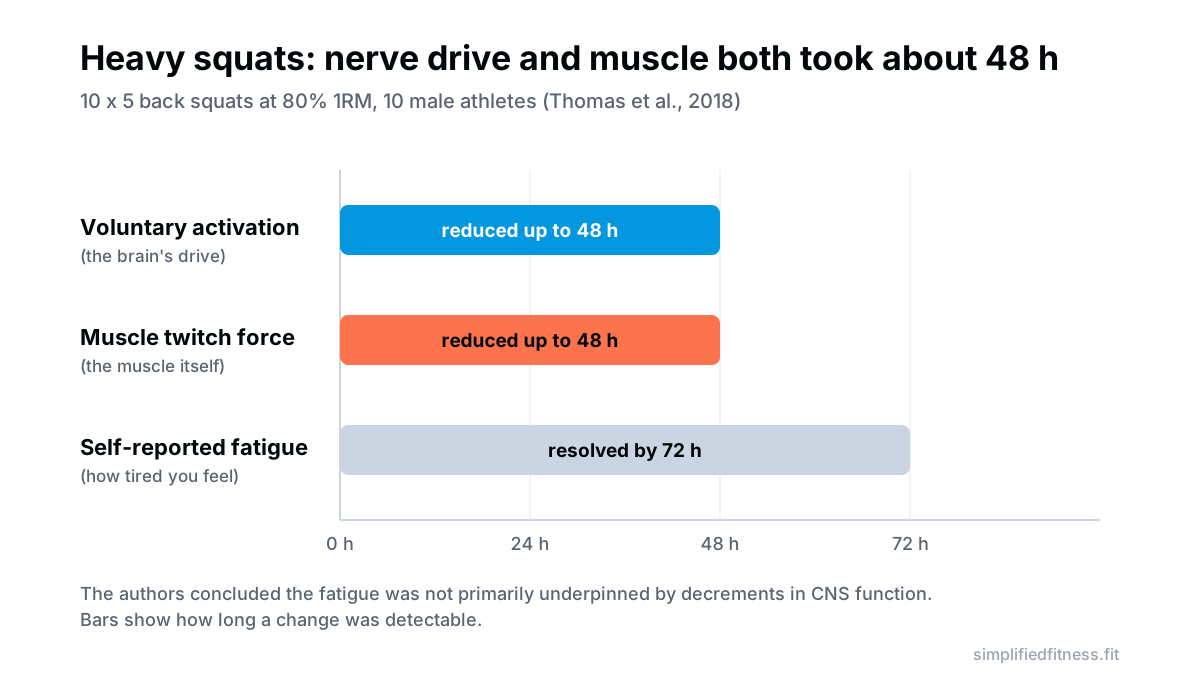
A more directly relevant test came in 2018. Ten male athletes did three maximal-effort sessions: 10 x 5 back squats at 80% of 1RM, 10 x 5 jump squats, and 15 x 30 m sprints. Nerve and brain stimulation measured function before, after, and at 24, 48 and 72 hours (Thomas et al., 2018).
- Fatigue resolved by 48 hours after jumps and by 72 hours after heavy squats and sprints.
- Muscle twitch force stayed reduced for 48 hours after all three.
- Voluntary activation was reduced for 24 hours after jumps and sprints and 48 hours after heavy squats.
- The authors concluded the fatigue was not primarily underpinned by decrements in CNS function.
The neurochemistry of CNS fatigue: what do we really know?
The old idea, the “central fatigue hypothesis”, said prolonged exercise raises serotonin in the brain, and serotonin is linked to sleep, lethargy and loss of motivation. A major review found that nutritional and drug experiments on serotonin have not yet shown a clear role for it in fatigue (Meeusen et al., 2006).
The revised view is a balance. A higher serotonin-to-dopamine ratio in the brain is associated with tiredness, and a low ratio with maintained motivation and arousal. Dopamine and noradrenaline also seem to matter for performance in the heat (Meeusen et al., 2006). For lifters in an Indian summer, that is worth noting: heat may add to fatigue through the brain as well as the muscle.
Adenosine is the other piece. In rats, caffeine infused directly into the brain extended treadmill run time to fatigue by 60%, while the same drugs given into the abdomen had no effect, which points to a brain mechanism involving adenosine receptors (Davis et al., 2003). That is animal data with brain injections, so do not read it as a human dose. In nine healthy young men, 6 mg/kg of caffeine extended time to task failure on repeated knee extensor sets by about 18%. Some measures of neural drive were higher after caffeine, but by the point of task failure they were back to placebo levels, and the authors note causality still needs testing (Bowtell et al., 2018).
The honest summary: brain chemistry plays a role in fatigue and motivation, but the field has not settled on a clean mechanism, and no supplement reliably “resets” it.
Lethargy vs CNS fatigue vs muscle fatigue
| Feeling | What it probably is | Typical timeline |
|---|---|---|
| Sore, stiff muscles 1-2 days later | Muscle damage and peripheral fatigue | 24-72 hours |
| Hard to hit max force right after a heavy set | Central plus peripheral fatigue | Minutes to hours |
| No desire to train, heavy limbs, but warm-up helps | Low motivation, sleep debt, stress | Often fixed by sleep and food |
| Flat lifts for weeks, bad mood, poor sleep | Accumulated fatigue, possibly overreaching | Weeks |
Why you may feel flat when it is not your CNS
Here are the usual suspects, in the order I would check them.
Sleep. A systematic review of 17 studies (moderate or weak quality) found that a single night of no sleep had little effect on strength, but several nights in a row of short sleep could reduce force in compound movements, not single-joint ones. The authors concluded inadequate sleep impairs maximal strength in compound lifts when nothing is done to boost motivation (Knowles et al., 2018). Sleep debt feels exactly like “fried CNS”. See our article on sleep restriction and muscle catabolism for more.
Food. Under-eating, especially low carbohydrate, makes training feel heavy. A day of dal, rice, roti and curd with enough total calories matters more than any “CNS supplement”.
Stress and life load. Exams, work deadlines and long commutes all reduce drive. They are real, but they are not CNS damage from the barbell.
Too much hard training. A few weeks of stacked high-effort sessions can leave you flat. That is accumulated fatigue, and the fix is a deload. Our deload checklist and deload science article cover it.
Why heavy deadlifts feel different from other lifts
Deadlifts are a special case in gym talk because they feel mentally heavy. You grip, brace, pull from a dead stop and the whole body is involved. That psychological load is real, and it can make you less keen to repeat the lift in two days. Feeling reluctant to pull again is information about effort and confidence, not a lab-confirmed measure of nervous system damage.
The study above used squats, not deadlifts, so we should be careful. What it does show is that even very hard, repeated maximal work did not produce a large, lasting central deficit in trained athletes. A simple read for lifters is that the heavy session itself leaves you tired in the muscle and a little reduced in neural drive for a day or two, and that this is normal.
If you are cutting calories, the picture changes. Low energy and low carbohydrate intake make heavy pulling feel worse, and that gets blamed on the CNS. Eat before training, and if you train fasted in the morning, notice whether a snack of banana and curd or poha changes how the first working set feels.
What about “CNS-heavy” and “CNS-light” exercises?
You will see lists claiming deadlifts, Olympic lifts and low-rep sets are “CNS-heavy”, while curls and machine work are “CNS-light”. The research we found does not support sorting lifts this way with confidence. The ten-athlete study found similar patterns of fatigue after heavy squats, jumps and sprints, and the nervous system was not the main driver (Thomas et al., 2018).
A more useful way to think about it is total hard effort. How many sets did you take near failure this week, how much of that was heavy and technical, and how well did you sleep? A high weekly dose of hard work from any exercise adds up. If you want to measure effort better, our RIR and RPE calculator helps you log it.
A simple self-check you can run in the gym
You cannot measure voluntary activation without lab equipment, but you can collect decent clues.
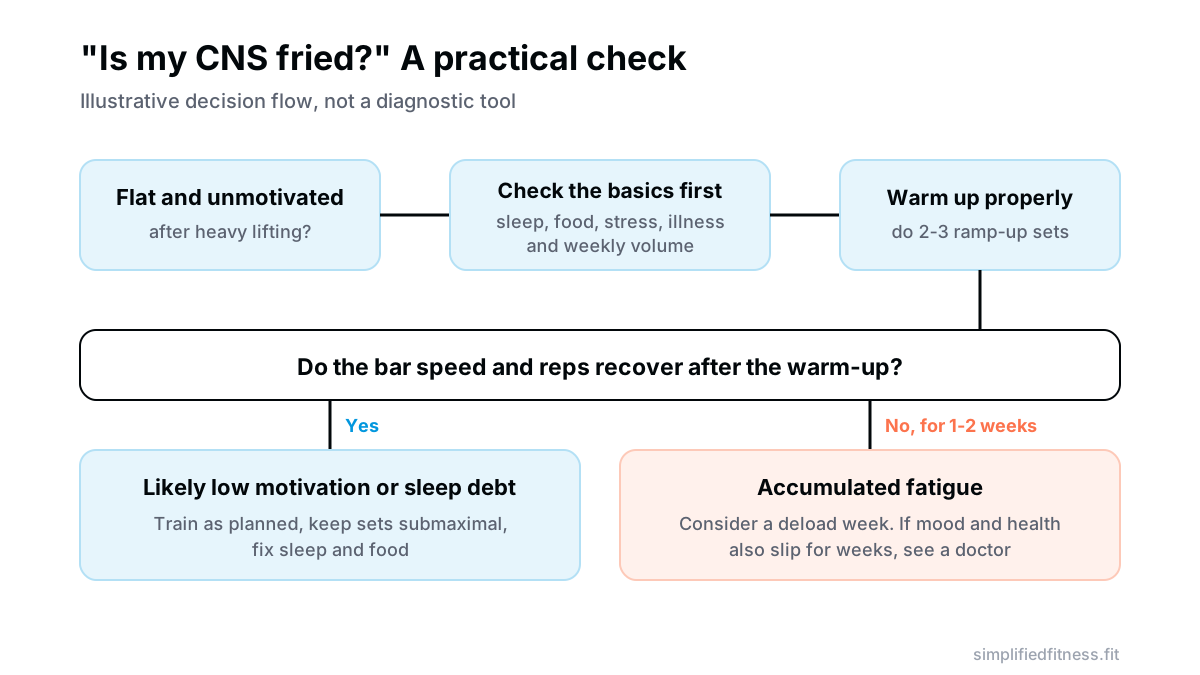
- Warm-up weights feel slow for several sessions in a row, not just one.
- Your usual working weight for your usual reps drops by a noticeable amount across a week or two.
- Mood, sleep and appetite are off at the same time.
- A rest day or two does not help, and a proper deload barely changes it.
If you tick one box, you probably need sleep or food. If you tick all four for weeks, ease off training and talk to a doctor. This is a practical checklist, not a validated test.
Overreaching and overtraining: when it is more than a bad week
The ECSS and ACSM consensus statement describes a spectrum. Functional overreaching is a short-term performance drop that improves after recovery. Non-functional overreaching and overtraining syndrome involve “prolonged maladaptation”, with fatigue, performance decline and mood disturbance. The statement says telling NFOR from overtraining syndrome is very difficult, and that no single marker is generally accepted (Meeusen et al., 2013). It also stresses excluding organic disease, infections, calorie restriction, low carbohydrate or protein intake, and iron or magnesium deficiency.
For the full picture, read overtraining syndrome vs non-functional overreaching. The practical point: weeks of unexplained fatigue is a medical question first and a training question second. Do not diagnose yourself from a gym article. See a doctor if it persists, or comes with weight loss, low mood, palpitations or frequent illness.
How to recover from “fried CNS” feelings in the gym
- Sleep first. Protect a consistent sleep window for a week. It is the lever with the best research behind it here.
- Eat enough. Hit your calories and protein. Use the protein calculator to check your daily target.
- Warm up with ramp-up sets. If bar speed and reps recover, it was likely low drive, not true fatigue.
- Stay a rep or two from failure on heavy compound lifts when you feel off. Our article on CNS vs peripheral fatigue and proximity to failure goes deeper.
- Use caffeine sensibly. It can reduce perceived fatigue. The 6 mg/kg used in the study above is a high dose (about 420 mg for a 70 kg person), so start lower, stay under about 400 mg a day from all sources, and keep it away from the evening so it does not wreck tomorrow’s sleep. Details in our afternoon caffeine cutoff guide.
- Take a lighter week if heavy lifts stay flat for 1-2 weeks, and drop volume by roughly a third to a half as a simple starting point (a coaching rule of thumb, not a research number).
The bottom line
CNS fatigue is real but narrow: a temporary dip in neural drive, mostly quick to recover. Most “fried CNS” feelings are sleep debt, low food intake, stress or accumulated training. Check those, warm up properly, and ease off for a week if needed. If tiredness lasts for weeks, see a doctor. To plan sessions that manage fatigue sensibly, start with our free training plans.
Frequently Asked Questions
Is my CNS fried from lifting?
Almost certainly not in the way gym culture means it. A study of ten athletes after heavy squats found fatigue lasted up to 72 hours but was not primarily caused by reduced central nervous system function (Thomas et al., 2018). Check sleep, food and weekly volume first, then do a proper warm-up before deciding to skip a session.
What are the symptoms of central nervous system fatigue?
True central fatigue is a reduced ability of the brain and spinal cord to fully activate your muscles, so maximal force feels harder to produce. Reviews describe it as a drop in voluntary activation that recovers quickly after brief hard efforts (Carroll et al., 2017). If you only feel unmotivated or sore, that is not enough to call it CNS fatigue.
How long does CNS fatigue last after heavy deadlifts?
Measured central fatigue after heavy lifting is short. In one study, voluntary activation was reduced for up to 48 hours after heavy squats, while after brief maximal efforts the central component typically recovers within about 2 minutes (Thomas et al., 2018; Carroll et al., 2017). Deadlifts were not tested directly, so plan your next heavy session by how you feel and perform after warming up.
Does heavy lifting fry your nervous system?
No evidence shows that normal heavy lifting damages the nervous system. Studies of heavy resistance training found the fatigue was not primarily underpinned by decrements in CNS function (Thomas et al., 2018). Keep most sets a rep or two from failure and add rest days as needed.
How do I recover a fried CNS?
The practical fix is the same as for any fatigue: sleep, enough food and a lighter week. Several nights of short sleep are linked to lower maximal strength in compound lifts (Knowles et al., 2018), so sleep is the best lever you control. Aim for consistent sleep and eat enough protein and carbohydrate (dal, rice, roti, curd) around training.
Is feeling unmotivated to train a sign of CNS fatigue?
Not by itself. Low motivation can come from poor sleep, stress, under-eating, illness or boredom, and the research on brain chemistry in fatigue is still unsettled (Meeusen et al., 2006). Start your warm-up anyway, since feeling better after 10 minutes is a good sign it was low drive, not true fatigue.
What is the serotonin hypothesis of central fatigue?
It proposed that exercise raises serotonin in the brain and causes tiredness during prolonged exercise. A major review found nutritional and drug manipulation of serotonin has not provided strong evidence for it, and suggests a serotonin-to-dopamine balance matters (Meeusen et al., 2006). Do not buy supplements claiming to fix brain serotonin for lifting.
Does caffeine help with CNS fatigue?
Caffeine can delay fatigue, partly through the brain. In rats, caffeine injected directly into the brain extended run time to fatigue, partly by blocking adenosine receptors (Davis et al., 2003), and in nine men a high 6 mg/kg dose extended time to task failure by about 18% (Bowtell et al., 2018). Most healthy adults should stay under about 400 mg a day, keep it to the morning or early afternoon, and check with a doctor first if pregnant or living with a heart condition or anxiety disorder.
Can lack of sleep mimic CNS fatigue?
Yes. A systematic review found inadequate sleep impairs maximal strength in compound movements, and the studies were of moderate or weak quality (Knowles et al., 2018). The feeling of heavy, weak lifts can therefore be sleep debt rather than overtraining. Fix sleep for a week before changing your program.
Do I need a deload if my lifts feel heavy?
Only if the heaviness persists for more than a week or two and performance drops. A single bad session is normal day-to-day variation. If it lasts, use a lighter week and see our signs you need a deload checklist.
What is the difference between CNS fatigue and overtraining syndrome?
CNS fatigue is a short-term drop in neural drive, while overtraining syndrome is prolonged maladaptation with performance decline and mood disturbance (Meeusen et al., 2013). The consensus statement notes that no single marker is generally accepted for diagnosing it. If you have weeks of unexplained fatigue, low mood or poor sleep, see a doctor.
Should I avoid deadlifting two days in a row?
There is no research proving it is necessary, but there is a practical reason to space heavy sessions. Fatigue after heavy squats took up to 72 hours to resolve, though mostly not from the CNS (Thomas et al., 2018). Space heavy pulling sessions 48-72 hours apart and watch your bar speed.
When should I see a doctor about constant tiredness?
See a doctor if fatigue lasts several weeks despite good sleep and food, or comes with weight loss, low mood, palpitations or frequent illness. Persistent fatigue has many medical causes that training changes cannot fix, such as iron deficiency or thyroid problems. Do not self-diagnose from a gym article.
Sources & References
Every claim above is checked against peer-reviewed research (PubMed, U.S. National Library of Medicine) or guidance from established health bodies. How we fact-check.
- Carroll TJ, et al. Recovery of central and peripheral neuromuscular fatigue after exercise. J Appl Physiol. 2017. PMID: 27932676
- Thomas K, et al. Neuromuscular fatigue and recovery after heavy resistance, jump, and sprint training. Med Sci Sports Exerc. 2018. PMID: 30067591
- Meeusen R, et al. Central fatigue: the serotonin hypothesis and beyond. Sports Med. 2006. PMID: 17004850
- Meeusen R, et al. Prevention, diagnosis, and treatment of the overtraining syndrome: joint consensus statement of the European College of Sport Science and the American College of Sports Medicine. Med Sci Sports Exerc. 2013. PMID: 23247672
- Knowles OE, et al. Inadequate sleep and muscle strength: implications for resistance training. J Sci Med Sport. 2018. PMID: 29422383
- Davis JM, et al. Central nervous system effects of caffeine and adenosine on fatigue. Am J Physiol Regul Integr Comp Physiol. 2003. PMID: 12399249
- Bowtell JL, et al. Improved exercise tolerance with caffeine is associated with modulation of both peripheral and central neural processes in human participants. Front Nutr. 2018. PMID: 29484298

Umair Hazrami · Founder & Head Coach, Simplified Fitness
Umair Hazrami founded Simplified Fitness and the Simplified Lifter channel to cut through fitness noise. With 4+ years of consistent training and 10+ coaching clients, he writes every guide from the peer-reviewed research and links the sources so you can check them. Our editorial standards.
Educational content only, not medical advice. If you have a medical condition, are pregnant, or take medication, talk to a qualified doctor before changing your diet, supplements or training. Full disclaimer.
Keep reading

Recovery
Active Recovery on Rest Days: Walking, Light Cycling and Mobility
Active recovery vs passive rest for lifters: what the research says about walking, light cycling and mobility, plus a 20-minute rest day routine you can copy.
7 min read
Recovery
Afternoon Caffeine Cutoff: Half-Life, Deep Sleep and Pre-Workout
Afternoon caffeine cutoff for lifters: how caffeine's half-life cuts sleep time and deep sleep even if you fall asleep fine, plus a practical cutoff by bedtime.
9 min read

Recovery
Blue Light, Melatonin and Screen Time: Do Blue-Blockers Actually Help You Sleep?
Blue light screen time melatonin suppression is real, but do blue-blocking glasses fix it? See what the trials found and the free fixes that matter more.
7 min read

Recovery
Circadian Rhythm and Strength: Why You Peak in the Late Afternoon
Circadian rhythm strength peak explained: why you lift more at 4-7 pm than at 7 am, what body temperature really does, and how to plan PR days.
8 min read