Nutrition for Muscle Soreness: Does Tart Cherry, Omega-3 or Protein Help?
Nutrition for muscle soreness, ranked by evidence: protein, tart cherry juice, omega-3 and antioxidants. See what helps DOMS, what is hype and what to skip.

TL;DR. The short answer
- Nothing you eat reliably switches off DOMS. Tart cherry juice and omega-3 give small, inconsistent reductions in soreness, and protein does not change soreness but helps strength recover.
- A 2021 meta-analysis of 14 tart cherry studies found a small soreness benefit (effect size -0.44) and a moderate strength recovery benefit (-0.78). A 2026 meta-analysis of 19 trials found no significant pooled soreness effect.
- Omega-3 reduced soreness by about 0.93 points on a 10-point scale in a 12-trial meta-analysis, below the 1.4-point change most people would notice.
- High-dose vitamin C and E supplements are a poor idea for lifters: in trained people they interfered with the cell signals for muscle growth and tentatively with strength gains.
- Enough total food and protein, plus sleep, still beat every soreness supplement. Use cherry or fish oil only as an optional extra.
Part of our complete guide: Muscle Soreness (DOMS), Heat/Cold Modalities & Recovery Methods: What Science Actually Supports
Table of contents
Nutrition for muscle soreness works at the edges, not the centre. Tart cherry juice and omega-3 fats can take a small bite out of post-workout pain for some people, protein helps your strength bounce back, and no food or supplement has been shown to switch DOMS off.
That is the honest answer, and it matters because the soreness aisle is full of confident promises. This article is one piece of our complete guide to muscle soreness, DOMS and recovery. Here we look only at what you eat and drink, and where the trade-offs sit.
What are you actually trying to fix with food?
DOMS is the dull, tender ache that peaks a day or two after unfamiliar or eccentric-heavy work, like a first week of lunges or a long downhill run. It comes from mechanical muscle damage followed by a secondary inflammatory response. If you want to know whether soreness even means you grew, read DOMS vs muscle growth.
The idea behind dietary tricks is simple. Compounds like anthocyanins in tart cherries and EPA/DHA in fish oil may dampen the secondary inflammation and oxidative stress, without the blunt “shut it all down” effect of painkillers. We cover that trade-off in NSAIDs and muscle growth.
Whether that actually works in people is the question. Let’s go through the candidates in order of how useful they tend to be.
Does total food and protein matter more than any supplement?
Yes, and it is the least exciting answer. Recovery needs raw material and energy. If you are eating far below maintenance and short on protein, no juice or capsule will fix that. Work out your target with the protein calculator and see our protein intake meta-analysis for the evidence on how much.
What does protein do for soreness itself? A 2023 meta-analysis of 29 studies (40 trials in at least one analysis) looked at protein around resistance training. It found better preservation of maximal strength at some time points (for example isometric strength at 96 hours) and lower creatine kinase, a marker of muscle damage, at 72 hours. It found no effect on muscle soreness (Pearson et al., 2023). The authors note that methods differ a lot between studies.
So protein will not make you feel less sore. It may help you regain force sooner, which is arguably the more useful outcome if you train the same muscle again in 2-3 days.
Does tart cherry juice help DOMS?
This is the best-studied option, and the evidence is a mixed bag with a hopeful lean.
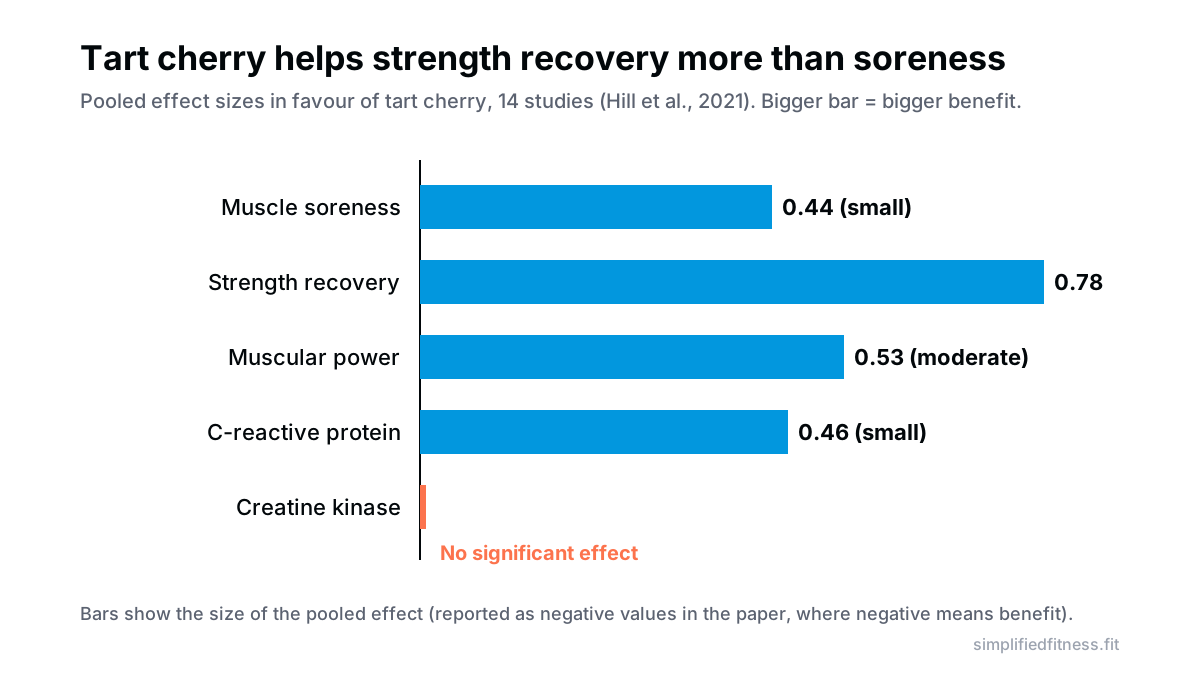
What the 2021 meta-analysis found. Pooling 14 studies, tart cherry supplementation showed a small reduction in muscle soreness (effect size -0.44, 95% CI -0.87 to -0.02), a moderate benefit for strength recovery (-0.78), and benefits for power, including jump height. It also lowered C-reactive protein and interleukin-6 slightly. Creatine kinase did not change significantly (Hill et al., 2021).
What the 2026 meta-analysis found. A newer analysis of 19 trials in athletes found improved maximal voluntary contraction recovery and lower CRP, but no significant pooled effects on muscle soreness, CK, IL-6, TNF-alpha or range of motion. Certainty of evidence ranged from very low to moderate, and several results depended on individual studies (Daab et al., 2026).
Why they may differ. Different studies, different exercise types (whole-body versus isolated muscle protocols), different juice or powder products and timing, and high heterogeneity between trials. Both reviews agree on the more consistent signal: strength tends to come back faster, while the soreness effect is smaller and less reliable.
For a deeper look at the juice itself, our tart cherry juice article goes into more detail.
How would you use it?
A literature review in athletes reports that most studies used 8-12 oz (about 240-350 ml) of juice twice a day, or 1 oz (30 ml) of concentrate, with a 4-5 day loading phase before the event and 2-3 days after. It also says timing and dose vary widely (Vitale et al., 2017). There is no proven ideal protocol.
The same review suggests tart cherry may not be optimal during the build phase of training, because the priority there is adaptation, not speed of recovery. It may make more sense in a competition week, a multi-day event or a brutal training camp. Note that this is a reasoned caution from a review, not a finding from a growth trial.
Does omega-3 help muscle soreness?
Omega-3 fats (EPA and DHA) are built into cell membranes and are involved in producing molecules that help resolve inflammation. That is the theory. The human data are less impressive.
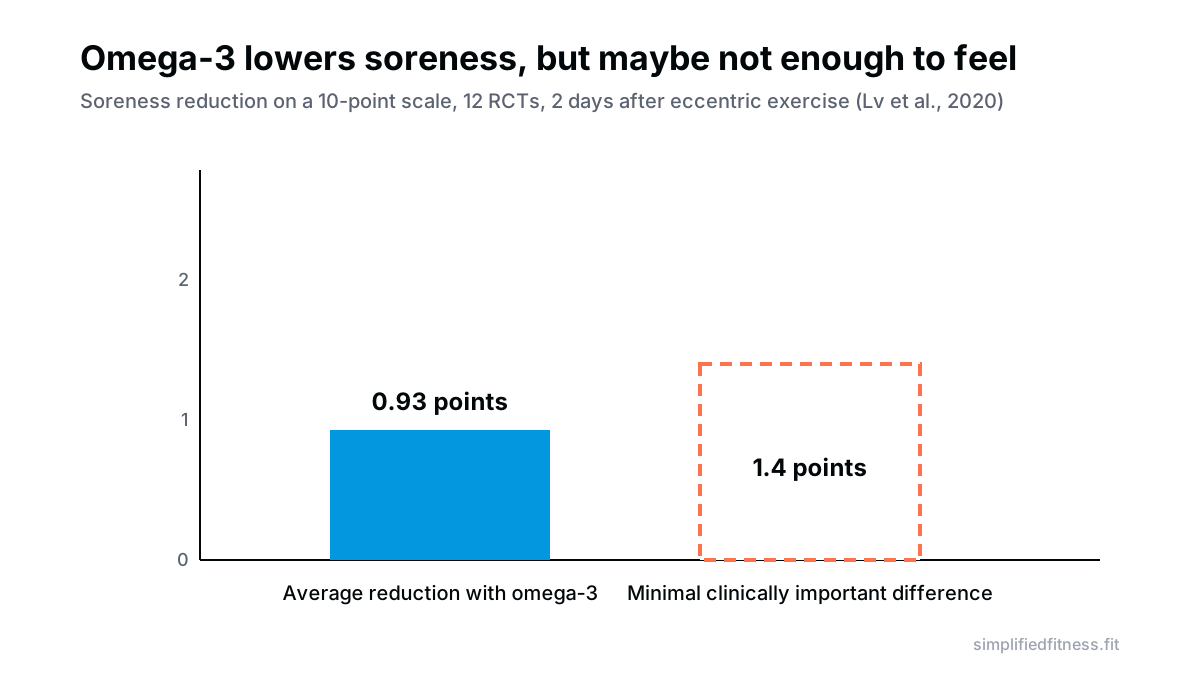
A 2020 meta-analysis of 12 randomized trials (145 people on omega-3, 156 controls) found a statistically significant reduction in soreness measured two days after eccentric exercise: a mean difference of -0.93 on a 10-point scale. But that is below the 1.4-point minimal clinically important difference, and the authors judged the evidence low quality and not clinically important. Strength and range of motion did not improve (Lv et al., 2020).
Individual trials disagree too. In 14 healthy men, 3 g/day of omega-3 for 4 weeks was followed by less soreness at 24 hours after a downhill run, though creatine kinase, strength and TNF-alpha did not differ between groups (Kyriakidou et al., 2021). In 16 moderately trained young men, 5 g/day of fish oil for 4 weeks did not improve soreness, muscle damage, inflammation or function after eccentric exercise (Mackay et al., 2023). Both trials were tiny, in young men only.
A reasonable reading: omega-3 might shave a little off soreness for some people, and it is unlikely to transform recovery. Its better case is general health if you rarely eat fish. For doses and food sources, see our omega-3 guide for muscle.
If you eat fish, sardines and mackerel are the usual high-omega-3 choices. If you are vegetarian, walnuts and flax seeds supply a plant omega-3, but they are not the same as EPA and DHA from fish or algae oil, so do not assume equal effects on soreness.
Should you take antioxidants like vitamin C and E?
This is where “more” can backfire. Because exercise creates oxidative stress, many assume antioxidant pills will speed recovery. The evidence in lifters points the other way.
In a 10-week randomized trial, 32 recreationally strength-trained men and women took 1000 mg vitamin C plus 235 mg vitamin E daily or a placebo while training heavily four times a week. Overall muscle mass gains were not affected, but the supplements blunted the increase in growth-related signalling after a session and hampered some strength gains (biceps curl). The authors concluded the supplements interfered with the acute cellular response and had tentative negative long-term effects on strength adaptation (Paulsen et al., 2014).
That is one trial in recreationally trained adults, so it is not the last word. Still, nothing in it suggests high-dose antioxidants are worth the risk if you want to build muscle. Fruit, vegetables and nuts supply antioxidants in normal food amounts, which is a different thing from 1000 mg pills.
How do the options compare?
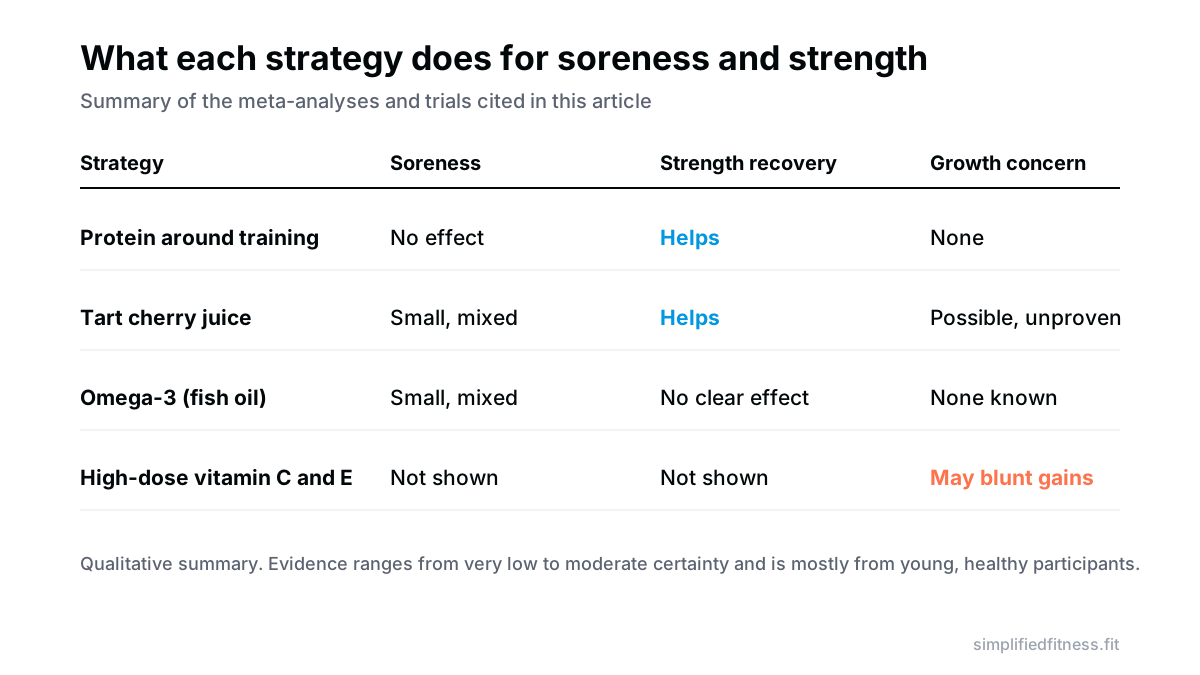
| Strategy | Soreness | Strength recovery | Practical note |
|---|---|---|---|
| Protein around training | No effect found | Helps at some time points | Cheapest, already part of good nutrition |
| Tart cherry juice | Small, inconsistent | Moderate benefit | Short, targeted use; adds sugar |
| Omega-3 | Small, below clinical threshold | No clear effect | Better as a general health habit |
| High-dose vitamin C and E | Not shown to help | Not shown to help | May blunt adaptation |
What should you eat in practice on an Indian budget?
You do not need imported products. A heavy leg day dinner of dal, rice, curd and paneer, or eggs, chicken or fish, covers the protein and energy recovery actually needs. Add a fruit portion and some vegetables, and keep up your fluids, especially in hot weather when you sweat more.
Soya chunks are an inexpensive protein option for vegetarians, and curd works as a simple post-workout side. If you want to test tart cherry, buy one bottle of juice or concentrate for a hard week, not a monthly stockpile. Our free diet plan shows how to lay out protein across the day on a budget.
Two non-food notes. Sleep also plays a role in how sore you feel; see sleep deprivation and soreness. And if you keep getting wrecked by every workout, the bigger fix is usually progression: the repeated bout effect means your muscles protect themselves after a first exposure.
When should you see a doctor?
Ordinary DOMS is annoying but safe. See a doctor if you have severe pain with marked swelling, dark brown or cola-coloured urine, extreme weakness, or soreness that does not improve after about a week. These can point to a condition such as rhabdomyolysis, which needs medical care. Do not use supplements to treat it. If you have kidney disease, take blood thinners or other medication, or are pregnant, check with your doctor before adding fish oil, antioxidants or large amounts of juice.
The bottom line
Nutrition for muscle soreness is mostly about the basics: enough food, enough protein, enough sleep. Protein supports strength recovery, tart cherry may add a modest bit on top (mostly for strength, less reliably for soreness), omega-3 has a small effect that may not be noticeable, and high-dose vitamin C and E is best skipped while you are trying to grow.
Most of the evidence comes from young, healthy people over short periods, and the trials are small and often disagree. If you try cherry juice or fish oil, run it as a personal experiment and be ready to drop it if nothing changes.
Frequently Asked Questions
What foods reduce muscle soreness?
No food has been shown to remove soreness, but a few may take the edge off. Tart cherry juice and fatty fish (omega-3) have the most research, and the effects are small to modest. Build your meals around enough protein and total calories first, then treat these as extras.
Does tart cherry juice help DOMS?
It might help a little. A 2021 meta-analysis found a small reduction in soreness, but a 2026 meta-analysis found no significant pooled soreness effect, while both suggest better strength recovery. If you want to try it, use it around hard blocks or competitions rather than all year.
How much tart cherry juice should I drink for muscle recovery?
A literature review reports that most studies used 8-12 oz (about 240-350 ml) of juice twice a day, or about 1 oz (30 ml) of concentrate, starting 4-5 days before the event and continuing 2-3 days after. Doses and timing vary widely between studies, so there is no proven optimum. Check the label and sugar content, since juice adds calories.
Does omega-3 reduce muscle soreness?
Slightly, at best. A meta-analysis of 12 randomized trials found about 0.93 points less soreness on a 10-point scale, which is below the 1.4-point change considered clinically meaningful. Some trials found nothing at all, so do not expect a big difference.
Does protein help with sore muscles?
Protein does not reliably reduce the feeling of soreness. A meta-analysis of 29 studies found no effect on soreness, but it did find better maintenance of strength and lower creatine kinase at some time points after resistance training. Eat protein across the day anyway, because that is what supports repair and growth.
Can supplements stop DOMS completely?
No. DOMS is a normal response to unfamiliar or eccentric-heavy training, and no supplement has been shown to prevent it. The best protection is gradual progression, which triggers the repeated bout effect. Add volume slowly and let your body adapt.
Do antioxidants like vitamin C and E reduce soreness?
They are not a good bet for lifters. In a 10-week trial of 32 recreationally trained people, 1000 mg vitamin C plus 235 mg vitamin E did not change muscle growth overall but blunted growth-related cell signalling and some strength gains. Get antioxidants from fruit and vegetables rather than high-dose pills.
Will tart cherry juice hurt my muscle gains?
There is no direct evidence that it does, but it has not been well tested for growth. A review suggests tart cherry may not be ideal during the build phase of training, when adaptation rather than rapid recovery is the goal. Keep it for periods when you need to bounce back fast.
Is fish oil worth it for lifters?
For soreness alone, probably not. Trials are mixed: one 4-week study using 5 g/day of fish oil found no benefit for soreness or muscle damage in trained young men, while another using 3 g/day of omega-3 found less soreness at 24 hours. If you rarely eat fish, it may be worth it for general health instead.
What should I eat after a heavy leg day?
Eat a normal protein-rich meal with carbohydrates, for example dal, rice, curd and paneer or chicken. This restores energy and gives your muscles the amino acids they need. Starting with a regular meal beats any single recovery product.
Should I take ibuprofen instead of supplements for DOMS?
Painkillers are a separate question with their own trade-offs for muscle growth. They are not a nutrition strategy, and regular use carries its own risks. Read our full breakdown before reaching for them.
When should I see a doctor about muscle soreness?
See a doctor if pain is severe, swelling is marked, your urine turns dark brown or cola-coloured, or soreness lasts longer than about a week. These can be signs of something more serious than ordinary DOMS, such as rhabdomyolysis. Do not try to fix them with supplements.
Sources & References
Every claim above is checked against peer-reviewed research (PubMed, U.S. National Library of Medicine) or guidance from established health bodies. How we fact-check.
- Vitale KC, et al. Tart Cherry Juice in Athletes: A Literature Review and Commentary. Curr Sports Med Rep. 2017. PMID: 28696985
- Hill JA, et al. Tart Cherry Supplementation and Recovery From Strenuous Exercise: A Systematic Review and Meta-Analysis. Int J Sport Nutr Exerc Metab. 2021. PMID: 33440334
- Daab W, et al. Effects of Tart Cherry Juice Supplementation on Recovery from Exercise-Induced Muscle Damage in Athletes: A Systematic Review and Meta-Analysis. Sports Med Open. 2026. PMID: 41945263
- Lv ZT, et al. Omega-3 Polyunsaturated Fatty Acid Supplementation for Reducing Muscle Soreness after Eccentric Exercise: A Systematic Review and Meta-Analysis of Randomized Controlled Trials. Biomed Res Int. 2020. PMID: 32382573
- Mackay J, et al. Fish oil supplementation fails to modulate indices of muscle damage and muscle repair during acute recovery from eccentric exercise in trained young males. Eur J Sport Sci. 2023. PMID: 37010103
- Kyriakidou Y, et al. The effect of Omega-3 polyunsaturated fatty acid supplementation on exercise-induced muscle damage. J Int Soc Sports Nutr. 2021. PMID: 33441158
- Pearson AG, et al. The impact of dietary protein supplementation on recovery from resistance exercise-induced muscle damage: A systematic review with meta-analysis. Eur J Clin Nutr. 2023. PMID: 36513777
- Paulsen G, et al. Vitamin C and E supplementation alters protein signalling after a strength training session, but not muscle growth during 10 weeks of training. J Physiol. 2014. PMID: 25384788

Umair Hazrami · Founder & Head Coach, Simplified Fitness
Umair Hazrami founded Simplified Fitness and the Simplified Lifter channel to cut through fitness noise. With 4+ years of consistent training and 10+ coaching clients, he writes every guide from the peer-reviewed research and links the sources so you can check them. Our editorial standards.
Educational content only, not medical advice. If you have a medical condition, are pregnant, or take medication, talk to a qualified doctor before changing your diet, supplements or training. Full disclaimer.
Keep reading

Recovery
Cold Plunge After Workout: Does an Ice Bath Blunt Muscle Growth?
Does a cold plunge after workout kill your gains? See what the lifting trials found on muscle fibre growth, strength, soreness and when cold is fine to use.
8 min read

Recovery
Ice Baths for Athletes: When Cold Water Immersion Helps at Tournaments
Ice baths for athletes can cut soreness between matches but may blunt muscle gain. See when cold water immersion is worth it and how to use it.
7 min read

Recovery
Compression Boots and Lymphatic Drainage: Do They Really Speed Recovery?
Do compression boots speed recovery or 'detox' your legs? See what pneumatic compression trials found on soreness, strength and lymph, and cheaper options.
7 min read

Recovery
Compression Garments for Lifters: Do Tights and Sleeves Really Help Recovery?
Do compression tights help recovery after lifting? Meta-analyses show small effects on soreness, swelling and strength. See what works, what doesn't, and when.
8 min read