Does Ibuprofen Kill Muscle Growth? What the Human Trials Show
Does ibuprofen muscle growth blunting happen at normal doses? See what human trials found on daily high doses, satellite cells, older adults and occasional use.

TL;DR. The short answer
- Taking the maximal over-the-counter dose of ibuprofen (1200 mg a day) for 8 weeks of leg training led to about half the thigh muscle growth of a low-dose aspirin group in young adults (3.7% vs 7.5%).
- The popular claim that ibuprofen blocks satellite cells in humans is not confirmed. The follow-up biopsy analysis of the same trial found no group difference in satellite cell content, so the mechanism is still unexplained.
- In older adults, one 12-week trial found ibuprofen or paracetamol did not blunt gains and may have enhanced them. It is a single small study, so treat it as interesting rather than settled.
- An occasional dose for a bad day of soreness or a headache is unlikely to matter for muscle growth, according to a review of the literature. The concern is daily, high-dose, long-term use.
- If you need painkillers regularly to train, the pain is the problem to solve. See a doctor, especially for joint pain, swelling or pain that lingers.
Part of our complete guide: Muscle Soreness (DOMS), Heat/Cold Modalities & Recovery Methods: What Science Actually Supports
Table of contents
Does ibuprofen muscle growth blunting really happen? Based on the best human trial we have, daily maximal doses (1200 mg a day) can reduce muscle growth in young lifters, while an occasional dose for a headache or a rough leg day is very unlikely to matter. The mechanism is less certain than gym lore suggests.
This is one piece of our complete guide to muscle soreness, DOMS and recovery. Here we stick to the pharmacology: what the drugs do, what the studies found, and how to use painkillers without feeling guilty or kidding yourself.
Why would a painkiller affect muscle growth at all?
Hard training causes small amounts of muscle damage and a local inflammatory response. That response is not just a nuisance. Part of it signals repair and remodelling.
Ibuprofen, naproxen, diclofenac and aspirin are NSAIDs. They work by blocking cyclooxygenase (COX) enzymes, which make prostaglandins, chemical messengers involved in pain, swelling and fever. Prostaglandins also show up in exercising muscle. A 2013 review notes that muscle makes them during and after exercise and that they influence muscle protein turnover (Trappe and Liu, 2013).
That gives a plausible story: block COX, dampen prostaglandins, dampen the repair signal, get less growth. A plausible story is not a proven one, which is why the human trials matter.
The cell-level evidence: satellite cells and COX
Satellite cells are the muscle stem cells that help repair fibres and add new nuclei when muscle grows. In one cell-culture study, researchers grew satellite cells from 9-month-old rats and exposed them to COX inhibitors for 96 hours. Blocking COX-2 alone reduced satellite cell proliferation, and blocking both COX-1 and COX-2 reduced differentiation and fusion (Mendias et al., 2004).
That is the origin of “NSAIDs kill your satellite cells.” It is rat cells in a dish, though, at drug exposures that do not map neatly onto a tablet swallowed by a person.
What the Karolinska trial found: 1200 mg ibuprofen vs 75 mg aspirin
This is the trial everyone cites. Researchers randomised 31 healthy men and women aged 18-35 to take either 1200 mg of ibuprofen or 75 mg of aspirin every day for 8 weeks of supervised knee-extension training (Lilja et al., 2018).
Results:
- Quadriceps volume (by MRI) rose 7.5% in the aspirin group and 3.7% in the ibuprofen group, a difference of 34 cm3.
- With conventional weight-stack training, strength improved similarly in both groups (11-20%).
- With the flywheel leg, which was trained with maximal effort on every rep, strength gains were generally greater in the aspirin group.
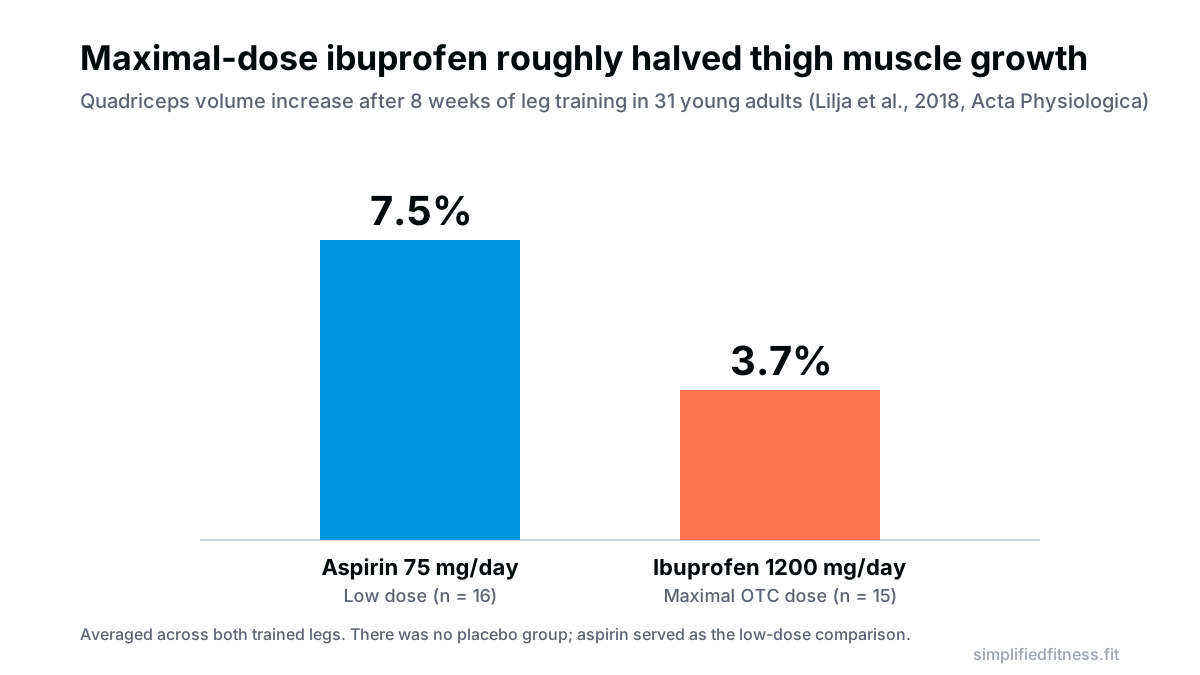
The authors concluded that young people training to maximise growth or strength should avoid excessive intake of anti-inflammatory drugs.
Two caveats are worth knowing. First, the comparison was ibuprofen versus low-dose aspirin, not versus a placebo. Aspirin at 75 mg is a low dose chosen as the comparison, but it is still a COX-inhibiting drug, not a true no-drug group. Second, this is one trial of about 15 people per group. It is good evidence, but not a final verdict.
Does ibuprofen really blunt satellite cells in humans?
Here is where the headline version of the story falls apart. The same Karolinska team took muscle biopsies from those lifters and looked closely. They found that satellite cell content, myonuclear accretion, muscle fibre size, capillarization, mTOR signalling and ribosome biogenesis were not differentially affected between the ibuprofen and aspirin groups (Lilja et al., 2023). Total RNA content, a marker of ribosome building, rose by about 14% in both.
There is a catch in reading this as proof that satellite cells are irrelevant. In this analysis, fibre size, satellite cell content and myonuclear number did not change with training in either group, even though whole-muscle volume grew. A measure that did not move with training at all is a weak test of whether a drug blunts it.
The authors say these established hypertrophy regulators do not explain the harm seen with ibuprofen. In other words, ibuprofen apparently blunted growth in this trial, but not by the satellite cell route that most articles assume.
This is how conflicting studies fit together. The dish studies say COX matters for satellite cells. The human biopsy study measured satellite cell content after 8 weeks and found no difference. They may differ because of dose, timing (biopsies at set time points can miss short-lived changes), species, or because the drugs act through some pathway nobody has measured yet.
Acute effects: what happens after a single hard session
Before the long trials, there was a short-term study. In 24 young men, a single session of 10-14 sets of 10 heavy eccentric knee extensions was followed by 1200 mg a day of ibuprofen, 4000 mg a day of paracetamol, or placebo. Over the following 24 hours, muscle protein synthesis rose 76% in the placebo group but was not significantly raised in either drug group. Neither drug changed soreness ratings or creatine kinase (Trappe et al., 2002).
Two takeaways. Protein synthesis is a short-term marker, not proof of long-term growth. And the drugs did nothing noticeable for soreness here, which weakens the case for taking them after training in the first place. For more on what soreness actually tells you, see DOMS vs muscle growth.
Are older adults affected differently?
Possibly, and the result runs the other way. In a double-blind trial, 36 adults (average ages 64-67) did 12 weeks of knee-extensor training while taking placebo, paracetamol (4 g a day) or ibuprofen (1.2 g a day). Both drug groups gained more muscle volume (12.5% paracetamol, 10.9% ibuprofen) than placebo (8.6%), and more strength too (Trappe et al., 2011). The authors called this unexpected.
A separate study looked at older men with slightly raised systemic inflammation (CRP above 2 mg/l). After one week of 1800 mg a day of ibuprofen versus placebo, there was no significant difference in how muscle protein synthesis responded to whey protein and resistance exercise (Dideriksen et al., 2016).
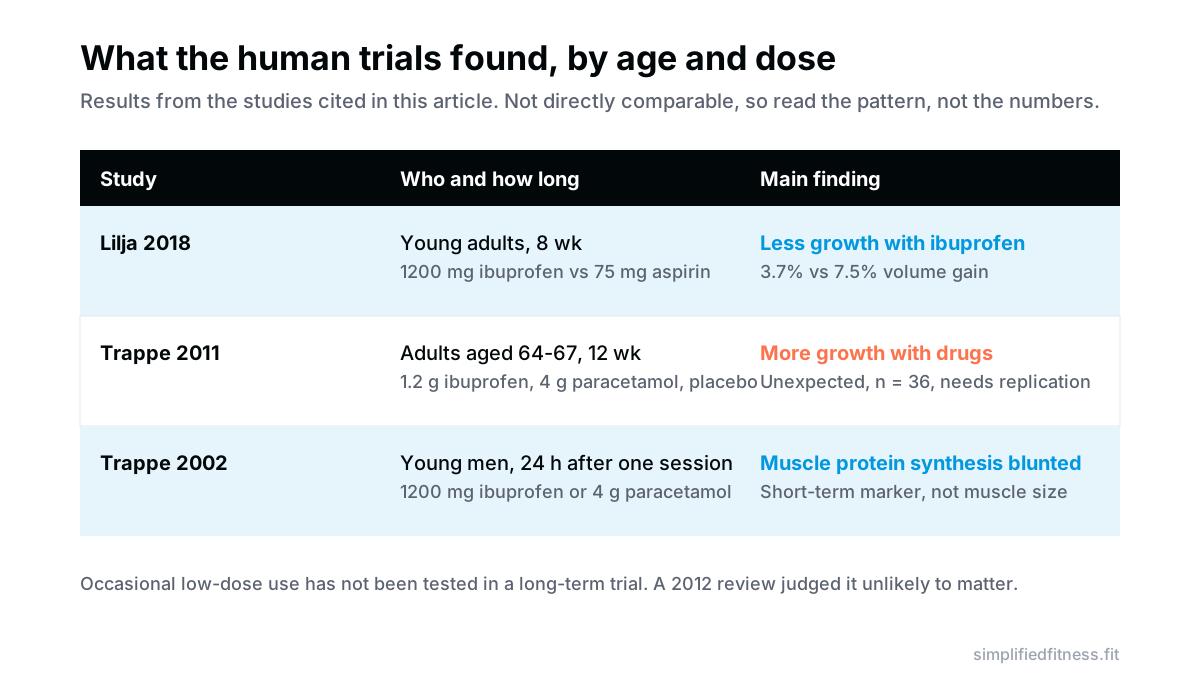
Why might older people respond differently? One idea is that chronic low-grade inflammation in ageing muscle may itself hold back growth, so dampening it could help. That is a hypothesis, not a finding, and the Dideriksen trial did not support it for protein synthesis. With only a few small trials, nobody should read this as a recommendation for older lifters to take NSAIDs. These drugs carry kidney, stomach and heart risks, and that decision belongs to a doctor.
Does occasional ibuprofen use matter?
The best summary is a review of the NSAID and muscle damage literature. Its author concluded there is little reason to believe occasional NSAID use will negatively affect muscle growth, that regular use looked harmless in the short term for untrained people, and that longer-term use may be more concerning, particularly for people with greater growth potential (Schoenfeld, 2012). It also questioned whether NSAIDs even help with exercise-related symptoms.
Note that this review is from 2012, before the Karolinska trial, and it is cautious about the evidence on chronic use. The newer trial leans toward the “chronic high dose may hurt” side, but still in a small sample.
No trial has tested one 400 mg tablet after a hard leg day. So what follows is an inference, not a proven rule.
So how should lifters think about painkillers?
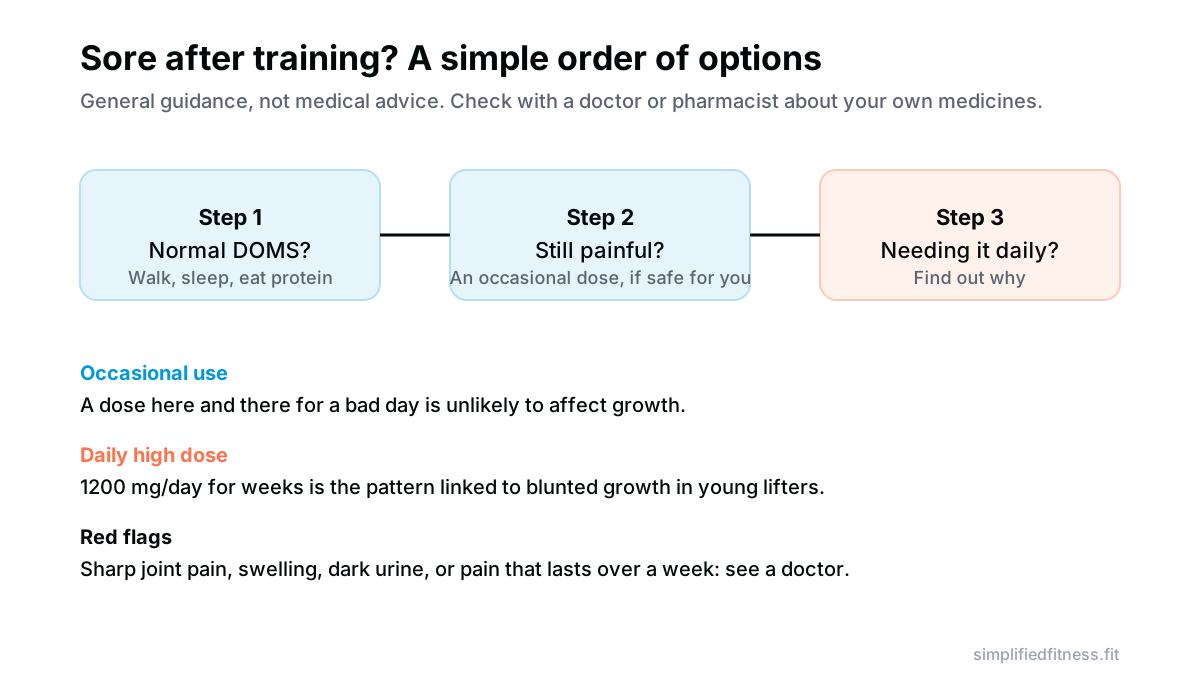
A practical approach, not medical advice:
- Treat normal soreness without drugs first. Walk, sleep properly, eat enough protein and calories. Soreness fades in days and gets milder as you adapt, which we cover in the repeated bout effect.
- An occasional dose is a reasonable call. A fever, a headache, or one unbearable day is not a threat to your physique.
- Avoid making it a daily habit. The pattern linked to blunted growth was maximal doses every day for weeks, in young lifters.
- Do not take it before training to push through pain. Pain is information. Numbing a sore knee or shoulder can let you make a small injury worse.
- Stay within the label. Do not go above the daily maximum on the pack, and do not combine two products that contain the same drug.
- Mind the other risks. NSAIDs can irritate the stomach and affect the kidneys, and they are not for everyone. People with kidney, heart or stomach conditions, those on blood thinners, and pregnant women should ask a doctor or pharmacist first.
Indian context: what is in your pharmacy tablet
Many people in India reach for over-the-counter combination tablets and do not know what is inside. Combiflam, for example, combines ibuprofen with paracetamol, and many other brands carry NSAIDs or paracetamol. Check the label for the active ingredient so you know whether you are taking an NSAID, and do not double up on brands. If you are on regular medication or have a stomach or kidney condition, ask your doctor or pharmacist. In hot weather, with heavy sweating and poor hydration, be especially careful with NSAIDs and the kidneys.
Non-drug options that fit a real routine
If your aim is to feel less beaten up, these are cheap and available:
- A walk of 20-30 minutes on rest days.
- Seven to nine hours of sleep. Poor sleep makes pain feel worse, as covered in our article on sleep loss and soreness.
- Enough protein. Dal, curd, paneer, eggs and soya all help. Use our protein calculator to get a daily target.
- Smarter progression: add load and volume gradually rather than jumping a lot in one week.
Heat and cold have their own trade-offs for growth. See cold plunges and hypertrophy, and for natural food-based options see curcumin and turmeric for recovery. If you are unsure whether to train at all while sore, our guide on training when sore helps. And if you want a structure that manages weekly volume sensibly, start with our free training plans.
The bottom line
The best human evidence says maximal-dose ibuprofen taken daily for weeks can blunt muscle growth in young lifters, with thigh growth at roughly half that of a low-dose aspirin group. The popular satellite cell explanation did not hold up in the same trial’s biopsies. Older adults may respond differently, but the data is thin. Occasional use is very unlikely to be a problem.
Use pills for real medical needs, not as a routine part of training. If pain is limiting your lifting, see a doctor or physiotherapist rather than covering it up.
Frequently Asked Questions
Does ibuprofen stop muscle growth?
Not at occasional doses, but daily maximal doses may reduce it in young lifters. In an 8-week trial, 1200 mg of ibuprofen a day led to 3.7% quadriceps growth versus 7.5% with 75 mg of aspirin. If you only take it now and then, there is little reason to worry.
Is it bad to take Advil after a workout?
A single dose after a brutal session is unlikely to hurt your gains. The trials that showed a problem involved 1200 mg every day for weeks, and a review concluded that occasional use should not affect growth. Use the lowest dose that works, and try walking, sleep and a protein-rich meal first.
Do NSAIDs affect satellite cells in humans?
Cell and animal studies suggest they can, but human data is not clear. A rat cell study found that blocking COX-2 reduced satellite cell proliferation, yet a human biopsy study found no difference in satellite cell content between ibuprofen and aspirin groups. The honest answer is that the human mechanism is unknown.
How much ibuprofen is too much for muscle growth?
The only dose clearly linked to blunted growth is the maximal over-the-counter amount, 1200 mg a day, taken daily for 8 weeks. No trial has pinned down a safe threshold below that. Keep it to occasional use and follow the label or your doctor's advice.
Is paracetamol (acetaminophen) better than ibuprofen for lifters?
It may be no better for muscle growth in the short term. A study in young men found that both ibuprofen and 4000 mg of paracetamol suppressed the muscle protein synthesis response 24 hours after hard eccentric exercise. Paracetamol is not an anti-inflammatory like ibuprofen. The 4000 mg used in research is the usual adult daily maximum, and going above the label dose can damage the liver.
Do NSAIDs reduce muscle soreness?
The evidence is weak. In the 2002 study, neither ibuprofen nor paracetamol changed perceived soreness or creatine kinase compared with placebo after hard eccentric training. If painkillers do not clearly help soreness, there is even less reason to take them routinely.
Do NSAIDs affect older adults differently?
Possibly. In a double-blind trial of 36 adults aged about 64-67, 12 weeks of ibuprofen (1.2 g a day) or paracetamol (4 g a day) alongside training produced more muscle volume and strength gain than placebo. It is one small trial, so older lifters should not treat it as a reason to use these drugs without medical guidance.
Does aspirin affect muscle growth?
Low-dose aspirin (75 mg a day) was the comparison group in the Karolinska trials, and those lifters grew more than the ibuprofen group. There was no placebo arm, so we cannot say aspirin has zero effect. It is also not a free pass, because aspirin has its own risks such as bleeding.
Should I take ibuprofen before training?
It is best avoided as routine prep. NSAIDs can mask pain that tells you a joint or tendon is in trouble, and the research gives no evidence that they improve training results. If something hurts enough to need a pill before you lift, get it checked.
What can I use instead of painkillers for sore muscles?
Easy movement, enough sleep, adequate protein and calories, and sensible progression do most of the work, because soreness fades naturally within a few days. Soreness also drops with repeated training. Our guide to the repeated bout effect explains why the same workout hurts less each time.
Do topical NSAID gels affect muscle growth?
There is no good evidence on this question. The trials covered oral doses that reach the whole body, and gels deliver much less drug to the bloodstream. If you want to use one on a sore joint, talk to a pharmacist about proper use.
When should I see a doctor about pain after training?
See a doctor for sharp or worsening joint pain, visible swelling, dark brown urine, weakness, or soreness that has not eased after about a week. These are not normal DOMS and need assessment. Also check before using NSAIDs if you have kidney, stomach or heart problems, or take blood thinners.
Sources & References
Every claim above is checked against peer-reviewed research (PubMed, U.S. National Library of Medicine) or guidance from established health bodies. How we fact-check.
- Lilja M, et al. High doses of anti-inflammatory drugs compromise muscle strength and hypertrophic adaptations to resistance training in young adults. Acta Physiol (Oxf). 2018. PMID: 28834248
- Lilja M, et al. Limited effect of over-the-counter doses of ibuprofen on mechanisms regulating muscle hypertrophy during resistance training in young adults. J Appl Physiol. 2023. PMID: 36794689
- Trappe TA, et al. Influence of acetaminophen and ibuprofen on skeletal muscle adaptations to resistance exercise in older adults. Am J Physiol Regul Integr Comp Physiol. 2011. PMID: 21160058
- Trappe TA, et al. Effect of ibuprofen and acetaminophen on postexercise muscle protein synthesis. Am J Physiol Endocrinol Metab. 2002. PMID: 11832356
- Schoenfeld BJ. The use of nonsteroidal anti-inflammatory drugs for exercise-induced muscle damage: implications for skeletal muscle development. Sports Med. 2012. PMID: 23013520
- Mendias CL, et al. Role of cyclooxygenase-1 and -2 in satellite cell proliferation, differentiation, and fusion. Muscle Nerve. 2004. PMID: 15372441
- Trappe TA, et al. Effects of prostaglandins and COX-inhibiting drugs on skeletal muscle adaptations to exercise. J Appl Physiol. 2013. PMID: 23539318
- Dideriksen K, et al. No effect of anti-inflammatory medication on postprandial and postexercise muscle protein synthesis in elderly men with slightly elevated systemic inflammation. Exp Gerontol. 2016. PMID: 27497779

Umair Hazrami · Founder & Head Coach, Simplified Fitness
Umair Hazrami founded Simplified Fitness and the Simplified Lifter channel to cut through fitness noise. With 4+ years of consistent training and 10+ coaching clients, he writes every guide from the peer-reviewed research and links the sources so you can check them. Our editorial standards.
Educational content only, not medical advice. If you have a medical condition, are pregnant, or take medication, talk to a qualified doctor before changing your diet, supplements or training. Full disclaimer.
Keep reading
Recovery
Cold Plunge After Workout: Does an Ice Bath Blunt Muscle Growth?
Does a cold plunge after workout kill your gains? See what the lifting trials found on muscle fibre growth, strength, soreness and when cold is fine to use.
8 min read

Recovery
Ice Baths for Athletes: When Cold Water Immersion Helps at Tournaments
Ice baths for athletes can cut soreness between matches but may blunt muscle gain. See when cold water immersion is worth it and how to use it.
7 min read

Recovery
Compression Boots and Lymphatic Drainage: Do They Really Speed Recovery?
Do compression boots speed recovery or 'detox' your legs? See what pneumatic compression trials found on soreness, strength and lymph, and cheaper options.
7 min read

Recovery
Compression Garments for Lifters: Do Tights and Sleeves Really Help Recovery?
Do compression tights help recovery after lifting? Meta-analyses show small effects on soreness, swelling and strength. See what works, what doesn't, and when.
8 min read