DOMS Explained: Why Muscle Soreness Does Not Equal Muscle Growth
Does soreness mean muscle growth? Not reliably. See what causes DOMS, why you stop getting sore, and how to judge a workout without relying on pain.

TL;DR. The short answer
- Soreness is not a reliable sign of muscle growth. DOMS reflects unfamiliar, especially lengthening, effort and the damage and sensitisation that follow, not how much hypertrophy a session produced.
- In a 2016 study of 10 young men, muscle damage and the protein-synthesis response were biggest in week 1, yet neither predicted growth. Later in training the response was smaller but did correlate with growth.
- Not being sore is normal once your body adapts. It does not mean the workout was wasted, as long as you are progressing in load, reps and hard sets.
- Chasing extreme soreness can cost you training days and quality. Judge sessions by performance trends in your logbook instead.
- Sharp, one-sided, joint or severe pain, very dark urine, or soreness that gets worse after a few days needs a doctor, not another workout.
Part of our complete guide: Muscle Soreness (DOMS), Heat/Cold Modalities & Recovery Methods: What Science Actually Supports
Table of contents
Does soreness mean muscle growth? Not reliably. Soreness tells you a muscle met something it was not used to, not that it received a good growth stimulus. A lifter can grow steadily without feeling sore, and another can be crippled for four days with nothing to show for it.
This page is part of our complete guide to muscle soreness, DOMS and recovery. Here the focus is narrow: what DOMS is, what the research says about damage and growth, and how to judge a session without using pain as the scoreboard.
What is DOMS and what causes it?
Delayed onset muscle soreness is the ache that shows up a day or so after unfamiliar exercise, usually peaks around 48 to 72 hours and then fades. A 2018 review describes it as a mild ultrastructural muscle injury, mainly triggered by eccentric or unfamiliar exercise, with symptoms like reduced force, stiffness and swelling (Hotfiel et al., 2018). The same review says the exact pathway is still unknown.
The leading picture goes like this. Mechanical stress, particularly while the muscle lengthens under load, disrupts structures inside muscle fibres. That is followed by protein breakdown and a local inflammatory response. Exercise-induced damage reviews also list swelling, a prolonged drop in force and muscle proteins appearing in the blood as markers (Clarkson and Hubal, 2002).
The pain itself involves your nervous system. In mice, lengthening contractions raised nerve growth factor and GDNF in muscle, and these sensitised pain receptors; knocking out TRPV1 or TRPV4 channels prevented the tenderness (Ota et al., 2013). That is animal data, so treat it as a plausible mechanism, not a proven human recipe.
Why does a new workout make you so sore, then stop?
Novelty is the main driver. Do slow Romanian deadlifts, deep lunges or heavy negatives after a break, and you get hammered. Repeat them for a few weeks and the same session feels ordinary. The protective adaptation behind that is covered in our repeated bout effect article, so I will not repeat the mechanisms here.
What matters for this question: the muscle did not stop working. Your numbers kept going up while the soreness went away. If soreness equalled growth, lifters would stop growing after the first month, which does not match what happens in the gym.
Do microtears cause muscle growth?
The “tear it to rebuild it” story is popular, and the evidence is less friendly to it than you would think.
In a 2016 study, 10 young men trained for 10 weeks, with muscle biopsies and protein-synthesis measurements at the start, week 3 and week 10. Muscle damage was highest after the first session, lower at week 3 and minimal at week 10. Myofibrillar protein synthesis was also largest after the first session. Yet the early response was not related to hypertrophy, while the smaller responses at weeks 3 and 10 correlated strongly with it (r about 0.9) (Damas et al., 2016). Fibre size only increased significantly by week 10.
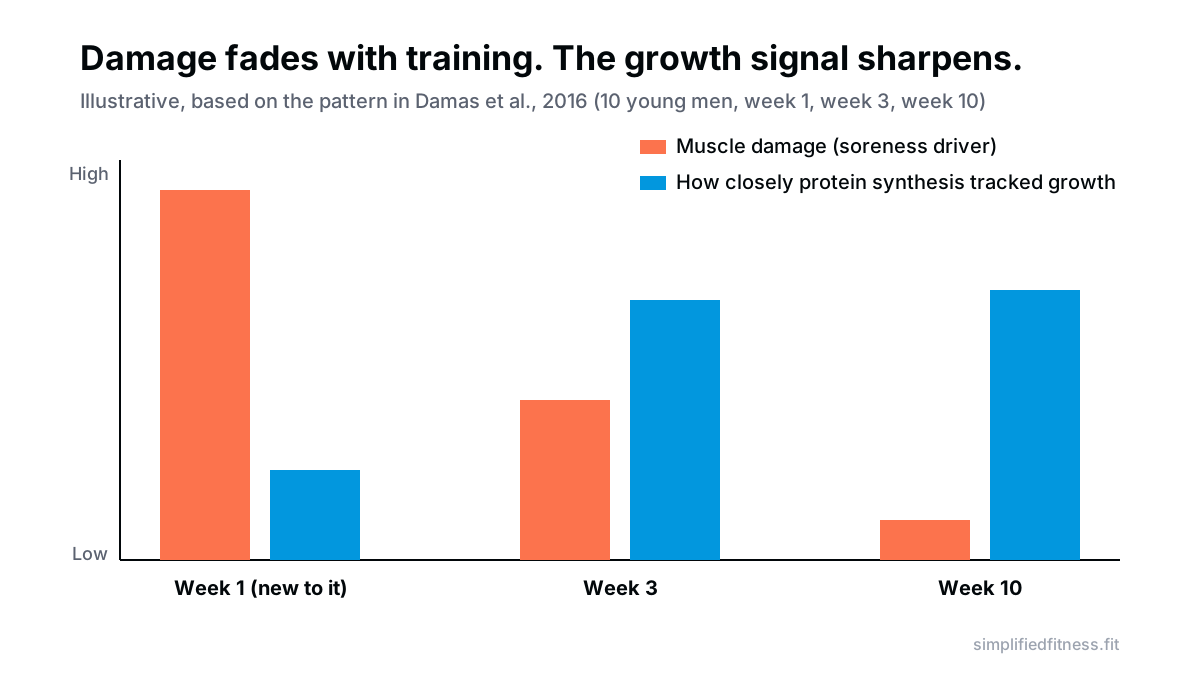
The authors’ follow-up review goes further. It argues the early rise in protein synthesis is mostly directed at repairing and remodelling damaged tissue, that early size increases are largely swelling, and that protocols causing little damage can still produce similar hypertrophy and strength gains (Damas et al., 2018). Their conclusion is that muscle damage does not mediate or potentiate hypertrophy.
Is that settled? Not entirely. A broader review notes that some researchers hypothesise inflammation and protein turnover from damage contribute to long-term adaptations, while others point out that hypertrophy occurs with little damage (Schoenfeld, 2012). The studies are small and mostly in young men, so the cautious reading is: damage is not required, and there is no good reason to chase it.
Is soreness required to build muscle?
No. What the research does support is mechanical tension from hard sets, plenty of them over weeks, with progressively heavier or more demanding work. Soreness can happen alongside that, but it is not the ingredient.
If you want the real levers, start with our muscle hypertrophy guide and the weekly set volume dose-response article.
Why am I not sore after a workout?
Usual suspects, in rough order of likelihood:
- You have adapted. The exercise is familiar, so it causes less damage and less sensitisation.
- The exercise has little lengthening stress. DOMS is mainly tied to unfamiliar, eccentric-heavy work, so a hard but familiar set with a quick lowering may leave you fine.
- Individual variation. People differ in how sore they get, and the same lifter can feel one muscle far more than another.
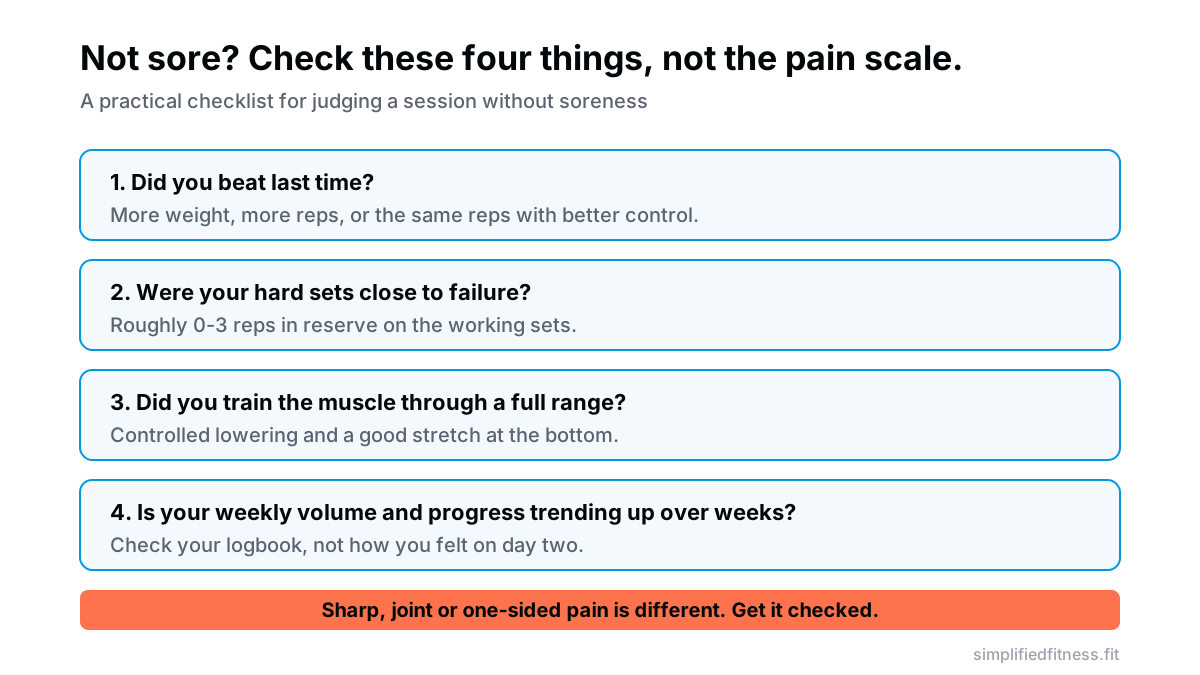
- Your sets were not hard enough. This is the one worth checking.
So when you ask “why am I not sore after a workout?”, the answer is rarely “it didn’t work”. Check the session against performance, not pain.
Why chasing extreme soreness backfires
DOMS is linked with reduced force capacity, stiffness and restricted movement (Hotfiel et al., 2018). In practice that means:
- You skip or shorten the next session for that muscle.
- When you do train, your reps and load can be lower than they would have been.
- Frequency drops, and weekly volume with it.
The most common mistake is the “destroy my legs” session on a Saturday, followed by a week of walking like a robot. A steadier approach, adding a set or two at a time, often gives you more productive sessions over the month. If you want to plan around soreness, see should you workout when sore and why stretching does not fix soreness.
What a good session looks like instead
If soreness is a poor scoreboard, you need a better one. Here is what I would track for each muscle group over a four-week block.
- Top-set performance. Same exercise, same rep target, slightly more load or one more rep over time.
- Hard sets per week. Count sets taken close to failure, not warm-ups or sets you coasted through. Our training volume calculator makes this easy.
- Technique and range. Controlled lowering and a full stretch make the same weight harder in a useful way.
- Recovery between sessions. If your performance is dropping week to week and everything hurts, you may be doing too much, which is a different problem from too little soreness.
For the bigger picture on how load should climb, read the progressive overload guide. A simple weekly structure is in our free push, pull, legs plans.
One more point worth knowing: the early gains a beginner sees, in the first few sessions, are largely not new muscle tissue. The 2018 review argues early increases in muscle size are mostly damage-induced swelling, with real hypertrophy appearing after roughly 18 sessions (Damas et al., 2018). That is a hypothesis from the authors, not a law, but it is another reason the sore-and-swollen feeling in week one should not be mistaken for fast progress.
Soreness versus growth at a glance
| Soreness (DOMS) | Muscle growth | |
|---|---|---|
| Main trigger | Unfamiliar or lengthening-heavy effort | Repeated hard sets with progression |
| Timing | Peaks about 24-72 hours | Builds over weeks and months |
| Tends to fade with | Repetition of the same exercise | Continues as long as training progresses |
| Reliable to track? | No | Yes, via performance and measurements |
When to see a doctor
Normal DOMS is a diffuse ache that settles within several days. Get medical advice if you have sharp or one-sided pain, a pop or sudden weakness, joint pain, marked swelling, pain that worsens after day three or four, or very dark urine after a brutal session. That pattern is not typical DOMS and needs a professional to assess, not another workout. This article is general information, not a diagnosis.
Practical takeaways for Indian lifters
Hot weather and long commutes make stacking up fatigue easy, so be conservative about adding volume after a break or festival gap. Eat enough protein (dal, paneer, curd, eggs, soya) and use our protein calculator to find your range. Protein supports training adaptation, but no food hack turns a bad session into a good one.
The bottom line
Soreness is a response to novelty, not a score for your workout. Damage and early repair look like a different process from the later changes that track hypertrophy. Do not chase pain. Progress your lifts, train hard sets close to failure, repeat, and let the logbook tell you the truth.
Frequently Asked Questions
Does soreness mean muscle growth?
No, not reliably. Soreness mostly reflects unfamiliar effort and the damage and inflammation that follow, and one review concluded muscle damage does not mediate or potentiate hypertrophy. Judge your sessions by whether your reps, load and hard sets are trending up over weeks.
What causes delayed onset muscle soreness?
DOMS usually follows unaccustomed exercise, especially lengthening (eccentric) contractions, and peaks around 24-72 hours later. Reviews describe ultrastructural damage to muscle cells followed by a local inflammatory response, although the exact pathway is still unclear. Mouse work also implicates nerve growth factor and pain-sensing channels such as TRPV1.
Why am I not sore after a workout?
Most often because your body has adapted to that exercise, so the same session now causes less damage. Soreness also depends on the exercise, your muscle length and how much you lowered the weight under control. Check your logbook: if you are still adding load or reps, the workout did its job.
Is soreness required to build muscle?
No. Damas and colleagues argue that training protocols that cause little damage still produce similar hypertrophy and strength gains. Focus on progressive overload with hard sets near failure and treat soreness as an unreliable side effect.
Does no soreness mean the workout was wasted?
No. A familiar session can still be effective without leaving you sore, because your body adapts to the damage from an exercise but the exercise can still provide a growth stimulus if you keep progressing. Ask whether you beat last session on weight, reps or control instead.
Are microtears the reason muscles grow?
Probably not in the way gym lore says. Damage is real after unfamiliar training, but the 2016 Damas study found the early protein-synthesis response, which coincided with the most damage, was not related to hypertrophy. Early repair work and later growth appear to be different processes, so do not try to tear muscle on purpose.
Why do I get sore after a long break?
A layoff makes the exercise unfamiliar again, so a normal session can trigger DOMS. Eccentric-heavy work like Romanian deadlifts, lunges and slow lowering makes it worse. Restart with fewer sets and stay a few reps short of failure for the first week or two.
Can too much soreness hurt my progress?
It can, mostly indirectly. DOMS is associated with reduced force capacity, stiffness and restricted movement, so you may train the next session with fewer good reps or skip it. Ramp volume gradually so soreness stays tolerable.
How long does DOMS last?
It typically starts within a day, peaks around 24-72 hours and fades over several days. Anything that is getting worse after that, or is sharp and localised, is not typical DOMS. If it does not settle, get it checked by a doctor or physio.
How do I know my workout was effective without soreness?
Look at performance over weeks: more reps at the same weight, more weight at the same reps, or the same numbers with cleaner form. Pair that with hard sets close to failure and a steady weekly volume. Log every session so you can see the trend.
Should I train a sore muscle?
Light to moderate soreness usually does not stop you training, but you may not perform at your best. If the pain changes how you move or you cannot hit your normal reps safely, train another muscle group. Our guide to training while sore covers the decision in more detail.
Is DOMS the same as a muscle strain?
No. DOMS is a diffuse, tender ache that appears after a delay and affects the whole worked muscle, while a strain is usually sudden, sharp and localised during the lift. Treat sudden sharp pain, swelling or bruising as an injury and see a doctor or physio.
Sources & References
Every claim above is checked against peer-reviewed research (PubMed, U.S. National Library of Medicine) or guidance from established health bodies. How we fact-check.
- Damas F, et al. Resistance training-induced changes in integrated myofibrillar protein synthesis are related to hypertrophy only after attenuation of muscle damage. J Physiol. 2016. PMID: 27219125
- Damas F, et al. The development of skeletal muscle hypertrophy through resistance training: the role of muscle damage and muscle protein synthesis. Eur J Appl Physiol. 2018. PMID: 29282529
- Schoenfeld BJ. Does exercise-induced muscle damage play a role in skeletal muscle hypertrophy? J Strength Cond Res. 2012. PMID: 22344059
- Hotfiel T, et al. Advances in Delayed-Onset Muscle Soreness (DOMS): Part I: Pathogenesis and Diagnostics. Sportverletz Sportschaden. 2018. PMID: 30537791
- Ota H, et al. TRPV1 and TRPV4 play pivotal roles in delayed onset muscle soreness. PLoS One. 2013. PMID: 23799042
- Clarkson PM, et al. Exercise-induced muscle damage in humans. Am J Phys Med Rehabil. 2002. PMID: 12409811

Umair Hazrami · Founder & Head Coach, Simplified Fitness
Umair Hazrami founded Simplified Fitness and the Simplified Lifter channel to cut through fitness noise. With 4+ years of consistent training and 10+ coaching clients, he writes every guide from the peer-reviewed research and links the sources so you can check them. Our editorial standards.
Educational content only, not medical advice. If you have a medical condition, are pregnant, or take medication, talk to a qualified doctor before changing your diet, supplements or training. Full disclaimer.
Keep reading

Supplements
The Antioxidant Paradox: Can Vitamin C and E Pills Blunt Muscle Growth and Endurance?
Does vitamin C blunt muscle growth? See what trials of 1000 mg vitamin C plus E found for strength, hypertrophy and endurance, and when pills are worth taking.
8 min read
Recovery
Cold Plunge After Workout: Does an Ice Bath Blunt Muscle Growth?
Does a cold plunge after workout kill your gains? See what the lifting trials found on muscle fibre growth, strength, soreness and when cold is fine to use.
8 min read
Recovery
Ice Baths for Athletes: When Cold Water Immersion Helps at Tournaments
Ice baths for athletes can cut soreness between matches but may blunt muscle gain. See when cold water immersion is worth it and how to use it.
7 min read
Recovery
Compression Boots and Lymphatic Drainage: Do They Really Speed Recovery?
Do compression boots speed recovery or 'detox' your legs? See what pneumatic compression trials found on soreness, strength and lymph, and cheaper options.
7 min read