Hydration and Strength: How Much Does a 2-3% Water Deficit Really Cost Your Lifts?
Hydration and strength explained: what a 2-3% body water deficit does to your reps and 1RM, what the studies really found, and how to check your own status.

TL;DR. The short answer
- A pooled analysis of 28 studies found dehydration cut muscle strength by about 5.5%, muscle endurance by about 8.3% and anaerobic power by about 5.8% on average.
- The cost is larger on high-rep sets than on a single heavy max. In one trial of 10 men, about 3% body mass loss meant roughly 15% fewer total reps across a full-body workout.
- Trained lifters and people who dehydrate passively (without sweating hard first) tend to lose less performance, and the data are mostly small studies in young adults.
- Check yourself with three things: first-morning body weight, urine colour and thirst. In the study behind this screen, all three flags reliably meant dehydration; two was a maybe, so we treat two as a cue to drink steadily before training.
- If you have kidney, heart or other medical conditions, or very dark urine that does not improve, ask a doctor before changing how much you drink.
Part of our complete guide: Carbohydrates, Fats, Fibre, Micronutrients and Hydration: The Lifter's Fueling Guide
Table of contents
Hydration and strength are linked, but not as dramatically as the gym folklore says. Being a couple of percent short on body water can cost you a few percent of strength and noticeably more reps on high-rep sets, and trained lifters seem to lose less than beginners do.
That is the honest answer, and it is a bit more modest than the “2% dehydration drops your 1RM by 5%” line you may have seen online. We will walk through what the studies actually measured, where they disagree, and what to do about it. For the wider nutrition picture, see our complete guide to carbs, fats and hydration for performance.
What does “a 2% water deficit” actually mean?
It means your body mass has dropped about 2% because of fluid loss. For an 80 kg lifter, that is roughly 1.6 kg of sweat and urine you have not replaced. The 2% mark is not random: the American College of Sports Medicine position stand says the goal of drinking during exercise is to prevent excessive dehydration, defined as more than 2% body weight lost from water deficit, because beyond that performance can be compromised (Sawka et al., 2007).
Researchers call this state hypohydration. Most strength studies create it by having people sweat in heat, sit in a hot bath, or restrict fluids for a day, then compare them with a trial where fluids were replaced.
One thing to hold on to: those are lab-made deficits, usually 2.5-5%. Walking into the gym slightly under-drunk is a smaller and different situation.
Does dehydration really reduce strength?
On average, a little. The best single summary is a 2015 meta-analysis pooling 28 manuscripts. Hypohydration lowered overall muscle strength by about 5.5%, muscle endurance by about 8.3%, and anaerobic power by about 5.8% (Savoie et al., 2015). Lower-body strength fell about 3.7% and upper-body about 6.2%, though that difference between body halves was not statistically significant.
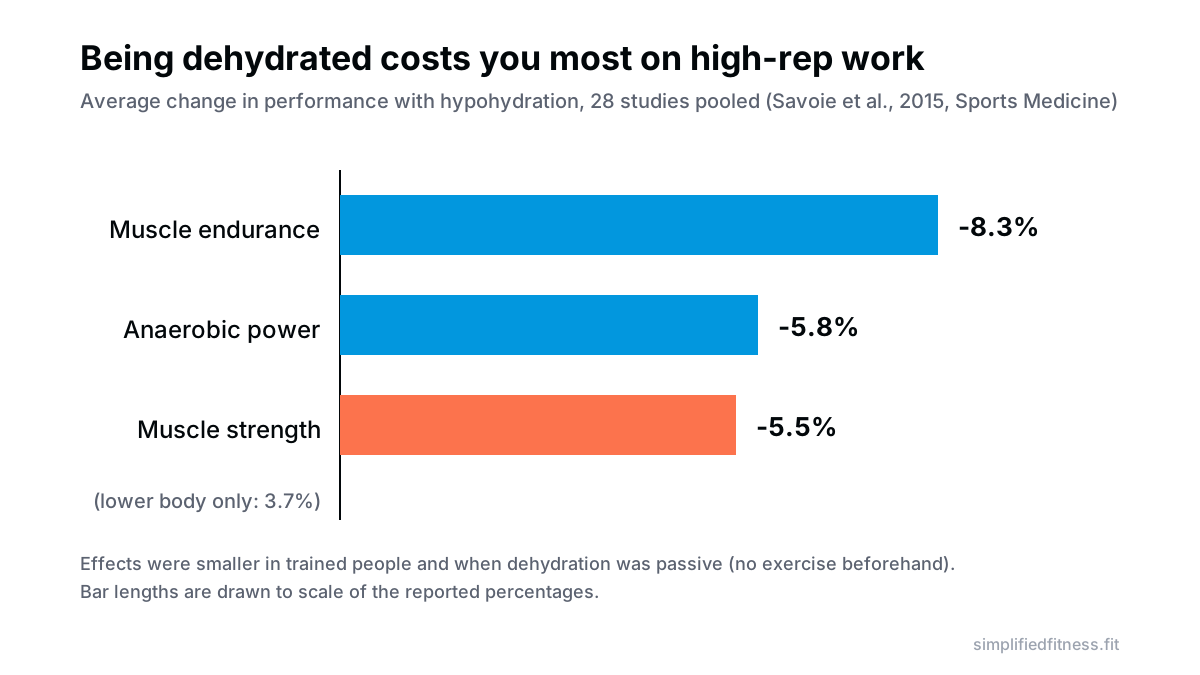
An earlier narrative review by the same lab that ran one of the key trials concluded that, after accounting for methodological choices, hypohydration appeared to consistently reduce strength by about 2%, power by about 3% and high-intensity endurance by about 10% (Judelson et al., 2007). Different method, similar shape: endurance-type work takes the biggest hit, a single maximal effort the smallest.
Notice what the headline numbers are not. They are not a flat “-5% on your bench” rule. And the meta-analysis found no clear relationship between how much water was lost and how much performance dropped, which is odd and tells you the studies are messy.
How many reps do you lose when dehydrated?
This is where the effect becomes visible in the gym. Reps to failure are more sensitive than a one-rep max.
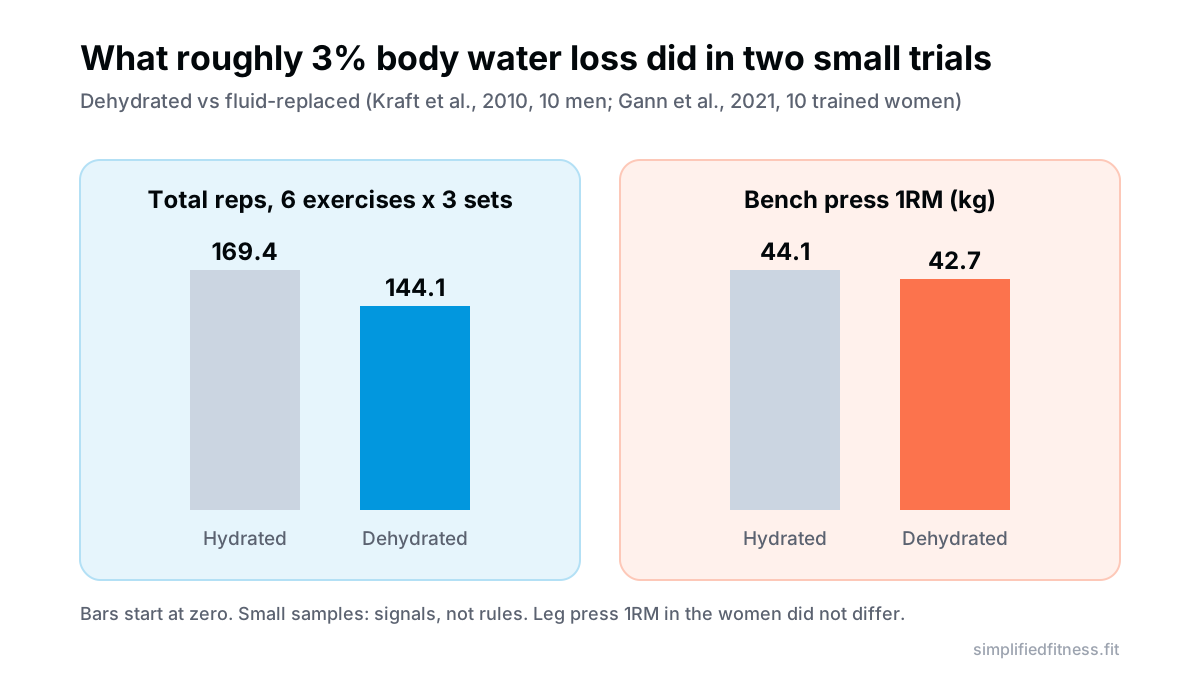
In a 2010 trial, 10 men completed three sets to failure of six exercises (bench press, lat pulldown, overhead press, barbell curl, triceps press and leg press). When dehydrated by about 3% of body mass they managed 144.1 total reps versus 169.4 when fluids were replaced. Pre-set perceived exertion and heart rate were higher in several of the exercises, and recovery heart rate was higher (Kraft et al., 2010). That works out to about 15% fewer reps (our arithmetic from their totals), or roughly 1-2 fewer reps per exercise on average.
A 2007 trial in seven resistance-trained men points the same way. At about 2.4% and 4.8% body mass loss, jump height, peak power and isometric force did not significantly change, yet work completed during a six-set back squat protocol dropped, from sets 2 to 3 onwards at the smaller deficit (Judelson et al., 2007). So a single quick max may hide what a full session reveals.
Think of a leg day with hack squats, leg press and extensions: 6-8 hard sets per muscle. That is exactly the kind of session where being under-hydrated would nibble away at your reps set after set.
What about 1RM specifically?
The data are thin and mixed. In a 2021 crossover trial of 10 resistance-trained women, bench press 1RM was 42.7 kg when dehydrated by about 3% versus 44.1 kg with fluid replacement (a difference of about 3%, our calculation). Leg press 1RM, total reps at 75% of 1RM and vertical jump did not differ significantly. The women also rated their recovery and readiness as worse when dehydrated (Gann et al., 2021).
So one study finds a small bench 1RM drop, and the same study finds nothing in the legs. A 2024 systematic review of 23 studies adds that evidence for dehydration affecting maximal strength is inconsistent: it found some evidence of no effect on maximal strength in isometric or moderate-speed isokinetic contractions, but reductions in slow-speed isokinetic strength and in fatigue resistance. It also concluded that the effects occur within the muscle rather than through reduced motor cortical output or spinal function (Francisco et al., 2024).
Why might studies differ? Test type, how dehydration was induced, the heat, how long people rested, and tiny samples (7 to 10 people in several of these trials). There is no clean verdict on 1RM, only a likely small, inconsistent cost.
Does dehydration make lifting feel harder?
It seems to. Besides the higher pre-set exertion and heart rate in the 2010 trial, the women in the 2021 study expected worse performance when dehydrated. Even if the bar speed difference is small, grinding through sets while feeling flat can change how hard you are willing to push.
Our practical read of that: on hot days when everything feels heavy, check fluids before you blame your program.
Could dehydration affect muscle growth?
Possibly, but the evidence is early. A 2025 study in 11 resistance-trained young men had them do two identical lower-body sessions, one with fluid restriction from 24 hours before to 3 hours after, one without. Muscle biopsies showed higher markers of oxidative stress (H2O2), and a smaller fibre cross-sectional area in the dehydrated condition. Some growth-signalling markers (p-S6K) were greater, and stress and breakdown-related markers rose too, which the authors interpret as additional cellular stress (Luk et al., 2025).
That is one small study of acute responses over a few hours. It does not show that dehydration shrinks your muscles over months, and it cannot tell us that being better than “normal” hydrated adds growth. You will also hear that cell swelling from extra water is an anabolic signal. It is a reasonable hypothesis, but none of the studies above tested drinking extra water on top of normal hydration, so we will not tell you to force litres down.
How much water should you drink for the gym?
Here is the awkward truth: there is no validated one-size formula. The ACSM position stand says there is considerable variability in sweating rates and sweat electrolyte content between individuals, so customised fluid plans are recommended, and individual sweat rate can be estimated by weighing yourself before and after exercise (Sawka et al., 2007).
A workable approach:
- Start with a ballpark from our water intake calculator.
- Drink to thirst plus steady sips with meals across the day.
- Weigh yourself nude before and after a typical session. Every kilo lost is roughly a litre of fluid to replace. (Standard physiology, and a rough guide only.)
- Adjust in hot months. In an Indian summer, a 90-minute session in a non-air-conditioned gym will take a bigger bite than a winter session.
Food counts toward your fluid intake too: dal, curd, buttermilk (chaas), fruit, soups. A salty meal such as dal, rice and curd after training is a perfectly decent rehydration meal for most people. Sodium and other minerals get their own treatment in our electrolytes for gym performance article, and if you are curious about the salt-before-lifting trend, see sodium and pre-workout pumps.
How do you check hydration without a lab?
You do not need a lab. A 2002 review of assessment methods found that body weight changes and urine measures, including colour, are widely used, and that urine colour has been used with reasonable accuracy for a quick estimate, especially with first-morning samples. It also states there is no true gold standard (Kavouras, 2002).
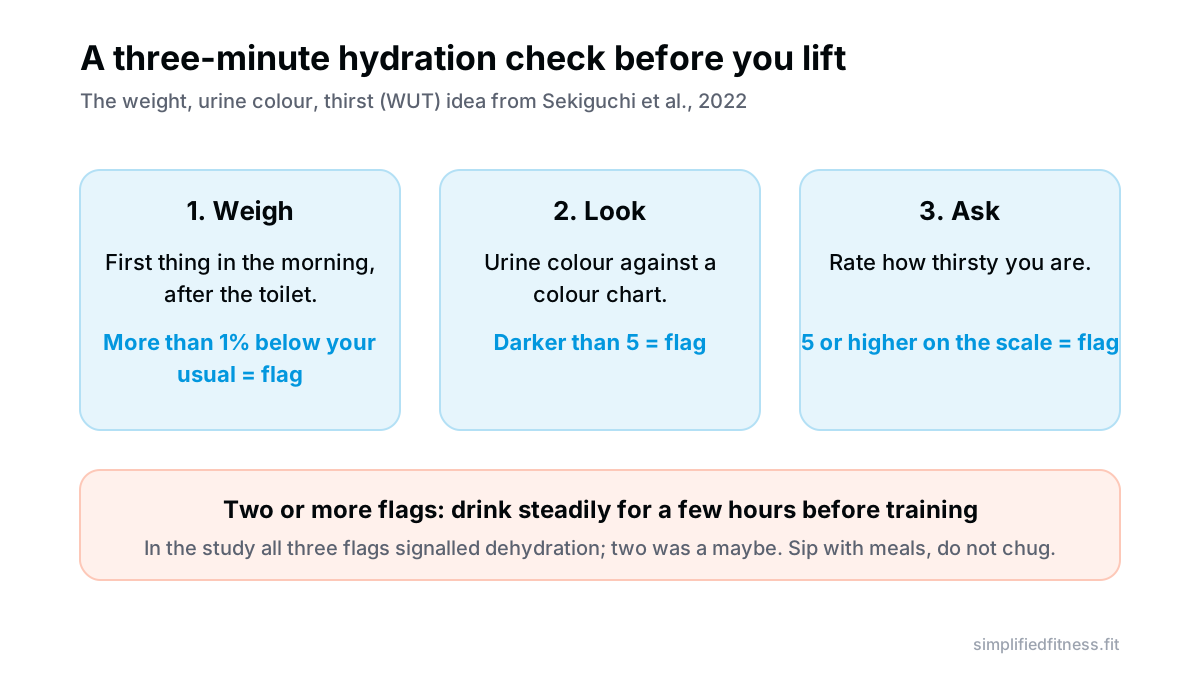
A practical screen is the WUT idea: weight, urine colour, thirst. In a 2022 study of 22 women and 21 men over 10 days, flags were body mass loss over 1%, urine colour above 5 on a chart, and thirst of 5 or higher. When all three were met, urine concentration indicated hypohydration with a specificity of 0.956, and when none were met, people were very likely well hydrated. One or two flags were indeterminate (Sekiguchi et al., 2022). That is a screening tool tested on first-morning measures in young, healthy adults, not a diagnosis. Treating two flags as a reason to drink a bit more is our cautious rule of thumb, not the study’s finding.
Can you overdo it?
Yes. Forcing fluid well beyond thirst is not shown to help strength, and the ACSM stand’s whole logic is to avoid both too little and excessive changes in electrolyte balance. If you feel bloated, nauseated, or confused after drinking large volumes, that is a reason to stop and seek advice.
A few people should not follow generic advice at all. If you have kidney disease, heart failure, take diuretics or other medicines affecting fluid balance, or are pregnant, ask your doctor what fluid intake suits you. And if you have extreme thirst that never settles, very dark urine that does not improve with drinking, dizziness or fainting, see a doctor rather than troubleshooting it with a bottle.
One more caution on weight cutting. Deliberately dehydrating to make a weight class is a separate and riskier subject. Trained athletes in that situation need qualified supervision, and nothing here is a how-to.
So how does hydration fit into your training week?
Think of it as maintenance, not a hack:
- Daily: drink normally, aim for pale straw urine most of the day, eat water-rich foods.
- Before training: if you flagged two or more WUT signs, sip fluids with a snack over the previous few hours.
- During: small sips between sets, more in heat. Our caffeine dosing for strength piece covers pre-workout drinks.
- After: replace what you lost with fluids and a regular meal.
- Scale weight: a big morning dip or jump is often water, not fat, as we explain in daily scale weight fluctuations. Sweating a lot also does not mean you burned fat, see does sweat equal fat loss.
If you want to see what your numbers look like, estimate your strength level with the 1RM calculator and keep notes: do your reps drop on days your urine is dark? That is the most useful experiment you can run, and it costs nothing.
The bottom line
Dehydration is not a secret killer of your bench press, and a bit of thirst will not erase a month of training. But across studies, being clearly under-hydrated tends to cost a few percent of strength and a bigger share of your reps, and it makes sets feel harder. Most of the evidence is from small trials in young, healthy people, so the sensible stance is modest: start sessions with pale urine, sip through the day, replace what you sweat, and do not drink more than your body asks for. Hydration is cheap, and it is one thing you control before the bar is even loaded.
Frequently Asked Questions
Does dehydration reduce muscle strength?
Usually a little. A meta-analysis of 28 studies found muscle strength fell by about 5.5% on average with hypohydration, though results varied a lot between studies. The effect seems smaller in trained people, so the practical move is to start sessions properly hydrated rather than to fear a single dry morning.
How much does a 2% water deficit affect lifting?
It can cost you some reps and some perceived readiness, but the size is uncertain. In a small trial of seven resistance-trained men, losing about 2.4% of body mass reduced work completed in sets 2 and 3 of a six-set squat protocol. Start training with normal urine colour and you will rarely be anywhere near this deficit.
Will dehydration lower my 1RM?
Possibly, by a few percent, and not consistently. In 10 resistance-trained women, bench press 1RM was about 1.4 kg lower when dehydrated by around 3%, but leg press 1RM did not differ significantly. If a max attempt matters, drink normally the day before and do not cut water to make a weight class unless a coach and doctor are supervising.
Does dehydration affect reps more than max strength?
Yes, that pattern shows up repeatedly. A meta-analysis found a larger average drop in muscle endurance (about 8.3%) than in strength (about 5.5%), and a trial of men doing sets to failure lost about 15% of total reps. Be most careful with hydration before high-volume sessions such as leg days and full-body workouts.
How much water should I drink for the gym?
There is no single validated number, because needs depend on body size, food, climate and sweat rate. The ACSM position stand recommends individualised plans and drinking enough to avoid losing more than 2% of body weight during exercise. Use our water intake calculator for a starting estimate, then adjust using your urine colour and pre/post-session body weight.
How do I know if I am dehydrated before training?
Look at three signs: first-morning weight more than 1% below your usual, darker urine (above 5 on a colour chart), and clear thirst. A 2022 study of 43 young adults found that when all three were present, urine tests confirmed dehydration, while one or two flags were indeterminate. Our cautious rule: if you hit two or more, drink steadily with a meal or snack and recheck in a couple of hours.
Is urine colour a reliable way to check hydration?
It is a reasonable quick check, not a precise one. A review of hydration assessment methods found urine colour has been used with reasonable accuracy, especially for first-morning samples, but there is no true gold standard. Some foods, vitamins and medicines change urine colour, so use trends over several days.
Should I drink a lot of water right before a workout?
No. Chugging a large volume right before lifting mostly gives you a sloshing stomach and a toilet break. The ACSM position stand advises starting any pre-hydration at least several hours before exercise so the body can absorb the fluid and urine output can return to normal. Sip with meals earlier in the day and keep a bottle for between sets.
Does being dehydrated make workouts feel harder?
Often yes. In a trial of 10 men dehydrated by about 3%, perceived exertion and heart rate before sets were higher in several exercises, and heart rate stayed higher during recovery. Notice if sets feel unusually grindy on hot, sweaty days and treat fluids as part of recovery between sessions.
Does dehydration hurt muscle growth?
We do not know yet. One 2025 study of 11 men found lifting while dehydrated changed growth signalling and increased muscle stress markers, and fibre cross-sectional area was smaller in that state, but it measured acute responses rather than months of growth. Treat it as an early signal and keep hydration steady across your training week.
Is the cell swelling idea real, and should I overdrink to get it?
Cell swelling is a plausible idea, but there is no trial here showing that drinking extra water beyond normal hydration builds more muscle. What the evidence supports is avoiding a deficit. Aim for normal hydration, not forced extra litres, because overdrinking has its own risks.
Do I need to drink more in Indian summers?
Probably yes, because heat and humidity raise sweat losses and the 2% body weight loss line is reached sooner. The ACSM stand notes sweating rates vary a lot between people, so weigh yourself before and after a session to see your own loss. Replace the deficit with fluids and a normal salty meal such as dal, rice and curd afterwards.
Can I just drink plain water or do I need electrolytes?
For most gym sessions under about an hour, water with normal meals is a sensible default. The ACSM position stand says electrolyte and carbohydrate drinks can help in certain circumstances, such as long or very sweaty sessions. Our electrolytes guide covers when that applies.
Sources & References
Every claim above is checked against peer-reviewed research (PubMed, U.S. National Library of Medicine) or guidance from established health bodies. How we fact-check.
- Savoie FA, et al. Effect of hypohydration on muscle endurance, strength, anaerobic power and capacity and vertical jumping ability: a meta-analysis. Sports Med. 2015. PMID: 26178327
- Judelson DA, et al. Hydration and muscular performance: does fluid balance affect strength, power and high-intensity endurance? Sports Med. 2007. PMID: 17887814
- Judelson DA, et al. Effect of hydration state on strength, power, and resistance exercise performance. Med Sci Sports Exerc. 2007. PMID: 17909410
- Kraft JA, et al. Impact of dehydration on a full body resistance exercise protocol. Eur J Appl Physiol. 2010. PMID: 20066432
- Gann JJ, et al. Effects of hypohydration on muscular strength, endurance, and power in women. J Strength Cond Res. 2021. PMID: 31977837
- Francisco R, et al. Does acute dehydration affect the neuromuscular function in healthy adults? A systematic review. Appl Physiol Nutr Metab. 2024. PMID: 39047298
- Luk HY, et al. Passive dehydration increases oxidative stress and mTOR signalling pathway activation in young men following resistance exercise. J Physiol. 2025. PMID: 40500991
- Sawka MN, et al. American College of Sports Medicine position stand. Exercise and fluid replacement. Med Sci Sports Exerc. 2007. PMID: 17277604
- Kavouras SA. Assessing hydration status. Curr Opin Clin Nutr Metab Care. 2002. PMID: 12172475
- Sekiguchi Y, et al. Relationships between WUT (body weight, urine color, and thirst level) criteria and urine indices of hydration status. Sports Health. 2022. PMID: 34465235

Umair Hazrami · Founder & Head Coach, Simplified Fitness
Umair Hazrami founded Simplified Fitness and the Simplified Lifter channel to cut through fitness noise. With 4+ years of consistent training and 10+ coaching clients, he writes every guide from the peer-reviewed research and links the sources so you can check them. Our editorial standards.
Educational content only, not medical advice. If you have a medical condition, are pregnant, or take medication, talk to a qualified doctor before changing your diet, supplements or training. Full disclaimer.
Keep reading
Nutrition
Alcohol and Muscle Growth: What a Heavy Night Does to MPS, Sleep and Recovery
Alcohol and muscle growth: does a heavy Saturday night wipe out your week? See what research says on MPS, REM sleep and recovery, and how to limit the damage.
7 min read
Nutrition
Ashwagandha and Cortisol: Does It Lower Stress and Boost Strength in the Gym?
Ashwagandha for lifting: what the trials show on cortisol, stress and strength gains, realistic dose (300-600 mg), who should skip it and how to buy it safely.
7 min read
Nutrition
Caffeine Sensitivity, CYP1A2 Genetics and Caffeine Cycling: Why Pre-Workout Works for Him, Not You
Caffeine sensitivity genetics explain why pre-workout gives your friend PRs and you anxiety. See what CYP1A2 and ADORA2A do, and how to find your dose.
8 min read
Nutrition
Creatine Non-Responders: Why It May Not Be Working and What to Try
Creatine non responder? Learn why roughly 1 in 4 people see little change, how baseline diet matters, and when carbs with creatine help. Studies linked.
7 min read