Is Salt Bad for Lifters' Blood Pressure? Sodium-to-Potassium Ratio vs Salt Phobia
Is salt bad for lifters blood pressure? See what trials say about sodium, potassium and the ratio between them, plus when to talk to your doctor first.
TL;DR. The short answer
- For most healthy lifters, normal salt intake is not the main blood pressure risk. Large cohort data link very high and very low sodium intakes with worse outcomes, with the lowest risk in a middle range.
- Cutting sodium lowers blood pressure most in people who already have high readings (about 5.7 mmHg systolic in white participants in one Cochrane review) and only about 1 mmHg in white participants with normal readings.
- Potassium matters too. Higher potassium intake lowers blood pressure in people with hypertension and seems to blunt the risk of a high-sodium diet.
- Family history of high blood pressure is a reason to check your readings and eat more potassium-rich foods, not a reason to fear every pinch of salt.
- If your readings are high, or you take blood pressure or kidney medication, follow your doctor's advice on salt and potassium before changing anything.
Part of our complete guide: Carbohydrates, Fats, Fibre, Micronutrients and Hydration: The Lifter's Fueling Guide
Table of contents
Is salt bad for lifters’ blood pressure? For most healthy people with normal readings, ordinary salt intake is not the main problem, and cutting it to the bone gives a small payoff. The bigger lever is the balance between sodium and potassium, plus knowing your own numbers.
That matters if your father or mother has hypertension and you now flinch every time the salt shaker comes out. Fair enough. But fear is not a plan. This article sits inside our wider guide to carbohydrates, fats and hydration for performance, and it covers the cardiovascular and safety side of salt. For the performance side, see our piece on electrolytes for gym performance.
Quick note on units. Sodium is not the same as salt. One gram of sodium is about 2.5 g of table salt, so 2 g sodium is roughly 5 g salt, and 5 g sodium is roughly 12.5 g salt. Studies use both, so watch which one a number refers to.
What does the research say about salt and blood pressure?
Start with the classic finding. Cutting sodium does lower blood pressure on average. A 2020 BMJ meta-analysis of 133 trials and 12,197 adults found that reducing sodium lowered systolic pressure by 4.26 mmHg and diastolic by 2.07 mmHg (Huang et al., 2020). The effect scaled with dose, and it was larger in older people and those with higher starting readings.
Now the part that gets lost on Instagram. Who benefits most? The Cochrane review by Graudal and colleagues, with 195 included references, split people by baseline pressure. In white participants with normal blood pressure, going from about 203 to 65 mmol of sodium a day lowered systolic pressure by only 1.14 mmHg and left diastolic pressure unchanged. In people with hypertension the same cut lowered systolic by 5.71 mmHg (Graudal et al., 2020).
That is a cut of roughly 140 mmol of sodium, which is a very large, hard-to-sustain change. A drop of 1 mmHg is real on a population level but invisible in your own cuff reading.
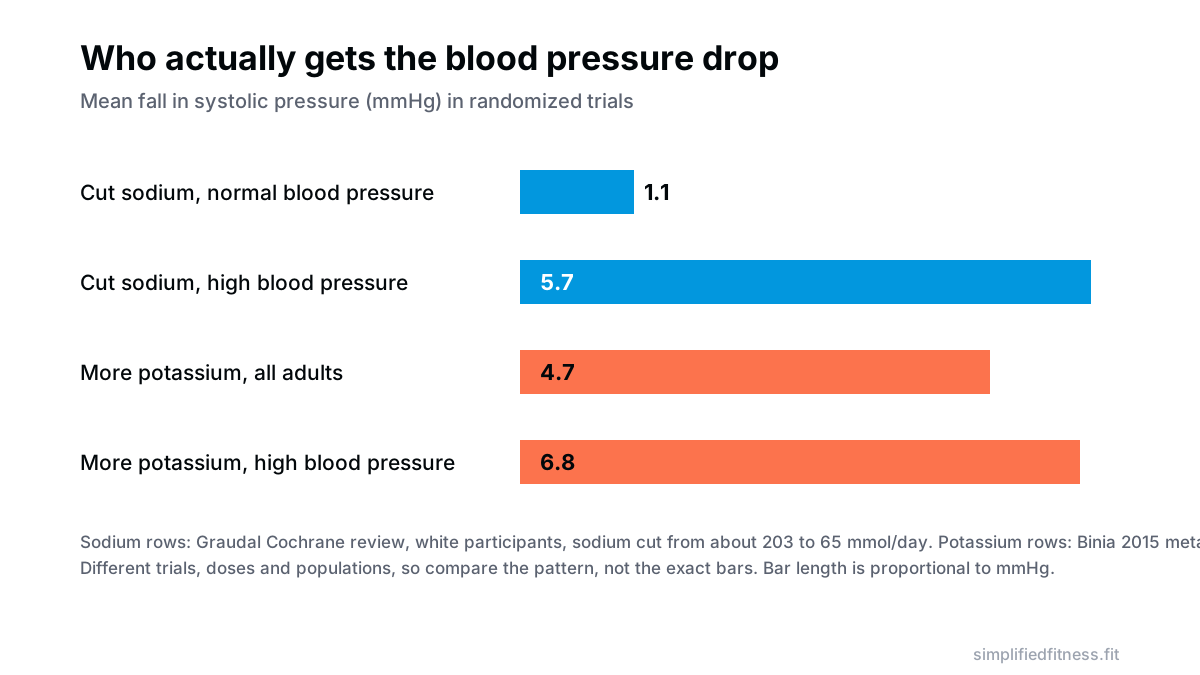
So the honest answer has two halves. If your readings are normal, strict salt avoidance buys little. If your readings are high, salt is worth taking seriously, and that is a conversation for your doctor rather than a gym forum.
Is a very low sodium diet actually safer?
Not obviously. Two lines of evidence push back on blanket salt phobia, and I want to present them carefully because both have limits.
The first is the large PURE cohort. Across 101,945 people in 17 countries, with an average follow-up of 3.7 years, estimated sodium excretion of 4-5.99 g a day was the reference range. Intake of 7 g or more was linked to a higher risk of death and cardiovascular events (odds ratio 1.15), but so was intake below 3 g a day (odds ratio 1.27) (O’Donnell et al., 2014). The authors concluded that 3-6 g of sodium a day was linked to the lowest risk. That is a J-shaped curve.
The second is the body’s own response. In the Cochrane analysis, when sodium fell, renin rose by 1.56 ng/mL/hour, aldosterone rose by 104 pg/mL and noradrenaline rose by 62.3 pg/mL (Graudal et al., 2020). Those are the hormones your body uses to hang on to salt. This is a normal defence, not proof of harm.
Here is where I part ways with the usual internet claim. You will see posts saying low-sodium diets stiffen arteries in active people. The data do not show that. A 2018 meta-analysis of randomized trials (11 studies, 431 people, 1-6 weeks) found that cutting sodium by about 89 mmol a day actually reduced arterial stiffness (pulse wave velocity) by 2.84% (D’Elia et al., 2018). Those trials were short and not in lifters.
Practical read: neither extreme looks like a clear winner. A middle range of intake, mostly from home cooking, is a safer default than either a salt-heavy packaged diet or a punishing no-salt one.
What is the sodium-to-potassium ratio and why does it matter?
Sodium nudges blood pressure up. Potassium works the other way, helping the kidneys excrete sodium and relaxing blood vessel walls. So the ratio between them tells you more than either number alone.
A meta-analysis of 15 randomized trials (917 people not on blood pressure drugs) found that potassium supplementation lowered systolic pressure by 4.7 mmHg and diastolic by 3.5 mmHg overall, and by 6.8 and 4.6 mmHg in people with hypertension. Blood pressure reductions tracked with a lower sodium-to-potassium ratio and higher potassium excretion (Binia et al., 2015). A BMJ review of 22 trials (1,606 people) reached a similar place: higher potassium lowered systolic pressure by 3.49 mmHg, an effect seen in people with hypertension but not in those without. It also found no significant adverse effect on kidney function, blood lipids or catecholamines in adults, and a 24% lower risk of stroke in the cohort data (Aburto et al., 2013).
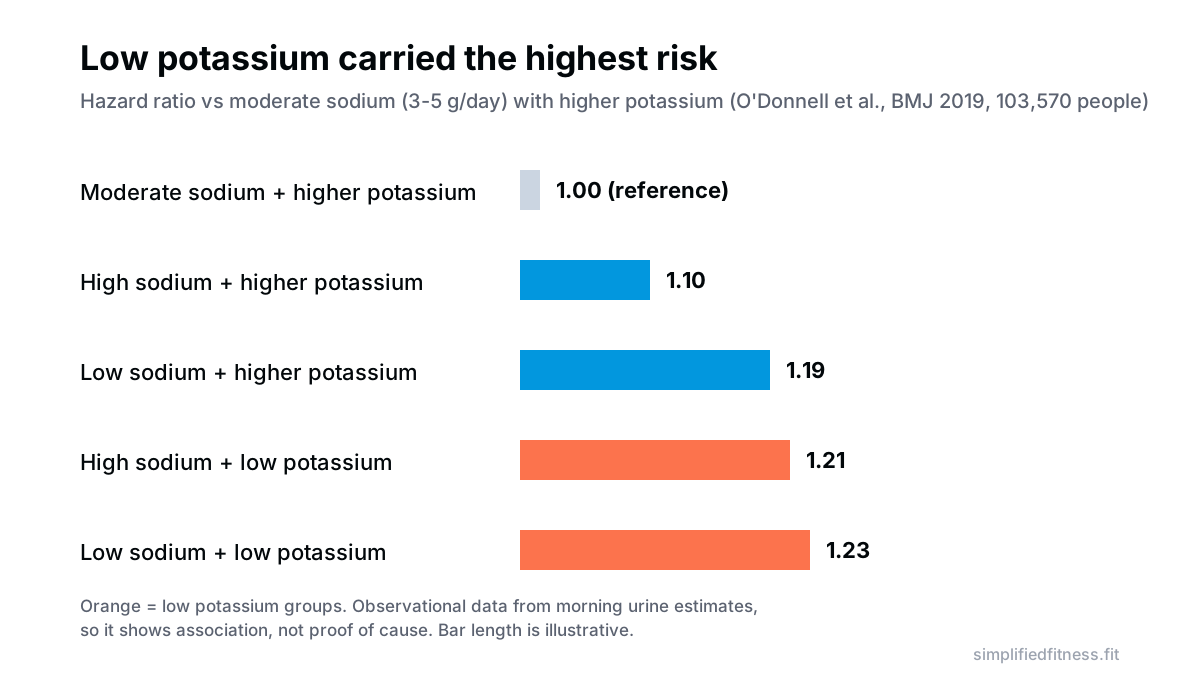
Then there is the combination data. In a second PURE analysis of 103,570 people, the lowest risk of death and cardiovascular events was in the group with moderate sodium (3-5 g a day) and higher potassium. Low potassium was the worst place to be, with hazard ratios of 1.23 (low sodium) and 1.21 (high sodium). Higher potassium also seemed to blunt the added risk of high sodium. Only 0.002% of people had both low sodium (under 2 g) and high potassium (over 3.5 g) (O’Donnell et al., 2019).
That last point deserves a second read. The textbook target of very low sodium plus high potassium is almost never seen in real life. Hitting it would take a very particular diet.
Do lifters lose enough sodium in sweat to worry about?
Sweat carries sodium, and the amount differs widely between people. A 2019 analysis of 1,303 athletes found whole-body sweat rates of 0.83-1.51 L/h by sport, and rates of sweat sodium loss of about 27-56 mmol/h, highest in American football and endurance sport (Barnes et al., 2019).
Note the limit. Those athletes played field and endurance sports. Lifting was not among the sports the study broke out, and an hour in an air-conditioned gym is a different thing from a football pre-season in the sun. In a hot Indian summer with a fan and no AC, you will sweat more, but I cannot give you a lifter-specific sodium number from this paper.
What it does tell you: sweat sodium loss is a real thing for long, hot sessions, and some sweat is salty. For most people training an hour with normal food intake, a normally salted meal covers it. For the sweat and hydration side of training, read our guide to hydration and strength, and use the water intake calculator for a starting point.
How do I eat for a better sodium-to-potassium ratio?
Skip the spreadsheet. Work with food.
- Potassium-rich staples: potatoes (with skin), bananas, spinach and other saag, dal, rajma, chana, curd, tomatoes, coconut water.
- Sodium-heavy items to trim first: pickles, papad, namkeen, instant noodles, packaged soups, processed meats, restaurant gravies.
- Cook at home: salt to taste while cooking, taste before adding more at the table.
- Read labels: many Indian packaged foods list sodium per 100 g. Compare brands.
- Vegetarian lifters: dal, curd, soya and vegetables bring potassium along with protein, which is a natural fit for this strategy. Our Indian high-protein nutrition guide shows how to build those meals.
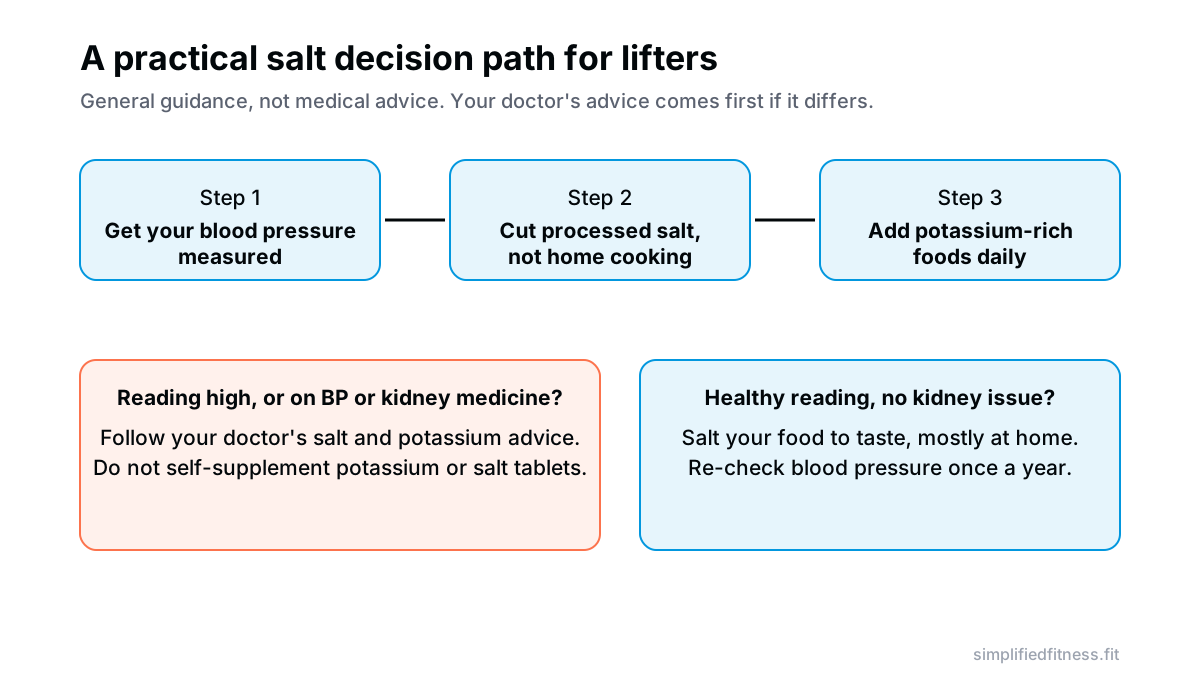
Food comes first for potassium. Supplements are a different risk profile, and potassium can build up in people with kidney problems or those on certain blood pressure medicines. Do not self-prescribe potassium pills or salt substitutes.
| Situation | Reasonable approach |
|---|---|
| Normal readings, no family history | Salt food to taste, limit packaged salt |
| Normal readings, family history | Check blood pressure yearly, add potassium-rich foods, avoid heavy packaged salt |
| High readings or on BP medicine | Follow your doctor’s salt and potassium plan |
| Kidney disease or on potassium-sparing drugs | Do not add potassium or salt substitutes without medical advice |
What if hypertension runs in my family?
Family history raises your odds of developing high blood pressure. It does not mean you already have it, and it does not mean salt is the only lever.
The actionable steps are boring and effective. Get your blood pressure measured, ideally seated and rested, on more than one day. Keep a note of the numbers. Eat more potassium-rich food. Keep body weight and training consistent, sleep well, and be cautious with alcohol. A single high reading right after a heavy set of squats is not a diagnosis, because blood pressure rises briefly during hard lifting.
Another myth worth dropping: that a pinch of salt before training is dangerous for everyone. If your readings are normal, a normally salted meal is unlikely to be an issue. If you want the performance angle, our article on pre-workout sodium and gym pumps covers it, but anyone with hypertension should skip that experiment and ask a doctor first.
When should you see a doctor?
See a doctor if repeated home readings are high, if you have severe headaches, chest pain, breathlessness or vision changes, or if you take blood pressure or kidney medication. Do the same if you plan any big change in salt or potassium intake and have a diagnosed condition.
This article is general education from published research. It cannot tell you your own blood pressure or your own risk.
The bottom line
Blanket salt phobia is not well supported for healthy lifters with normal readings. Blanket salt-loading is not supported either. Aim for mostly home-cooked food, fewer packets, more potassium-rich foods, and a blood pressure check you actually repeat.
If you want help turning this into a plan for your own meals and training, use our free diet plan as a starting point.
Frequently Asked Questions
Is salt bad for lifters' blood pressure?
Not automatically. In a Cochrane review, cutting sodium lowered systolic pressure by only about 1 mmHg on average in white participants with normal blood pressure, versus roughly 5-6 mmHg in those with hypertension. The few trials in Black and Asian participants suggested somewhat larger effects. If you have high readings or a strong family history, get your blood pressure checked and follow your doctor's advice before changing your salt intake.
How much sodium is too much?
In the large PURE cohort, estimated intake of 7 g of sodium per day or more was linked to higher risk, with the risk starting from 6 g per day in people with hypertension. The average in that cohort was about 4.9 g a day, and the WHO recommends under 2 g of sodium (about 5 g of salt) a day, so the right target is debated. Check food labels and cut back on packaged snacks, pickles and instant noodles first.
What is the sodium-to-potassium ratio?
It compares how much sodium you take in with how much potassium you take in. A lower ratio means more potassium relative to sodium, and trials link lower ratios with lower blood pressure. You get there mostly by eating more potatoes, bananas, dal, curd and leafy vegetables, not only by shaking less salt.
Does potassium really lower blood pressure?
Yes, in people with hypertension. A BMJ meta-analysis of randomized trials found higher potassium intake lowered systolic pressure by about 3.5 mmHg overall, with the effect seen in people with hypertension but not in those without. If you have kidney disease or take certain blood pressure drugs, check with your doctor first because potassium can build up.
Do lifters need more salt because they sweat?
Sweat does carry sodium, and the amount varies a lot between people. In one dataset of 1,303 athletes, rates of sweat sodium loss averaged roughly 27-56 mmol per hour depending on the sport, though lifting was not among the sports analysed. Salt your food normally and spend more attention on hydration if you train long in the heat.
Does a low-sodium diet hurt performance or health?
It may not be harmless. A Cochrane review found that reducing sodium raised renin, aldosterone and noradrenaline levels, which is the body's way of holding on to salt. The clinical meaning is debated, so avoid extreme restriction unless your doctor has asked for it.
Is there a safe level of salt for someone with a family history of hypertension?
Family history raises your risk of hypertension, but it does not mean you must eat as little salt as possible. Research suggests a middle range of sodium combined with good potassium intake carried the lowest risk in a large cohort. Check your blood pressure yearly and discuss targets with your doctor.
Does salt cause high blood pressure in young, fit people?
Salt raises blood pressure in some people more than others, and the effect tends to be bigger in older people and those with higher baseline readings. In fit people with normal readings the average change from cutting salt is small. A home cuff or a yearly check tells you more than guessing.
Which foods lower the sodium-to-potassium ratio?
Potassium-rich foods such as potatoes, bananas, spinach, dal, rajma, curd and coconut water move the ratio in the right direction. Most of the sodium in modern diets comes from packaged and restaurant food, so cooking at home helps too. Add one or two potassium-rich foods to each meal instead of overhauling everything.
Should I take potassium supplements for blood pressure?
No, food first. Trials of potassium used amounts around 90-120 mmol per day in some analyses, and excess potassium can be dangerous for people with kidney problems or on some medicines. Talk to your doctor before using any potassium pill or salt substitute.
Does salt make the pump better, and is it risky?
A pre-workout salt strategy is a separate topic covered in our pre-workout sodium article. If your blood pressure is normal, a normal salted meal is unlikely to be a problem. If you are hypertensive, skip the experiment and ask your doctor.
Can I keep eating pickles, papad and namkeen?
Occasionally, yes. They are concentrated sodium sources with little potassium, so a daily habit adds up fast. Enjoy them in small portions and put the saved sodium budget toward roti, dal and sabzi cooked at home.
When should I see a doctor about blood pressure?
See a doctor if repeated home readings are high, if you get severe headaches, chest pain, breathlessness or vision changes, or if you take blood pressure or kidney medicines. One high gym reading right after lifting heavy is not a diagnosis. A calm, seated reading on a different day is far more informative.
Sources & References
Every claim above is checked against peer-reviewed research (PubMed, U.S. National Library of Medicine) or guidance from established health bodies. How we fact-check.
- Binia A, et al. Daily potassium intake and sodium-to-potassium ratio in the reduction of blood pressure: a meta-analysis of randomized controlled trials. J Hypertens. 2015. PMID: 26039623
- O'Donnell M, et al. Urinary sodium and potassium excretion, mortality, and cardiovascular events. N Engl J Med. 2014. PMID: 25119607
- O'Donnell M, et al. Joint association of urinary sodium and potassium excretion with cardiovascular events and mortality: prospective cohort study. BMJ. 2019. PMID: 30867146
- Huang L, et al. Effect of dose and duration of reduction in dietary sodium on blood pressure levels: systematic review and meta-analysis of randomised trials. BMJ. 2020. PMID: 32094151
- Aburto NJ, et al. Effect of increased potassium intake on cardiovascular risk factors and disease: systematic review and meta-analyses. BMJ. 2013. PMID: 23558164
- Barnes KA, et al. Normative data for sweating rate, sweat sodium concentration, and sweat sodium loss in athletes: An update and analysis by sport. J Sports Sci. 2019. PMID: 31230518
- Graudal NA, et al. Effects of low sodium diet versus high sodium diet on blood pressure, renin, aldosterone, catecholamines, cholesterol, and triglyceride. Cochrane Database Syst Rev. 2020. PMID: 33314019
- D'Elia L, et al. Effect of dietary sodium restriction on arterial stiffness: systematic review and meta-analysis of the randomized controlled trials. J Hypertens. 2018. PMID: 29084085

Umair Hazrami · Founder & Head Coach, Simplified Fitness
Umair Hazrami founded Simplified Fitness and the Simplified Lifter channel to cut through fitness noise. With 4+ years of consistent training and 10+ coaching clients, he writes every guide from the peer-reviewed research and links the sources so you can check them. Our editorial standards.
Educational content only, not medical advice. If you have a medical condition, are pregnant, or take medication, talk to a qualified doctor before changing your diet, supplements or training. Full disclaimer.
Keep reading
Nutrition
Alcohol and Muscle Growth: What a Heavy Night Does to MPS, Sleep and Recovery
Alcohol and muscle growth: does a heavy Saturday night wipe out your week? See what research says on MPS, REM sleep and recovery, and how to limit the damage.
7 min read
Nutrition
Ashwagandha and Cortisol: Does It Lower Stress and Boost Strength in the Gym?
Ashwagandha for lifting: what the trials show on cortisol, stress and strength gains, realistic dose (300-600 mg), who should skip it and how to buy it safely.
7 min read
Nutrition
Caffeine Sensitivity, CYP1A2 Genetics and Caffeine Cycling: Why Pre-Workout Works for Him, Not You
Caffeine sensitivity genetics explain why pre-workout gives your friend PRs and you anxiety. See what CYP1A2 and ADORA2A do, and how to find your dose.
8 min read
Nutrition
Creatine Non-Responders: Why It May Not Be Working and What to Try
Creatine non responder? Learn why roughly 1 in 4 people see little change, how baseline diet matters, and when carbs with creatine help. Studies linked.
7 min read