Saturated vs Unsaturated Fats: Lipid Profiles, Heart Health, and Testosterone Production
Saturated vs unsaturated fats for lifters: what butter and coconut oil do to LDL, ApoB and testosterone, and which fats to eat. Every study linked.
TL;DR. The short answer
- You need enough total fat for hormone production, but there is no good evidence that butter or coconut oil raises testosterone more than olive oil, nuts or fish. The testosterone meta-analyses compare total fat, not fat type.
- Higher saturated fat intake raises LDL cholesterol and ApoB in controlled feeding trials, and coconut oil raised LDL by about 10 mg/dL versus nontropical vegetable oils in a 16-trial meta-analysis.
- In long trials, cutting saturated fat reduced combined cardiovascular events, and a 2026 review found the clearest benefit when it was replaced with polyunsaturated fat in people at higher cardiovascular risk.
- A practical split for most lifters is to keep saturated fat modest, make olive oil, groundnut oil, nuts, seeds and fish the default fats, and keep total fat above a very low intake.
- Family history of early heart disease or a high LDL on a blood test? Ask your doctor about a lipid panel and ApoB before you change your diet.
Part of our complete guide: Carbohydrates, Fats, Fibre, Micronutrients and Hydration: The Lifter's Fueling Guide
Table of contents
Should you eat butter and coconut oil for testosterone, or stay with olive oil? Stay mostly with olive oil. You do need enough fat overall for hormone production, but the research does not show that saturated fat raises testosterone more than unsaturated fat, while it does raise LDL cholesterol and ApoB.
This sits inside our wider guide to carbohydrates, fats and hydration for performance. Here we look at only one question: which kinds of fat should a lifter eat, and why does it matter beyond the mirror?
Does saturated fat increase testosterone?
The “eat more saturated fat for testosterone” idea has a kernel of truth buried under a lot of gym lore. Dietary fat supplies raw material for hormone production, so a very low-fat diet is not a smart move. That is a point about total fat, though, and we cover the floor in our article on the minimum fat threshold for hormone production.
What the studies actually compared matters.
A 2021 meta-analysis of intervention studies found lower total testosterone (standardised mean difference -0.38, 95% CI -0.75 to -0.01), free testosterone and DHT on low-fat diets compared with high-fat diets (Whittaker et al., 2021). The authors said more randomized trials are needed, and the effect looked stronger in men of European and North American background.
A 2025 meta-analysis of 11 randomized trials with 888 participants, using a cut-off of 30% of energy or less for “low fat”, found no significant difference in testosterone or other sex hormones between low-fat and high-fat diets (Soltani et al., 2025). It also flagged the small number of studies and low certainty of evidence.
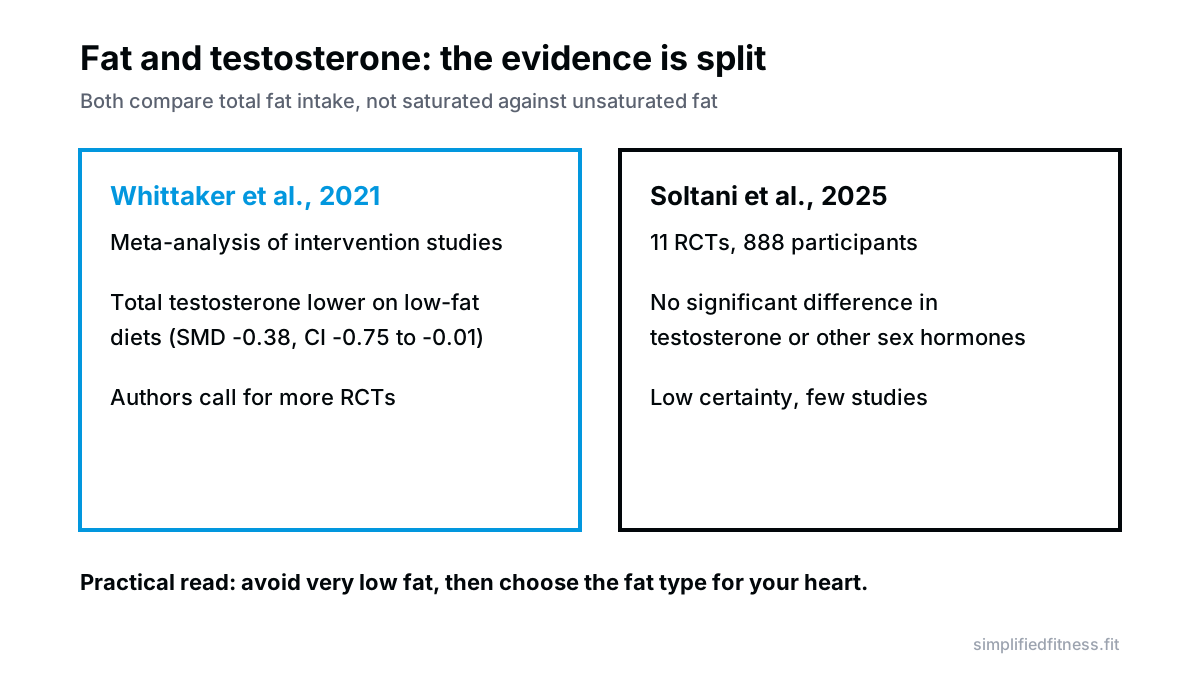
Why might they disagree? The pooled studies differ in design, population, how low the fat went and how long people followed the diet. Neither paper tested saturated fat head to head against unsaturated fat. So the honest reading is: avoid very low fat, and do not use testosterone as the reason to pick butter.
What saturated fat does to LDL and ApoB
LDL cholesterol is the fraction of cholesterol carried on LDL particles, and ApoB is a protein found on each atherogenic particle, so it tracks particle number. Higher numbers mean more particles that can lodge in artery walls over decades.
In a randomized feeding trial, people ate diets with either high or low saturated fat. Independent of protein source, high compared with low saturated fat increased LDL cholesterol, ApoB and large LDL particles (Bergeron et al., 2019). The same trial found LDL and ApoB were higher with red and white meat than with nonmeat protein, regardless of saturated fat content. That is a feeding study, so it shows what happens to blood markers, not who gets heart disease.
So it is not just butter. Where the protein comes from also moved these markers. Dal, soya and other plant proteins earn their place. Fish and eggs were not tested in this trial.
Butter, ghee and coconut oil
A network meta-analysis of 54 randomized trials compared oils and solid fats. Most oils tested, including olive, rapeseed, sunflower, corn, soybean, palm and coconut (and even beef fat), lowered LDL cholesterol more than butter did (by roughly 0.23 to 0.42 mmol/L), and the authors said the findings support replacing high saturated fat foods with unsaturated oils (Schwingshackl et al., 2018).
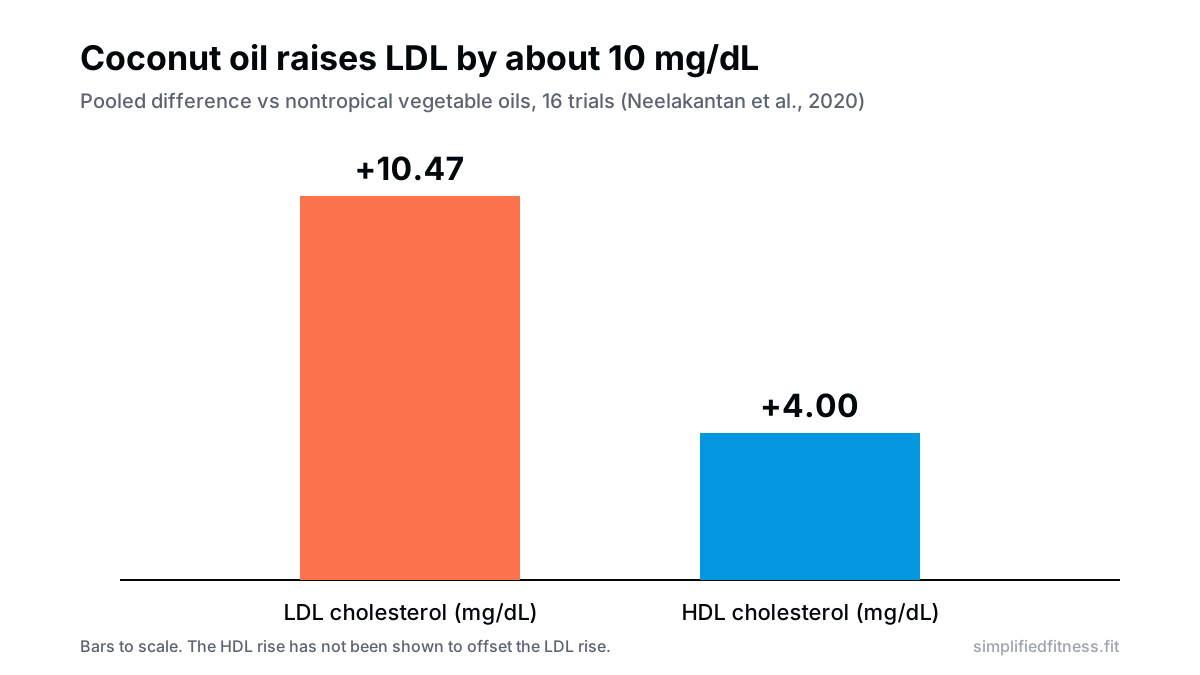
Coconut oil has its own meta-analysis. Across 16 trials, it raised LDL cholesterol by 10.47 mg/dL and HDL cholesterol by 4.00 mg/dL compared with nontropical vegetable oils, without clear effects on glucose, inflammation or body fat (Neelakantan et al., 2020). The authors concluded that this should inform choices about coconut oil.
Ghee is mostly saturated fat too, but we did not find a trial in the sources we checked that tested it directly against vegetable oils, so we are not going to guess at a number. Treat it like butter: great flavour, small spoon.
Do saturated fats actually cause heart disease?
This is where the research is not as one-sided as either camp online claims.
A 2020 Cochrane review of 15 randomized trials (about 59,000 participants, trials lasting at least 24 months) found that reducing saturated fat lowered combined cardiovascular events by 21% (RR 0.79, 95% CI 0.66 to 0.93), with moderate-quality evidence. But it found little or no effect on all-cause mortality (RR 0.96) or cardiovascular mortality, and replacing with polyunsaturated fat or carbohydrate did not differ significantly, while data on monounsaturated fat or protein as the replacement were very limited (Hooper et al., 2020).
A 2026 risk-stratified review of 17 trials (66,337 participants) added a useful nuance. For people at low cardiovascular risk, reducing or modifying saturated fat had little or no benefit over five years. For those at high risk, there was low to moderate certainty for important reductions in events, particularly nonfatal heart attack when saturated fat was replaced with polyunsaturated fat (RR 0.75, CI 0.58 to 0.99) (Steen et al., 2026). The authors noted limited data on monounsaturated replacement and large variation between trials.
What does that mean for a healthy 25-year-old lifter? The five-year trial benefit is small if your baseline risk is low. But those trials ran for years, not decades, and LDL and ApoB exposure builds over a lifetime. If you have a family history, high blood pressure, diabetes, a high LDL on a blood test or you smoke, the swap matters more. That is a conversation for your doctor, who can interpret your lipid panel and, if appropriate, an ApoB.
Which fats should lifters eat instead?
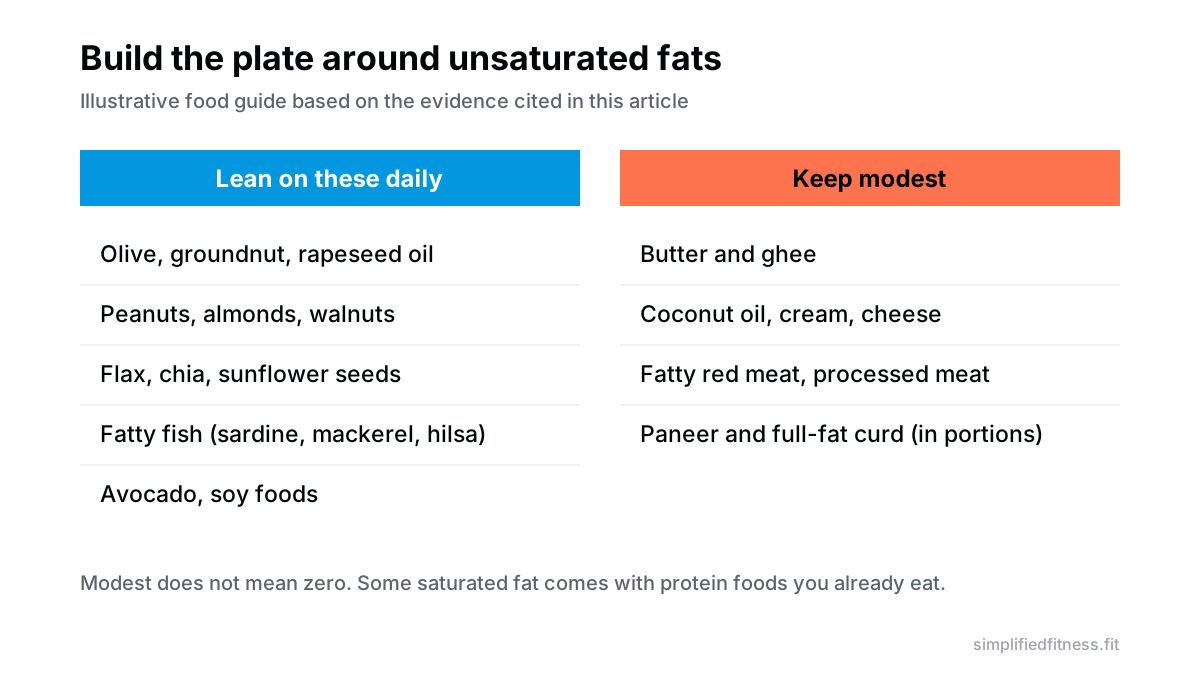
Think in terms of swaps, not bans. The goal is to keep saturated fat modest and let unsaturated fat carry most of your fat intake.
- Monounsaturated: olive oil, groundnut oil, avocado, almonds, peanuts.
- Polyunsaturated: walnuts, flax, chia, sunflower seeds, soya foods, fatty fish.
- Olive oil in particular: a 2022 meta-analysis of prospective studies found about 16% lower cardiovascular risk for each extra 25 g/day of olive oil, along with lower type 2 diabetes risk and all-cause mortality (Martinez-Gonzalez et al., 2022). Those results come almost entirely from observational cohort studies, so they cannot prove olive oil is the cause, but they fit the lipid data above.
Practical Indian-kitchen swaps:
- Cook sabzi and dal tadka in groundnut, rapeseed or olive oil, and finish with a small spoon of ghee if you like the taste.
- Keep a handful of peanuts, almonds or walnuts at your desk instead of namkeen or biscuits.
- Choose fish a couple of times a week if you eat it, and soya chunks or dal on other days.
- Use toned or low-fat curd and moderate paneer portions when calories are tight.
- Check labels on packaged snacks, since many are fried in palm oil or contain coconut fat.
For our broader view of fat needs, use the macro calculator to set a sensible total, then split it using the list above. If you eat keto-style, see our article on low-carb and ketogenic diets for lifters, because fat type matters more when fat is a much bigger share of calories. For marine fats specifically, we cover EPA and DHA dosing separately.
A simple weekly plan
| Situation | What to do |
|---|---|
| Healthy, low risk, normal lipids | Keep total fat comfortably above very low levels, make unsaturated the default, enjoy ghee or butter in small amounts |
| Lipid panel shows high LDL or ApoB | Cut butter, ghee and coconut oil further, add dal, soya, nuts and fish, and discuss testing and treatment with your doctor |
| Family history of early heart disease | Get a lipid panel early and treat the fat swap as a priority, not a preference |
| Cutting on a calorie deficit | Fat is calorie dense (about 9 kcal per gram), so measure oil with a spoon and favour nuts and fish for satiety |
| Keto or very high fat | Build fat from olive oil, nuts, eggs and fish, then recheck bloodwork after a few months |
Fibre also affects cholesterol, and our piece on soluble vs insoluble fibre covers how oats, dal and fruit fit in.
When to see a doctor
Nothing here diagnoses you. If you have a known lipid disorder, a family history of early heart disease, diabetes, kidney disease, or you are on cholesterol medication, follow your doctor’s advice over any general article. Chest pain, breathlessness on exertion or fainting during training need medical attention, not a diet tweak.
The bottom line on saturated vs unsaturated fats
Fat is not the enemy, and neither is a spoon of ghee. But the data points one way on the question you asked: eat enough total fat for your hormones, keep saturated fat modest for your arteries, and let olive oil, groundnut oil, nuts, seeds and fish do most of the work. That plan does not cost you muscle, and it keeps your LDL and ApoB on your side for the decades you plan to keep lifting.
Frequently Asked Questions
Does saturated fat increase testosterone?
There is no good evidence that saturated fat raises testosterone more than unsaturated fat does. The trials that found a drop in testosterone compared low-fat with higher-fat diets overall, not fat types against each other. Eat enough total fat, then choose most of it from unsaturated sources.
Is butter or ghee better than olive oil for muscle building?
No study shows that butter or ghee builds more muscle than olive oil at the same calories. Butter raised LDL cholesterol more than most vegetable oils in a 54-trial network meta-analysis, which is the part that matters for long-term heart health. Use ghee or butter for flavour in small amounts and cook with groundnut, rapeseed or olive oil most days.
How much saturated fat should a lifter eat?
Most heart-health guidance aims to keep saturated fat modest and replace it with unsaturated fat, but the exact gram target varies between guidelines and individuals. The evidence shows that reducing it helps most when the replacement is polyunsaturated fat and when baseline risk is high. Track it for a week with the food labels you already have, and check your LDL and ApoB on a blood test.
Is coconut oil healthy for lifters?
Small amounts are unlikely to matter much, but coconut oil is not a health food either. A 2020 meta-analysis found it raised LDL cholesterol by about 10 mg/dL and HDL by about 4 mg/dL compared with nontropical vegetable oils. Treat it like butter, a flavour choice, and not your main cooking fat.
Does a higher HDL from coconut oil cancel out the LDL rise?
Not that we can say. The meta-analysis reported both changes, but LDL is the particle linked to plaque build-up, and the study does not show that the HDL increase protects you. If you like coconut oil, keep the portion small and watch your lipid panel.
What is ApoB and why does it matter for lifters?
ApoB is a protein carried on each atherogenic particle such as LDL, so it reflects particle number rather than just cholesterol content. A 2019 feeding trial found that high saturated fat intake raised both LDL cholesterol and ApoB regardless of protein source. Ask your doctor whether an ApoB test makes sense, especially if you eat a lot of meat, cheese and ghee.
Is olive oil better than butter?
For blood lipids, yes. Olive oil lowered LDL cholesterol compared with butter in a network meta-analysis of randomized trials, and a meta-analysis of prospective cohorts linked more olive oil to lower cardiovascular risk. Cohort studies cannot prove cause, so treat olive oil as a good default, not a cure.
Do I need to avoid red meat and paneer to protect my heart?
You do not have to avoid them, but portions and the rest of the plate matter. In one feeding trial, red and white meat both gave higher LDL and ApoB than nonmeat protein sources such as legumes, nuts and soy, independent of saturated fat content. Rotate in dal and soya, and pick leaner cuts or smaller paneer portions.
Can too little fat lower my testosterone?
Possibly. A 2021 meta-analysis found lower total testosterone on low-fat diets, though a 2025 meta-analysis of 11 randomized trials found no significant difference and rated the certainty as low. Avoid very low fat intakes and read our guide on the minimum fat threshold for hormones.
Are seed oils bad for lifters?
The trial evidence points the other way. In a 2026 trial review, replacing saturated fat with polyunsaturated fat was linked to fewer nonfatal heart attacks, with low to moderate certainty. Online claims that vegetable oils are toxic do not match the controlled data, so you do not need to avoid groundnut, sunflower or rapeseed oil.
Should I take fish oil to protect my heart?
Eating fatty fish is the better-supported starting point, and supplements are a separate question with mixed evidence. Fish and some nuts and seeds supply polyunsaturated fats that fit the swap strategy described here. If you are curious about EPA and DHA doses, see our dedicated omega-3 article.
Does a low-carb or keto diet change this advice?
It makes the fat type decision more important, not less, because fat becomes a larger share of your calories. Higher fat intake means more saturated fat if you lean on butter, cheese and fatty meat. Build a keto plate around olive oil, nuts, fish and eggs and get your lipids checked after a few months.
Sources & References
Every claim above is checked against peer-reviewed research (PubMed, U.S. National Library of Medicine) or guidance from established health bodies. How we fact-check.
- Hooper L, et al. Reduction in saturated fat intake for cardiovascular disease. Cochrane Database Syst Rev. 2020. PMID: 32428300
- Steen JP, et al. Effect of interventions aimed at reducing or modifying saturated fat intake on cholesterol, mortality, and major cardiovascular events: a risk stratified systematic review of randomized trials. Ann Intern Med. 2026. PMID: 41397264
- Schwingshackl L, et al. Effects of oils and solid fats on blood lipids: a systematic review and network meta-analysis. J Lipid Res. 2018. PMID: 30006369
- Neelakantan N, et al. The effect of coconut oil consumption on cardiovascular risk factors: a systematic review and meta-analysis of clinical trials. Circulation. 2020. PMID: 31928080
- Bergeron N, et al. Effects of red meat, white meat, and nonmeat protein sources on atherogenic lipoprotein measures in the context of low compared with high saturated fat intake: a randomized controlled trial. Am J Clin Nutr. 2019. PMID: 31161217
- Martinez-Gonzalez MA, et al. Effect of olive oil consumption on cardiovascular disease, cancer, type 2 diabetes, and all-cause mortality: a systematic review and meta-analysis. Clin Nutr. 2022. PMID: 36343558
- Whittaker J, et al. Low-fat diets and testosterone in men: systematic review and meta-analysis of intervention studies. J Steroid Biochem Mol Biol. 2021. PMID: 33741447
- Soltani S, et al. The effect of low-fat diets versus high-fat diet on sex hormones: a systematic review and meta-analysis of randomized controlled trials. J Food Sci. 2025. PMID: 40387562

Umair Hazrami · Founder & Head Coach, Simplified Fitness
Umair Hazrami founded Simplified Fitness and the Simplified Lifter channel to cut through fitness noise. With 4+ years of consistent training and 10+ coaching clients, he writes every guide from the peer-reviewed research and links the sources so you can check them. Our editorial standards.
Educational content only, not medical advice. If you have a medical condition, are pregnant, or take medication, talk to a qualified doctor before changing your diet, supplements or training. Full disclaimer.
Keep reading
Nutrition
Alcohol and Muscle Growth: What a Heavy Night Does to MPS, Sleep and Recovery
Alcohol and muscle growth: does a heavy Saturday night wipe out your week? See what research says on MPS, REM sleep and recovery, and how to limit the damage.
7 min read
Nutrition
Ashwagandha and Cortisol: Does It Lower Stress and Boost Strength in the Gym?
Ashwagandha for lifting: what the trials show on cortisol, stress and strength gains, realistic dose (300-600 mg), who should skip it and how to buy it safely.
7 min read
Nutrition
Caffeine Sensitivity, CYP1A2 Genetics and Caffeine Cycling: Why Pre-Workout Works for Him, Not You
Caffeine sensitivity genetics explain why pre-workout gives your friend PRs and you anxiety. See what CYP1A2 and ADORA2A do, and how to find your dose.
8 min read
Nutrition
Creatine Non-Responders: Why It May Not Be Working and What to Try
Creatine non responder? Learn why roughly 1 in 4 people see little change, how baseline diet matters, and when carbs with creatine help. Studies linked.
7 min read