Can You Build Muscle on Keto? What Trials Show for Lifters
Keto diet for muscle growth: what the trials show on strength, power and lean mass, when keto works for fat loss, and when carbs serve lifters better.

TL;DR. The short answer
- Keto can maintain muscle while you lose fat, but trials in trained lifters do not show it builds more muscle than a normal-carb diet, and some show less.
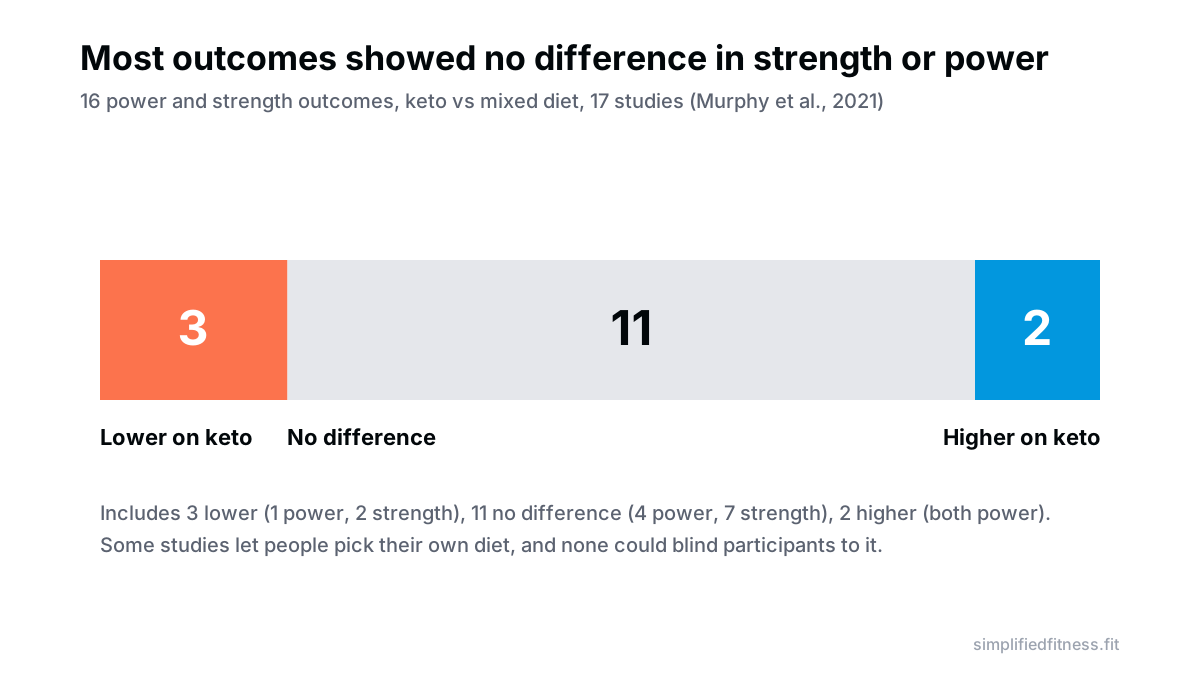
- Strength and power usually hold up on keto. A 2021 systematic review found 11 of 16 power and strength outcomes showed no difference versus a mixed diet.
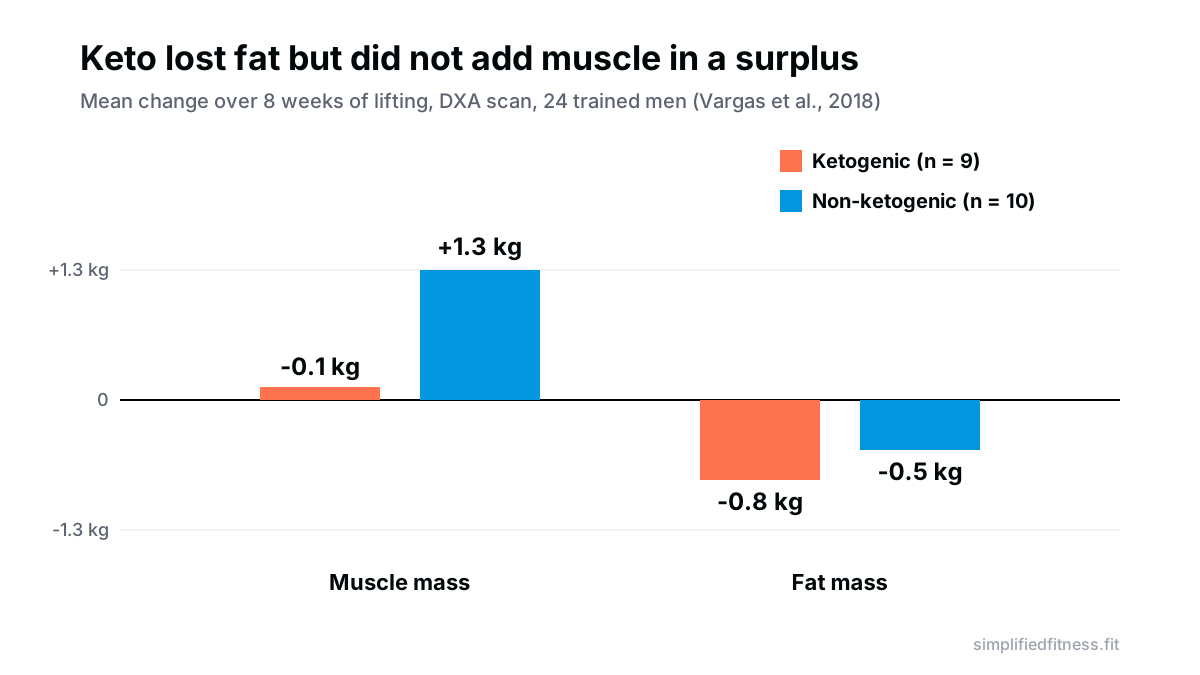
- In an 8-week trial with a calorie surplus, lifters on keto lost fat but gained no muscle (-0.1 kg), while the non-keto group gained 1.3 kg.
- A 2026 meta-analysis found higher carbohydrate intake did not clearly boost hypertrophy when protein was matched, so carbs are not magic either. Certainty is low.
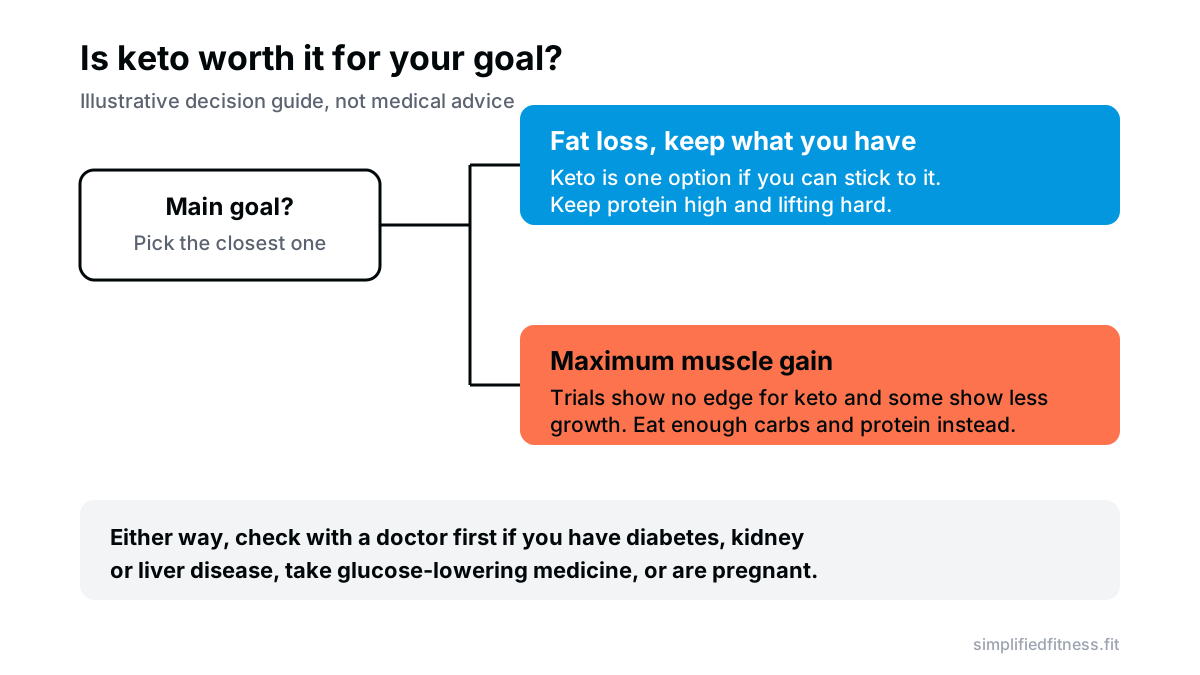
- Keto suits you if you enjoy it and want fat loss. For maximum muscle gain, an ordinary diet with enough carbs and protein is the lower-risk choice.
Part of our complete guide: Carbohydrates, Fats, Fibre, Micronutrients and Hydration: The Lifter's Fueling Guide
Table of contents
Is a keto diet for muscle growth a good idea? Based on the trials we have, keto can hold on to muscle while you lose fat, but it has not been shown to build more muscle than a normal-carb diet, and a few studies suggest it builds less. Strength and power mostly survive. Extra growth does not show up.
That is the short answer. The longer one matters because keto is sold hard to lifters, usually with a before-and-after photo and no control group. This article sits inside our guide to carbs, fats and hydration for performance. For the carbohydrate side of the story, see how dietary carbohydrates affect hypertrophy and glycogen. Here we audit the ketogenic diet itself, using the trials in lifters.
What counts as a ketogenic diet for lifters?
A ketogenic diet restricts carbohydrate hard enough that your body relies more on fat and ketones for fuel. In the lifting trials below, that meant roughly 50 g of carbohydrate or less a day, or about 10% of calories. Greene and colleagues, for instance, defined theirs as 50 g or 10% of daily intake or less, against more than 250 g a day on the usual diet (Greene et al., 2018).
For context, one katori of cooked rice or two rotis can use up a big part of that allowance. Dal, rajma, fruit and curd add more. That is why keto is a real lifestyle change in an Indian kitchen, not a tweak.
A note on evidence quality before we start. Most keto-and-lifting trials are small, run about 2-3 months, and mostly use men. Treat everything below as “what happened in these groups,” not a promise for you.
Can you build muscle on keto? The trials
Three of the better-known trials in trained lifters give three slightly different answers. That is normal in a small literature.
Vargas et al. (2018), calorie surplus. Twenty-four trained men did 8 weeks of resistance training in a calorie surplus. Those on keto lost 0.8 kg of fat and showed no meaningful change in muscle mass (-0.1 kg). The non-keto group gained 1.3 kg of muscle. The authors concluded keto may reduce fat without cutting lean mass, but might not help build muscle during positive energy balance (Vargas et al., 2018). The keto group had only 9 people, so the numbers are rough.
Paoli et al. (2021), natural bodybuilders. Nineteen competitive natural bodybuilders were randomised to keto or a western diet for two months. Body fat fell on keto, and lean mass rose significantly only in the western-diet group. Maximal strength improved similarly in both. The authors said keto may be used in contest prep for health and leaning, with the caution that the hypertrophic response could be blunted (Paoli et al., 2021).
Wilson et al. (2020), a different result. Twenty-five resistance-trained men followed keto or a western diet for 10 weeks with matched calories and protein. Lean body mass increased in both groups (2.4% on keto, 4.4% on western), and strength and power rose to the same extent. After a one-week carbohydrate reintroduction, the keto group’s lean mass rose a further 4.8% (Wilson et al., 2020). That final jump is likely at least partly water and glycogen coming back, though the abstract does not break it down, so do not read it as fresh muscle.
Why do the results disagree?
Several things differ between these trials, and each one can move the numbers.
- Calories. Vargas fed everyone a surplus, Wilson matched calories, and Greene let lifters eat freely. Gaining in a surplus and holding muscle in a deficit are different questions.
- Protein and design. Wilson matched calories and protein. Different protocols make results hard to stack side by side.
- Measurement. Lean mass from a body composition scan includes water and glycogen. Switching diets changes both, so a lean mass change is not the same as a muscle fibre change.
- Duration and sample size. All of these trials are short and small. A single dropout can swing a group average.
The honest read: keto is unlikely to wreck muscle in the short term, and just as unlikely to beat carbs for growth. Where keto has differed from a mixed diet, it has tended to lag behind it on lean mass, not lead.
Does keto hurt strength and anaerobic power?
Less than the internet suggests. A 2021 systematic review of 17 studies looked at power and strength outcomes in healthy, non-obese people eating keto for at least 14 days. Of 16 power or strength outcomes, 3 were lower on keto, 11 showed no difference, and 2 (both power) were higher. The authors concluded keto neither helps nor harms physical performance overall, while noting that diet duration, training status, test type and sex may explain the mixed results (Murphy et al., 2021).
A 2025 meta-analysis of 33 studies in adults, not only lifters, agreed. There was no significant difference in countermovement jump power or in squat and bench press strength between keto and other diets. It did find slightly lower fat-free mass on keto (about 0.5 kg), and the authors called for better trials (Wang et al., 2025).
Trials in lifters back the “strength holds” picture. Paoli and Wilson both saw similar strength gains on keto and a western diet (above). In Greene’s crossover study of 14 competitive powerlifters and weightlifters, each diet phase lasted 3 months and lifting performance did not differ between keto and the usual diet. But lean mass was 2.26 kg lower on keto, so strength held while lean tissue slipped (Greene et al., 2018).
Then there is the idea that keto costs you 10-15% of your anaerobic power. We could not confirm a figure like that in the studies above, and the meta-analytic data point to no significant difference in jump power. That does not mean nobody feels worse. A narrative review noted that some studies show lower absolute performance (such as 1-rep max), especially when not expressed relative to body mass (Valenzuela et al., 2021). If you notice your high-rep sets or last working sets fading, that fits what many lifters report, though the trials do not prove it.
Is keto or high carb better for hypertrophy?
Here is the twist. Carbs are not clearly magic either. A 2026 meta-analysis of 11 randomised trials compared higher and lower carbohydrate intakes in resistance-training adults with matched protein. It found no significant effect of carbohydrate on muscle growth (SMD = 0.15, p = 0.23). The authors graded certainty as low, because of imprecision and moderate risk of bias (Henselmans et al., 2026).
Put those findings together and you get a fair picture.
- Keto has not been shown to build more muscle than a normal diet.
- Carbs have not been shown to be essential for muscle growth either, at least in these data.
- Total calories, protein and hard training probably matter more than the carb number.
So why do we still lean towards carbs for bulking? Because the keto trials that did find differences favoured carbs, and carbs make a calorie surplus easier to hit. That is a practical argument, not a proven mechanism.
When keto is reasonable and when it is not
A narrative review of randomised trials concluded that an unrestricted, energy-balanced keto diet reduces body and fat mass in the short term. But it found no or negligible extra benefit when keto and conventional diets produced the same calorie deficit, and it said keto may not be a recommendable option to gain muscle mass and strength or power (Valenzuela et al., 2021).
| Situation | Keto reasonable? | Why |
|---|---|---|
| Fat loss, you like fatty foods | Often yes | Short-term fat loss, muscle mostly kept |
| Fat loss, you love roti and rice | Probably not | You will struggle to stick to it |
| Lean bulk or maximum muscle | Not the best choice | No trial advantage, some show less lean gain |
| Weight-class powerlifter | Possible, test early | Lifts held, but lean mass dropped in one trial |
| Vegetarian | Harder | Dal, rajma and grains are limited |
| Diabetes, kidney or liver disease | Doctor first | Medication and safety change |
How to lift on keto if you still want to
If you try it, give yourself the best shot.
- Keep protein up. Do not let fat crowd out protein. Work out your target with our protein calculator. If you are cutting, see high protein during caloric restriction.
- Do not stack a big deficit on top. Keto and an aggressive cut together makes muscle loss more likely. Read setting an optimal calorie deficit first.
- Expect a rough start. Many lifters feel flat in the first weeks while they adapt, though the trials above did not time this precisely. Lower your ego loads for a couple of weeks before judging the diet.
- Do not cut fat too low. Keto is high in fat by design, but the principle still applies if you drift away from it. Our guide to the minimum fat threshold covers it.
- Track the numbers that matter. Log working-set reps and weight. Waist measurement and strength tell you more than scale weight, which swings with water.
For a lifter who trains hard in the evening and wants carbs around workouts, see our note on intra-workout carbohydrates.
Who should talk to a doctor first
For some people keto is a big enough change to need medical input. See a doctor before starting if you:
- have type 1 or type 2 diabetes, or take glucose-lowering medicine such as insulin, sulfonylureas or SGLT2 inhibitors (doses may need adjusting, and some combinations carry real risks)
- have kidney or liver disease
- are pregnant or breastfeeding
- have a history of disordered eating
- take blood pressure medicine, since weight and fluid shifts can change dosing needs
We cannot diagnose or advise on medication here. If you feel dizzy, very weak or unwell on keto, stop and seek medical advice.
The bottom line
Keto does not break lifting and it does not boost it. In trained lifters it tends to lose fat, keep strength roughly intact, and add less lean mass than a normal diet when you are trying to gain. The evidence is short-term and mostly from young men, so it will not settle every question.
Choose keto if you enjoy it and the main goal is fat loss. Choose a normal diet with enough carbs and protein if you want maximum muscle. Either way, the basics still do the work: enough protein, hard progressive training and enough sleep. To set calories and macros for your goal, use the macro calculator.
Frequently Asked Questions
Can you build muscle on keto?
Yes, some muscle gain is possible, but the evidence suggests it is not better than a normal-carb diet and may be smaller. In an 8-week trial in trained men eating a calorie surplus, the keto group's muscle mass did not change while the non-keto group gained about 1.3 kg. If muscle gain is your main goal, a higher-carb diet is the safer bet.
Will keto make me lose muscle?
Not necessarily. A 2025 meta-analysis of 33 studies in adults (not only lifters) found no significant difference in muscle mass between keto and other diets, though fat-free mass was about 0.5 kg lower on keto. Keeping protein high and lifting heavy gives you the best chance of keeping muscle in a deficit.
Does keto reduce strength?
Usually not in the studies we have. A 2021 systematic review found most strength outcomes showed no difference, and two trials in trained lifters found similar strength gains on keto and a western diet. Some people still feel flat for the first few weeks, so do not judge your training in week one.
Is keto or high carb better for hypertrophy?
Evidence does not show keto beats carbohydrate-based eating for hypertrophy. A 2026 meta-analysis of 11 trials found higher carbohydrate intake did not significantly increase muscle growth when protein was matched, but certainty was low. In practice, many lifters find carbs help them train harder, so that is what we suggest for a gaining phase.
Does keto lower anaerobic power and training volume?
The research is mixed rather than clearly negative. Meta-analytic data show no significant difference in countermovement jump power, and the Greene crossover trial found lifting performance did not differ from the usual diet. Individual experience varies, so track your own working sets and bar speed through the adaptation period.
How long does keto adaptation take for lifters?
There is no fixed number in the lifting studies, so any figure you see online is a rough guess. Many lifters report feeling flat in the first few weeks, which is why judging performance in week one is unfair to the diet. Plan a few easier weeks, keep fluids and salt up, and judge your training after that.
How much protein should I eat on keto?
Do not drop protein just because fat is high. Trials in lifters used diets with adequate protein, and the keto groups were not eating low-protein diets. Our protein calculator can set a daily target for your body weight, and the usual lifting range applies on keto too.
Is keto good for fat loss in lifters?
It can be, although it is not special. A narrative review found that when keto and a conventional diet create the same calorie deficit, keto gives no or negligible extra body composition benefit. Keto helps some people because it makes eating less easier, so choose the diet you can actually follow.
Can keto work for powerlifters in a weight class?
It may be one option. In a crossover trial of 14 competitive powerlifters and weightlifters, a low-carb ketogenic diet lowered body mass by 3.26 kg compared with their usual diet, and lifting performance did not differ. Lean mass was also 2.26 kg lower, so it should be tried well before competition.
Is keto a good idea during a bulk?
Probably not if you want maximum muscle. Ketogenic bulking was tested in trained men in a calorie surplus and muscle mass did not rise on keto. A diet with plenty of rice, roti, oats or potatoes gives you easy calories and carries a better track record for growth.
Can vegetarians do keto and still lift well?
It is harder. Dal, rajma, roti, rice and fruit are the usual Indian vegetarian staples and they are hard to fit within keto carb limits, so protein sources shrink to paneer, tofu, eggs if you eat them, and whey. Protein variety matters for lifters, so a vegetarian lifter may find a moderate-carb pattern easier.
What are the risks of a ketogenic diet?
People often report fatigue, headaches or constipation early on, and a 2021 review noted that the long-term effectiveness and safety of keto in strength-trained people remains to be determined. Diabetes medicine, kidney or liver disease and pregnancy all change the picture. Speak to a doctor before starting if any of those apply, and never change diabetes medicine on your own.
Do I need to cycle carbs back in around workouts?
It is not proven, but a narrative review lists reintroducing carbohydrates as a strategy that needs more research. One trial saw lean mass jump after a one-week carb reintroduction, though that may include water. If you try it, treat it as an experiment and track your performance.
Sources & References
Every claim above is checked against peer-reviewed research (PubMed, U.S. National Library of Medicine) or guidance from established health bodies. How we fact-check.
- Vargas S, et al. Efficacy of ketogenic diet on body composition during resistance training in trained men: a randomized controlled trial. J Int Soc Sports Nutr. 2018. PMID: 29986720
- Paoli A, et al. Effects of Two Months of Very Low Carbohydrate Ketogenic Diet on Body Composition, Muscle Strength, Muscle Area, and Blood Parameters in Competitive Natural Body Builders. Nutrients. 2021. PMID: 33530512
- Wilson JM, et al. Effects of Ketogenic Dieting on Body Composition, Strength, Power, and Hormonal Profiles in Resistance Training Men. J Strength Cond Res. 2020. PMID: 28399015
- Greene DA, et al. A Low-Carbohydrate Ketogenic Diet Reduces Body Mass Without Compromising Performance in Powerlifting and Olympic Weightlifting Athletes. J Strength Cond Res. 2018. PMID: 30335720
- Valenzuela PL, et al. Effects of Combining a Ketogenic Diet with Resistance Training on Body Composition, Strength, and Mechanical Power in Trained Individuals: A Narrative Review. Nutrients. 2021. PMID: 34578961
- Murphy NE, et al. High-Fat Ketogenic Diets and Physical Performance: A Systematic Review. Adv Nutr. 2021. PMID: 32865567
- Wang Y, et al. Effects of ketogenic diet on muscle mass, strength, aerobic metabolic capacity, and endurance in adults: a systematic review and meta-analysis. J Health Popul Nutr. 2025. PMID: 41035089
- Henselmans M, et al. The Effect of Carbohydrate Intake on Muscle Hypertrophy: A Systematic Review and Meta-analysis. Sports Med. 2026. PMID: 41712097

Umair Hazrami · Founder & Head Coach, Simplified Fitness
Umair Hazrami founded Simplified Fitness and the Simplified Lifter channel to cut through fitness noise. With 4+ years of consistent training and 10+ coaching clients, he writes every guide from the peer-reviewed research and links the sources so you can check them. Our editorial standards.
Educational content only, not medical advice. If you have a medical condition, are pregnant, or take medication, talk to a qualified doctor before changing your diet, supplements or training. Full disclaimer.
Keep reading
Nutrition
Alcohol and Muscle Growth: What a Heavy Night Does to MPS, Sleep and Recovery
Alcohol and muscle growth: does a heavy Saturday night wipe out your week? See what research says on MPS, REM sleep and recovery, and how to limit the damage.
7 min read

Nutrition
Ashwagandha and Cortisol: Does It Lower Stress and Boost Strength in the Gym?
Ashwagandha for lifting: what the trials show on cortisol, stress and strength gains, realistic dose (300-600 mg), who should skip it and how to buy it safely.
7 min read
Nutrition
Caffeine Sensitivity, CYP1A2 Genetics and Caffeine Cycling: Why Pre-Workout Works for Him, Not You
Caffeine sensitivity genetics explain why pre-workout gives your friend PRs and you anxiety. See what CYP1A2 and ADORA2A do, and how to find your dose.
8 min read
Nutrition
Creatine Non-Responders: Why It May Not Be Working and What to Try
Creatine non responder? Learn why roughly 1 in 4 people see little change, how baseline diet matters, and when carbs with creatine help. Studies linked.
7 min read