Glycemic Index (GI) vs Glycemic Load (GL): Does Carb Speed Matter for Body Composition?
Glycemic index vs glycemic load for bodybuilding: do insulin spikes make white rice fattening? See what controlled trials show and how to pick your carbs.
TL;DR. The short answer
- For most lifters eating enough protein and a set calorie target, carb speed (glycemic index) is a minor factor for fat loss and muscle gain. Total calories, protein and training decide most of the outcome.
- Insulin rising after a meal does not by itself store fat. In two inpatient trials, cutting carbs and insulin did not speed up fat loss, and a low-fat, high-carb diet led people to eat fewer calories.
- Glycemic load (GL) is more useful than glycemic index (GI) because it multiplies carb speed by portion size. A big plate of a 'slow' carb can have a higher load than a small portion of a 'fast' one.
- White rice, potatoes and bread are fine in a lifter's diet. Pick carbs by how full they keep you, how your stomach handles them and your budget.
- If you have diabetes, prediabetes or PCOS, GI and GL may matter more for blood sugar control. Speak to your doctor or dietitian for your own plan.
Part of our complete guide: Carbohydrates, Fats, Fibre, Micronutrients and Hydration: The Lifter's Fueling Guide
Table of contents
If you are weighing glycemic index vs glycemic load for bodybuilding, here is the short answer: when your calories, protein and training are the same, carb speed has little effect on fat loss or muscle gain that anyone has been able to show reliably. White rice, potatoes and bread do not make you fat because they raise insulin quickly. Fat gain comes from a sustained calorie surplus.
This article is part of our complete guide to carbohydrates, fats and hydration. Here we focus on one question: does the speed of a carb matter, or is that just another fear that keeps lifters eating bland food they hate?
What are glycemic index and glycemic load?
The glycemic index (GI) ranks carbohydrate foods by how much a fixed amount of their carbohydrate raises blood glucose over roughly two hours, compared with pure glucose, on a 0-100 scale. Lifters call it “carb speed”, which is close enough, though strictly it measures the size of the blood sugar rise. Foods at 55 or below count as low GI. An expert summit on the topic described GI as a valid and reproducible way of classifying carbohydrate foods for this purpose (Augustin et al., 2015).
GI has one big blind spot: it is measured per fixed amount of carbohydrate, not per plate. That is where glycemic load (GL) comes in. GL = GI x grams of carbohydrate in your serving / 100. It combines speed with portion size.
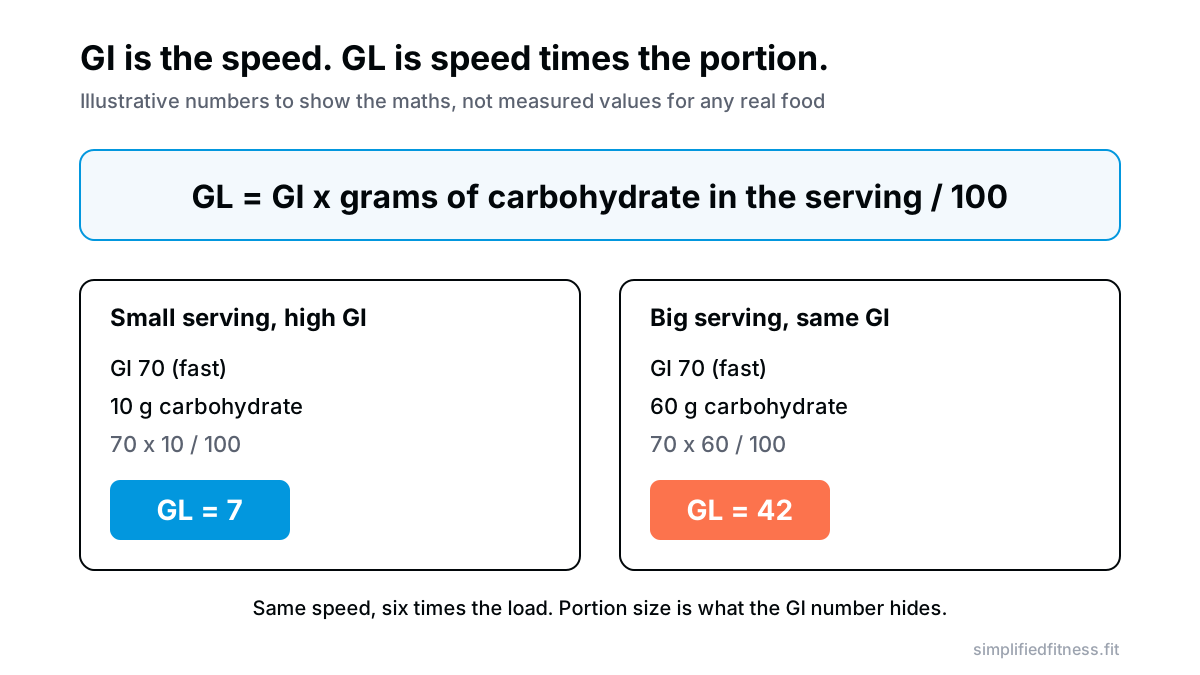
Think of GI as how fast the car is going and GL as how far it travels. A fast carb in a tiny portion can have a lower load than a slow carb in a huge one. That is why GL is the more practical number, and it is also why a food chart alone can mislead you.
Does an insulin spike make you store fat?
This is the heart of the fear, so let’s treat it fairly. The idea is called the carbohydrate-insulin model: high-carb food raises insulin, insulin pushes energy into fat cells and locks it there, so you get hungrier and gain fat regardless of calories.
It sounds tidy. The problem is what happens when researchers test it.
Trial one: same calories, cut carbs or cut fat. In a 2015 metabolic ward study, 19 adults with obesity ate two isocaloric diets in random order, one with carbohydrate restricted and one with fat restricted, for 6 days each. Body fat loss was 53 g/day on the carb-restricted diet and 89 g/day on the fat-restricted diet, a significant difference favouring cutting fat (Hall et al., 2015). Mathematical modelling in the same paper predicted that the body acts to minimise such differences over longer periods, so do not read this as “low-fat wins”. Read it as “low insulin did not give a fat loss edge”.
Trial two: let people eat as much as they want. In 2021, 20 adults lived in a research centre and ate freely from two diets for 2 weeks each: a plant-based low-fat diet with a high glycemic load, and an animal-based ketogenic diet with a very low one. The low-fat, high-GL diet led to about 689 kcal/day less intake over 2 weeks, and 544 kcal/day less over the final week (Hall et al., 2021). The authors concluded the carbohydrate-insulin model’s predictions were inconsistent with what they saw.
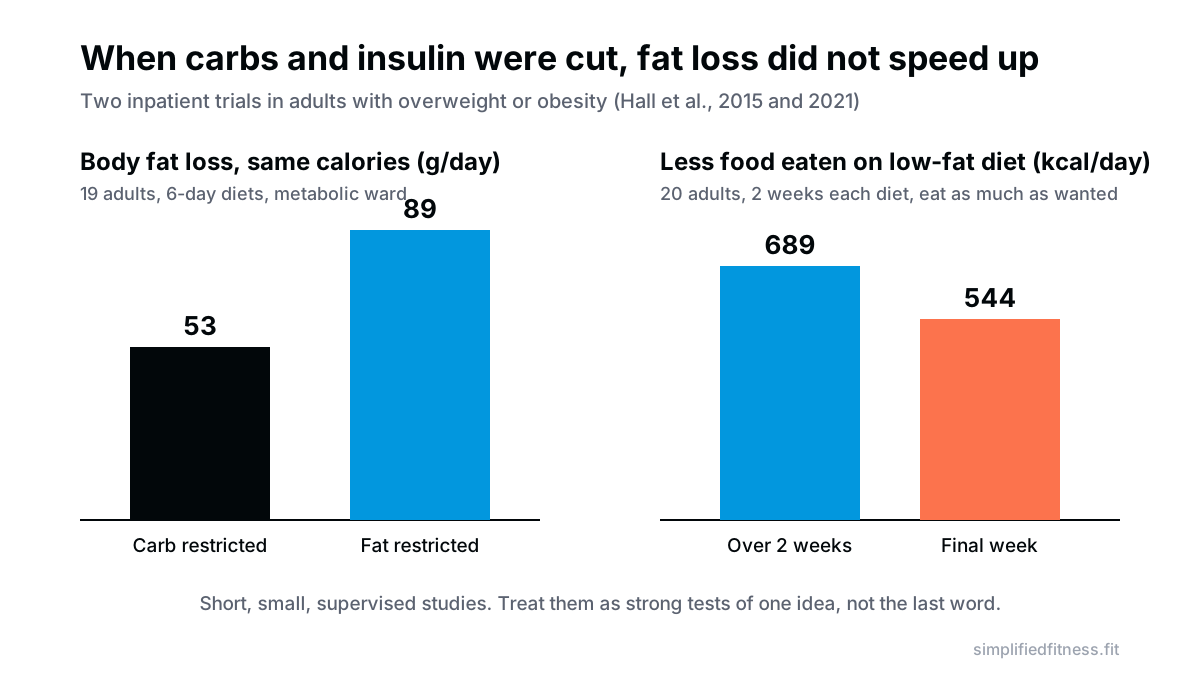
Both studies are small and short, and were run in adults with obesity (2015) or mostly overweight (2021), not trained lifters. They are strong tests of a specific idea, but not the final word.
What about long-term trials and the conflicting evidence?
Not every study points the same way, and that is worth being honest about.
In the 12-month DIETFITS trial, 609 adults without diabetes were assigned to a healthy low-fat or healthy low-carb diet. Weight change was -5.3 kg versus -6.0 kg, a difference of 0.7 kg that was not statistically significant. Baseline insulin secretion did not predict who did better on which diet (Gardner et al., 2018).
On the other side, a 2018 randomized trial of 164 adults who had first lost weight found that people on a 20% carbohydrate diet burned more energy than those on a 60% carbohydrate diet: 209 kcal/day more in the intention-to-treat analysis, and more in the highest-insulin-secretion group (Ebbeling et al., 2018). The authors saw this as consistent with the carbohydrate-insulin model. Note that the setting was weight maintenance after weight loss, not a lifter in a muscle-building phase.
Why might the results differ? The designs are not alike: 6 days versus 20 weeks versus 12 months, ward-fed versus provided meals versus free living, and different outcomes (fat loss, energy expenditure, weight). A careful reading is that carbohydrate quantity might nudge energy expenditure a little in some people, but nobody has shown that it overrides calorie balance for fat loss or gain.
The expert summit statement takes a similar middle line: low GI and GL diets are relevant to diabetes and heart disease and “probably” obesity (Augustin et al., 2015). Probably is not the same as proven.
Is insulin anabolic, and do you need a spike to build muscle?
Here the myth swings the other way: “insulin builds muscle, so I need fast carbs after every set.” The real picture is more modest.
In a study where young men received intravenous amino acids at four different insulin levels, tripling amino acid availability doubled muscle protein synthesis. Raising insulin from a low level to 30 mU/l roughly halved muscle protein breakdown, but muscle protein synthesis was the same at higher insulin doses as at the lowest (Greenhaff et al., 2008). In plain words: amino acids drive synthesis, and a modest amount of insulin helps by cutting breakdown. Beyond that, more insulin did not add anything for synthesis.
This was an infusion study in a small sample of healthy young men, so it is a mechanism clue, not a gym rule. Still, it fits the practical picture. Hitting your daily protein is the priority, and a moderate carb meal around training already produces enough insulin to do its job. For hypertrophy basics, see our muscle hypertrophy guide for natural lifters.
White rice vs brown rice for lifting
Brown rice keeps its bran, so it has more fibre and typically a lower glycemic response. White rice is milled, digests quickly and sits lighter in the stomach. Neither is “the fat loss rice.”
A few practical points:
- Gut comfort. Close to a hard session, many lifters find white rice easier on the stomach than high-fibre foods. That is a comfort call, not a GI call.
- Fullness. If you tend to get hungry on a cut, the extra fibre and chewing in brown rice, millets or dal can help. We cover fibre targets in our dietary fibre guide.
- Calories. A cup of cooked white and a cup of cooked brown rice are close in energy. Your portion size matters far more than the colour.
- Variability. As the GI tables show, rice GI differs by variety and processing, so a single label on a chart is shaky.
The same goes for potatoes, roti and bread. They are all usable carbs, and the right one is the one you will stick to.
Choose carbs by fullness and comfort, not by fear
If GI is not the decider, what is? Satiety is a good one. In a study that fed 240 kcal servings of 38 foods to groups of 11-13 people, boiled potatoes scored 323% on fullness compared with white bread at 100%, while a croissant scored 47%. Fullness was higher in foods with more protein, fibre and water, and lower with more fat (Holt et al., 1995). Potatoes are high GI by most charts, yet they were the most filling food tested.
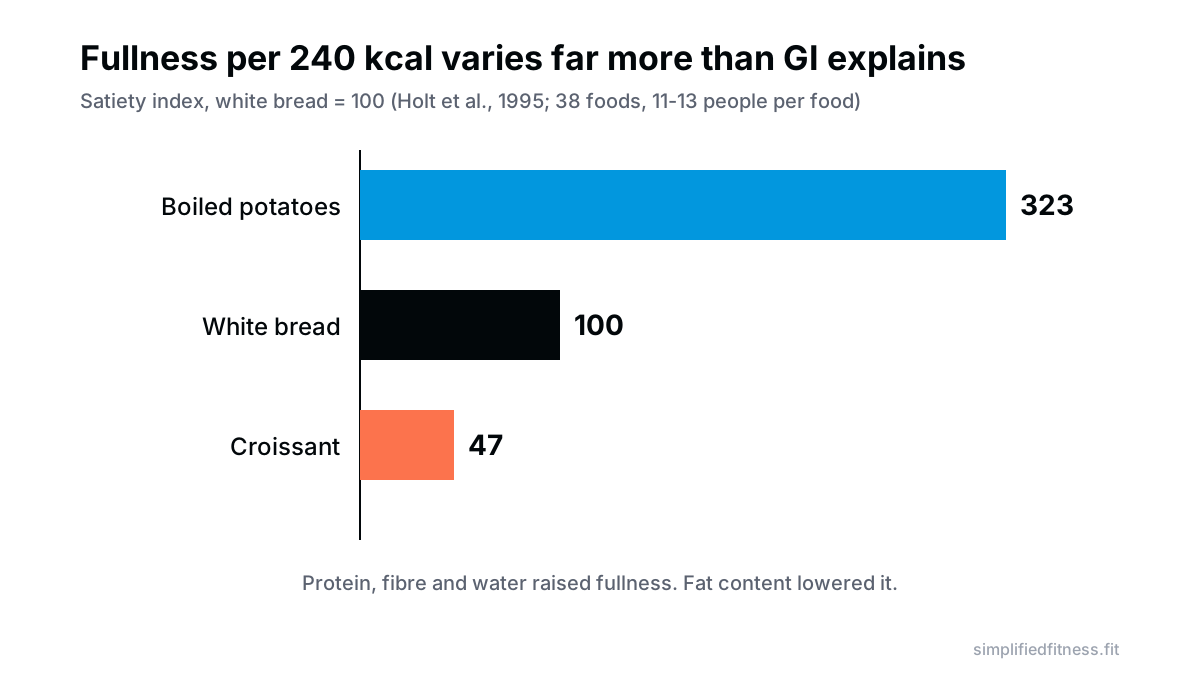
This was a single-session test in small groups, so it does not tell you what happens over months. It does show why “high GI equals bad” is too blunt.
A simple way to choose:
| Your situation | Carbs that tend to work | Why |
|---|---|---|
| Cutting, often hungry | Dal, chana, rajma, oats, boiled potatoes, fruit | Fibre, protein and water add fullness |
| Hard session in 1-2 hours | White rice, banana, poha, plain roti | Low fibre, easy on the stomach |
| Bulking, struggling to eat enough | White rice, rice dishes, bread, curd rice | Compact, easy to eat in volume |
| Tight budget | Rice, roti, potatoes, seasonal fruit | Cheap and filling; no need to buy “low GI” products |
| Diabetes, prediabetes or PCOS | Discuss with your doctor or dietitian | GI and GL may matter more for blood sugar |
How to use GL if you want to
If you like numbers, use GL as a rough check on meals, not as a rule. Use it as a tiebreaker when two options are equal in calories and protein. Skip it if tracking it makes eating stressful.
A workable order of priorities for body composition:
- Hit a calorie target that fits your goal. Our calorie calculator gives a starting point.
- Hit your protein target.
- Fill the rest with carbs and fats you enjoy and digest well.
- Only then, use fibre, fullness and GL to fine-tune.
For carb amounts by training load, see our article on dietary carbohydrates, glycogen and hypertrophy. If you are wondering whether skipping carbs would help, we look at that in low-carb and keto diets for lifters.
When GI and GL do matter
Everything above is about healthy lifters eating to a calorie target. Some people are in a different situation. The consensus summit noted that low GI and GL diets are particularly relevant for people with insulin resistance (Augustin et al., 2015). If you have diabetes, prediabetes, PCOS, or a family history, or if you feel shaky and faint after carb-heavy meals, talk to a doctor or registered dietitian. Do not diagnose yourself from a food chart, and do not change diabetes medication or diet without medical advice.
The bottom line
Carb speed is not the villain it is made out to be. In controlled feeding trials, lowering insulin did not accelerate fat loss, and higher-carb diets did not push people to overeat. Long-term trials are mixed on small metabolic effects, but none show that GI beats calorie balance. Insulin helps muscle mainly by cutting breakdown, and protein does the building.
So eat the rice. Set calories and protein first, then choose carbs for fullness, digestion, taste and budget. Our free diet plan shows how this looks on an Indian plate, and the macro calculator turns your targets into grams.
Frequently Asked Questions
Is glycemic index vs glycemic load a big deal for bodybuilding?
Not for most lifters. When calories, protein and training are matched, the evidence does not show that choosing lower-GI carbs builds more muscle or burns more fat. Glycemic load is the more practical number because it accounts for portion size, but it still sits well below total intake and training in importance.
Does an insulin spike cause fat gain?
Not on its own. Insulin does help store energy, but fat gain depends on whether you eat more energy than you use over weeks. In a 2021 inpatient trial, a low-carb diet with a very low glycemic load led people to eat more, not less, than a high-carb low-fat diet. If you are gaining fat, check your total calories before blaming the carb type.
Is white rice bad for lifters?
No. White rice digests fast and is high on the GI scale, but it is low in fibre and easy on the stomach, which many lifters use to their advantage around training. Over a whole day, your calorie total and protein matter far more than which rice you chose. Use white rice when you want an easy meal and brown rice when you want more fibre and chew.
White rice vs brown rice for lifting, which is better?
Neither is better by default. Brown rice has more fibre and usually a lower glycemic response, but GI values for rice vary widely by variety and cooking method. Choose the one you digest well and will actually eat consistently, and match the portion to your calorie target.
What is the difference between glycemic index and glycemic load?
Glycemic index ranks how much a fixed amount of carbohydrate from a food raises blood glucose over about two hours, compared with pure glucose. People call it carb speed, though it really measures the size of the rise. Glycemic load multiplies that GI by the grams of carbohydrate in your actual serving, then divides by 100. This means a food can have a high GI but a small load if you eat a small portion.
Do high-GI carbs make you fatter than low-GI carbs?
The evidence does not show that clearly for people eating to a set calorie target. An expert consensus group concluded low GI and GL diets are relevant to diabetes and heart disease and 'probably' obesity, so the weight link is less certain. Focus on calories first, then use GI as a tiebreaker if it helps you feel fuller.
Is insulin anabolic, and do I need a carb spike to build muscle?
Insulin is anabolic mainly because it reduces muscle protein breakdown, not because it drives protein synthesis harder. In a controlled infusion study in young men, raising insulin while holding amino acids steady cut muscle protein breakdown but did not increase muscle protein synthesis. Amino acids from protein did, so protein intake is the priority.
Should I eat fast carbs after a workout?
They are optional for most people. Fast carbs refill glycogen quicker, which matters if you train the same muscles again within hours, but over a normal 24-hour recovery gap your total daily carbohydrate matters more. If a banana or white rice after training feels good and fits your calories, it is a fine choice.
Do potatoes make you fat?
Not by themselves. In a satiety study of 38 foods, boiled potatoes were the most filling per calorie, with a score more than three times that of white bread. That fullness can make it easier to stay at your calorie target, as long as you do not drown them in oil or butter.
What is a good glycemic load per meal?
There is no single target lifters need to hit. Published GL cut-offs are meant for general health and blood sugar, not for muscle gain. Use GL as a rough guide only if you have blood sugar concerns, and otherwise build meals around protein, fibre and your calorie goal.
Does eating carbs with protein and fat lower the glycemic response?
Protein, fat and fibre in the same meal generally slow stomach emptying, so the blood sugar rise from a mixed meal is usually gentler than from the carb alone. GI values are measured on a single food eaten alone, so they do not describe a typical plate of rice, dal and sabzi. Judge your real meals rather than the number on a chart.
Do I need low-GI carbs when cutting?
Not necessarily. Low-GI foods like dal, chana, oats and most fruit often keep you fuller, which can help you stick to a deficit. The benefit comes from fullness and fibre, not from avoiding an insulin rise, so choose the carbs you find filling.
When might GI and GL matter more for me?
If you have diabetes, prediabetes, PCOS or insulin resistance, how fast carbs raise your blood sugar can matter for your health. The 2015 consensus statement singled out people with insulin resistance as a group where low GI and GL diets are particularly relevant. See a doctor or registered dietitian before changing your diet for a medical reason.
Sources & References
Every claim above is checked against peer-reviewed research (PubMed, U.S. National Library of Medicine) or guidance from established health bodies. How we fact-check.
- Augustin LSA, et al. Glycemic index, glycemic load and glycemic response: An International Scientific Consensus Summit from the International Carbohydrate Quality Consortium (ICQC). Nutr Metab Cardiovasc Dis. 2015. PMID: 26160327
- Atkinson FS, et al. International tables of glycemic index and glycemic load values 2021: a systematic review. Am J Clin Nutr. 2021. PMID: 34258626
- Hall KD, et al. Calorie for calorie, dietary fat restriction results in more body fat loss than carbohydrate restriction in people with obesity. Cell Metab. 2015. PMID: 26278052
- Hall KD, et al. Effect of a plant-based, low-fat diet versus an animal-based, ketogenic diet on ad libitum energy intake. Nat Med. 2021. PMID: 33479499
- Gardner CD, et al. Effect of low-fat vs low-carbohydrate diet on 12-month weight loss in overweight adults and the association with genotype pattern or insulin secretion: the DIETFITS randomized clinical trial. JAMA. 2018. PMID: 29466592
- Ebbeling CB, et al. Effects of a low carbohydrate diet on energy expenditure during weight loss maintenance: randomized trial. BMJ. 2018. PMID: 30429127
- Greenhaff PL, et al. Disassociation between the effects of amino acids and insulin on signaling, ubiquitin ligases, and protein turnover in human muscle. Am J Physiol Endocrinol Metab. 2008. PMID: 18577697
- Holt SH, et al. A satiety index of common foods. Eur J Clin Nutr. 1995. PMID: 7498104

Umair Hazrami · Founder & Head Coach, Simplified Fitness
Umair Hazrami founded Simplified Fitness and the Simplified Lifter channel to cut through fitness noise. With 4+ years of consistent training and 10+ coaching clients, he writes every guide from the peer-reviewed research and links the sources so you can check them. Our editorial standards.
Educational content only, not medical advice. If you have a medical condition, are pregnant, or take medication, talk to a qualified doctor before changing your diet, supplements or training. Full disclaimer.
Keep reading
Nutrition
Alcohol and Muscle Growth: What a Heavy Night Does to MPS, Sleep and Recovery
Alcohol and muscle growth: does a heavy Saturday night wipe out your week? See what research says on MPS, REM sleep and recovery, and how to limit the damage.
7 min read
Nutrition
Ashwagandha and Cortisol: Does It Lower Stress and Boost Strength in the Gym?
Ashwagandha for lifting: what the trials show on cortisol, stress and strength gains, realistic dose (300-600 mg), who should skip it and how to buy it safely.
7 min read
Nutrition
Caffeine Sensitivity, CYP1A2 Genetics and Caffeine Cycling: Why Pre-Workout Works for Him, Not You
Caffeine sensitivity genetics explain why pre-workout gives your friend PRs and you anxiety. See what CYP1A2 and ADORA2A do, and how to find your dose.
8 min read
Nutrition
Creatine Non-Responders: Why It May Not Be Working and What to Try
Creatine non responder? Learn why roughly 1 in 4 people see little change, how baseline diet matters, and when carbs with creatine help. Studies linked.
7 min read