Dietary Fibre Guidelines: Soluble vs Insoluble Fibre for Gut Health, Digestion, and Fullness
Dietary fibre guidelines for lifters: how many grams you need, soluble vs insoluble fibre, and how to stop bloating when you raise fibre, with studies linked.

TL;DR. The short answer
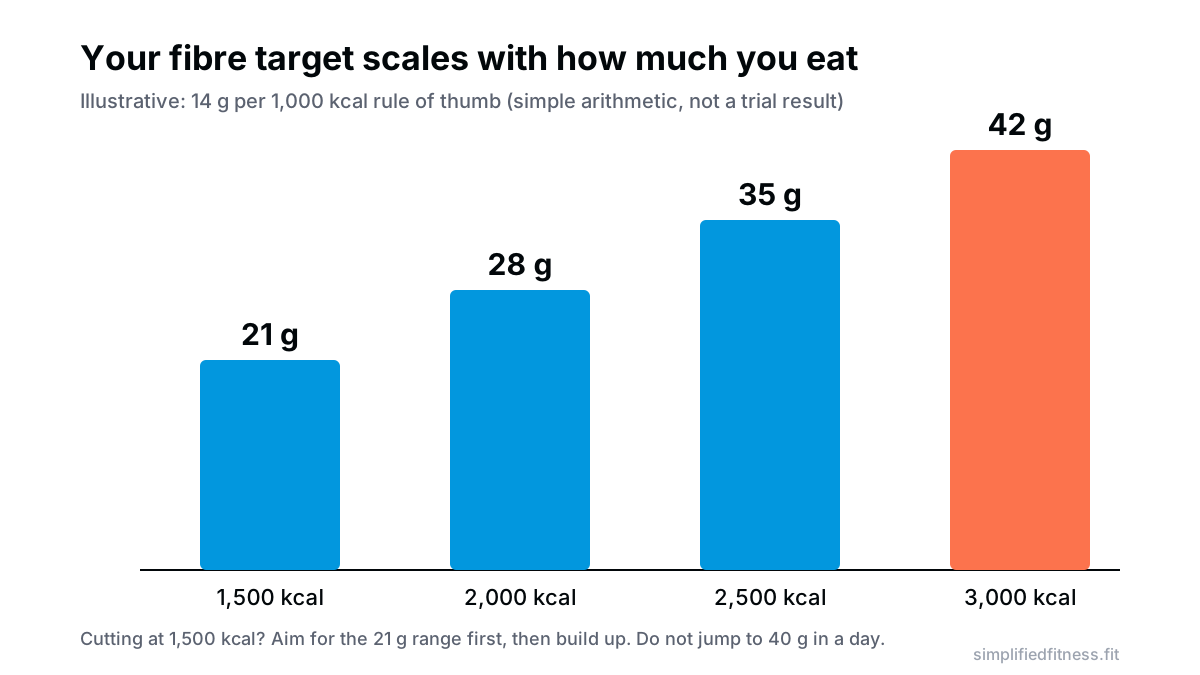
- A common rule of thumb is about 14 g of fibre per 1,000 kcal you eat, which works out to roughly 25-40 g a day for most lifters. A large meta-analysis found risk reductions across several diseases were greatest at 25-29 g a day.
- Soluble fibre (oats, isabgol, dal, fruit) forms a gel and feeds gut bacteria. Insoluble fibre (wheat bran, whole grains, vegetable skins) adds bulk. Most foods contain both, so variety beats counting types.
- Bloating usually comes from raising fibre too fast, not from fibre itself. In one trial, symptoms rose for about three weeks on a high fibre dose and then returned toward baseline as people adapted.
- There is no trial-proven danger line, but piling very high intakes into a small calorie budget is an easy way to end up with gas, cramps and poor gym comfort. Build up in steps and drink to thirst.
- Persistent pain, blood in stool, unexplained weight loss or a sudden change in bowel habit needs a doctor, not another dietary tweak.
Part of our complete guide: Carbohydrates, Fats, Fibre, Micronutrients and Hydration: The Lifter's Fueling Guide
Table of contents
Most lifters should aim for roughly 25-40 g of fibre a day, which is about 14 g for every 1,000 kcal you eat. That is the practical answer behind the usual dietary fibre guidelines, and it is the same whether you are bulking or cutting. The catch is how you get there, because jumping from 15 g to 45 g in a week is the classic way to end up bloated and cramping through leg day.
This article sits inside our complete guide to carbs, fats and hydration. It covers how much fibre you need, what soluble and insoluble fibre actually do, and how to raise your intake without wrecking your gut.
How much fibre per day do lifters need?
The most quoted rule is about 14 g per 1,000 kcal. I should be upfront that this comes from general dietary guidance, such as the US Dietary Guidelines, not from lifting studies. Nobody has run a large trial on bodybuilders and fibre.
What we do have is a big body of general-population evidence. A 2019 set of systematic reviews in The Lancet pooled 185 prospective studies and 58 clinical trials. Observational data suggested a 15-30% lower risk of all-cause and cardiovascular mortality, coronary heart disease, stroke, type 2 diabetes and colorectal cancer when comparing the highest fibre eaters with the lowest. Trials showed lower bodyweight, systolic blood pressure and total cholesterol on higher fibre intakes. Risk reduction across many outcomes was greatest at 25-29 g a day, and the dose-response curves suggested more benefit could come from going higher (Reynolds et al., 2019).
A separate 2023 meta-analysis of cohort studies found the highest fibre intakes were linked to about 10% lower all-cause mortality (summary RR 0.90) (Yao et al., 2023). Both are observational at heart, so they show association, not proof. But the trial data on blood pressure, cholesterol and weight point in the same direction.
Soluble vs insoluble fibre: what is the difference?
You will see the soluble and insoluble split everywhere, so here is the plain version.
Soluble fibre dissolves in water and forms a gel. It slows stomach emptying and is often fermented by gut bacteria. Think oats, isabgol (psyllium husk), dal, beans, apple and guava.
Insoluble fibre does not dissolve. It adds bulk and tends to speed things through. Think whole wheat atta, wheat bran, brown rice, nuts, seeds and vegetable skins.
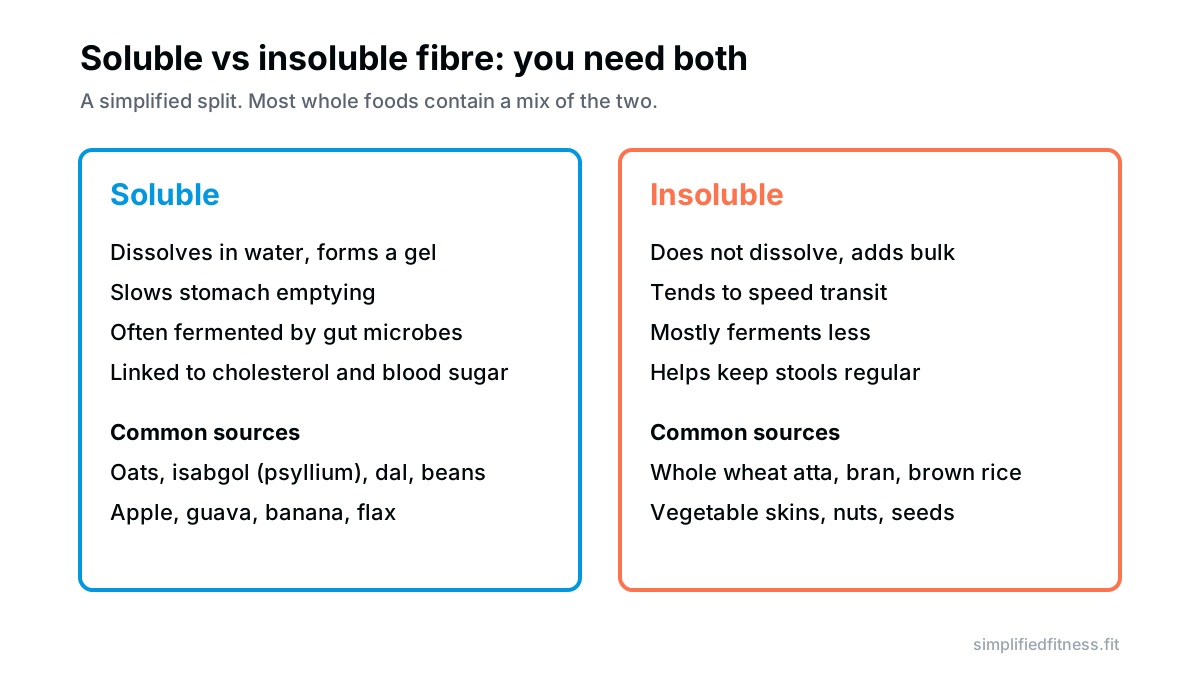
Here is the honest nuance. A 2025 review argues that the soluble versus insoluble binary is too simple, because fibres also differ in fermentability, water-holding capacity and structure, and those traits predict their effects better (Opperman et al., 2025). In the mortality meta-analysis above, soluble, cereal, fruit and vegetable fibre were all linked to lower all-cause and cardiovascular mortality, while insoluble, fruit and vegetable fibre did not show a significant link with cancer mortality (Yao et al., 2023). That does not mean insoluble fibre is useless. It means food variety is a safer plan than chasing one type.
Fibre and gut health for lifters
Your gut microbes ferment fibre your own enzymes cannot digest. In the process they produce short-chain fatty acids such as acetate, propionate and butyrate, which is a major reason fibre is linked to gut health (Holscher, 2017).
For a lifter, the realistic benefits are digestive regularity, steadier appetite and better long-term health markers, not a direct muscle-building effect. I would be cautious about any claim that fibre “boosts gains”. There is no evidence for that. For the broader microbiome picture and troubleshooting, see our guide to gut microbiome, nutrient absorption and bloating solutions.
Does fibre keep you full?
Sometimes. The evidence is mixed, and that matters for anyone cutting.
A systematic review of 44 publications (107 treatments, mostly single-meal studies) found only 39% of treatments reduced subjective appetite and only 22% reduced food or energy intake. Fibre type and dose did not predict the response, though beta-glucan, lupin kernel fibre, rye bran and mixed high-fibre diets had support in more than one publication (Clark and Slavin, 2013).
A meta-analysis of randomised trials on soluble fibre supplements found different results by type. Guar gum had the biggest pooled effect on post-meal energy intake (effect size -0.90), followed by beta-glucan, alginate, polydextrose and pectin, though risk of bias was high in every study (Salleh et al., 2019).
Why the gap? Short trials, different fibres and different meals. The practical takeaway: do not expect any fibre to switch off hunger, but oats, legumes, vegetables and fruit are bulky, filling foods that fit well into a deficit. For more on this, read our guide to high-volume, low-calorie foods for cutting.
Why too much fibre causes bloating and gas
Fermentation makes gas. If your gut bacteria suddenly get a lot more material to work with, they produce more of it.
A six-week randomised trial in adults with excess weight gave 25 g/day (women) or 35 g/day (men) of corn bran arabinoxylan or a non-fermentable cellulose control. The fermentable fibre increased flatulence, bloating and stomach aches during the first three weeks, but symptoms returned toward baseline by the end. People adapted, and better adaptation was linked to baseline Bifidobacterium longum levels, lower baseline animal-food intake and higher whole-grain intake (Deehan et al., 2024). The trial was small (15 and 16 per group), used a supplement, and two authors have ties to fibre manufacturers, so treat it as a clue, not a rule.
A small feasibility trial of 38 people found that increasing fibre through a barley-based product caused minor gastrointestinal symptoms that faded after a short adaptation period, and the gradual-increase group did not clearly differ from the immediate group (Borkoles et al., 2022). That study was not powered to settle the question, and one author works for the product’s maker. So the “build up slowly” advice is sensible and widely used, but the trial evidence that it beats going fast is thin.
Is there an upper limit? What about 60-70 g?
No trial draws a clean line, so I will not pretend there is one. What I can say from the adaptation data is that discomfort depends on dose, speed of increase, fibre type and the person.
In practice, there is rarely a reason to push well above 50 g a day. Very high intakes tend to creep in on aggressive cuts, when people eat huge volumes of vegetables and add fibre-fortified products to stay full. That setup can leave you gassy, cramped and, if it crowds out other food, short on calories and protein. If you are chasing protein targets in a deficit, our guide to high-protein eating during a cut shows how to keep protein first and fibre second.
Does high fibre block mineral absorption?
This worry is old and the answer is mixed. Fibre can bind minerals such as iron, zinc and calcium in lab and some human studies. But a review concluded that raising fibre would not be expected to harm mineral absorption if you also raise other dietary components such as protein, fruits and vegetables, with the bigger concern being excessive phytate intake, especially for people with high mineral needs (Torre et al., 1991). That review is old and mostly about how hard the question is to untangle.
For an Indian vegetarian lifter eating lots of wheat, dal and rice, the practical moves are simple: vary your grains and legumes, include a vitamin C source (lemon, amla, guava, tomato) with iron-rich meals, and get blood tests if you suspect low iron or zinc.
How to raise fibre without the bloat
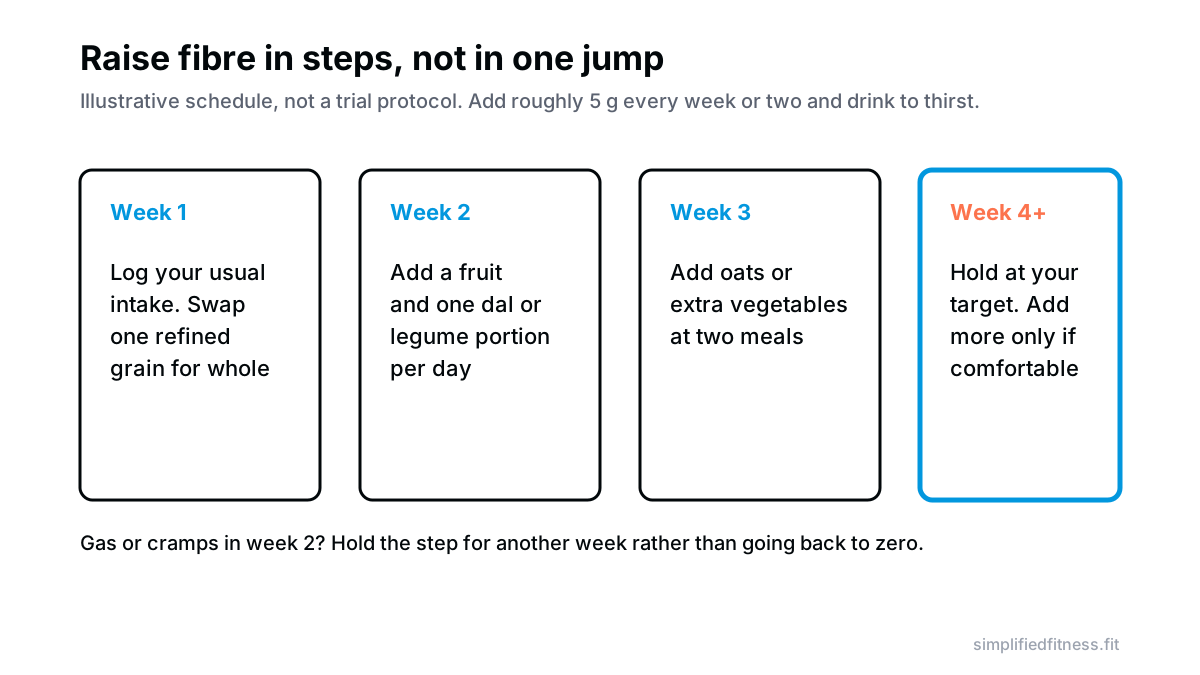
A simple approach that most people tolerate:
- Log first. Know your current intake before you change it.
- Swap before you add. Replace maida, white rice or refined cereal with whole wheat roti, oats or brown rice.
- Add one source at a time. A fruit, then a dal or chana portion, then extra vegetables.
- Drink to thirst. Adequate fluids matter, and our water intake calculator gives you a starting range for your size and climate.
- Keep pre-workout meals moderate in fibre. A huge bowl of rajma an hour before squats is a bad idea. Move the heavy fibre meals away from training.
- Be careful with fibre supplements. Isabgol can be a useful top-up, but start small.
What a fibre-friendly Indian day looks like
You do not need protein bars and powders. A typical vegetarian day might be oats or a vegetable besan chilla for breakfast, dal with whole wheat roti and a sabzi for lunch, a fruit and curd mid-afternoon, and rajma or chana with salad and a smaller portion of rice for dinner. Non-vegetarian lifters can keep the same fibre base and add eggs, chicken or fish for protein.
If you want a full meal structure, see our free diet plan, or the Indian vegetarian 1,800 kcal cutting plan for a worked example with fibre-rich staples.
When to see a doctor
Fibre fixes ordinary constipation and sluggish digestion for many people, but it does not explain everything. See a doctor if you have severe or persistent bloating or pain, blood in your stool, black stools, unexplained weight loss, fever, or a sudden lasting change in bowel habit. If symptoms started after you raised fibre and settle when you pull back, that is usually a pacing issue. If they do not, get it checked rather than adding more fibre.
The bottom line
For most lifters, 25-40 g of fibre a day, scaled to about 14 g per 1,000 kcal, is a sensible target, backed by large general-population evidence rather than lifting-specific trials. Get it from a mix of whole foods, raise it in steps, and expect a few weeks of adjustment. Fibre will not build muscle, and it will not reliably switch off hunger, but it supports digestion, heart health and consistency, which is what keeps a diet going.
Frequently Asked Questions
How much fibre per day do I need for bodybuilding?
Most lifters do well with roughly 25-40 g a day, or about 14 g per 1,000 kcal eaten. A 2019 meta-analysis found benefits across several health outcomes were greatest at 25-29 g a day, with possibly more at higher intakes. Work out your calories with the macro calculator, then scale fibre to match.
What is the difference between soluble and insoluble fibre?
Soluble fibre dissolves in water and forms a gel, while insoluble fibre stays intact and adds bulk. Soluble types are often fermented by gut bacteria, which is linked to cholesterol and blood sugar effects, and insoluble types tend to speed stool movement. You do not need to track each type, just eat oats, dal, fruit, vegetables and whole grains.
Why does fibre make me bloated and gassy?
Gut bacteria ferment some fibre and produce gas as a by-product, so a sudden jump in fibre can cause bloating. In a six-week trial, symptoms rose in the first three weeks of a high fibre supplement and then settled as participants adapted. Raise fibre gradually and keep your fluids steady.
Can I eat too much fibre?
Yes, in the sense that too much too quickly causes gas, cramps and discomfort. No trial gives one exact upper limit, and tolerance varies from person to person. If you feel bloated, pull back to the last comfortable intake and build up more slowly.
Does fibre block mineral absorption like iron and zinc?
It can in some situations, but the picture is mixed. A review concluded that raising fibre would not be expected to harm mineral absorption when protein, fruit and vegetable intake rise too, and that excess phytate is the bigger concern. If you rely heavily on wheat, dal and rice, soaking, sprouting and varied foods help.
Is fibre good for fat loss and fullness?
Sometimes, but not every fibre works. A systematic review found most single-meal fibre treatments did not reduce appetite or food intake, while certain types such as beta-glucan (oats, barley) had more support. Use fibre-rich whole foods as one tool, not a guaranteed appetite switch.
Should lifters take an isabgol (psyllium) supplement?
It can be a cheap way to top up soluble fibre if food falls short. The evidence base is mostly general-population studies rather than lifters. Start with a small dose, take it with plenty of water, and stop if it upsets you.
How do I get more fibre on a vegetarian Indian diet?
Dal, rajma, chana, whole wheat roti, oats, vegetables and fruit already give you a strong base. Many vegetarian lifters find it is easy to reach the target and the real issue is pacing. Swap refined grains for whole grains first, then add legumes.
Does fibre affect protein digestion?
We found no good evidence that normal fibre intakes meaningfully hurt protein use in lifters. The bigger practical issue is comfort, since a very large high fibre meal right before training can feel heavy. Keep pre-workout meals moderate in fibre and put the bulk of it at other meals.
How long does it take to adapt to a higher fibre diet?
Many people adapt within a few weeks. In one trial, high-dose fibre symptoms peaked early and returned toward baseline by the end of six weeks, though individual responses differed. Add about 5 g every week or two and let your gut catch up.
When should I see a doctor about bloating?
See a doctor if bloating is severe, persistent or comes with blood in stool, black stools, unexplained weight loss, fever or ongoing pain. These signs are not explained by simply eating more fibre. A clinician can check for conditions such as coeliac disease, IBS or inflammatory bowel disease.
Sources & References
Every claim above is checked against peer-reviewed research (PubMed, U.S. National Library of Medicine) or guidance from established health bodies. How we fact-check.
- Reynolds A, et al. Carbohydrate quality and human health: a series of systematic reviews and meta-analyses. Lancet. 2019. PMID: 30638909
- Yao F, et al. Dietary intake of total vegetable, fruit, cereal, soluble and insoluble fiber and risk of all-cause, cardiovascular, and cancer mortality: systematic review and dose-response meta-analysis of prospective cohort studies. Front Nutr. 2023. PMID: 37854351
- Opperman C, et al. Beyond soluble and insoluble: A comprehensive framework for classifying dietary fibre's health effects. Food Res Int. 2025. PMID: 40058888
- Holscher HD. Dietary fiber and prebiotics and the gastrointestinal microbiota. Gut Microbes. 2017. PMID: 28165863
- Deehan EC, et al. Adaptation to tolerate high doses of arabinoxylan is associated with fecal levels of Bifidobacterium longum. Gut Microbes. 2024. PMID: 38860973
- Borkoles E, et al. Short-Term Effect of Additional Daily Dietary Fibre Intake on Appetite, Satiety, Gastrointestinal Comfort, Acceptability, and Feasibility. Nutrients. 2022. PMID: 36235865
- Clark MJ, et al. The effect of fiber on satiety and food intake: a systematic review. J Am Coll Nutr. 2013. PMID: 23885994
- Salleh SN, et al. Unravelling the Effects of Soluble Dietary Fibre Supplementation on Energy Intake and Perceived Satiety in Healthy Adults: Evidence from Systematic Review and Meta-Analysis of Randomised-Controlled Trials. Foods. 2019. PMID: 30621363
- Torre M, et al. Effects of dietary fiber and phytic acid on mineral availability. Crit Rev Food Sci Nutr. 1991. PMID: 1657026

Umair Hazrami · Founder & Head Coach, Simplified Fitness
Umair Hazrami founded Simplified Fitness and the Simplified Lifter channel to cut through fitness noise. With 4+ years of consistent training and 10+ coaching clients, he writes every guide from the peer-reviewed research and links the sources so you can check them. Our editorial standards.
Educational content only, not medical advice. If you have a medical condition, are pregnant, or take medication, talk to a qualified doctor before changing your diet, supplements or training. Full disclaimer.
Keep reading

Nutrition
Alcohol and Muscle Growth: What a Heavy Night Does to MPS, Sleep and Recovery
Alcohol and muscle growth: does a heavy Saturday night wipe out your week? See what research says on MPS, REM sleep and recovery, and how to limit the damage.
7 min read

Nutrition
Ashwagandha and Cortisol: Does It Lower Stress and Boost Strength in the Gym?
Ashwagandha for lifting: what the trials show on cortisol, stress and strength gains, realistic dose (300-600 mg), who should skip it and how to buy it safely.
7 min read
Nutrition
Caffeine Sensitivity, CYP1A2 Genetics and Caffeine Cycling: Why Pre-Workout Works for Him, Not You
Caffeine sensitivity genetics explain why pre-workout gives your friend PRs and you anxiety. See what CYP1A2 and ADORA2A do, and how to find your dose.
8 min read

Nutrition
Creatine Non-Responders: Why It May Not Be Working and What to Try
Creatine non responder? Learn why roughly 1 in 4 people see little change, how baseline diet matters, and when carbs with creatine help. Studies linked.
7 min read