Creatine Non-Responders: Why It May Not Be Working and What to Try
Creatine non responder? Learn why roughly 1 in 4 people see little change, how baseline diet matters, and when carbs with creatine help. Studies linked.
TL;DR. The short answer
- A creatine non responder is someone whose muscle creatine barely rises on supplements. Small studies and one 2026 review suggest roughly one in four people fall into this group, though the exact number depends on how response is defined.
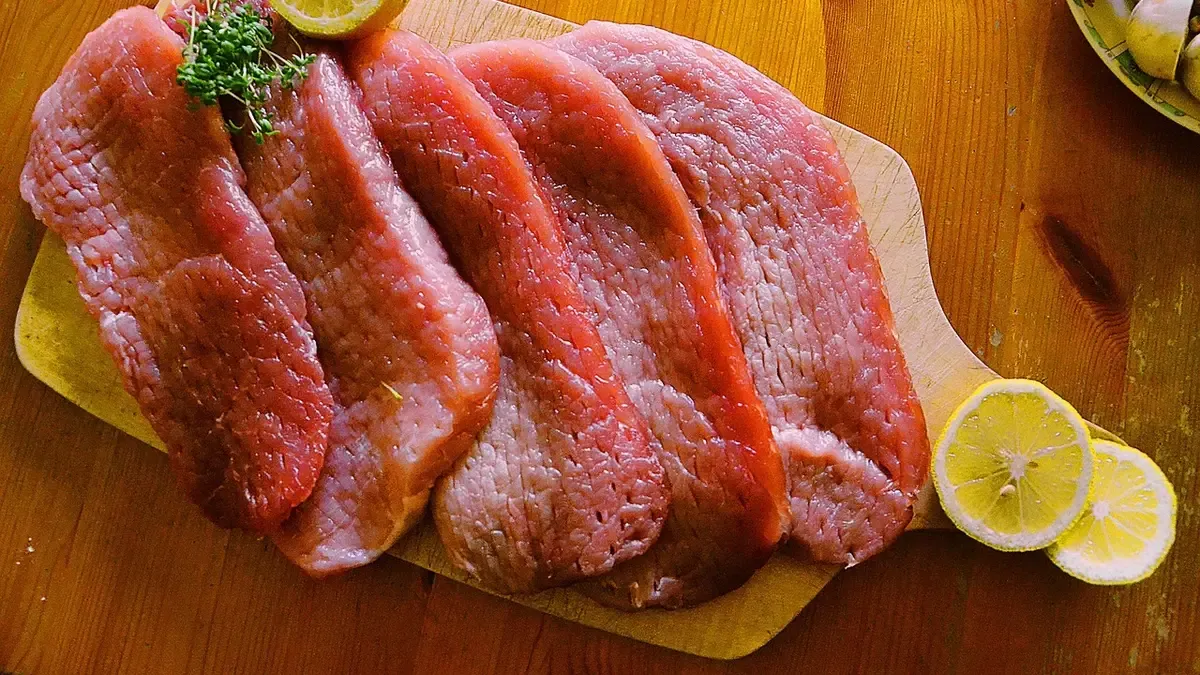
- People who already have high muscle creatine (possibly from eating a lot of meat and fish) have less room to fill. In one 5-day loading study, nonresponders started with higher creatine levels and gained about 5 mmol/kg, versus about 30 in responders.
- Taking creatine with a carbohydrate meal raised muscle creatine gain by about 60% in a classic 1996 trial, but it used about 93 g of carbs per dose. It is a tool for low responders, not a requirement.
- Four weeks at 3-5 g a day is often too short to judge. Muscle stores take about 28 days to fill at 3 g a day, and the visible effects are small.
- If you have diabetes, kidney disease or any medical condition, check with your doctor before adding large carb doses or starting creatine.
Part of our complete guide: Carbohydrates, Fats, Fibre, Micronutrients and Hydration: The Lifter's Fueling Guide
Table of contents
You took creatine for four weeks. The scale did not move, your bench did not jump, and you are wondering if you are a creatine non responder. It is possible, but it is less common than the internet makes it sound, and most “it did nothing” stories come down to timing, expectations or a high starting level.
This guide covers who really does respond poorly, what the biology says, and when taking creatine with carbs is worth the effort. It sits inside our wider guide to carbs, fats and hydration for performance, because food around your dose is part of the answer.
What is a creatine non responder?
In research, a non responder is defined by the muscle, not by how you feel. Scientists take a biopsy before and after a loading week and count how much total creatine rose.
In a small study of 11 young men on a 5-day load, three groups appeared. Responders gained 29.5 mmol/kg dry weight (n = 3), quasi responders gained 14.9 (n = 5) and nonresponders gained 5.1 (n = 3) (Syrotuik and Bell, 2004). Only the responders improved their leg press 1RM.
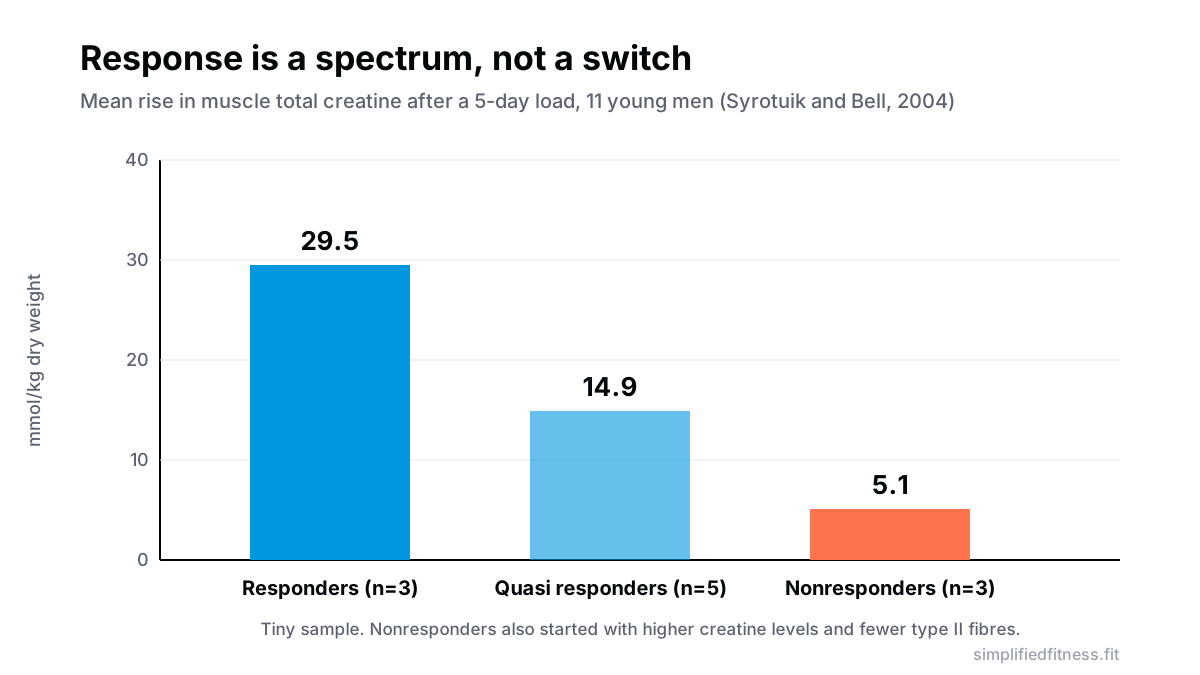
Notice the word “spectrum”. The study did not find a clean on-off switch, and with 11 people, it cannot give you a percentage you should rely on.
What percentage of people are creatine non responders?
The commonly quoted figure is 20-30%. Here is what sits behind it.
- A 2026 review states that approximately one-quarter of individuals show minimal increases in tissue creatine or functional benefit (Ostojic and Kavecan, 2026).
- In a trial of 32 resistance-trained men, 4 of the 21 who took creatine were classified as nonresponders (a rise of 21 mmol/kg or less) and 17 as responders (Kilduff et al., 2002).
That trial works out at roughly 19%. In the 11-man study above, 3 of 11 (about 27%) were nonresponders, with another 5 in between. Tiny samples, different cut-offs. So “about one in four” is a fair rough summary, not a precise rate. Take it as a ballpark.
Why creatine may not work: the biology
The leading explanation is simple. If your muscles are already well stocked, there is less room to add more.
In the 11-man study, the responders had the lowest starting creatine, the highest share of type II (fast-twitch) fibres and the largest muscle size and fat-free mass. Nonresponders had higher starting levels and fewer type II fibres (Syrotuik and Bell, 2004). The authors suggest a favourable starting biology partly decides how much you gain.
A second line of evidence comes from diet. In an 8-week trial of 42 adults, vegetarians began with lower muscle total creatine than meat eaters (117 vs 130 mmol/kg), and on creatine they gained more total creatine, lean tissue and work output (Burke et al., 2003). The change in muscle creatine was correlated with the starting level.
So the story many people tell is: lots of meat and fish, high baseline, small gain. It is a reasonable reading of those studies, but nobody has proven that diet alone makes someone a non responder.
Genes may play a part too. A 2026 narrative review proposes that response is a graded, polygenic trait, with common small variants in the creatine transporter gene SLC6A8 and in synthesis genes shaping it, rather than a rare mutation (Ostojic and Kavecan, 2026). That is a mechanism-based argument. It does not give you a test you can order.
Why isn’t creatine working for me? Check these first
Before you label yourself a non responder, go through the boring explanations. These catch a lot of cases.
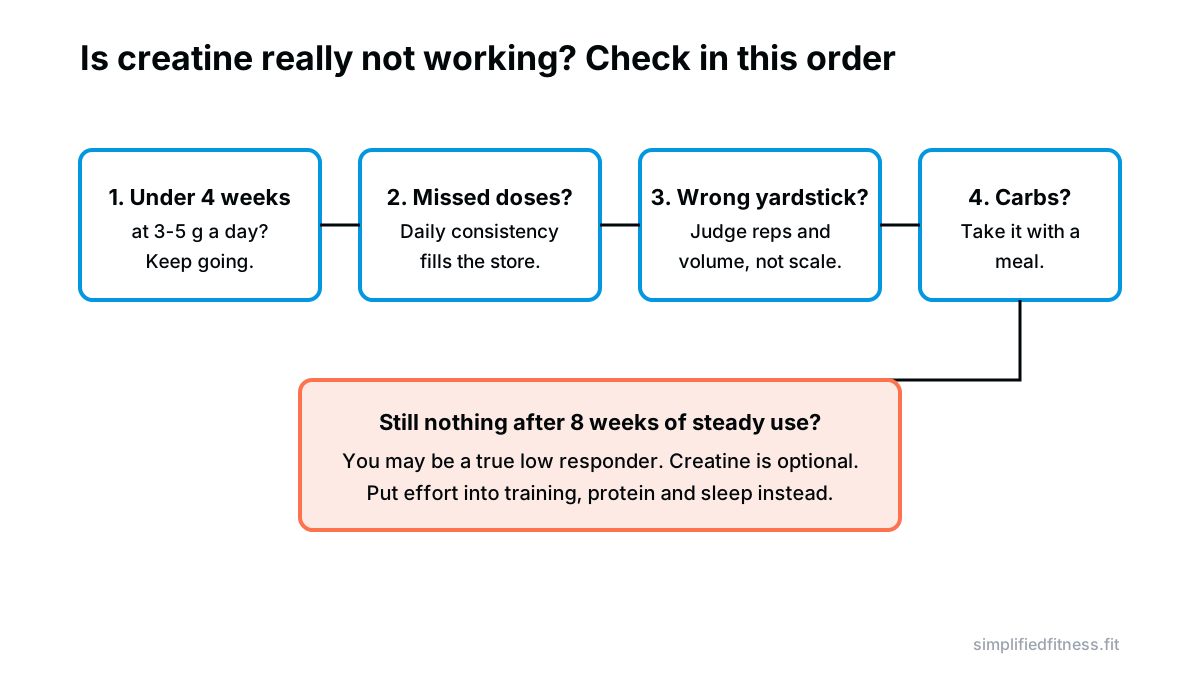
- You judged too early. At 3 g a day, muscle total creatine rose about 20% over roughly 28 days. A 20 g load for 6 days did it faster (Hultman et al., 1996). Four weeks of 3 g is right at the edge.
- You skipped days. The store only stays full if you keep topping up. After stopping, levels in that study drifted back to baseline over about 30 days.
- You expected the wrong thing. Creatine tends to add a few extra reps across your sets over time, plus around a kilo of body weight, much of it water inside the muscle (in one 5-day loading trial in trained men, body weight rose by about 1.2 kg on average (Kilduff et al., 2002)). No dramatic strength jump. See our guide to creatine and water weight for what that scale change looks like.
- You measured the wrong thing. Look at total reps across your sets over 8 weeks, not a single max test.
- Dose too low for your size. Use the creatine dosage calculator for a number based on body weight.
For the full mechanism of how creatine recycles ATP, read how creatine monohydrate works at the cellular level.
How to absorb creatine with carbs: what the research found
This is where the carb idea comes from. Insulin helps drive creatine into muscle, and carbs raise insulin.
In a classic trial, 24 men took 5 g creatine four times a day for 5 days, either alone or followed 30 minutes later by 93 g of simple carbohydrate. The carb group’s increase in muscle total creatine was 60% greater, and they excreted less creatine in urine (Green et al., 1996). The authors conclude the effect appears insulin mediated.
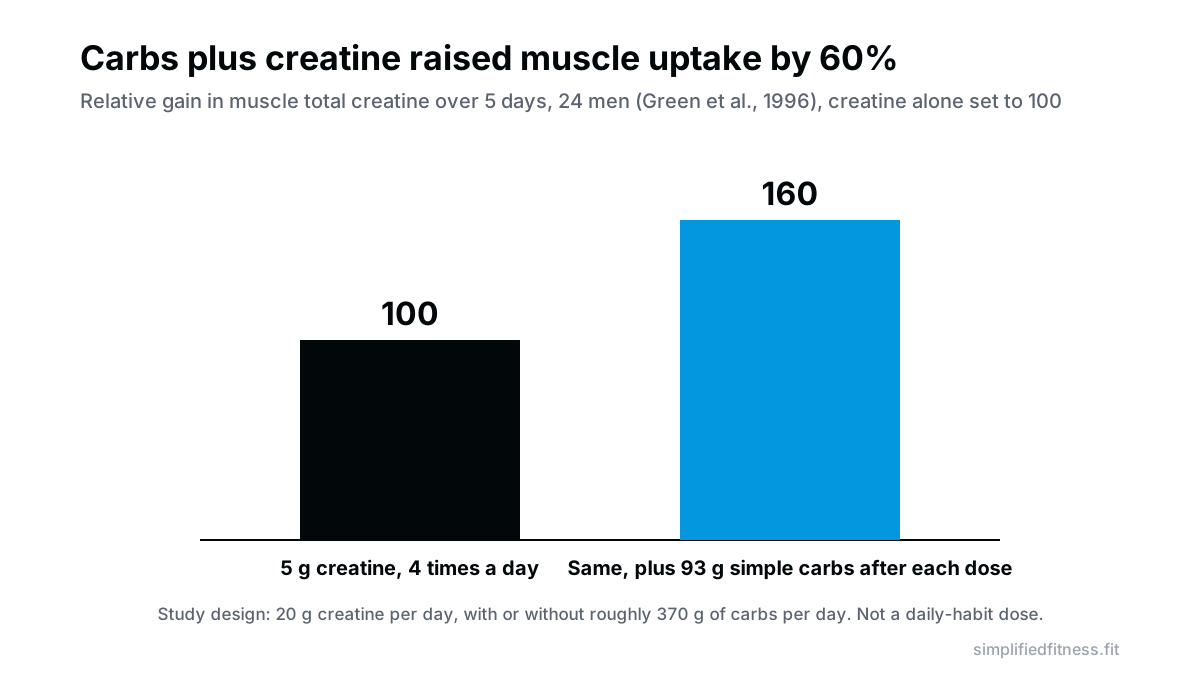
Note the numbers. That is about 370 g of carbs a day on top of the creatine, for five days. Not a daily-life habit for most of us.
Does a smaller amount work? A later study of 12 men found that 5 g creatine four times a day with 50 g protein plus 47 g carbs raised whole-body creatine retention by about 25%, similar to taking it with 96 g of carbs, compared with taking it with only 5 g of carbs (Steenge et al., 2000). Protein can stand in for part of the carb.
There are limits. An insulin clamp study in 7 men found that insulin raised muscle creatine only at physiologically high or supraphysiological levels (Steenge et al., 1998). And the 2000 study found the insulin effect faded within the first 24 hours of supplementation. So the carb boost looks strongest early and at high doses.
How I would use carbs with creatine (practical)
For most people, the simplest version works. Take your daily 3-5 g with a normal meal, whenever you will remember it.
If you want to lean on the carb trick, for example because you are in your first week or you suspect you are a low responder:
- Breakfast: mix creatine into a glass of juice, or take it alongside oats with banana, or poha with a glass of milk.
- Post-workout: take it with rice, dal and curd, or roti with paneer bhurji. That gives you carbs and some protein, which fits the 2000 study.
- On a budget: glucose powder, jaggery water or a banana are cheaper than a branded “creatine transport” product.
Keep the calories in mind. Adding a 90 g carb drink four times a day is roughly 1,400 kcal, which is not sensible if you are cutting. Count it against your daily intake with the macro calculator. For how fast and slow carbs differ, see our guide to glycemic index versus glycemic load.
Are some people better off not bothering?
If you have done 8 weeks of consistent use, with a fair dose and a sensible measure, and your reps, loads and bodyweight are unchanged, you may simply be a low responder. That is a legitimate outcome.
Stopping is fine. Your muscle stores drift back to baseline over about a month (Hultman et al., 1996), and there is nothing to taper. Spend the money on protein and food instead. Our hypertrophy guide for natural lifters covers what really drives progress, and a structured plan such as our push day workout gives you a clear measure of reps to track.
When to see a doctor
Creatine is well studied in healthy adults, but this article is not medical advice. Speak to a doctor before starting creatine or adding large carb doses if you have kidney disease, diabetes or prediabetes, take medication that affects blood sugar or the kidneys, or are pregnant or breastfeeding. If a supplement causes persistent stomach pain, swelling or any alarming symptom, stop and get checked.
Frequently Asked Questions
What is a creatine non responder?
A creatine non responder is a person whose muscle creatine content rises very little after supplementation, so they see little change in strength or body weight. Researchers usually define it with muscle biopsies, for example a rise of under 10 mmol/kg dry weight after a 5-day load. If you suspect you are one, rule out short duration and missed doses first.
What percentage of people are creatine non responders?
Roughly one in four, though the figure is an estimate rather than a fixed number. A 2026 review states that approximately one-quarter of individuals show minimal increases in tissue creatine or benefit, and in a trial where 21 trained men took creatine, 4 were classed as nonresponders. Treat 20-30% as a rough range, because different studies draw the line in different places.
Why is creatine not working for me?
The most common reasons are judging too early, inconsistent dosing, and expecting a big visible change from a small effect. Muscle stores take about four weeks to fill at 3 g a day, and the result is a modest bump in reps and training volume, not a new physique. Take it daily for 8 weeks and track total training volume before you decide.
How long does creatine take to work?
Loading 20 g a day for about 6 days raised muscle creatine by roughly 20%, while 3 g a day reached a similar rise over about 28 days. Strength and lean mass changes then build over weeks of training, not days. Give a steady 3-5 g dose at least 4 weeks to saturate and 8 weeks to judge.
Do vegetarians respond better to creatine?
On average, yes. In an 8-week trial, vegetarians started with lower muscle creatine than meat eaters (117 vs 130 mmol/kg) and gained more lean tissue and total work on creatine. If you eat mostly dal, paneer, curd and roti, you may have more room to fill, so you are a good candidate to respond.
Does eating a lot of meat make creatine useless?
Not useless, but there may be less to gain. Meat and fish supply creatine, and responders in one small study had the lowest starting levels while nonresponders started higher. Diet is only one factor, so you cannot predict your response from your plate alone.
Should I take creatine with carbs?
Carbs with creatine can raise muscle uptake, but you do not need them to benefit. In a 1996 trial, adding 93 g of simple carbs to each 5 g creatine dose raised muscle creatine gain by 60% compared with creatine alone. For daily use, take your creatine with a normal meal that contains rice, roti, fruit or oats.
How many carbs do I need to absorb creatine?
The research used about 50-100 g of carbohydrate per dose, and 50 g of protein plus 47 g of carbs worked as well as 96 g of carbs. Those doses sit inside loading protocols of 4 servings a day, so they are high in calories. A balanced meal around your normal creatine dose is a realistic compromise.
Does insulin really help creatine get into muscle?
Yes, in lab studies insulin increases creatine accumulation in muscle, probably by boosting creatine transport into the cell. A clamp study found the effect needed physiologically high insulin levels, and a different study found the effect faded within about 24 hours of supplementation. This means carbs are a modest helper, not a fix for everyone.
Can I do creatine and low-carb at the same time?
Yes. Creatine monohydrate has no carbs and low-carb eaters can still saturate their muscles with a steady daily dose over several weeks. Take it with whatever meal you eat, and give it a little longer to judge. If you are on medication for diabetes, talk to your doctor before changing your carbs.
Is it worth continuing if I am a low responder?
It is optional. If 8 weeks of steady use show no change in your reps, loads or body weight, the cost-benefit is weak and you can stop without harm. Redirect the money to protein, food quality and sleep, which matter more.
Could genes explain why creatine does not work for me?
Possibly. A 2026 review argues that response is a graded trait shaped by many small genetic variants, including ones affecting the creatine transporter SLC6A8, rather than one rare defect. This is mechanistic and still being worked out, and there is no consumer test that can tell you your response. The practical step is a fair trial of 8 weeks, not a genetic test.
Sources & References
Every claim above is checked against peer-reviewed research (PubMed, U.S. National Library of Medicine) or guidance from established health bodies. How we fact-check.
- Green AL, et al. Carbohydrate ingestion augments skeletal muscle creatine accumulation during creatine supplementation in humans. Am J Physiol. 1996. PMID: 8944667
- Steenge GR, et al. Protein- and carbohydrate-induced augmentation of whole body creatine retention in humans. J Appl Physiol. 2000. PMID: 10956365
- Steenge GR, et al. Stimulatory effect of insulin on creatine accumulation in human skeletal muscle. Am J Physiol. 1998. PMID: 9843739
- Syrotuik DG, et al. Acute creatine monohydrate supplementation: a descriptive physiological profile of responders vs. nonresponders. J Strength Cond Res. 2004. PMID: 15320650
- Kilduff LP, et al. Effects of creatine on isometric bench-press performance in resistance-trained humans. Med Sci Sports Exerc. 2002. PMID: 12131259
- Burke DG, et al. Effect of creatine and weight training on muscle creatine and performance in vegetarians. Med Sci Sports Exerc. 2003. PMID: 14600563
- Hultman E, et al. Muscle creatine loading in men. J Appl Physiol. 1996. PMID: 8828669
- Ostojic SM, et al. Genetic Determinants of Creatine Bioavailability and Responsiveness: Emphasis on Common Low-Impact Variants. Lifestyle Genom. 2026. PMID: 41719210

Umair Hazrami · Founder & Head Coach, Simplified Fitness
Umair Hazrami founded Simplified Fitness and the Simplified Lifter channel to cut through fitness noise. With 4+ years of consistent training and 10+ coaching clients, he writes every guide from the peer-reviewed research and links the sources so you can check them. Our editorial standards.
Educational content only, not medical advice. If you have a medical condition, are pregnant, or take medication, talk to a qualified doctor before changing your diet, supplements or training. Full disclaimer.
Keep reading

Nutrition
Alcohol and Muscle Growth: What a Heavy Night Does to MPS, Sleep and Recovery
Alcohol and muscle growth: does a heavy Saturday night wipe out your week? See what research says on MPS, REM sleep and recovery, and how to limit the damage.
7 min read

Nutrition
Ashwagandha and Cortisol: Does It Lower Stress and Boost Strength in the Gym?
Ashwagandha for lifting: what the trials show on cortisol, stress and strength gains, realistic dose (300-600 mg), who should skip it and how to buy it safely.
7 min read
Nutrition
Caffeine Sensitivity, CYP1A2 Genetics and Caffeine Cycling: Why Pre-Workout Works for Him, Not You
Caffeine sensitivity genetics explain why pre-workout gives your friend PRs and you anxiety. See what CYP1A2 and ADORA2A do, and how to find your dose.
8 min read

Nutrition
Dietary Carbohydrates and Hypertrophy: Glycogen, Performance and Training Volume
Do you need carbohydrates for muscle hypertrophy? See what meta-analyses say about glycogen, training volume and daily carb targets per kg, plus Indian foods.
8 min read