Electrolytes for Gym Performance: Sodium, Potassium and Magnesium Explained
Electrolytes for lifting performance explained: how sodium and potassium fire your muscles, what the cramp research says, and when plain water backfires.
TL;DR. The short answer
- Sodium and potassium are what let a muscle fibre fire. Every contraction shifts them across the cell membrane, and the sodium-potassium pump restores the balance within seconds.
- Typical salted meals already supply plenty of sodium, so extra electrolytes matter mainly after long, hot, very sweaty sessions. Sweat rate and sweat sodium vary a lot from person to person.
- Cramps are not simply a salt problem. A major review favours altered neuromuscular control (fatigue) over electrolyte loss, though small trials show plain water after heavy sweating can make cramps easier to trigger.
- Magnesium has little evidence for preventing cramps. A Cochrane review found no meaningful benefit in people with idiopathic cramps, mostly older adults.
- Have kidney disease, heart disease, high blood pressure or take blood pressure medicine? Check with your doctor before adding salt or potassium supplements.
Part of our complete guide: Carbohydrates, Fats, Fibre, Micronutrients and Hydration: The Lifter's Fueling Guide
Table of contents
Electrolytes for lifting performance matter because sodium and potassium are what let a muscle fibre fire at all. Every rep depends on them moving across the cell membrane and being pumped back within seconds. But for most lifters eating normal meals, extra electrolytes are a situational tool, not a daily requirement, and they are not the proven cramp cure that supplement labels suggest.
This article covers the physiology and the cramp evidence. It sits inside our wider guide to carbs, fats and hydration for performance, which covers the rest of the picture.
How do sodium and potassium make a muscle contract?
Your muscle cells sit in a salty bath. Outside the cell, sodium is high. Inside, potassium is high. That imbalance is the battery.
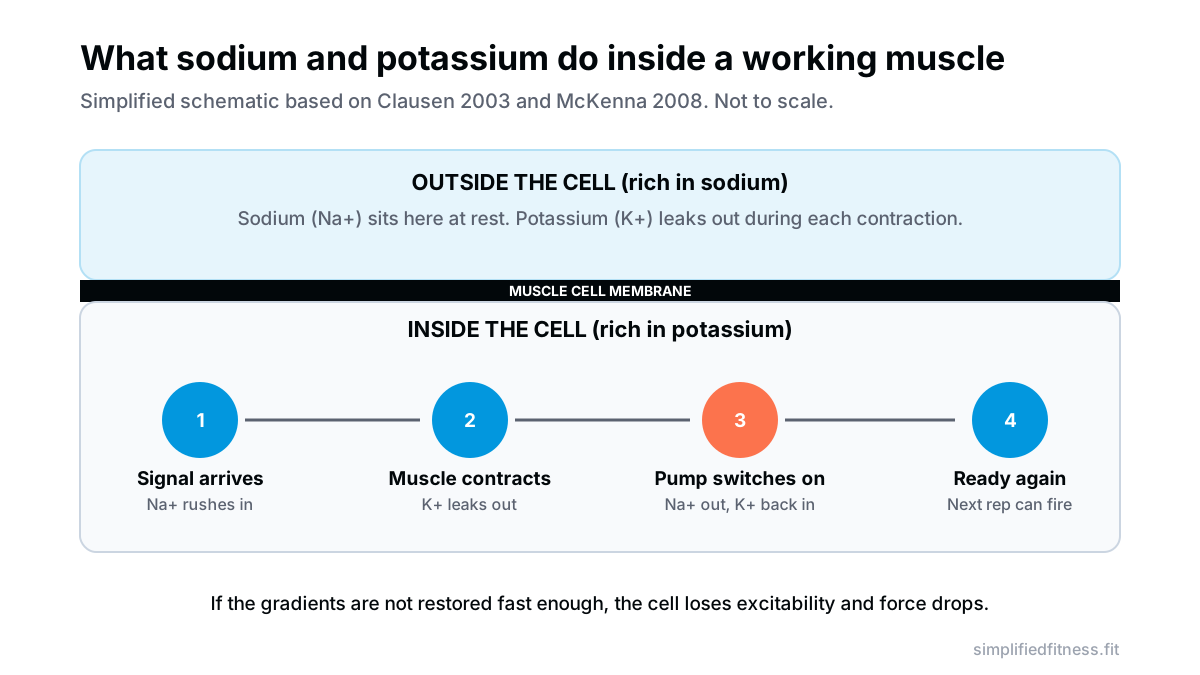
When a nerve signal reaches a fibre, sodium rushes in and potassium leaks out. That electrical change is what starts the chain that ends in actin and myosin pulling on each other. A review of muscle physiology puts the problem plainly: excitation causes potassium loss, a rise in intracellular sodium and depolarization, and these events interfere with excitability, so the process is self-limiting (Clausen, 2003). The cell has to restore the gradients quickly or it stops responding.
What does the sodium-potassium pump do during a set?
The pump is the restoration crew. It moves sodium out and potassium in, using energy, and it works hard. According to the same review, stimulation can activate up to all available pumps within 10 seconds, causing up to a 22-fold increase in sodium efflux (Clausen, 2003). Most of these experiments come from isolated muscle and animal or lab work, so treat the exact numbers as physiology, not gym advice.
Two practical points come out of it:
- Training builds more pumps. Pump content is upregulated by training, and downregulated by things like immobilization, potassium deficiency, starvation and diabetes. Reduced pump content is linked with loss of contractility and endurance (Clausen, 2003).
- The pump can be overwhelmed. During intense contractions, muscle potassium outside the cell can rise to roughly 11-13 mM, and some pumps become inactivated, which likely contributes to fatigue (McKenna et al., 2008).
Do electrolytes give you a better gym pump?
Short answer: the evidence I reviewed does not show it. A pump is mostly blood flow and fluid shifting into worked muscle, which comes from sets, rep ranges, rest periods and carbs. The physiology above explains why electrolytes matter for contraction, but it does not show that adding more sodium to a normal diet makes the pump larger.
Some lifters report feeling fuller after a salty pre-workout meal. That may be real for them, but it is anecdote, and I would not build a plan on it. We cover the practical angle in pre-workout sodium strategy.
How much sodium and potassium do you lose when you sweat?
Quite a lot in extreme heat, and it varies a lot between people. In one lab study, 10 unacclimated men alternated moderate cycling with one leg or the upper body in about 39 degrees C heat for around 3.8 hours, until they lost roughly 4.7% of body mass. They lost about 4.0 g of sodium and 0.6 g of potassium in sweat (Braulick et al., 2013). That is a long, hot session, far beyond a normal lifting workout.
A review of sweat testing makes the bigger point: sweat rate and sweat sodium concentration vary within and among individuals, with exercise intensity, heat acclimation, body size, sex, diet and hydration status all in play (Baker, 2017). The same review notes that the simplest accurate way to estimate sweat rate is the change in body mass during exercise.
Do electrolytes prevent muscle cramps when lifting?
This is where marketing and research disagree most.
What the sceptical side found. A 2009 review looked at the “electrolyte depletion” and “dehydration” explanations for exercise-associated muscle cramps. It found that support came mainly from anecdotal observations, case series totalling 18 cases and one small case-control study, while four prospective cohort studies did not support them. The author concluded that altered neuromuscular control, essentially a fatigued nervous system misfiring, is the principal mechanism with accumulating support (Schwellnus, 2009).
A lab study backs this up. Ten men were dehydrated by 3.8 hours of cycling until they lost about 4.7% of body mass, and their cramp threshold (how easily an electrical stimulus triggers a cramp) did not change (Braulick et al., 2013).
What the other side found. In a 2005 trial, 13 men with a history of cramps did a calf-fatiguing protocol in the heat. Among the 7 men who cramped in both trials, cramps started later when they drank a carbohydrate-electrolyte drink (about 37 vs 15 minutes without fluid). But 9 of the 13 still cramped while hydrated and supplemented (Jung et al., 2005).
Why they might differ. The studies use different designs, tiny samples, hot labs, and different cramp tests. The fair reading is that electrolytes may help some people in some conditions, but dehydration and salt loss are probably not the whole story. For a gym session, that points at fatigue, sudden volume jumps and poor warm-ups as likelier culprits.
Can plain water make cramps worse?
A small 2019 study suggests it can in one specific scenario. Ten men ran downhill in heat (35-36 degrees C) until they lost 2% of body mass. Ten minutes later they drank either spring water or an electrolyte drink. Cramp threshold fell after water at 30 and 60 minutes, by 4.3 Hz and 5.1 Hz, but rose after the electrolyte drink by 3.7 and 5.4 Hz. Blood sodium and chloride dropped after water but held steady with the electrolyte drink (Lau et al., 2019).
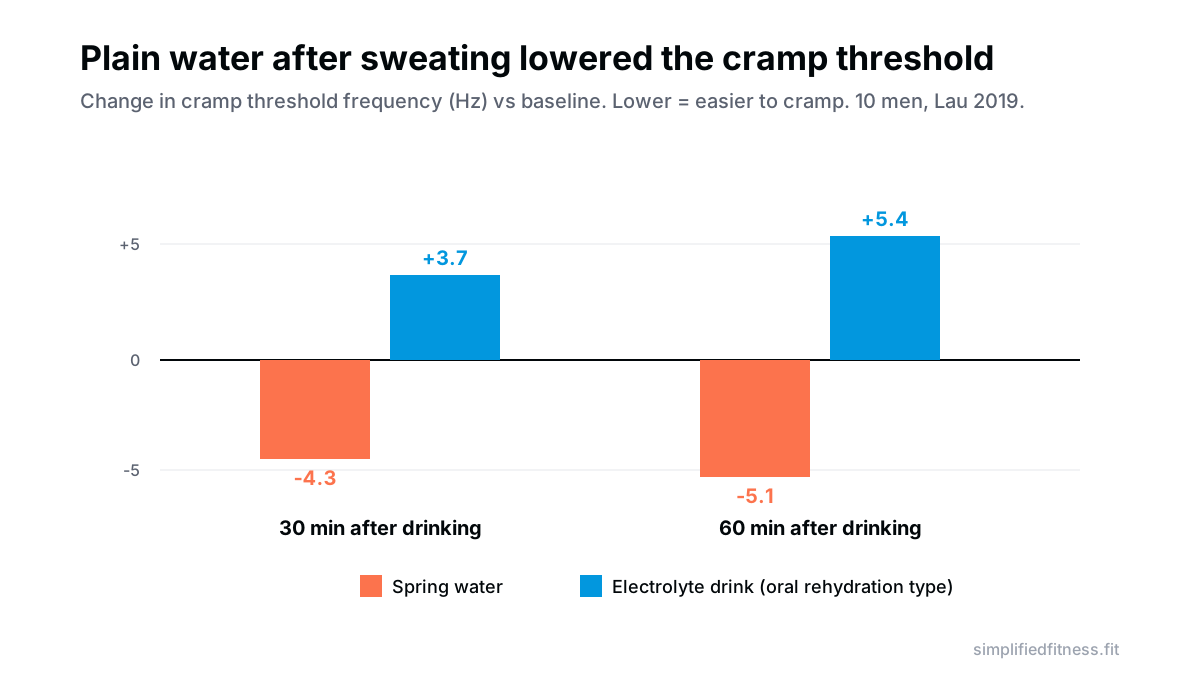
Keep the limits in mind: 10 young men, induced cramps in a lab, a downhill running task. It does not prove that your calf cramp at squats was caused by drinking water. It does give a sensible reason not to chug litres of plain water after a very sweaty session, and to pair it with food or salt.
Does magnesium help with cramps or performance?
Probably less than the labels suggest. A Cochrane review pooled 11 randomized trials of magnesium for muscle cramps. For idiopathic cramps, largely in older adults, the difference versus placebo was small and not statistically significant, for example about 0.18 fewer cramps per week (95% CI -0.84 to 0.49) at four weeks (Garrison et al., 2020).
Note the population: mostly older adults with nocturnal leg cramps, not young lifters. So the review does not rule out a benefit in someone who is actually deficient, but it gives little reason to expect one. If you are curious about forms and sleep claims, we compare them in magnesium glycinate vs citrate vs oxide.
How much potassium and sodium should lifters aim for?
Aim for food first. Potassium is easy to get from banana, potato, dal, curd, spinach and coconut water. Sodium is easy to overshoot in a diet with pickles, namkeen, packaged snacks and restaurant food.
Potassium has a wrinkle on the blood pressure side. A meta-analysis of 22 randomized trials found that higher potassium intake lowered systolic blood pressure by about 3.5 mm Hg in adults, with the effect seen in people with hypertension but not those without (Aburto et al., 2013). A later dose-response analysis of 32 trials found a U-shaped relationship, with the benefit weakening above a certain increase and blood pressure rising at very high levels, particularly among people on blood pressure drugs (Filippini et al., 2020).
That is why I do not suggest potassium pills for lifters. The long-term sodium and potassium balance, especially in people with high blood pressure, has its own article: salt, blood pressure and the sodium-potassium ratio.
A practical electrolyte plan for Indian gyms
Hot, humid gyms without AC change the picture, so here is a simple tiering.
| Situation | What to do |
|---|---|
| 45-75 min lifting, AC or fans, normal meals | Water to thirst. No electrolyte product needed. |
| Hot, humid gym, drenched, lots of sweat | Weigh in and out. Sip water through the session, add salt in the next meal. |
| Long session in heat, or sports like cricket or football after lifting | Electrolyte drink or nimbu pani with a pinch of salt and sugar. See our guide to electrolyte powders vs salt water. |
| Cramps keep returning | Review warm-up, volume jumps and sleep. Do not rely on supplements alone. |
Work out a baseline fluid target with our water intake calculator. For how much fluid loss actually affects strength, see hydration and strength. For the cramp supplement angle beyond salt, there is taurine and muscle cramps.
When to see a doctor
Frequent, severe or night-time cramps that come with weakness, swelling, dark urine, palpitations or dizziness are not a gym problem. Get them checked. Anyone with kidney disease, heart disease, high blood pressure, or on diuretics or blood pressure medicine should speak to a doctor before changing salt, potassium or magnesium intake. This article is general education, not a diagnosis.
The bottom line
Sodium and potassium make every rep possible, and the pump that restores them is trainable. But the idea that more electrolytes means better performance, bigger pumps and no cramps does not hold up in the research reviewed here. Most lifters need good meals, water to thirst, and a bit more salt only after genuinely heavy sweating.
Use your food first, test what happens on your own scale and in your own gym, and spend the money you would put into electrolyte powders on protein or a better program. Our free training plans are a good place to start.
Frequently Asked Questions
Do electrolytes improve gym performance?
Electrolytes are essential for muscle contraction, but extra intake only helps when you are actually losing a lot through sweat. The sodium-potassium pump keeps muscle cells excitable, and training improves its capacity. For a normal 60-minute session with regular salted meals, food and water will usually cover it.
How does the sodium-potassium pump work in muscle?
It moves sodium out of the muscle cell and potassium back in, using energy. Each nerve signal lets sodium in and potassium out, and a review of the physiology shows the pumps can switch on almost fully within 10 seconds of stimulation. Without this restoration the cell loses excitability and force drops, which is why pump capacity matters for endurance.
Do electrolytes give you a better gym pump?
There is no solid evidence in the studies reviewed here that electrolyte drinks create a bigger muscle pump. A pump comes mostly from blood flow and fluid shifting into worked muscle during higher-rep sets. If you want to experiment, keep meals normal and read our dedicated article on pre-workout sodium.
Do electrolytes prevent muscle cramps while lifting?
Not reliably. A 2009 review found little support for electrolyte depletion as the main cause of exercise cramps and favoured altered neuromuscular control, while a small trial found electrolyte water raised the cramp threshold after dehydration. Warm up well, avoid sudden jumps in volume, and treat electrolytes as one possible factor rather than a cure.
Can drinking too much plain water cause cramps?
In one small lab trial, plain water after exercise in the heat lowered cramp threshold while an electrolyte drink raised it, probably because blood sodium was diluted. That was 10 men and an electrical stimulation test, so it is suggestive, not proof. Drink to thirst, and add salt through food or an electrolyte drink after very sweaty sessions.
How much sodium do you lose in sweat?
It varies widely between people and conditions. In one study of 10 men exercising in a very hot lab, sweating cost about 4.0 g of sodium and 0.6 g of potassium over roughly 3.8 hours. A review notes that sweat sodium differs between individuals and with heat acclimation, so your own number may be quite different.
Does magnesium stop muscle cramps?
The best evidence says probably not for most people. A Cochrane review of 11 trials found that for idiopathic cramps, mostly in older adults, magnesium did not significantly reduce cramps compared with placebo. If you suspect a deficiency, speak to a doctor rather than guessing with high doses.
Is potassium important for lifters?
Yes, potassium is the other half of the pump, and low potassium reduces pump content in muscle. A review of the physiology lists potassium deficiency among the conditions linked to lower pump content. Get it from food such as banana, potato, dal, curd and coconut water rather than supplements.
Should I take potassium supplements?
Usually not without medical advice. A dose-response meta-analysis found a U-shaped relationship with blood pressure, with benefit weakening at higher doses and a rise at very high ones. Food sources are the safer route, and anyone with kidney problems or on blood pressure medicine should ask a doctor first.
Do I need an electrolyte drink for a normal workout?
Usually no. For a one-hour session in a gym with fans or AC, a normal meal and water will usually replace what you lose. Consider an electrolyte option for sessions over about an hour in heat, or when you finish with a white crust of salt on your clothes.
Does sweating more mean I need more salt?
Not automatically, because sweat rate and sweat sodium concentration are separate things and both vary between people. A review of sweat testing found that body mass change during a session is the simplest accurate way to estimate sweat loss. Weigh yourself before and after a hot session to see how much fluid you actually lose.
What is the best food source of electrolytes for Indian lifters?
Everyday foods cover most needs: curd and milk, banana, potato, dal, spinach, nuts and a pinch of salt in nimbu pani. Food gives sodium, potassium and magnesium together alongside protein and carbs. Build meals around these before buying any powder.
Sources & References
Every claim above is checked against peer-reviewed research (PubMed, U.S. National Library of Medicine) or guidance from established health bodies. How we fact-check.
- Clausen T. Na+-K+ pump regulation and skeletal muscle contractility. Physiol Rev. 2003. PMID: 14506306
- McKenna MJ, et al. Muscle K+, Na+, and Cl disturbances and Na+-K+ pump inactivation: implications for fatigue. J Appl Physiol. 2008. PMID: 17962569
- Schwellnus MP. Cause of exercise associated muscle cramps (EAMC): altered neuromuscular control, dehydration or electrolyte depletion? Br J Sports Med. 2009. PMID: 18981039
- Braulick KW, et al. Significant and serious dehydration does not affect skeletal muscle cramp threshold frequency. Br J Sports Med. 2013. PMID: 23222192
- Lau WY, et al. Water intake after dehydration makes muscles more susceptible to cramp but electrolytes reverse that effect. BMJ Open Sport Exerc Med. 2019. PMID: 30899546
- Jung AP, et al. Influence of hydration and electrolyte supplementation on incidence and time to onset of exercise-associated muscle cramps. J Athl Train. 2005. PMID: 15970952
- Garrison SR, et al. Magnesium for skeletal muscle cramps. Cochrane Database Syst Rev. 2020. PMID: 32956536
- Baker LB. Sweating rate and sweat sodium concentration in athletes: a review of methodology and intra/interindividual variability. Sports Med. 2017. PMID: 28332116
- Aburto NJ, et al. Effect of increased potassium intake on cardiovascular risk factors and disease: systematic review and meta-analyses. BMJ. 2013. PMID: 23558164
- Filippini T, et al. Potassium intake and blood pressure: a dose-response meta-analysis of randomized controlled trials. J Am Heart Assoc. 2020. PMID: 32500831

Umair Hazrami · Founder & Head Coach, Simplified Fitness
Umair Hazrami founded Simplified Fitness and the Simplified Lifter channel to cut through fitness noise. With 4+ years of consistent training and 10+ coaching clients, he writes every guide from the peer-reviewed research and links the sources so you can check them. Our editorial standards.
Educational content only, not medical advice. If you have a medical condition, are pregnant, or take medication, talk to a qualified doctor before changing your diet, supplements or training. Full disclaimer.
Keep reading
Nutrition
Alcohol and Muscle Growth: What a Heavy Night Does to MPS, Sleep and Recovery
Alcohol and muscle growth: does a heavy Saturday night wipe out your week? See what research says on MPS, REM sleep and recovery, and how to limit the damage.
7 min read

Nutrition
Ashwagandha and Cortisol: Does It Lower Stress and Boost Strength in the Gym?
Ashwagandha for lifting: what the trials show on cortisol, stress and strength gains, realistic dose (300-600 mg), who should skip it and how to buy it safely.
7 min read
Nutrition
Caffeine Sensitivity, CYP1A2 Genetics and Caffeine Cycling: Why Pre-Workout Works for Him, Not You
Caffeine sensitivity genetics explain why pre-workout gives your friend PRs and you anxiety. See what CYP1A2 and ADORA2A do, and how to find your dose.
8 min read
Nutrition
Creatine Non-Responders: Why It May Not Be Working and What to Try
Creatine non responder? Learn why roughly 1 in 4 people see little change, how baseline diet matters, and when carbs with creatine help. Studies linked.
7 min read