Micronutrient Deficiencies in Lifters: Zinc, Magnesium, Iron and B-Vitamins
Micronutrient deficiencies lifters worry about: what zinc, magnesium, iron and B-vitamins do, who is really at risk, which tests help and when to supplement.

TL;DR. The short answer
- Most healthy lifters who eat enough varied food do not have a performance-limiting vitamin or mineral gap. The ones most at risk are people eating little, cutting whole food groups, menstruating women and vegetarians (for B12).
- Iron is the one with the clearest performance link. In a 2025 systematic review of high-level female athletes with low ferritin, iron deficiency was linked to roughly 3-4% poorer endurance performance, and supplementation helped in those who were deficient.
- In well-nourished athletes, extra micronutrients generally do not improve performance. A supplement helps when it corrects a confirmed shortfall.
- You cannot reliably diagnose a deficiency from gym fatigue alone. Blood tests (ferritin, B12, vitamin D) read with a doctor are the way to find out.
- Food first: pulses, seeds, nuts, dairy, eggs, greens and whole grains cover most needs, and iron or zinc pills should not be taken blind.
Part of our complete guide: Carbohydrates, Fats, Fibre, Micronutrients and Hydration: The Lifter's Fueling Guide
Table of contents
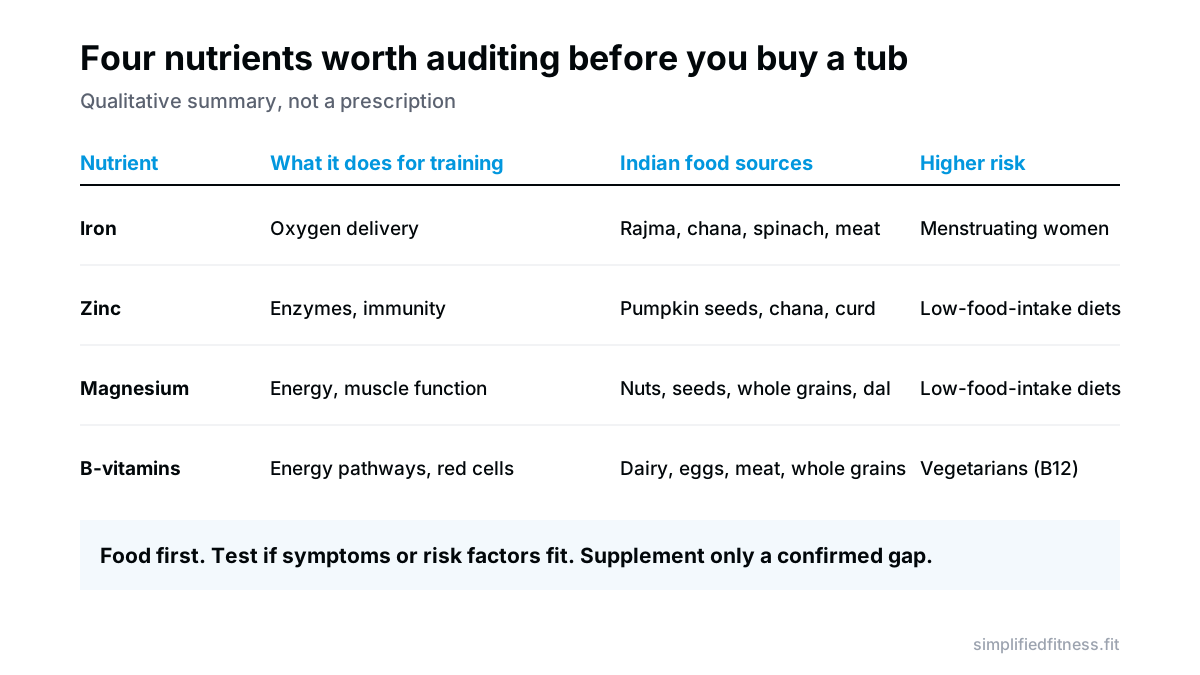
If you eat enough varied food, micronutrient deficiencies lifters worry about are usually not what is holding back your strength. The picture changes when intake is low, whole food groups are cut, or iron is being lost every month. Iron has the clearest link to performance, while zinc, magnesium and the B-vitamins matter mostly when you are genuinely short.
This article sits inside our complete guide to carbs, fats and hydration for performance. It is about auditing whole-food nutrient adequacy first. If you are already weighing pills, see multivitamins for lifters afterwards.
Which micronutrient deficiencies lifters actually get
Short answer: fewer than supplement ads suggest. A review by Lukaski found that physically active people generally eat vitamins and minerals in amounts consistent with public recommendations, but when intakes fall short some functional impairments do appear (Lukaski, 2004). The same review noted that people in weight-class or aesthetic sports, and young girls, are more prone to gaps because they restrict food.
A 2021 review reached a similar balance: supplementation in well-nourished athletes does not enhance performance, but it can be warranted with a diagnosed deficiency, compromised energy intake, or altitude training (Beck et al., 2021). Most of that research is in athletes, not casual gym-goers, so treat it as a guide rather than a guarantee.
Iron: the one that most clearly affects performance
Iron carries oxygen in haemoglobin and supports muscle function. It is the micronutrient with the strongest performance data, and the strongest for women.
A 2025 systematic review covered 23 studies and 669 high-level female athletes with ferritin under 40 µg/L. It reported that iron deficiency was associated with about 3-4% poorer endurance performance, and that endurance improved by 2-20% when deficient athletes took about 100 mg/day of elemental iron for up to 56 days (Pengelly et al., 2025). Strength and anaerobic power effects were less clear. Most studies had 20 or fewer athletes, which limits confidence.
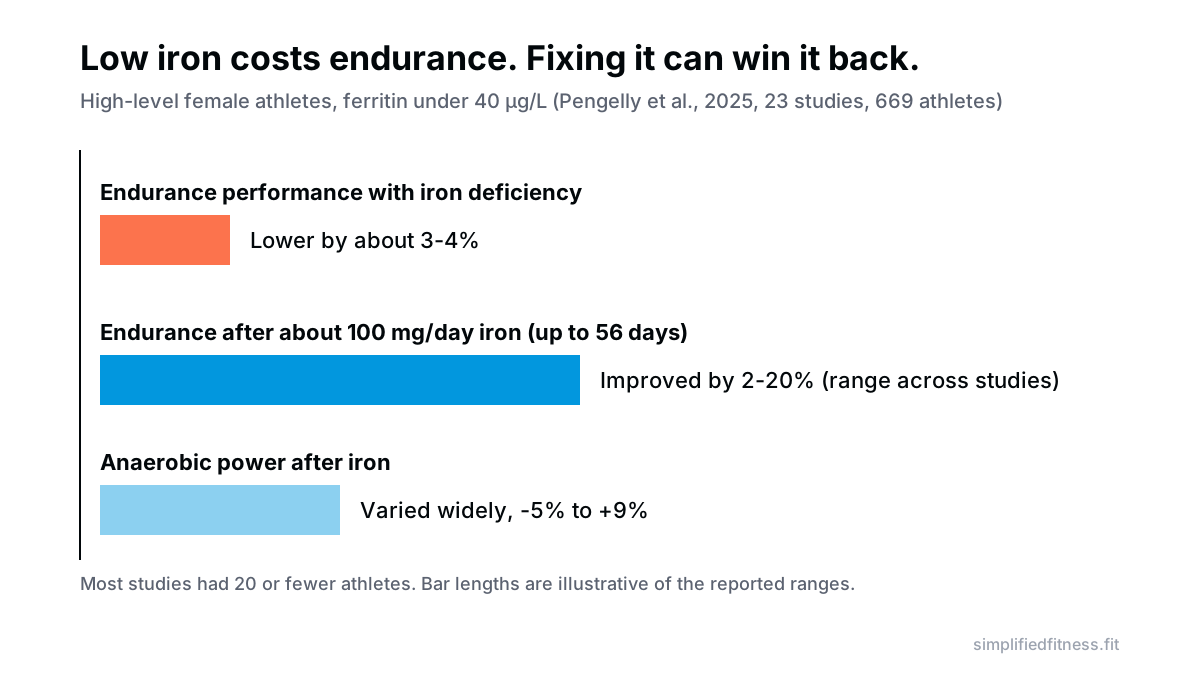
Another review found iron supplementation worked best in athletes with the lowest iron status, with benefits mostly seen in those who started deficient (Solberg and Reikvam, 2023). That is the key practical point: iron helps the iron-deficient, not everyone.
For Indian diets, iron sources include rajma, chana, lentils, spinach and, for non-vegetarians, meat. Pairing pulses with a vitamin C source such as lemon or amla and keeping tea away from the meal are common practical tips, though I would not oversell their effect.
Zinc: sweat losses and the testosterone myth
Zinc is involved in energy metabolism, immunity and antioxidant defence. A systematic review of 45 studies (34 of them pooled) noted that zinc losses during exercise, particularly through sweat, are well documented, yet serum zinc was actually higher immediately after aerobic exercise (Chu et al., 2016). The authors said the long-term consequences for requirements in active people need more research.
Two takeaways. First, a blood draw straight after training can mislead. Second, the idea that zinc is a testosterone booster is not supported for people who are not deficient. Lukaski’s review found supplemental zinc and magnesium apparently improved strength and muscle metabolism in some studies, but evidence was lacking on whether that reflected impaired status or a pharmacological effect (Lukaski, 2000).
Food sources include pumpkin seeds, chana, curd and meat. Pulses contain compounds that can reduce absorption, so soaking, sprouting and fermenting (idli and dosa batter) are sensible habits.
Magnesium: relaxation, energy and a lot of marketing
Magnesium takes part in energy metabolism and muscle function. Lukaski noted that magnesium deprivation increases oxygen cost of submaximal exercise and reduces endurance performance (Lukaski, 2004). That is about deprivation, not about topping up.
When supplements were tested in people who may not be short, results were underwhelming. In a randomized crossover trial of 32 physically active women, 212 mg/day of magnesium oxide for four weeks raised ionic magnesium but did not change performance or recovery (Finstad et al., 2001). One trial in young women does not close the question, but it fits the broader pattern.
Food first again: nuts, seeds, whole grains, dal and leafy vegetables. If you sweat heavily in Indian summers, see our note on electrolytes in the gym.
B-vitamins: energy pathway helpers, with a B12 catch
Thiamin, riboflavin and B6 sit in energy-producing pathways, while folate and B12 are needed for new and repairing cells, including red blood cells. A review concluded that active people with poor or marginal B-vitamin status may have decreased ability to exercise at high intensities, and that exercise may increase requirements for riboflavin and B6, with limited data for folate and B12 (Woolf and Manore, 2006).
Lukaski added that severe folate and B12 deprivation causes anaemia and reduces endurance work performance, while short-term marginal shortfalls on blood measures had no effect on performance (Lukaski, 2004).
The Indian vegetarian angle matters. In a study of 119 young, healthy vegetarian graduates in Pune, about half met the definition of B12 deficiency, though none had clinical signs (Naik et al., 2018). That is one single-centre sample, not a national figure. But if you are vegetarian and train hard, B12 is worth testing. For more on the protein side, see our top vegetarian protein foods.
How to detect a deficiency: symptoms, food audit, tests
Symptoms are a weak guide. Tiredness, poor recovery and stalled lifts also come from short sleep, low calories and too much volume. A review on nutrient assessment in athletes stressed that dietary data is error-prone, biomarkers are not available for every nutrient, and reference norms for trained athletes are not well established (Larson-Meyer et al., 2018).
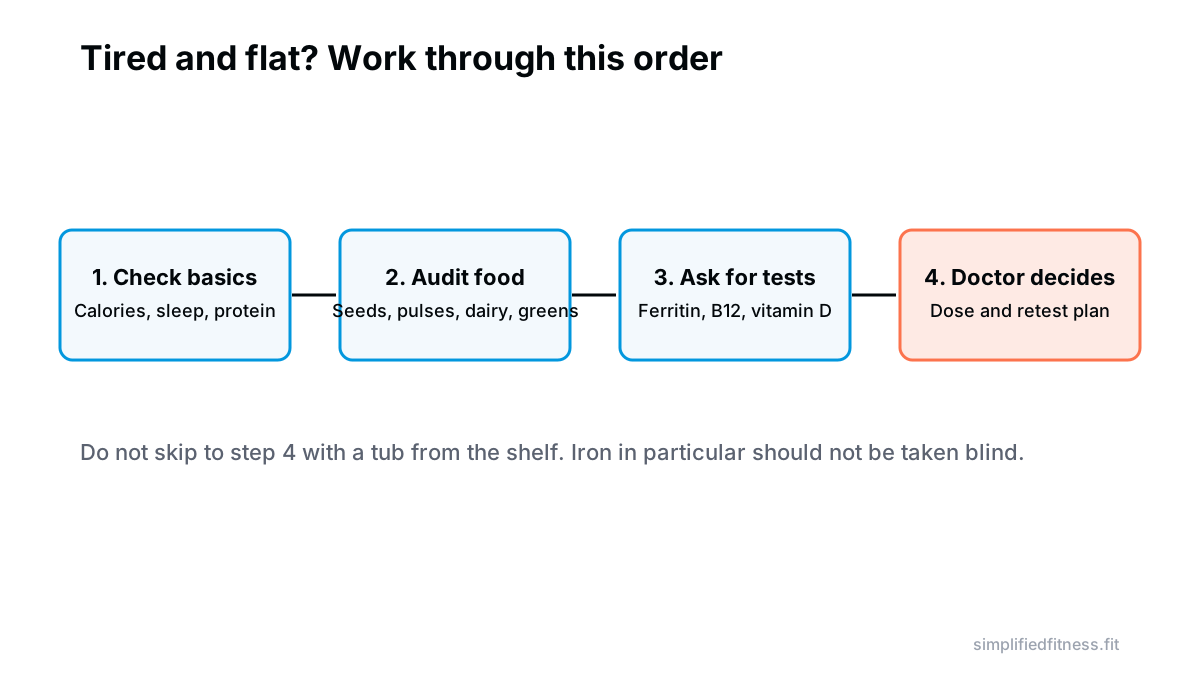
A practical order:
- Check the basics. Are you eating enough calories, protein and sleeping? Use the protein calculator as a start.
- Audit your plate. Over a week, count how often you eat pulses, seeds or nuts, dairy or eggs, greens and whole grains.
- Ask for tests. Ferritin, haemoglobin, B12 and vitamin D are common starting points, as your doctor decides. For vitamin D, see our vitamin D guide.
- Let a doctor choose the dose and the retest date.
Who is most likely to fall short
Risk is not spread evenly, so it helps to be honest about where you sit.
- Women who menstruate. Iron losses plus lower total food intake are a common pairing. The 2025 review above cites figures of up to 60% of female athletes with iron deficiency, though that is an athlete figure rather than a recreational lifter one.
- Anyone eating very little. Lukaski’s review linked inadequate magnesium and zinc intakes to activities that require restricting body weight. Fewer calories means fewer places for nutrients to hide.
- Strict vegetarians. B12 is the main concern. Iron and zinc deserve a look too, because plant sources come with absorption trade-offs.
- People cutting whole food groups. Dropping dairy, grains or pulses for months removes entire nutrient streams. Keto-style or “only chicken and rice” plans are common examples in gyms.
- Heavy sweaters in hot weather. Sweat does contain minerals, but research on what that means for long-term requirements is still thin, so a varied diet is the practical answer rather than a tub of zinc.
If none of these describe you and you eat a normal mixed Indian diet, a deficiency is a less likely explanation for a bad month in the gym. Look at sleep, stress and training volume first.
A simple one-week plate audit
You do not need an app. For seven days, tick a box each time you eat one of these:
- A pulse (dal, rajma, chana, soya) at least once a day
- A handful of nuts or seeds
- Curd, milk, paneer or eggs
- A green leafy vegetable or other vegetable at lunch and dinner
- Whole grains such as atta roti, oats or brown rice on most days
- For non-vegetarians, fish, chicken or meat a few times a week
Missing a whole category most days is a better clue than any symptom checklist. It tells you where to fix the diet, and it gives your doctor something concrete to work with if you do get tested.
What if you are dieting hard?
Low food intake is the biggest practical risk factor, because there is simply less food carrying micronutrients. We cover this in micronutrient support in deep deficits. A moderate deficit with a varied plate (a bowl of dal, a roti or two, curd, a vegetable, a handful of nuts) is far safer than crash dieting on rice and shakes. If you want a structure, our free diet plan is a starting point, and for iron specifically see iron deficiency and ferritin in athletes.
When supplements make sense
- You have a confirmed deficiency on a blood test.
- Your diet excludes a food group, as with B12 in strict vegetarians or vegans.
- Your energy intake is compromised, or you are at altitude, as the 2021 review notes.
Even then, the review recommended these be prescribed by a medical professional (Beck et al., 2021). Lukaski warned that indiscriminate mineral supplements can impair physiological function (Lukaski, 2000).
The bottom line
Fix food first. Test before you treat. Most lifters who eat enough varied food will not gain performance from extra micronutrients, but iron, B12 and a very restricted diet are the exceptions worth checking. This article is general information, not medical advice, so speak to a doctor about symptoms or test results.
Frequently Asked Questions
Can micronutrient deficiencies hurt strength and recovery?
Yes, but mostly when a deficiency is real. Reviews of the evidence find that marginal shortfalls in minerals such as iron can impair muscle function and work capacity, while extra intake in people who are already well nourished does not improve performance. If you feel unusually flat for weeks despite good food and sleep, ask a doctor about blood tests.
Which vitamins are essential for muscle growth?
No single vitamin builds muscle. Muscle growth is driven by training, enough protein and enough total calories, while vitamins and minerals work in the background in energy metabolism and red blood cell production. Eat a varied diet with pulses, dairy, eggs, vegetables and whole grains and you have covered the basics.
How do I know if I have a vitamin deficiency from the gym?
Gym symptoms such as fatigue, weaker lifts or slow recovery are not specific, because poor sleep, low calories or overtraining cause the same picture. Blood markers such as ferritin and vitamin B12, ordered by a doctor, are how deficiencies are actually confirmed. Do not diagnose yourself from a symptom list.
Do lifters lose zinc through sweat?
Sweat does contain zinc, and a 2016 meta-analysis noted that zinc losses during exercise are well documented. That review also found that serum zinc was higher right after a session, so a blood test straight after training can be misleading. Long-term effects on requirements are still unclear, so food sources such as seeds, pulses and curd are the sensible response.
Does zinc raise testosterone in lifters?
There is no good evidence that extra zinc raises testosterone in people who are not deficient. An older review found zinc and magnesium supplements seemed to help strength in some studies, but could not tell whether that only reflected people who were short to begin with. Zinc is needed for normal hormone and enzyme function, so a true deficiency is a problem, but extra zinc beyond need is not a proven way to raise testosterone. Fix food intake first and ask a doctor before taking a zinc supplement.
Does magnesium improve gym performance?
In people who are not deficient, the evidence says mostly no. A 14-week crossover trial in physically active women found that four weeks of 212 mg/day magnesium oxide raised blood ionic magnesium but did not change performance or recovery. Eating nuts, seeds, whole grains and dal covers most people, and a doctor can advise if you suspect a real shortfall.
Is iron deficiency common in female lifters?
The 2025 systematic review cites figures of up to 60% of female athletes experiencing iron deficiency, though those figures come from athletic groups and may not match recreational lifters. Menstrual blood loss and lower food intake are common reasons. If you are female, tired and training hard, ask for a ferritin test rather than guessing.
Should vegetarian lifters worry about vitamin B12?
Yes, it deserves attention. In a Pune study of 119 young healthy vegetarians, about half met the definition of B12 deficiency even though none had clinical signs. B12 is found mainly in animal foods such as dairy and eggs, so get tested and discuss supplementation with your doctor.
Do B-vitamins give you energy for workouts?
Only if you are short of them. B-vitamins are needed in energy-producing pathways, and a review found that active people with poor or marginal B-vitamin status may have a reduced ability to exercise at high intensity. Taking more when you are not deficient has not been shown to boost training, so a balanced diet is enough for most lifters.
Should I take a multivitamin as insurance?
It might help if your diet is restricted, but it is not a substitute for food. Reviews suggest athletes who eat poorly or cut food groups may benefit from a multivitamin, while well-nourished athletes see no performance gain. Our guide on multivitamins for lifters covers the pros and cons in detail.
Which blood tests should I ask for?
Common starting points are ferritin and haemoglobin for iron, vitamin B12, and vitamin D, with other tests decided by your doctor based on your symptoms and diet. Reference ranges for well-trained athletes are not well established, so results need interpreting in context. Bring your diet history and training load to the appointment.
Can too many supplements be harmful?
Yes. Reviews warn that indiscriminate mineral supplementation can impair physiological function, and excessive supplement use may blunt some training adaptations. Iron is a particular concern because it should be taken only when needed. Stick to food and treat supplements as targeted tools prescribed for a confirmed gap.
Sources & References
Every claim above is checked against peer-reviewed research (PubMed, U.S. National Library of Medicine) or guidance from established health bodies. How we fact-check.
- Pengelly M, et al. Iron deficiency, supplementation, and sports performance in female athletes: a systematic review. J Sport Health Sci. 2025. PMID: 39536912
- Solberg A, et al. Iron status and physical performance in athletes. Life (Basel). 2023. PMID: 37895389
- Beck KL, et al. Micronutrients and athletic performance: a review. Food Chem Toxicol. 2021. PMID: 34662692
- Lukaski HC. Vitamin and mineral status: effects on physical performance. Nutrition. 2004. PMID: 15212745
- Lukaski HC. Magnesium, zinc, and chromium nutriture and physical activity. Am J Clin Nutr. 2000. PMID: 10919964
- Woolf K, et al. B-vitamins and exercise: does exercise alter requirements? Int J Sport Nutr Exerc Metab. 2006. PMID: 17240780
- Chu A, et al. Immediate effects of aerobic exercise on plasma/serum zinc levels: a meta-analysis. Med Sci Sports Exerc. 2016. PMID: 26540263
- Finstad EW, et al. The effects of magnesium supplementation on exercise performance. Med Sci Sports Exerc. 2001. PMID: 11252079
- Naik S, et al. Identification of vitamin B12 deficiency in vegetarian Indians. Br J Nutr. 2018. PMID: 29446340
- Larson-Meyer DE, et al. Assessment of nutrient status in athletes and the need for supplementation. Int J Sport Nutr Exerc Metab. 2018. PMID: 29252049

Umair Hazrami · Founder & Head Coach, Simplified Fitness
Umair Hazrami founded Simplified Fitness and the Simplified Lifter channel to cut through fitness noise. With 4+ years of consistent training and 10+ coaching clients, he writes every guide from the peer-reviewed research and links the sources so you can check them. Our editorial standards.
Educational content only, not medical advice. If you have a medical condition, are pregnant, or take medication, talk to a qualified doctor before changing your diet, supplements or training. Full disclaimer.
Keep reading
Nutrition
Alcohol and Muscle Growth: What a Heavy Night Does to MPS, Sleep and Recovery
Alcohol and muscle growth: does a heavy Saturday night wipe out your week? See what research says on MPS, REM sleep and recovery, and how to limit the damage.
7 min read

Nutrition
Ashwagandha and Cortisol: Does It Lower Stress and Boost Strength in the Gym?
Ashwagandha for lifting: what the trials show on cortisol, stress and strength gains, realistic dose (300-600 mg), who should skip it and how to buy it safely.
7 min read
Nutrition
Caffeine Sensitivity, CYP1A2 Genetics and Caffeine Cycling: Why Pre-Workout Works for Him, Not You
Caffeine sensitivity genetics explain why pre-workout gives your friend PRs and you anxiety. See what CYP1A2 and ADORA2A do, and how to find your dose.
8 min read

Nutrition
Creatine Non-Responders: Why It May Not Be Working and What to Try
Creatine non responder? Learn why roughly 1 in 4 people see little change, how baseline diet matters, and when carbs with creatine help. Studies linked.
7 min read