Omega-3 Fatty Acids (EPA/DHA): Joint Pain, Muscle Growth and How Much to Take
Omega-3 fish oil benefits for lifters: what EPA and DHA do for muscle, joints and triglycerides, a sensible dose range, and what the trials really found.

TL;DR. The short answer
- Fish oil has modest, not dramatic, effects for lifters. A 2023 meta-analysis of 14 studies (1,443 people) found a very small gain in strength and no significant change in muscle mass.
- The strongest muscle signal is in older adults: omega-3 raised the muscle protein synthesis response to amino acids and insulin, but not the baseline rate.
- Joint pain relief is real mainly in inflammatory conditions such as rheumatoid arthritis, after about 3-4 months. Evidence for ordinary gym aches is thin.
- A reasonable lifter range is roughly 1-2 g of combined EPA + DHA a day, counted from the facts panel. Higher doses raise atrial fibrillation risk in large trials, so go above that only with a doctor.
- Algal oil is a legitimate vegetarian option. One 2025 trial in 74 adults found its EPA and DHA absorption non-inferior to fish oil.
Part of our complete guide: Carbohydrates, Fats, Fibre, Micronutrients and Hydration: The Lifter's Fueling Guide
Table of contents
Do omega 3 fish oil benefits for lifters actually show up in the gym? Mostly in small ways. The best evidence says fish oil adds, at most, a tiny strength bump and no reliable extra muscle in healthy adults, with more promising signals in older people and in inflammatory joint pain. It is a reasonable supplement to consider, not a shortcut.
This article is the biochemistry and the practical dosing. It sits inside our carbohydrates, fats and hydration guide, and the supplement-by-supplement dosing walkthrough lives in the fish oil EPA and DHA dosing guide.
What are EPA and DHA, and what do they do?
Omega-3s are polyunsaturated fats. The two that matter for this conversation are EPA (eicosapentaenoic acid) and DHA (docosahexaenoic acid), found mainly in fatty fish and algae.
Here is the mechanism in plain terms. EPA and DHA get built into the phospholipid membranes that wrap every cell, muscle fibres included. The idea is that a membrane richer in these fats changes how the cell signals and how it handles inflammation. That is the theory behind the claims about anabolic sensitivity, soreness and joints.
Theory is cheap, though. What did people actually measure?
Does omega-3 improve muscle protein synthesis?
This is where the famous study comes from. In a randomized trial of 16 healthy older adults, 8 weeks of omega-3 versus corn oil did not change the basal rate of muscle protein synthesis (0.051 vs 0.053 %/h). But it increased the rise in synthesis during an amino acid and insulin infusion, from 0.009 to 0.031 %/h above basal, with greater p70s6k phosphorylation (Smith et al., 2011). The authors concluded omega-3 may help against sarcopenia.
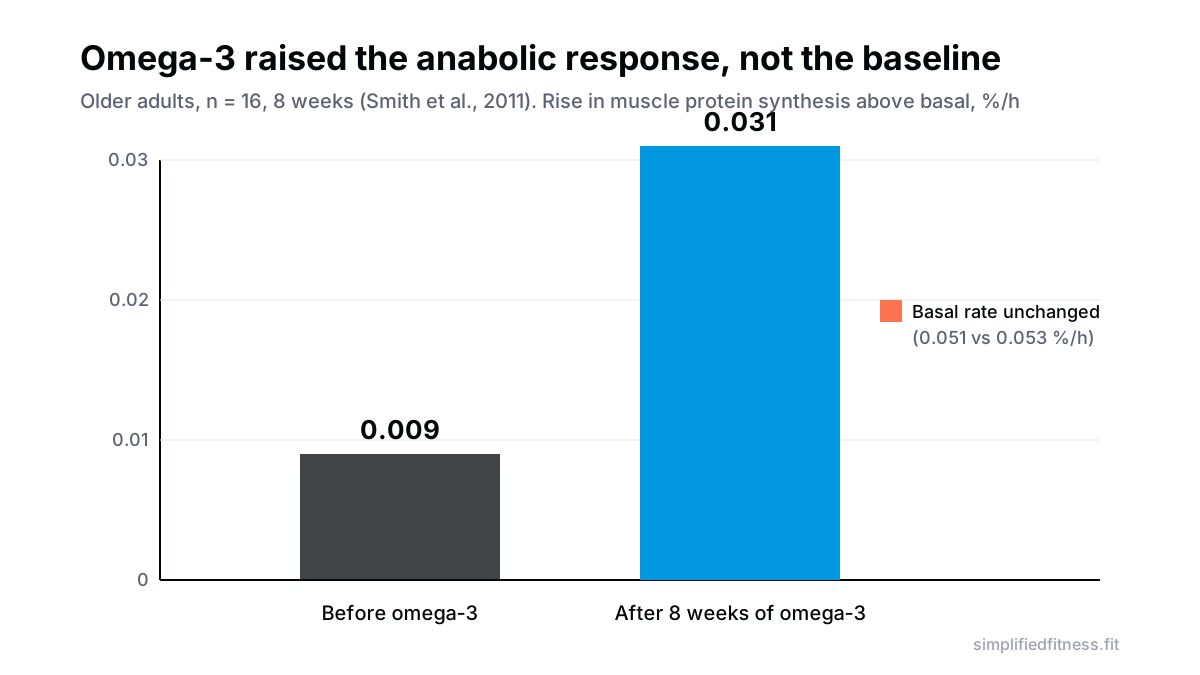
Read that carefully. Sixteen people, older, an infusion rather than a protein shake, and a measure of synthesis rather than actual muscle gained. Useful, but not proof that your biceps will grow.
A longer training trial points the same direction in the same kind of people. In 16 older women doing 6 weeks of unilateral leg training, 3,680 mg a day of omega-3 did not change strength gains compared with placebo. Only the omega-3 group showed a statistically significant rise in thigh fat-free mass and type II fibre area, and there was no added benefit on muscle protein synthesis itself (Brook et al., 2021). Again: eight people per group.
What do the pooled data say?
Zoom out and the picture is less exciting. A 2023 meta-analysis pooled 14 studies and 1,443 healthy young and older adults. Omega-3 had no significant effect on muscle mass (SMD 0.07) or function, and a very small positive effect on strength (SMD 0.12). Age, dose and whether people lifted did not change this, though the authors rated the studies at high overall risk of bias (Santo André et al., 2023).
Why the mismatch? Small mechanistic trials in older people can show a signal that disappears when you pool younger, trained and mixed groups. Young lifters with adequate protein may simply have less room to benefit. The cautious takeaway: omega-3 may matter more as you age or if your diet is poor. For a healthy young lifter, expect little.
Protein and training volume are far bigger levers. Check yours with the protein calculator before buying anything.
Does fish oil help with joint pain and recovery?
Two separate questions hide in here.
Inflammatory joint pain. A 2007 meta-analysis of 17 randomized trials in people with rheumatoid arthritis and joint pain from inflammatory bowel disease or dysmenorrhea found that 3-4 months of omega-3 reduced patient-reported pain (SMD -0.26), morning stiffness (SMD -0.43), painful joints and NSAID use. It found no significant effect on physician-assessed pain (Goldberg and Katz, 2007). So the benefit is real but modest, and in patients with inflammatory disease. It does not automatically carry over to a lifter with cranky knees. For other options, see our joint health supplements breakdown.
Soreness after hard training. Here the data conflict. A 2021 systematic review of 15 studies concluded omega-3 appeared to have favourable effects on delayed onset muscle soreness and inflammatory markers, but only one study met current design recommendations (Anthony et al., 2021). Then a 2023 trial gave 16 moderately trained men 5 g a day of fish oil for 4 weeks before a heavy eccentric session. Blood omega-3 was higher, yet creatine kinase, inflammation, soreness and function were no better than placebo (Mackay et al., 2023).
Why might they differ? Dose, duration, the exercise used and study quality all vary, and this trial was small. Our best reading: if omega-3 helps soreness, the effect is small enough that a trained person may not notice it. For soreness tools with their own evidence, see tart cherry and omega-3 for muscle soreness.
Do omega-3s lower triglycerides?
This is the best-supported benefit. A dose-response meta-analysis of 90 randomized trials (72,598 participants) found that omega-3 intake lowered triglycerides and non-HDL cholesterol in a near-linear way, most evidently in people with high lipids or overweight at doses above 2 g a day (Wang et al., 2023).
Note the population. If you are lean, training and eating well, your triglycerides may already be fine, and a supplement will have less to fix. If a blood test says they are high, that is a conversation for your doctor, who may treat it differently from a gym supplement.
How much EPA and DHA should you take?
You will see “2-3 g a day” quoted widely. Here is why we are more cautious.
A 2021 meta-analysis of 7 large cardiovascular trials (81,210 patients, mean age 65, average follow-up 4.9 years) linked marine omega-3 supplements to a higher risk of atrial fibrillation (HR 1.25). The risk was greater in trials testing more than 1 g a day (HR 1.49) than in those at or below 1 g (HR 1.12), and rose with each extra gram (Gencer et al., 2021). Those were older people with cardiovascular risk, so we cannot map the numbers straight onto a healthy 25-year-old. But it is a reason not to treat “more” as automatically safe.
Meanwhile the muscle trials above used doses around 3-4 g in older adults, and the pooled analysis found no dose effect on muscle outcomes.
Putting it together, here is a practical frame:
| Goal | Reasonable approach | Notes |
|---|---|---|
| General lifter, low fish intake | About 1-2 g combined EPA + DHA a day | Our cautious range, not a clinical standard |
| Eat fatty fish 2+ times a week | Supplement may be unnecessary | Food counts toward the total |
| High triglycerides on a blood test | Dose set by your doctor | Trials show effects above 2 g a day |
| Heart rhythm condition, blood thinners, pregnancy | Ask a doctor first | Do not self-prescribe |
Fish oil forms, purity and algal oil
Triglyceride vs ethyl ester. The evidence is product-specific and limited. In a 16-week trial of 60 young healthy adults, a fish oil that was over 95% re-esterified triglyceride raised red cell EPA and DHA more than one under 70% at week 16 (Minton et al., 2023). The higher-scoring group also got slightly more EPA plus DHA (2,750 vs 2,500 mg a day), and the lead authors work for the company that makes the winning product. It also compares two triglyceride products, not triglyceride against ethyl ester head to head, so do not read it as a universal rule. Total EPA plus DHA per serving matters first.
Purity. Supplements are loosely checked, so look for independent testing. Our guide to third-party supplement certifications covers what the seals mean.
Vegetarian and vegan options. Fish oil is not your only source. A 2025 randomized trial of 74 adults found plasma DHA and EPA from microalgal oil statistically non-inferior to fish oil after 6 and 14 weeks. The trial was run by the manufacturer’s employees, so it is useful but not independent (Bailey et al., 2025). If you eat no fish, algal oil is a sensible choice, and our vegan protein guide covers the other nutrition pieces.
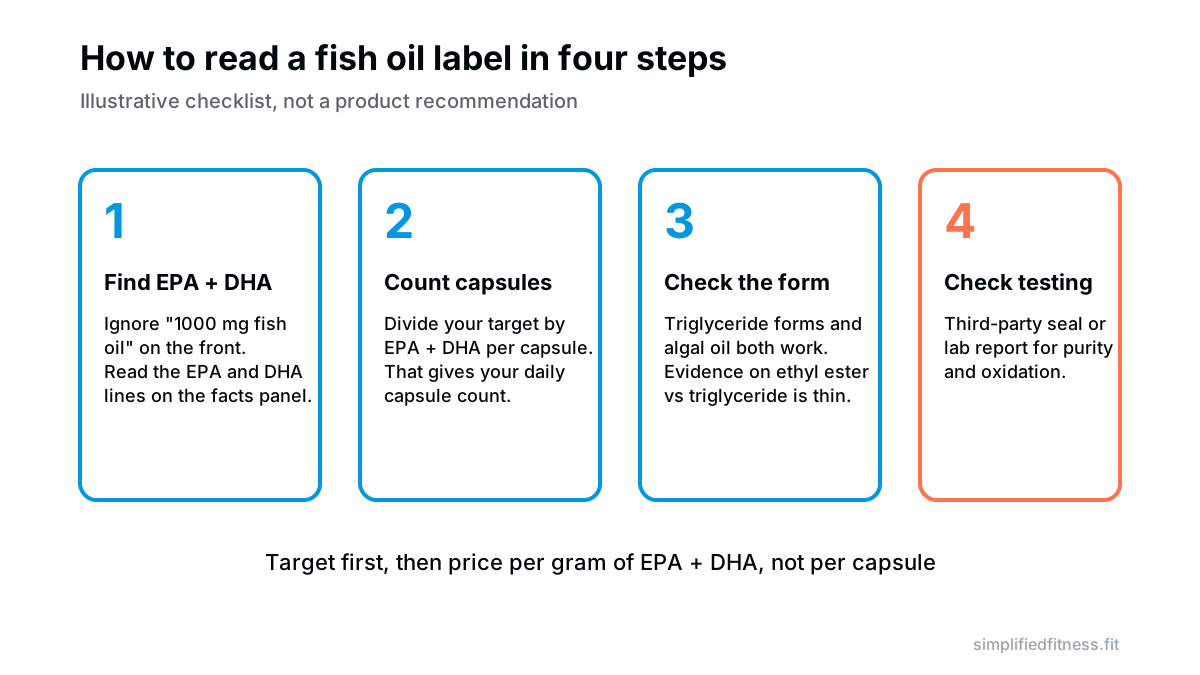
A simple way to use omega-3 in an Indian diet
- Food first: oily fish such as mackerel or sardines two or three times a week covers a decent share for many people. Boiled, steamed or lightly pan-cooked works.
- If you are vegetarian: algal oil is the direct route. Flax and walnuts supply a different omega-3 that is generally not a like-for-like swap for EPA and DHA.
- Heat and storage: keep capsules away from a hot kitchen shelf. Oil that smells strongly fishy or rancid should go in the bin.
- Timing: with a meal that has some fat, any time of day, every day.
- Budget: price per gram of EPA plus DHA, not per bottle. A cheap bottle with little EPA and DHA per capsule is expensive in practice.
Who should be careful
Check with a doctor first if you:
- take blood thinners or have a bleeding disorder
- have a heart rhythm condition or cardiovascular disease
- are pregnant or breastfeeding
- have a fish or shellfish allergy
- are having surgery soon
Persistent joint pain, swelling or stiffness that does not settle needs a proper assessment. A supplement is not a diagnosis.
The bottom line
Omega-3 is worth considering if you eat little fish, are older, or have a doctor-identified reason such as high triglycerides. For a healthy young lifter, the muscle effect is small, the soreness data are mixed, and the dose should stay conservative.
Spend your effort on the basics first. Get protein right, train hard on a plan like our free push, pull and legs routine, and treat fish oil as the garnish, not the meal. Then compare it with other supplements in our evidence-based supplements guide.
Frequently Asked Questions
Does fish oil help build muscle?
Only a little, if at all, in healthy adults. A 2023 meta-analysis of 14 studies found no significant effect on muscle mass and a very small effect on strength. Fix protein and training first, and treat fish oil as an optional extra.
How much EPA and DHA should I take per day?
About 1-2 g of combined EPA and DHA is a sensible range for most lifters. Trials that used more than 1 g a day showed a higher atrial fibrillation risk in a 2021 meta-analysis of cardiovascular patients. Check the EPA and DHA lines on the label, and ask a doctor before going higher.
Is EPA or DHA better for muscle?
We do not know, because most trials give both together. Neither has been shown to beat the other for hypertrophy. Choose a product that lists both and stop worrying about the ratio.
Does omega-3 reduce muscle soreness?
The results are mixed. One 2023 trial gave 5 g of fish oil a day for 4 weeks to trained men and found no effect on soreness or muscle damage markers, while a 2021 systematic review reported some favourable effects but flagged poor study design. Do not expect it to replace sleep, protein and sensible volume.
Does fish oil help joint pain?
It can help in inflammatory joint disease. A 2007 meta-analysis of 17 trials found lower patient-reported pain and morning stiffness after 3-4 months in people with rheumatoid arthritis and related conditions. Persistent joint pain needs a doctor, not just a supplement.
How long does omega-3 take to work?
Weeks to months. Studies of joint pain looked at 3-4 months, and muscle studies ran 6-8 weeks or more. Take it daily with a meal and judge it over at least 8-12 weeks.
Should I take fish oil with food?
Yes, with a meal that contains some fat. Fat helps absorption of fish oil, and taking it with food often reduces fishy burps. Pair it with lunch or dinner.
Triglyceride or ethyl ester fish oil, which is better?
Evidence is limited and partly product-specific. A 16-week trial in 60 young adults found a highly re-esterified triglyceride oil raised red cell EPA and DHA more than a less re-esterified one, but it was manufacturer-run and the doses were not identical. Check EPA plus DHA per serving first, and treat the form as a secondary tiebreaker.
Is algal oil as good as fish oil?
It appears to be. A 2025 randomized trial in 74 adults found plasma EPA and DHA from microalgal oil non-inferior to fish oil, though the study was funded by the manufacturer. Vegetarians can use it and check the label for the EPA and DHA content.
Can fish oil lower triglycerides?
Yes, at higher doses. A dose-response meta-analysis of 90 trials found a near-linear fall in triglycerides, most evident above 2 g a day in people with high lipids or overweight. If your triglycerides are high, get a doctor to set the dose.
Are there side effects of fish oil?
Fishy aftertaste and stomach upset are the common complaints. In large cardiovascular trials, marine omega-3 was linked to a higher risk of atrial fibrillation, and the risk was greater in trials using more than 1 g a day. Talk to a doctor first if you take blood thinners, have a heart rhythm condition or are pregnant.
How do I know my fish oil is pure?
Look for a third-party testing seal or a batch lab report, since supplements are loosely regulated. Testing checks purity and what is actually in the capsule, and a strong fishy smell can suggest the oil has oxidised. Our guide to third-party certifications explains what to look for.
Can I just eat fish instead of taking fish oil?
Yes, fatty fish gives you EPA and DHA along with protein. The trials in this area used capsules, so the exact amounts are easier to count with supplements. If you rarely eat fish, a supplement fills the gap.
Sources & References
Every claim above is checked against peer-reviewed research (PubMed, U.S. National Library of Medicine) or guidance from established health bodies. How we fact-check.
- Smith GI, et al. Dietary omega-3 fatty acid supplementation increases the rate of muscle protein synthesis in older adults: a randomized controlled trial. Am J Clin Nutr. 2011. PMID: 21159787
- Brook MS, et al. Omega-3 supplementation during unilateral resistance exercise training in older women: A within subject and double-blind placebo-controlled trial. Clin Nutr ESPEN. 2021. PMID: 34857226
- Santo André HC, et al. The Influence of n-3PUFA Supplementation on Muscle Strength, Mass, and Function: A Systematic Review and Meta-Analysis. Adv Nutr. 2023. PMID: 36811583
- Goldberg RJ, et al. A meta-analysis of the analgesic effects of omega-3 polyunsaturated fatty acid supplementation for inflammatory joint pain. Pain. 2007. PMID: 17335973
- Mackay J, et al. Fish oil supplementation fails to modulate indices of muscle damage and muscle repair during acute recovery from eccentric exercise in trained young males. Eur J Sport Sci. 2023. PMID: 37010103
- Anthony R, et al. The Influence of Long-Chain Omega-3 Fatty Acids on Eccentric Exercise-Induced Delayed Muscle Soreness: Reported Outcomes Are Compromised by Study Design Issues. Int J Sport Nutr Exerc Metab. 2021. PMID: 33477110
- Wang T, et al. Association Between Omega-3 Fatty Acid Intake and Dyslipidemia: A Continuous Dose-Response Meta-Analysis of Randomized Controlled Trials. J Am Heart Assoc. 2023. PMID: 37264945
- Gencer B, et al. Effect of Long-Term Marine omega-3 Fatty Acids Supplementation on the Risk of Atrial Fibrillation in Randomized Controlled Trials of Cardiovascular Outcomes: A Systematic Review and Meta-Analysis. Circulation. 2021. PMID: 34612056
- Minton ST, et al. Comparative membrane incorporation of omega-3 fish oil triglyceride preparations differing by degree of re-esterification: A sixteen-week randomized intervention trial. PLoS One. 2023. PMID: 36706088
- Bailey E, et al. Comparative Bioavailability of DHA and EPA from Microalgal and Fish Oil in Adults. Int J Mol Sci. 2025. PMID: 41096614

Umair Hazrami · Founder & Head Coach, Simplified Fitness
Umair Hazrami founded Simplified Fitness and the Simplified Lifter channel to cut through fitness noise. With 4+ years of consistent training and 10+ coaching clients, he writes every guide from the peer-reviewed research and links the sources so you can check them. Our editorial standards.
Educational content only, not medical advice. If you have a medical condition, are pregnant, or take medication, talk to a qualified doctor before changing your diet, supplements or training. Full disclaimer.
Keep reading

Nutrition
Alcohol and Muscle Growth: What a Heavy Night Does to MPS, Sleep and Recovery
Alcohol and muscle growth: does a heavy Saturday night wipe out your week? See what research says on MPS, REM sleep and recovery, and how to limit the damage.
7 min read

Nutrition
Ashwagandha and Cortisol: Does It Lower Stress and Boost Strength in the Gym?
Ashwagandha for lifting: what the trials show on cortisol, stress and strength gains, realistic dose (300-600 mg), who should skip it and how to buy it safely.
7 min read
Nutrition
Caffeine Sensitivity, CYP1A2 Genetics and Caffeine Cycling: Why Pre-Workout Works for Him, Not You
Caffeine sensitivity genetics explain why pre-workout gives your friend PRs and you anxiety. See what CYP1A2 and ADORA2A do, and how to find your dose.
8 min read

Nutrition
Creatine Non-Responders: Why It May Not Be Working and What to Try
Creatine non responder? Learn why roughly 1 in 4 people see little change, how baseline diet matters, and when carbs with creatine help. Studies linked.
7 min read