Vitamin D3 for Lifters: What a Low Result (18 ng/mL) Means for Strength
Your vitamin D level for lifters explained: what a low 18 ng/mL result means, what trials show for strength, the 40-60 ng/mL claim, and how to fix it.

TL;DR. The short answer
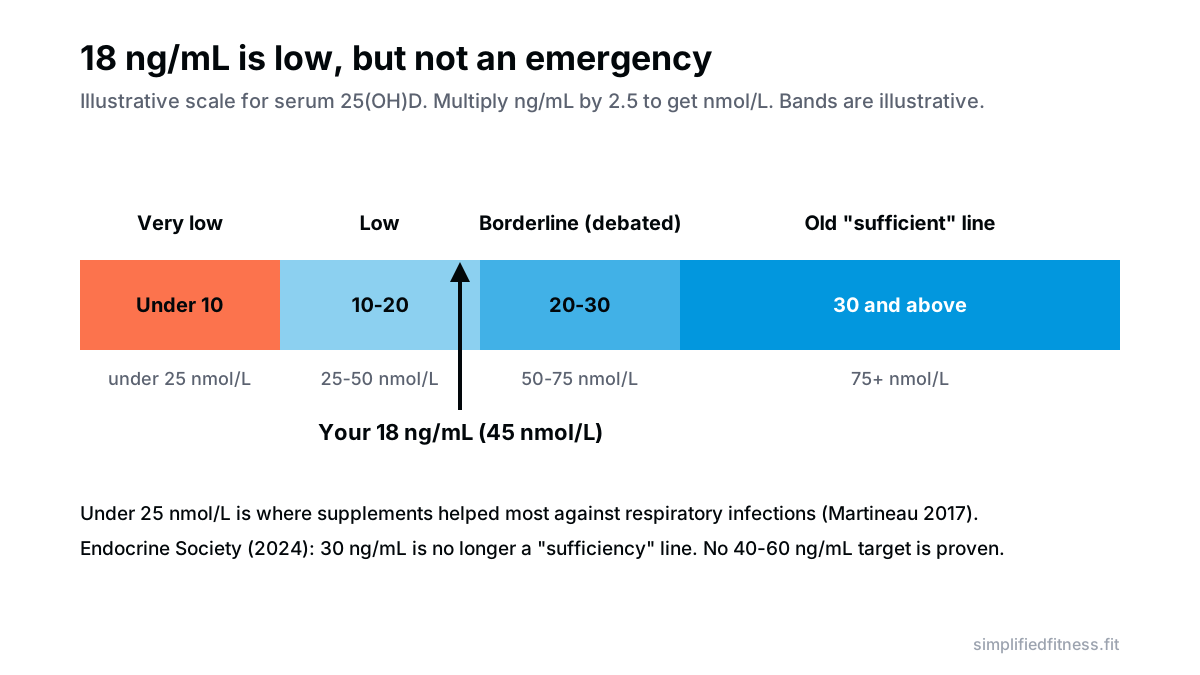
- A result of 18 ng/mL (about 45 nmol/L) is low by most lab cut-offs, and it is common: a 2021 meta-analysis of South Asian adults put pooled deficiency at 68%.
- Randomized trials in lifters and athletes have not shown that correcting a low level adds strength or muscle. A 12-week trial in deficient young men raised levels almost four-fold with no extra gains over placebo.
- The popular 40-60 ng/mL target is not backed by trials. In 2024 the Endocrine Society said the evidence does not allow it to set thresholds that predict benefit.
- The clearest benefit of fixing a low level is health-related, such as fewer respiratory infections, and it is largest under about 10 ng/mL. It is not bigger lifts.
- Get the dose from your doctor, retest after a few months, and do not stack high doses on top of a multivitamin without checking the total.
Part of our complete guide: Carbohydrates, Fats, Fibre, Micronutrients and Hydration: The Lifter's Fueling Guide
Table of contents
Your blood test says 18 ng/mL and you want to know what that vitamin D level means for lifters like you. (This sits inside our guide to carbs, fats and hydration for performance.) Short answer: it is low, it is worth fixing, and it is probably not the reason your bench has stalled. The research on vitamin D3 for lifters and muscle strength is much less exciting than the supplement ads.
Here we stay on the lab number: what it means, what trials show, and what to do next.
Why is vitamin D so low in people who train indoors?
Vitamin D is made in your skin when UVB light hits it, then converted in the liver to 25-hydroxyvitamin D, the form your test measures. Fewer hours outdoors, covered skin, darker skin pigment and heavy air pollution all cut the amount you make. Food adds little for most people.
India is a good example of “sunny but low.” A 2021 meta-analysis of 65 studies and 44,717 South Asian adults reported pooled deficiency of 68%, with average levels between 4.7 and 32 ng/mL (Siddiqee et al., 2021). Heterogeneity between studies was very high, so treat this as a rough picture, not an exact rate.
So an 18 ng/mL result puts you with a large share of the population. Not a reason to panic. Also not a reason to ignore it.
What does vitamin D actually do in muscle?
Vitamin D acts like a hormone. The active form binds to vitamin D receptors found in many tissues, including skeletal muscle, and helps regulate calcium handling for bone and muscle contraction. That is the biology behind the idea that low levels weaken you.
Biology and outcomes are different things. A receptor being present in muscle does not mean topping up a level you already roughly cover will give you more force. The rest of this article is about the outcome trials, because those are what matter at the squat rack.
Does fixing a low vitamin D level make you stronger?
Mostly, trials say no. Let us go through them, because this is where most online advice overreaches.
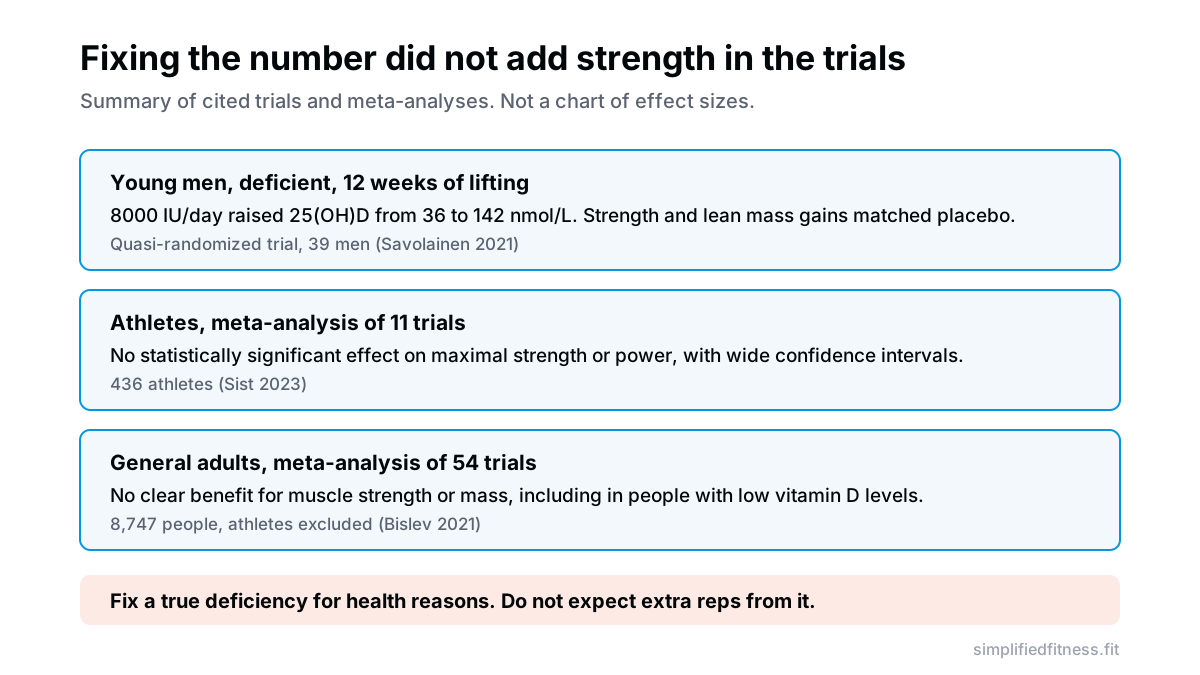
Lifters in a deficient state. In a 12-week trial of 39 young men with baseline levels under 50 nmol/L, 8000 IU a day lifted serum 25(OH)D from 36 to 142 nmol/L while the placebo group stayed low. Strength rose equally in both groups, and in two exercises (chest press and seated row) the placebo group gained more. Lean mass also rose equally (Savolainen et al., 2021). The trial was small and participants were quasi-randomized, so it cannot settle the question alone.
Athletes. A 2023 meta-analysis of 11 randomized trials in 436 athletes found no statistically significant effect on maximal strength or power, though the confidence intervals were wide and the authors call for better studies (Sist et al., 2023). A 2017 review of 13 trials in 532 athletes reached a similar conclusion: even after supplementation of 3000 IU or more raised blood levels, none of the seven trials that measured physical performance found a significant improvement over 12 weeks (Farrokhyar et al., 2017).
General population. A 2021 meta-analysis of 54 randomized trials (8,747 people, athletes excluded) found no clear benefit for muscle strength or mass, including in people with low baseline levels. Two measures actually came out slightly worse on vitamin D, such as a small drop in knee flexion strength, which the authors say needs consideration (Bislev et al., 2021).
Why do supplement ads still claim strength gains? Part of it is that observational studies link low vitamin D with weakness, and association cannot show cause. Results in older or very deficient groups also do not transfer neatly to a 25-year-old training four days a week.
Is 40-60 ng/mL the right target for athletes?
You will see 40-60 ng/mL (100-150 nmol/L) quoted as the “optimal” range on supplement sites. I could not find randomized trial evidence that supports it as better than lower values.
What the guideline bodies say is more cautious. In 2024 the Endocrine Society stated that clinical trial evidence does not permit setting 25(OH)D thresholds that predict meaningful benefit from supplementation, rated its certainty in the evidence as very low, and withdrew its earlier definitions of “sufficiency” (30 ng/mL or more) and “insufficiency” (20-30 ng/mL) (McCartney et al., 2024). That guidance covers generally healthy people, not a specific athlete group, so apply it with that caveat.
For context, the Institute of Medicine’s 2011 review set 20 ng/mL (50 nmol/L) as the level that meets the bone health needs of at least 97.5% of people, and found that higher values were not consistently linked with greater benefit (Ross et al., 2011).
So where does that leave the number? Low enough to be clearly deficient, below about 25 nmol/L (10 ng/mL), is where the strongest health case exists. Above that, the target is a judgment call with your doctor, not a precise optimum.
When fixing it does matter: immunity and bone
Strength is not the only reason to care. The best case for correcting a very low level is health protection.
A 2017 individual participant data meta-analysis of 25 trials (10,933 participants) found vitamin D reduced the odds of acute respiratory infection (adjusted odds ratio 0.88). Protection was seen with daily or weekly dosing (0.81) but not with big bolus doses (0.97). Among daily or weekly takers it was strongest in people starting under 25 nmol/L (0.30, versus 0.75 for everyone else). Serious adverse events did not differ from placebo (Martineau et al., 2017). Notice the pattern: the benefit concentrates in the people who start very low.
For bone, the story depends on your age and your calcium intake, and I have not found trial evidence in young male lifters showing vitamin D prevents fractures. If bone health is your worry, our article on calcium and vitamin D for bone density in lifters goes deeper.
What about vitamin D3 with K2?
The “D3 plus K2” stack is everywhere. The theory is that K2 helps direct calcium into bone. The evidence in lifters is missing, and the best trial I found in another group was neutral: 142 postmenopausal women with osteopenia took 375 mcg of K2 (MK-7) or placebo for three years on top of vitamin D3 and calcium, and bone density fell similarly in both groups (Ronn et al., 2021).
That does not prove K2 is useless. It means you should not expect extra training benefit and should not pay a premium for it. Our dedicated guide to vitamin D3 and K2 dosing covers this combination in more detail.
How to fix a low vitamin D result
Here is the sequence I would follow. Your doctor may adjust it.
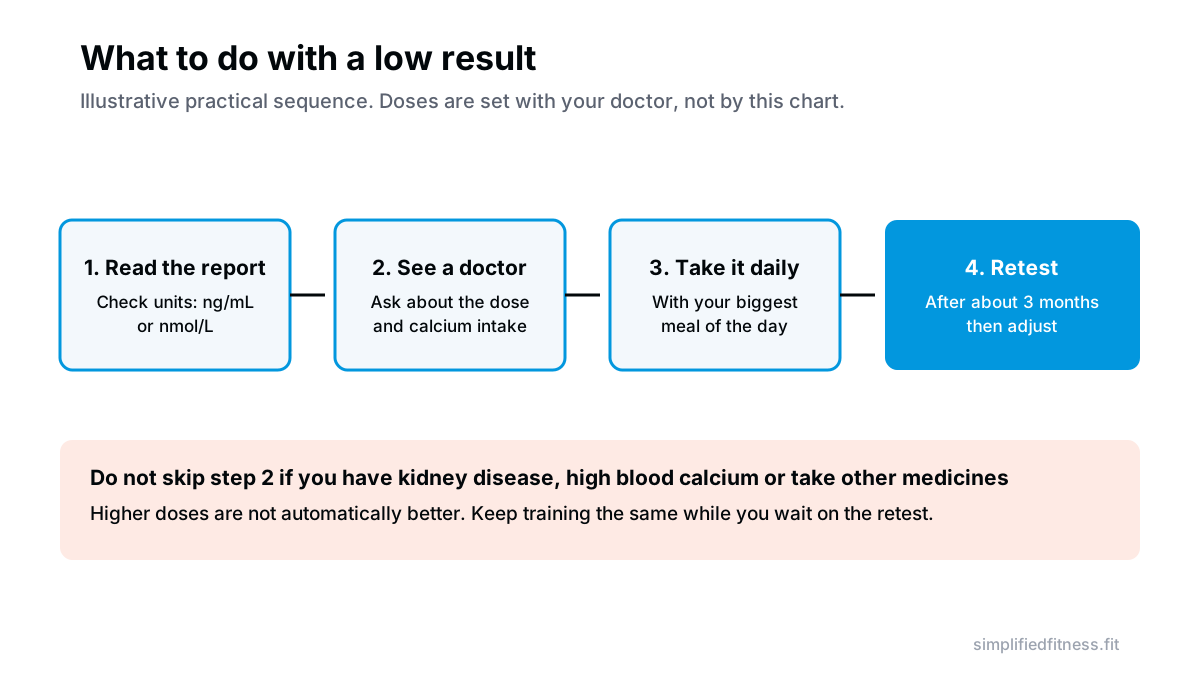
- Check the units. ng/mL and nmol/L look similar on different labs. Multiply ng/mL by 2.5 to convert.
- Talk to a doctor. Especially if you have kidney disease, a history of high calcium or kidney stones, or take other medicines. Dose depends on how low you are.
- Take it daily with a meal. The infection data favoured daily or weekly dosing over large single doses. Vitamin D is fat-soluble, so take it with your biggest meal. A paneer or egg meal works better than an empty stomach.
- Retest after a few months. Levels rise over weeks, but your doctor will want a follow-up number to adjust.
How big a dose? That depends on your result, your skin, your diet and your location, so a single number for everyone would be false precision. For reference, studies in athletes living above 45 degrees latitude found 3000 IU a day raised 25(OH)D by about 15 ng/mL and 5000 IU by about 28 ng/mL in people starting low, with large variation between the 5000 IU studies (Farrokhyar et al., 2017). That is research data, not a prescription, and those athletes live far from India’s latitude.
What about sunlight and food?
Sun helps, but it is hard to measure. How much you make depends on time of day, skin tone, season, clothing and pollution, and burning your skin to fix a lab number is a bad trade. Short, regular sun exposure without burning is a reasonable add-on for many people, not a replacement for testing.
Food is a weak lever. Egg yolks, UV-exposed mushrooms, fatty fish and fortified milk add something. A typical vegetarian Indian plate of dal, roti, rice, sabzi and curd adds very little. If you eat that way and your result is low, a supplement is usually the practical fix.
What to do about training in the meantime
Keep training exactly as you are. Nothing in the trials suggests you should delay lifting or change your program until the number is corrected. If your plan is the issue, start with our free push pull legs plan and check your intake with the diet plan.
If you also feel unusually tired, have bone pain, frequent infections or muscle weakness that does not match your training, see a doctor rather than guessing. Those can be signs of something other than vitamin D. Our guide to zinc, magnesium and iron deficiencies in lifters covers other nutrients worth checking. And if you want the muscle-specific version of this topic, see vitamin D3 and muscle function.
The bottom line
An 18 ng/mL result is low and common, especially in India. Fixing it is worth doing because deficiency matters for health and immunity. It is not a proven strength hack: trials in lifters and athletes show no significant extra strength or muscle from correcting it, and the 40-60 ng/mL target has no trial evidence behind it.
Get a dose from your doctor, take it daily with food, retest, and spend your energy on the things that move the bar: progressive overload, enough protein, enough sleep.
Frequently Asked Questions
Does vitamin D3 increase muscle strength in lifters?
Not reliably. A 2023 meta-analysis of 11 randomized trials in 436 athletes found no statistically significant effect on maximal strength or power. Supplementing makes sense if a test shows you are low, but treat it as a health fix, not a strength supplement.
What is a good vitamin D level for athletes?
There is no agreed athlete-specific target. The Institute of Medicine treats 20 ng/mL (50 nmol/L) as enough for nearly everyone's bone health, and in 2024 the Endocrine Society dropped its 30 ng/mL (75 nmol/L) sufficiency line because trials could not identify a level where supplementing reliably helps. Ask your doctor what range they use. Below about 10 ng/mL is the clearest reason to act.
Is 18 ng/mL vitamin D bad?
It is on the low side. 18 ng/mL equals about 45 nmol/L, just under the 20 ng/mL (50 nmol/L) level the Institute of Medicine says covers the needs of almost everyone. It is not an emergency, so book a doctor visit, ask about a dose, and retest in a few months.
Is 40-60 ng/mL the ideal vitamin D range?
That range is widely quoted online, but no randomized evidence in the studies I reviewed shows it is better than lower values. The Endocrine Society guideline panel rated the evidence very low certainty for any threshold. Chasing a number above what your doctor advises adds cost and some risk without proven benefit.
How long does it take to correct vitamin D deficiency?
Blood levels rise over weeks to months. In one 12-week trial, 8000 IU a day raised young men from 36 to 142 nmol/L, but that was a supervised research dose and well above what most people need, so do not copy it. Your doctor will usually pick a dose and retest after roughly three months.
Should I take vitamin D3 with K2?
There is no evidence in lifters that adding K2 improves strength or muscle. In a 3-year trial of 142 postmenopausal women with osteopenia, adding 375 mcg of K2 (MK-7) to vitamin D3 and calcium did not change bone density versus placebo. If a product combines them, fine, but do not pay extra expecting a training benefit.
Can I get enough vitamin D from sunlight in India?
Often not, despite the sunshine. A 2021 meta-analysis of South Asian adults found pooled deficiency of 68%, and common explanations include clothing, indoor work, skin pigmentation, air pollution and few fortified foods. Short midday sun helps some people, but a blood test is the only way to know where you stand.
Does vitamin D help with colds and immunity?
A little, mainly in people who are very deficient. A 2017 meta-analysis of 25 trials (10,933 participants) found vitamin D reduced the odds of acute respiratory infection, with the biggest effect when baseline levels were under 25 nmol/L. If your result is close to that, correcting it is a reasonable health goal.
Can you take too much vitamin D?
Yes. Very high intakes can raise blood calcium and cause problems with the kidneys and other organs, and routine use well above guideline doses is not supported by trial evidence. Ask your doctor for a dose, check the vitamin D content of any multivitamin, and retest rather than guessing.
What food sources of vitamin D are there for vegetarians?
Few foods carry meaningful amounts. Fortified milk or fortified cereals where available, mushrooms exposed to UV light and egg yolks add small amounts, while most Indian dal, roti, rice and paneer meals contribute very little. This is why many vegetarians need a supplement if a test shows low levels.
Is vitamin D deficiency linked to low testosterone or poor recovery?
I did not find strong randomized evidence that vitamin D supplements raise testosterone or speed recovery in healthy lifters. Observational links exist but cannot show cause. If you feel run down, check sleep, calories and protein first, then ask your doctor about a full blood panel.
Should I take vitamin D3 every day or one big weekly dose?
Daily dosing has better support for infection protection. In the 2017 individual participant data analysis, daily or weekly dosing protected against respiratory infection (adjusted odds ratio 0.81) while regimens with one or more large bolus doses did not (0.97). Follow your doctor's schedule and take it with a meal that contains some fat.
Sources & References
Every claim above is checked against peer-reviewed research (PubMed, U.S. National Library of Medicine) or guidance from established health bodies. How we fact-check.
- Siddiqee MH, et al. High prevalence of vitamin D deficiency among the South Asian adults: a systematic review and meta-analysis. BMC Public Health. 2021. PMID: 34627207
- Bislev LS, et al. Vitamin D and muscle health: a systematic review and meta-analysis of randomized placebo-controlled trials. J Bone Miner Res. 2021. PMID: 34405916
- Sist M, et al. Effects of vitamin D supplementation on maximal strength and power in athletes: a systematic review and meta-analysis of randomized controlled trials. Front Nutr. 2023. PMID: 37841405
- Farrokhyar F, et al. Effects of vitamin D supplementation on serum 25-hydroxyvitamin D concentrations and physical performance in athletes: a systematic review and meta-analysis of randomized controlled trials. Sports Med. 2017. PMID: 28577257
- Savolainen L, et al. Vitamin D supplementation does not enhance resistance training-induced gains in muscle strength and lean body mass in vitamin D deficient young men. Eur J Appl Physiol. 2021. PMID: 33821332
- Ross AC, et al. The 2011 report on dietary reference intakes for calcium and vitamin D from the Institute of Medicine: what clinicians need to know. J Clin Endocrinol Metab. 2011. PMID: 21118827
- McCartney CR, et al. Vitamin D insufficiency and epistemic humility: an Endocrine Society guideline communication. J Clin Endocrinol Metab. 2024. PMID: 38828961
- Martineau AR, et al. Vitamin D supplementation to prevent acute respiratory tract infections: systematic review and meta-analysis of individual participant data. BMJ. 2017. PMID: 28202713
- Rønn SH, et al. The effect of vitamin MK-7 on bone mineral density and microarchitecture in postmenopausal women with osteopenia, a 3-year randomized, placebo-controlled clinical trial. Osteoporos Int. 2021. PMID: 33030563

Umair Hazrami · Founder & Head Coach, Simplified Fitness
Umair Hazrami founded Simplified Fitness and the Simplified Lifter channel to cut through fitness noise. With 4+ years of consistent training and 10+ coaching clients, he writes every guide from the peer-reviewed research and links the sources so you can check them. Our editorial standards.
Educational content only, not medical advice. If you have a medical condition, are pregnant, or take medication, talk to a qualified doctor before changing your diet, supplements or training. Full disclaimer.
Keep reading

Nutrition
Alcohol and Muscle Growth: What a Heavy Night Does to MPS, Sleep and Recovery
Alcohol and muscle growth: does a heavy Saturday night wipe out your week? See what research says on MPS, REM sleep and recovery, and how to limit the damage.
7 min read

Nutrition
Ashwagandha and Cortisol: Does It Lower Stress and Boost Strength in the Gym?
Ashwagandha for lifting: what the trials show on cortisol, stress and strength gains, realistic dose (300-600 mg), who should skip it and how to buy it safely.
7 min read
Nutrition
Caffeine Sensitivity, CYP1A2 Genetics and Caffeine Cycling: Why Pre-Workout Works for Him, Not You
Caffeine sensitivity genetics explain why pre-workout gives your friend PRs and you anxiety. See what CYP1A2 and ADORA2A do, and how to find your dose.
8 min read
Nutrition
Creatine Non-Responders: Why It May Not Be Working and What to Try
Creatine non responder? Learn why roughly 1 in 4 people see little change, how baseline diet matters, and when carbs with creatine help. Studies linked.
7 min read