Dietary Fats and Hormone Production: How Low Can Fat Go on a Cut? (0.6-0.8 g/kg)
What is the minimum fat intake for lifters and testosterone health? See what studies show, why 0.6-0.8 g/kg is a sensible floor, and how to hit it on a cut.
TL;DR. The short answer
- A sensible fat floor for most lifters is about 0.6-0.8 g/kg of body weight a day (roughly 40-55 g for a 70 kg person). This is a practical guardrail from sports nutrition practice, not a measured biological cliff.
- Controlled trials of low-fat diets in men show a small average drop in testosterone (a 2021 meta-analysis of 6 studies), but a 2025 meta-analysis of 11 randomized trials found no significant change in sex hormones. The evidence is mixed and low certainty.
- The bigger danger is not fat alone but long, deep calorie deficits. A review of natural bodybuilding prep links very low energy availability with muscle loss, hormonal disruption and mood problems.
- Cutting fat to near zero saves very little: fat is 9 kcal per gram, so going from 60 g to 20 g frees only about 360 kcal, and it costs you a hormone-friendly buffer plus fat-soluble vitamins and essential fatty acids.
- Falling libido, low mood, poor sleep or missed periods during a cut are reasons to eat more and talk to a doctor, not to push harder.
Part of our complete guide: Carbohydrates, Fats, Fibre, Micronutrients and Hydration: The Lifter's Fueling Guide
Table of contents
If you are asking about the minimum fat intake for lifters and testosterone, the practical answer is about 0.6-0.8 g of fat per kg of body weight a day, or 15-30% of your calories. Go much lower for weeks and you risk missing essential fats and fat-soluble vitamins, and you may blunt your hormones. The research on that last part is more mixed than gym lore suggests, and we will lay out both sides below.
This article is part of our complete guide to carbs, fats, fibre and hydration. Here we zoom in on one common mistake: dropping fat to nearly zero on a cut, then wondering why libido, mood and training fell off a cliff.
Why does your body need dietary fat at all?
Fat is not just stored energy. Three jobs matter for lifters.
First, essential fatty acids. Your body cannot make certain fats, so they have to come from food. The ACSM position stand says fat intake should be enough to provide essential fatty acids and fat-soluble vitamins, and to contribute energy for weight maintenance (Rodriguez et al., 2009).
Second, vitamin absorption. Vitamins A, D, E and K travel with dietary fat. Eat almost none and you absorb less of them.
Third, hormone building blocks. Steroid hormones, including testosterone, oestrogen and progesterone, are built from cholesterol. Your liver makes plenty of cholesterol on its own, so you do not need to eat huge amounts of it. The bigger hormonal risk is being chronically underfed overall, which we cover below.
Does low fat intake lower testosterone? What the studies show
This is where the internet gets overconfident, so let us be careful. There are two meta-analyses, and they do not fully agree.
A 2021 systematic review and meta-analysis pooled 6 intervention studies with 206 men comparing low-fat and high-fat diets. Low-fat diets were linked to significantly lower total testosterone (standardised mean difference -0.38), free testosterone (-0.37), urinary testosterone and DHT. There were no significant differences in luteinising hormone or SHBG. The authors concluded that low-fat diets appear to decrease testosterone, but that more randomized trials are needed (Whittaker et al., 2021). A later erratum was published for this paper, so check the journal page if you want the final figures.
A 2025 meta-analysis took a wider net: 11 randomized trials with 888 adults, comparing diets with 30% or less of energy from fat against higher-fat diets. It found no significant differences in testosterone, estradiol, SHBG, progesterone and other sex hormones. The authors flagged the small number of studies and low certainty of evidence (Soltani et al., 2025).
Why might they differ? The 2025 review included adults rather than only men, and “low-fat” was defined as 30% of energy or less, which is not especially extreme. The 2021 review was men only. Study length, calorie balance and baseline fat intake also vary widely between trials.
There is also observational data from athletes. In a small study of 8 strength athletes and 10 active non-athletes, resting testosterone correlated positively with fat intake and negatively with protein intake. The authors suggested that diets with insufficient fat and/or excessive protein may compromise the anabolic hormonal environment over a training program (Sallinen et al., 2004). Correlation in 18 people is a hint, not proof.
So where does 0.6-0.8 g/kg come from?
Honest answer: it is a coaching guardrail, not a number carved in stone. No trial has found that 0.59 g/kg breaks your hormones and 0.61 g/kg saves them.
What we do have is a pattern. The natural bodybuilding review by Helms and colleagues suggests most (not all) lifters in contest prep do well on 15-30% of calories from fat, with protein and carbs filling the rest (Helms et al., 2014). Converted to grams for most body weights and calorie levels, 0.6-0.8 g/kg lands in or near that range, and it leaves room for a mix of fat sources across the day.
Here is what that looks like in grams. (Figures are simple multiplication, shown for planning.)
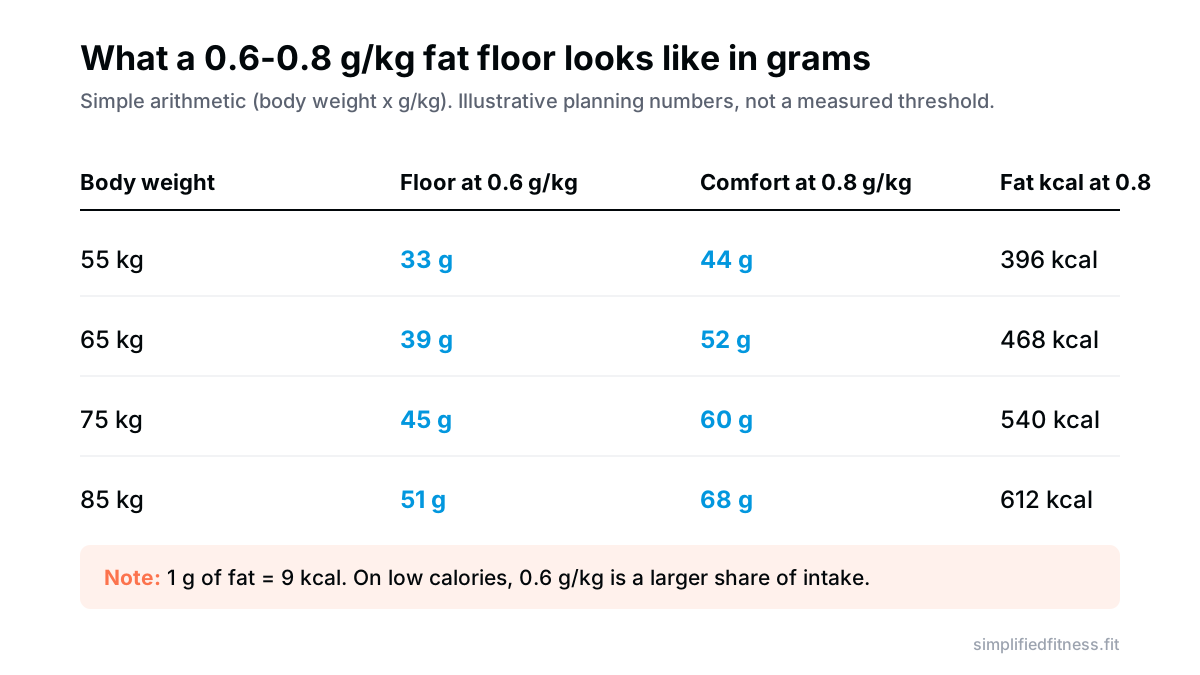
One catch: percentages and grams drift apart as calories change. A 70 kg lifter on 1,800 kcal who eats 42 g of fat (0.6 g/kg) is at about 21% of calories. A 70 kg lifter on 2,800 kcal at the same 42 g is only 14%. Always check the grams, not just the percentage.
Is cutting fat to near zero worth the calories?
Rarely. Fat has 9 kcal per gram, so it feels like the obvious thing to slash. Drop from 60 g to 20 g and you free about 360 kcal. That is roughly the same as one extra serving of rice and dal, and far less than the diet culture drama suggests.
What you give up is bigger. Meals get less filling. Training fuel gets thinner. Vitamin absorption and essential fat intake may suffer. And a plan you cannot stick to is worth nothing.
The most common mistake here is treating “fat” and “fat gain” as the same thing. Fat gain comes from eating more energy than you burn, not from fat as a nutrient. If your deficit is too aggressive, trimming a few grams of carbs or reducing portion size usually gives the same saving with fewer side effects. To set your total calories, use the calorie calculator, then build macros step by step with our guide to calculating macronutrient splits.
Is it fat, or is it the deficit? Low energy availability
Here is the point many lifters miss. When people crash their hormones on a cut, the cause is often the size and length of the energy deficit, not fat grams alone.
A review of natural male bodybuilding by Fagerberg summarised what can be extrapolated from related research. A prolonged energy availability below about 25 kcal per kg of fat-free mass was linked with muscle loss, hormonal imbalances, psychological problems and cardiovascular effects as athletes approached very low body fat (roughly 4-5%). Case studies of natural male bodybuilders showed muscle loss above 40% of total weight lost with energy availability below 20 kcal/kg FFM. The author noted that no well-controlled studies in natural male bodybuilders exist, so this is extrapolation, and that a more tempered approach (above 25 kcal/kg FFM) might lead to less muscle loss (Fagerberg, 2018).
That matters because very low-fat diets and very low-calorie diets often come as a package. Cut fat to the floor, cut carbs hard, and you end up chronically under-fuelled. Pick the slower option. Helms and colleagues recommend a calorie intake that produces weight loss of about 0.5-1% of body weight a week to maximise muscle retention (Helms et al., 2014).
If you are lean and still pushing, our guide to high protein during a cut covers how to keep muscle on while eating less.
Signs your cut may be too aggressive
None of these prove a hormone problem. Many things cause them, and only a doctor can tell you what is going on. But a pile-up of them is a signal to stop and reassess.
- Libido has noticeably dropped for weeks
- Mood is flat or irritable, with poor motivation to train
- Sleep is bad even when you are tired
- Strength is falling, not just stalling
- You feel cold, light-headed or constantly hungry
- Women: periods become irregular or stop
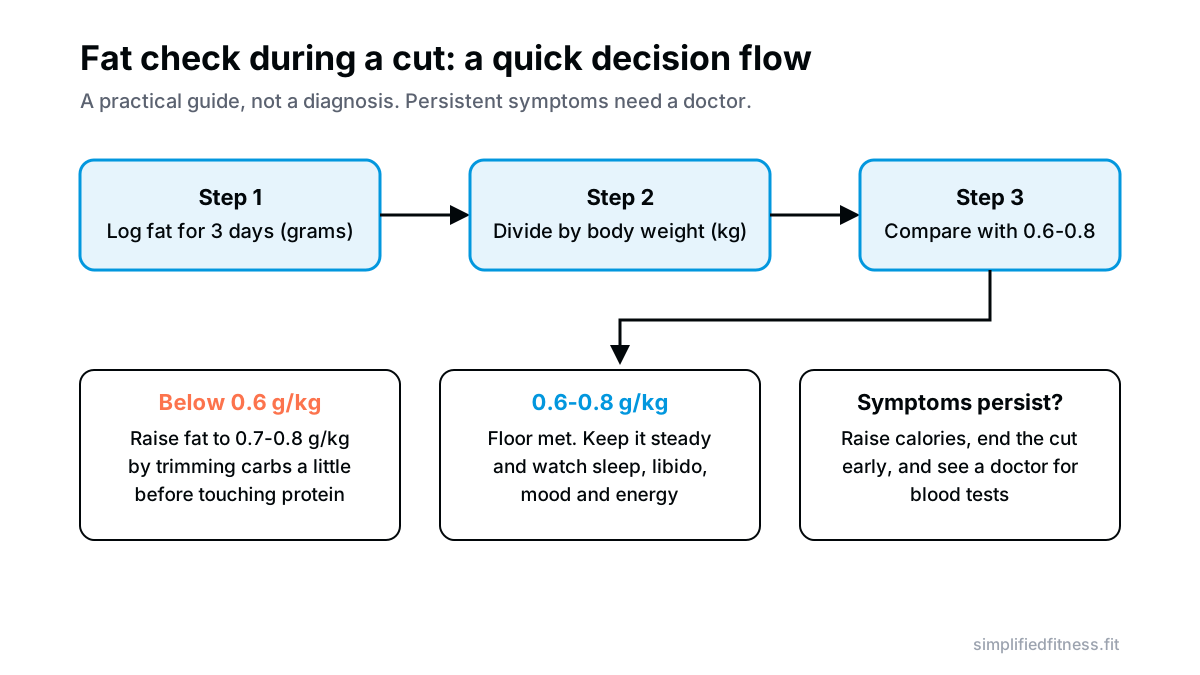
If this sounds familiar, raise calories first, bring fat back to 0.7-0.8 g/kg or higher, and see a doctor if symptoms last more than a few weeks. Blood tests can check testosterone and other markers properly. Do not self-diagnose from a symptom list, and do not reach for supplements or “boosters” to fix it.
How to hit your fat target in an Indian diet
Fat is easy to under-eat on a typical vegetarian cutting plate of dal, roti, sabzi and rice cooked with a teaspoon of oil. These are rough, label-dependent numbers, so check packs and use a food-tracking app for exact values.
- Cooking oil or ghee: about 4-5 g of fat per teaspoon. Two teaspoons across the day is already close to 10 g. (If you cook with a lot of oil the opposite problem shows up, which we cover in hidden calorie traps in Indian cooking.)
- Whole eggs: roughly 5 g of fat each, if you eat eggs. See eggs in the Indian diet for the cost and cholesterol question.
- Paneer and curd: full-fat versions bring a meaningful amount per serving. Toned versions bring less.
- Peanuts and almonds: a small handful adds around 10-15 g and is cheap in India, especially groundnuts.
- Fish: fatty fish like sardines or mackerel adds omega-3s, and our omega-3 guide covers dosing.
A simple approach: spread fat across three meals instead of loading it all at dinner. That keeps meals satisfying and makes the daily total easy to hit.
What about fat quality?
Once you are above the floor, the type of fat starts to matter more than the exact gram count. Mix sources: nuts, seeds, oils, dairy, eggs and fish. We dig into the heart-health and testosterone angle in saturated vs unsaturated fats, so we will not repeat it here.
Who should talk to a doctor first
Speak to a doctor or registered dietitian before running a very low-fat or very low-calorie plan if you:
- have a history of disordered eating
- are pregnant or breastfeeding
- have gallbladder, pancreas or lipid disorders
- take medication that affects hormones or digestion
- are a teenager still growing
Persistent low libido, missed periods or constant fatigue always deserve a proper check, whatever your macros look like.
The bottom line
A fat intake of roughly 0.6-0.8 g/kg per day is a sensible floor for most lifters, not a magic threshold. The evidence that low-fat diets lower testosterone is mixed: one meta-analysis says modestly yes, another says no. What is clearer is that long, deep deficits with very low energy availability tend to go badly for muscle, mood and hormones.
So keep it simple. Set protein, hold fat at or above the floor, trim carbs and calories modestly, and lose weight slowly. Then use the macro calculator to put real numbers on your plate.
Frequently Asked Questions
What is the minimum fat intake for lifters?
A practical minimum for most lifters is about 0.6-0.8 g of fat per kg of body weight per day, which is roughly 40-55 g for a 70 kg person. This number is a coaching rule of thumb rather than a proven biological cutoff or a figure from a specific guideline. A natural bodybuilding review suggests 15-30% of calories from fat, and 0.6-0.8 g/kg lands in or near that range for most people. Check your current intake for three days and raise it if you sit below 0.6 g/kg.
Does low fat intake reduce testosterone?
It might, modestly, but the evidence is mixed. A 2021 meta-analysis of 6 intervention studies (206 men) found lower total and free testosterone on low-fat diets, while a 2025 meta-analysis of 11 randomized trials found no significant difference in sex hormones. If you feel flat on a very low-fat diet, adding fat back is a cheap and low-risk experiment.
Does eating more fat increase testosterone?
Not beyond a point. The research suggests that going from very low fat to moderate fat can help, but there is no good evidence that pushing fat very high keeps raising testosterone. Aim for adequate fat, not extreme fat, and spend the rest of your calories on protein and carbs that fuel training.
What happens if fat intake is too low?
Very low fat intake can make it harder to absorb fat-soluble vitamins (A, D, E and K) and to get essential fatty acids, and it may be tied to lower sex hormones in some men. In long, aggressive cuts, low energy availability is linked with muscle loss, mood problems and hormonal disruption. If you notice persistent symptoms, raise your calories and speak to a doctor.
How much fat should I eat per day to build muscle?
There is no trial-tested number here. A common coaching range is about 0.8-1.2 g/kg, and the natural bodybuilding review used 15-30% of calories from fat during contest prep. Fat is not the main driver of muscle growth, so there is no need to chase a high number. Use the macro calculator to fit it around your protein target.
Is 20% of calories from fat enough?
For many lifters, yes. The 2009 ACSM position stand says fat intake should be sufficient to provide essential fatty acids and fat-soluble vitamins and to help with weight maintenance, and the natural bodybuilding review above gave a range of 15-30% of calories. Check the gram number too, because 20% of a very small calorie budget can still land below 0.6 g/kg.
Can I do a very low fat diet on a cut?
You can, but it is rarely the best use of your calories. Carbs and fat both feed training and satiety, and a very low-fat plan often feels worse and is hard to keep up. Keep fat at or above your floor and trim carbs or total calories modestly instead.
Are Indian vegetarian diets too low in fat for lifters?
They can be if you cook with very little oil and rely on dal, roti and rice, but they are usually easy to fix. Paneer, curd, nuts, seeds, peanuts, mustard or groundnut oil, ghee and eggs (if you eat them) all add fat quickly. Log a typical day once to see where you land against 0.6-0.8 g/kg.
Do women need the same minimum fat intake?
Women also need adequate fat and energy for normal hormone function, and long periods of low energy availability can disrupt periods and bone health. The studies in this article mostly involve men, so treat the gram targets as a starting point only. Missed or irregular periods during a diet are a reason to eat more and see a doctor.
Do I need to eat cholesterol or saturated fat for hormones?
Your body makes cholesterol itself, and cholesterol is the raw material for steroid hormones, but that does not mean you need to eat large amounts of it. Food choices still matter for heart health, so mix sources rather than relying on one. Our guide to saturated versus unsaturated fats covers the trade-offs.
Will cutting fat to zero speed up fat loss?
No. Fat loss comes from the overall calorie deficit, and fat is simply the most calorie-dense macro, so the saving is small relative to the downsides. Energy balance, not the nutrient itself, is what drives weight change. Set protein first, keep fat above the floor, then adjust carbs to hit your calories.
How do I know if my fat intake is too low?
No single sign proves it, but a mix of low mood, poor sleep, flat libido, dry skin, constant hunger and stalled training can point to under-eating overall. Compare your logged grams to 0.6-0.8 g/kg, then raise fat for a few weeks and note any change. If symptoms persist, see a doctor for proper blood work rather than guessing.
Sources & References
Every claim above is checked against peer-reviewed research (PubMed, U.S. National Library of Medicine) or guidance from established health bodies. How we fact-check.
- Whittaker J, et al. Low-fat diets and testosterone in men: Systematic review and meta-analysis of intervention studies. J Steroid Biochem Mol Biol. 2021. PMID: 33741447
- Soltani S, et al. The Effect of Low-Fat Diets Versus High-Fat Diet on Sex Hormones: A Systematic Review and Meta-Analysis of Randomized Controlled Trials. J Food Sci. 2025. PMID: 40387562
- Fagerberg P. Negative Consequences of Low Energy Availability in Natural Male Bodybuilding: A Review. Int J Sport Nutr Exerc Metab. 2018. PMID: 28530498
- Helms ER, et al. Evidence-based recommendations for natural bodybuilding contest preparation: nutrition and supplementation. J Int Soc Sports Nutr. 2014. PMID: 24864135
- Rodriguez NR, et al. American College of Sports Medicine position stand. Nutrition and athletic performance. Med Sci Sports Exerc. 2009. PMID: 19225360
- Sallinen J, et al. Relationship between diet and serum anabolic hormone responses to heavy-resistance exercise in men. Int J Sports Med. 2004. PMID: 15532008

Umair Hazrami · Founder & Head Coach, Simplified Fitness
Umair Hazrami founded Simplified Fitness and the Simplified Lifter channel to cut through fitness noise. With 4+ years of consistent training and 10+ coaching clients, he writes every guide from the peer-reviewed research and links the sources so you can check them. Our editorial standards.
Educational content only, not medical advice. If you have a medical condition, are pregnant, or take medication, talk to a qualified doctor before changing your diet, supplements or training. Full disclaimer.
Keep reading
Nutrition
Alcohol and Muscle Growth: What a Heavy Night Does to MPS, Sleep and Recovery
Alcohol and muscle growth: does a heavy Saturday night wipe out your week? See what research says on MPS, REM sleep and recovery, and how to limit the damage.
7 min read
Nutrition
Ashwagandha and Cortisol: Does It Lower Stress and Boost Strength in the Gym?
Ashwagandha for lifting: what the trials show on cortisol, stress and strength gains, realistic dose (300-600 mg), who should skip it and how to buy it safely.
7 min read
Nutrition
Caffeine Sensitivity, CYP1A2 Genetics and Caffeine Cycling: Why Pre-Workout Works for Him, Not You
Caffeine sensitivity genetics explain why pre-workout gives your friend PRs and you anxiety. See what CYP1A2 and ADORA2A do, and how to find your dose.
8 min read
Nutrition
Creatine Non-Responders: Why It May Not Be Working and What to Try
Creatine non responder? Learn why roughly 1 in 4 people see little change, how baseline diet matters, and when carbs with creatine help. Studies linked.
7 min read