Multivitamin During a Cutting Deficit: Do You Need One? What the Evidence Says
Should you take a multivitamin during a cutting deficit? See what ACSM and ISSN say, which nutrients slip first, and a simple food-first plan for Indian diets.

TL;DR. The short answer
- A multivitamin during a cutting deficit is reasonable insurance, not a requirement. ACSM says supplements are not needed if you eat enough varied food, but athletes who restrict energy may require them.
- The deeper and longer the deficit, the stronger the case. ISSN's 2026 position stand specifically cautions about vitamin, mineral and fibre shortfalls on very-low and low-energy diets.
- Choose a standard-dose product (around 100% of daily values) and skip mega-doses. High-dose vitamin C and E, and very high zinc, have shown downsides in studies.
- A multivitamin will not speed up fat loss or protect muscle on its own. Protein, resistance training and a sensible deficit do that job.
- Get bloods done before adding single nutrients like iron or vitamin D, and see a doctor if you feel unusually tired, dizzy or weak.
Part of our complete guide: Carbohydrates, Fats, Fibre, Micronutrients and Hydration: The Lifter's Fueling Guide
Table of contents
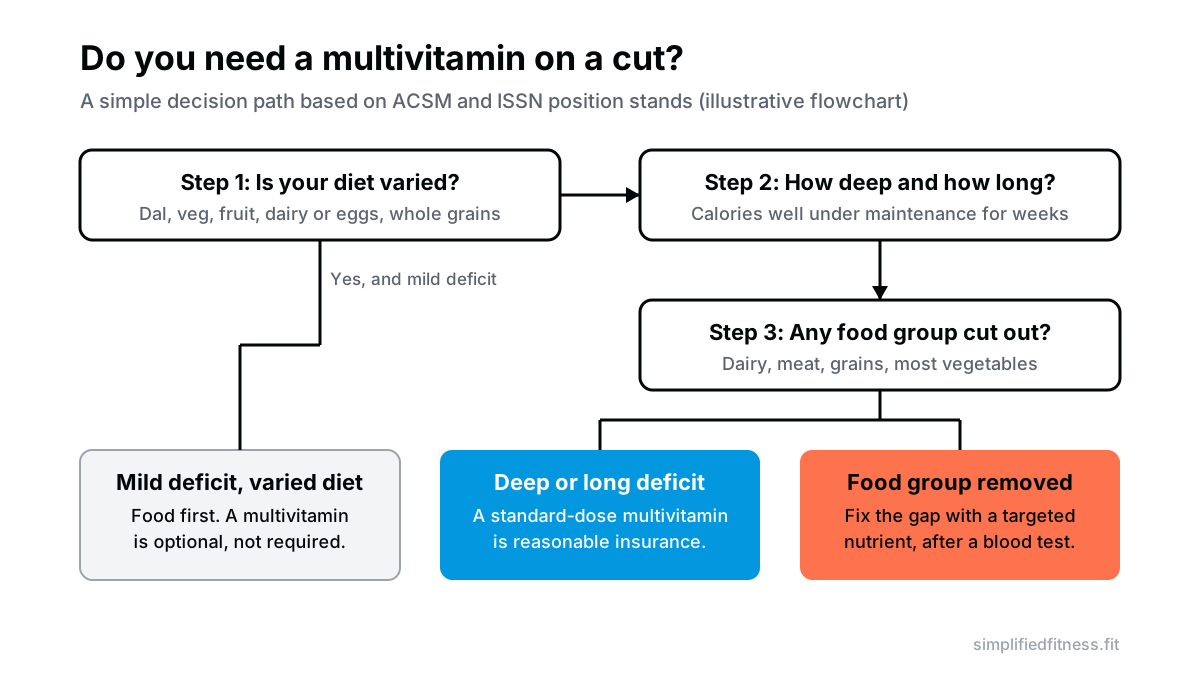
Should you take a multivitamin during a cutting deficit? Often, yes, as cheap insurance, but it is not mandatory. The joint ACSM, American Dietetic Association and Dietitians of Canada position stand says vitamin and mineral supplements are not needed when you eat enough energy from varied foods, while athletes who restrict energy intake may require them (Rodriguez et al., 2009). A multivitamin is a safety net for the gaps. It is not a fat-loss tool.
This guide sits inside our complete guide to carbohydrates, fats, fibre, micronutrients and hydration. Here we stay narrow: what changes when calories drop, which gaps are realistic, and what is worth buying.
Why a deficit makes micronutrients harder
Vitamins and minerals ride along inside food. Cut the food and you cut the carriers. That is the whole problem in one line.
At maintenance calories, a mixed diet usually covers most needs without effort. On a long cut you have fewer meals to hit every target, and the calories you do have are often spent on protein, which is great for muscle but only covers some nutrients. Rice, chicken and whey are not a complete micronutrient plan.
I will be straight about one claim you may have seen online: that below roughly 1,800-2,000 kcal it becomes mathematically impossible to hit every RDA from food. I could not find a study that tests that exact threshold, so treat it as a rough rule of thumb, not a law. It is easier to fall short with less food and a narrow menu. It is not impossible with planning.
Which nutrients actually slip on a diet?
It depends on what you remove. The best illustration is the A TO Z trial, which compared four popular diets in overweight or obese women. After 8 weeks, energy intake had fallen similarly in every group, yet the nutrient shortfalls differed by diet (Gardner et al., 2010).
| Diet (8 weeks) | Nutrients where more women moved into risk of inadequacy |
|---|---|
| Atkins (very low carb) | Thiamine, folic acid, vitamin C, iron, magnesium |
| LEARN (conventional low fat) | Vitamin E, thiamine, magnesium |
| Ornish (very low fat) | Vitamin E, B12, zinc |
| Zone (moderately low carb) | Risk fell for vitamins A, E, K and C |
The authors concluded that dieters should watch overall quality and that diets with moderately low carbohydrate and nutrient-dense foods may carry a micronutrient advantage. Two caveats. These were overweight or obese women, not resistance-trained lifters, and they were counselled on diet rather than eating contest-style menus.
The takeaway is practical. Ask what your plan leaves out. Cut dairy and calcium plus B12 are in question. Skip fruit and vegetables and vitamin C and potassium follow. Drop grains and B vitamins and magnesium can thin out.
So how does a multivitamin help, exactly?
Think of it as a floor, not a ceiling. A standard-dose multivitamin covers small gaps on days you ate badly or ate little.
Reviews agree on where supplements make sense. One 2021 review concluded that, in well-nourished athletes, micronutrient supplementation does not enhance physical performance, but that supplementation is warranted in cases such as a diagnosed deficiency or when energy intake is compromised, and that these should be prescribed by a medical professional (Beck et al., 2021). A 2023 Sports Medicine review adds that a food-first approach is the main goal and that practitioners should assess energy needs, diet and clinical status before recommending supplements (Peeling et al., 2023).
Put those together: a deep cut is exactly the “compromised energy intake” case.
What a multivitamin will not do:
- Speed up fat loss.
- Add muscle.
- Rescue a terrible diet.
- Preserve your metabolic rate on its own. I found no trials showing that, so I would be wary of any product promising it.
Does a long deficit really cause deficiencies? Conflicting evidence
Here the research is not one-sided.
On one side, position stands from ACSM and ISSN flag the risk when energy intake is restricted. On the other side, the CALERIE Phase 2 randomized trial put 220 healthy adults on 25% calorie restriction or normal eating for 2 years and found that prolonged restriction in the absence of malnutrition did not adversely affect iron status or hepcidin (Dugan et al., 2026). Anemia prevalence stayed above 5% in both groups at every timepoint.
Why might these differ? One big detail: every participant in CALERIE received a multivitamin/mineral supplement containing 18 mg iron, and the trial coaches helped people plan their eating. So that trial cannot tell us what happens without a multivitamin. It also looked at iron markers only, not every nutrient.
My cautious read: a well-planned long deficit can be safe for iron status, but in this trial that was with a daily multivitamin and coaching in place. It does not show a multivitamin is required, and it does not show you can safely skip one either.
What should you take? A food-first plan
Start with food, add a multivitamin if the deficit is deep, and treat single nutrients as a last step.
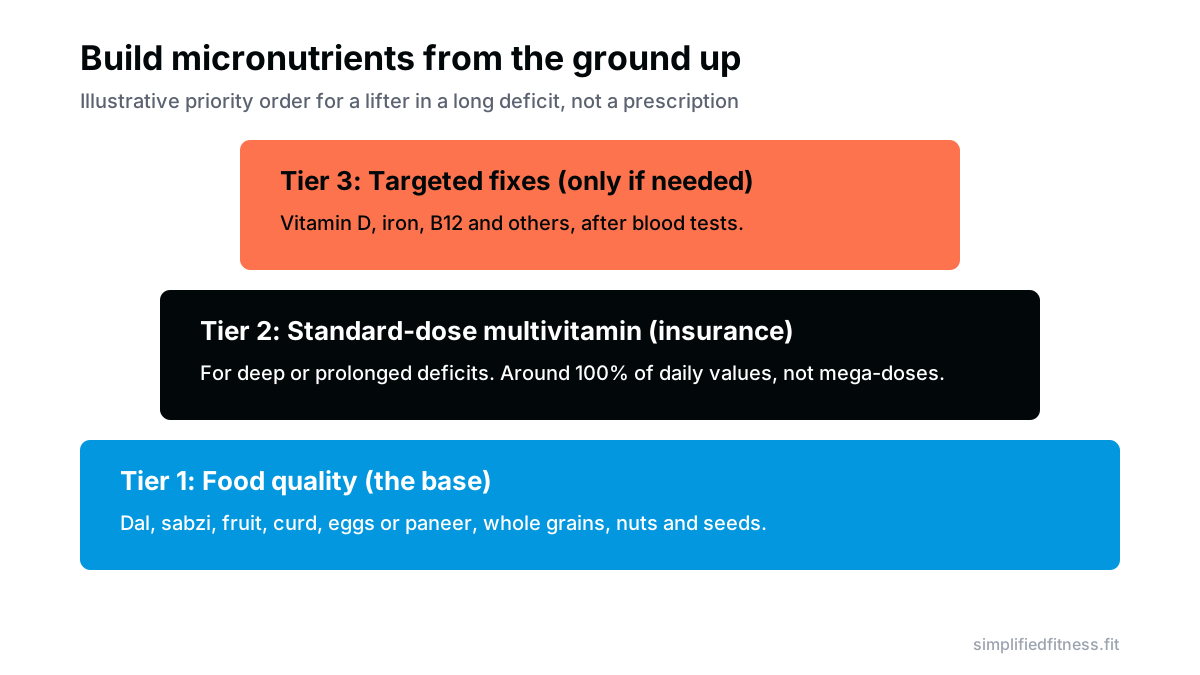
Tier 1: Make your calories count
In the gym this looks like swapping some refined carbs for dense foods without raising calories. Some Indian-friendly options:
- Dal and chana for folate, magnesium and zinc alongside protein.
- Two or more vegetables at lunch and dinner. Palak, methi and cabbage cost very little.
- Curd or paneer for calcium if dairy fits your diet.
- Eggs if you eat them.
- A handful of nuts or seeds (pumpkin, almonds) for magnesium and zinc.
- One or two fruits a day, often amla, guava or citrus for vitamin C.
If you are vegetarian, our Indian vegetarian 1,800-calorie cutting plan shows how to fit this into a protein-heavy day. Not sure what your calories should be? Check the calorie calculator, and read how aggressive a deficit should be before you push it.
Tier 2: A standard-dose multivitamin
If the deficit is deep or you will be dieting for months, a plain multivitamin is a fair choice. Look for a product near 100% of daily values and avoid mega-dose formulas.
Why avoid big doses? Two examples from the research:
- Vitamin C and E. In a 4-week trial of 39 healthy young men, 1000 mg of vitamin C plus 400 IU of vitamin E prevented the exercise-driven improvement in insulin sensitivity that happened without the supplements (Ristow et al., 2009). This was a small, short trial, and it measured insulin sensitivity rather than muscle growth. It still argues against high-dose antioxidant pills. See the antioxidant paradox for the full story.
- Zinc. A 1990 review reported that zinc far above the RDA (100-300 mg/day versus an RDA of 15 mg/day) was linked to induced copper deficiency, and that even smaller excess amounts may interfere with copper and iron use (Fosmire, 1990). Our zinc and copper balance guide goes deeper.
Tier 3: Targeted nutrients, only when there is a reason
The brief answer to “which single supplements?” is: it depends on you.
- Vitamin D. A 2014 review described deficiency as widespread across the Indian subcontinent, with reported prevalence of 70-100% in the general population (G and Gupta, 2014). Even so, a blood test is more useful than guessing. Our vitamin D3 optimisation guide covers targets.
- Iron. Do not take it blind. Iron loads can be harmful if you do not need them, so test ferritin first. See our iron deficiency and ferritin guide.
- B12. Worth thinking about if you eat little or no animal food. Test first.
- Zinc and magnesium. Follow the food-first rule, and check our guide to zinc, magnesium and iron in lifters for who is more at risk.
For the broader question of multivitamins in general (not just on a cut), see multivitamins for lifters: insurance versus whole-food nutrition.
How to buy a multivitamin without wasting money
- Check the dose per serving. Aim near 100% of daily values, not 1,000%.
- Prefer third-party testing. The ACSM position stand warns that regulations for nutritional ergogenic aids are poorly enforced, so products should be evaluated for safety, efficacy, potency and legality (Rodriguez et al., 2009).
- Skip proprietary blends that hide amounts.
- Take it with a meal. Some vitamins are fat-soluble and absorb better with food.
- Do not pay extra for “cutting” or “fat burner” branding.
When to see a doctor
Nutrient problems rarely announce themselves clearly. Fatigue, dizziness, hair shedding, cramps, frequent infections and unusual paleness all have many causes, and I cannot diagnose any of them from an article. If they persist for a few weeks despite better eating, see a doctor and ask about a simple blood panel. Do the same if you are pregnant, take medication, have a medical condition, or have a history of disordered eating. A cut that has you skipping meals and feeling awful is a signal to ease off, not to buy more supplements. For a gentler pace, our diet breaks versus refeeds guide is a good next read.
The bottom line
Most lifters in a moderate cut can cover their needs from a varied diet. If your deficit is deep, long or narrow, a standard-dose multivitamin is cheap insurance, and the major sports nutrition bodies support the idea for athletes who restrict energy. Single nutrients belong after a blood test, not before. Keep protein high and the training hard, because that is what protects muscle. For a sample day of eating, see our free diet plan.
Frequently Asked Questions
Do I need a multivitamin during a cutting deficit?
Not always, but it is a sensible low-cost safety net if your deficit is deep or long. ACSM states that supplements are not needed when enough energy comes from varied foods, but athletes who restrict energy may require them. If your diet is narrow or your calories are very low, a standard-dose multivitamin is a reasonable choice.
Can you get all your vitamins and minerals from food while cutting?
Yes, it is possible, but it gets harder as calories fall because there is less food to carry the nutrients. Studies of weight-loss diets show some micronutrient intakes slip depending on what you cut out. Plan your plate around dal, vegetables, fruit, curd and whole grains, and use a multivitamin if you cannot cover the gaps.
Which vitamins and minerals are most likely to run low on a diet?
It depends on the diet. In an 8-week trial of four popular diets in women, more people moved into risk of low intake for thiamine, folic acid, vitamin C, iron and magnesium on Atkins, and for vitamin E, B12 and zinc on Ornish. Look at what your own diet excludes and cover that group first.
Will a multivitamin help me lose fat faster?
No evidence supports that. Reviews of micronutrients in well-nourished athletes find supplementation does not enhance performance, and fat loss is driven by your energy deficit. Spend your effort on calories, protein and steps, and treat the multivitamin as insurance.
Does a multivitamin protect my metabolic rate or muscle in a deficit?
I did not find trials showing that it does. What protects muscle in a deficit is resistance training and enough protein, according to the ISSN position stand. A multivitamin only helps if it fixes a real shortfall.
Is it safe to take a multivitamin every day while dieting?
For most healthy adults a standard-dose product is considered low risk, but safety depends on dose and your health. The problems in research come mainly from high doses of single nutrients. Stick to the label dose, and check with a doctor if you have a medical condition or take medication.
Should I take zinc and magnesium separately on a cut?
Only if you have a reason, such as a restricted diet or a doctor's advice. Zinc in large amounts can interfere with copper and iron use, according to a 1990 review, so more is not better. A multivitamin often covers modest amounts, and food sources like pumpkin seeds, chana and nuts help too.
Do I need a B-complex while cutting?
Usually not if you already take a multivitamin, since most contain B vitamins. B12 deserves attention if you are vegetarian or vegan because it is mainly found in animal foods. Ask your doctor about a B12 blood test before taking more.
Should I take vitamin D while in a calorie deficit?
Possibly, but test first if you can. Low vitamin D is common across the Indian subcontinent according to a 2014 review, so a blood test is more useful than guessing. Dose and duration are best set with your doctor.
Do vitamin C and E supplements help recovery on a cut?
They may do the opposite at high doses. In a 4-week study of young men, 1000 mg vitamin C plus 400 IU vitamin E blocked some of the benefits of exercise on insulin sensitivity. Get these from fruit and vegetables rather than high-dose pills.
What should I look for on a multivitamin label?
Look for roughly 100% of daily values for most nutrients rather than 500% or more. The joint ACSM position stand warns that regulations for nutritional ergogenic aids are poorly enforced, so third-party testing is a good sign. Skip proprietary blends that hide amounts.
When should I see a doctor about nutrient deficiency while dieting?
See a doctor if you have persistent fatigue, dizziness, hair shedding, frequent infections, cramps, or pale skin that does not improve with a few weeks of better eating. These symptoms can have many causes, so do not self-diagnose. A simple blood panel can show whether iron, B12 or vitamin D are actually low.
Do I still need supplements if I am only in a small deficit?
Probably not if your diet is varied. A modest deficit leaves plenty of room for dense foods, and ACSM says supplements are not needed when varied food provides enough energy. Focus on food quality first.
How long does a multivitamin take to work?
It is not a stimulant, so you will not feel it work. Its job is quiet: filling small gaps in intake over weeks and months. Take it with a meal, consistently, and judge it by your blood work rather than by how you feel.
Sources & References
Every claim above is checked against peer-reviewed research (PubMed, U.S. National Library of Medicine) or guidance from established health bodies. How we fact-check.
- Rodriguez NR, et al. American College of Sports Medicine position stand. Nutrition and athletic performance. Med Sci Sports Exerc. 2009. PMID: 19225360
- Aragon AA, et al. International Society of Sports Nutrition position stand: diets for body weight reduction. J Int Soc Sports Nutr. 2026. PMID: 42867412
- Beck KL, et al. Micronutrients and athletic performance: A review. Food Chem Toxicol. 2021. PMID: 34662692
- Peeling P, et al. Considerations for the consumption of vitamin and mineral supplements in athlete populations. Sports Med. 2023. PMID: 37358750
- Gardner CD, et al. Micronutrient quality of weight-loss diets that focus on macronutrients: results from the A TO Z study. Am J Clin Nutr. 2010. PMID: 20573800
- Dugan C, et al. Effect of 2-year caloric restriction in the absence of malnutrition on indicators of anemia, iron status, and hepcidin in healthy adults: a randomized clinical trial. J Nutr. 2026. PMID: 41825741
- Ristow M, et al. Antioxidants prevent health-promoting effects of physical exercise in humans. Proc Natl Acad Sci U S A. 2009. PMID: 19433800
- Fosmire GJ. Zinc toxicity. Am J Clin Nutr. 1990. PMID: 2407097
- G R, Gupta A. Vitamin D deficiency in India: prevalence, causalities and interventions. Nutrients. 2014. PMID: 24566435

Umair Hazrami · Founder & Head Coach, Simplified Fitness
Umair Hazrami founded Simplified Fitness and the Simplified Lifter channel to cut through fitness noise. With 4+ years of consistent training and 10+ coaching clients, he writes every guide from the peer-reviewed research and links the sources so you can check them. Our editorial standards.
Educational content only, not medical advice. If you have a medical condition, are pregnant, or take medication, talk to a qualified doctor before changing your diet, supplements or training. Full disclaimer.
Keep reading
Nutrition
Alcohol and Muscle Growth: What a Heavy Night Does to MPS, Sleep and Recovery
Alcohol and muscle growth: does a heavy Saturday night wipe out your week? See what research says on MPS, REM sleep and recovery, and how to limit the damage.
7 min read

Nutrition
Ashwagandha and Cortisol: Does It Lower Stress and Boost Strength in the Gym?
Ashwagandha for lifting: what the trials show on cortisol, stress and strength gains, realistic dose (300-600 mg), who should skip it and how to buy it safely.
7 min read
Nutrition
Caffeine Sensitivity, CYP1A2 Genetics and Caffeine Cycling: Why Pre-Workout Works for Him, Not You
Caffeine sensitivity genetics explain why pre-workout gives your friend PRs and you anxiety. See what CYP1A2 and ADORA2A do, and how to find your dose.
8 min read
Nutrition
Creatine Non-Responders: Why It May Not Be Working and What to Try
Creatine non responder? Learn why roughly 1 in 4 people see little change, how baseline diet matters, and when carbs with creatine help. Studies linked.
7 min read