Dietary Carbohydrates and Hypertrophy: Glycogen, Performance and Training Volume
Do you need carbohydrates for muscle hypertrophy? See what meta-analyses say about glycogen, training volume and daily carb targets per kg, plus Indian foods.

TL;DR. The short answer
- Carbohydrates are not required to build muscle. A 2026 meta-analysis of 11 randomized trials found no significant independent effect of higher carbohydrate intake on hypertrophy (SMD 0.15), though certainty was low.
- Carbs help most when training volume is high. A 2022 systematic review found little performance benefit up to about 10 sets per muscle group in a fed state, with more chance of benefit in higher-volume sessions, two-a-days or fasted training.
- A single lifting session does lower muscle glycogen, and the drop is larger with more sets and longer sessions, but it rarely empties the tank the way long endurance work does.
- A practical range for most lifters is roughly 3-5 g/kg a day, going toward 5-7 g/kg for very high volume. These are coaching starting points, not trial-proven optima.
- Very low carbohydrate diets have not been shown to improve muscle growth, and two small trials saw lean mass rise only on the non-ketogenic diet. See a doctor first if you have diabetes or take glucose-lowering medication.
Part of our complete guide: Carbohydrates, Fats, Fibre, Micronutrients and Hydration: The Lifter's Fueling Guide
Table of contents
Do you need carbohydrates for muscle hypertrophy? Not strictly. Current trial data does not show that more carbs build more muscle on their own, but carbs do keep hard, high-volume training productive, which is why most lifters grow best with a moderate intake rather than none.
That is a more modest answer than the usual “carbs are king” line, and it is also more useful. Below we look at what a lifting session actually does to glycogen, when carbs change performance, and how to set a daily number. (This piece sits inside our wider guide to carbohydrates, fats and hydration for performance.)
What carbohydrates actually do for a lifter
Your muscles store carbohydrate as glycogen. Hard sets draw on that glycogen for fast energy, so the fuel tank matters most when you pile up lots of sets.
Carbs do two main jobs for lifters:
- Fuel the sets themselves.
- Refill muscle glycogen between sessions.
Notice what is missing: carbs are not a growth hormone. Hypertrophy is driven by mechanical tension from hard training, adequate protein and a reasonable energy supply. Carbs support the first of those by making you better at it.
Does lifting deplete glycogen?
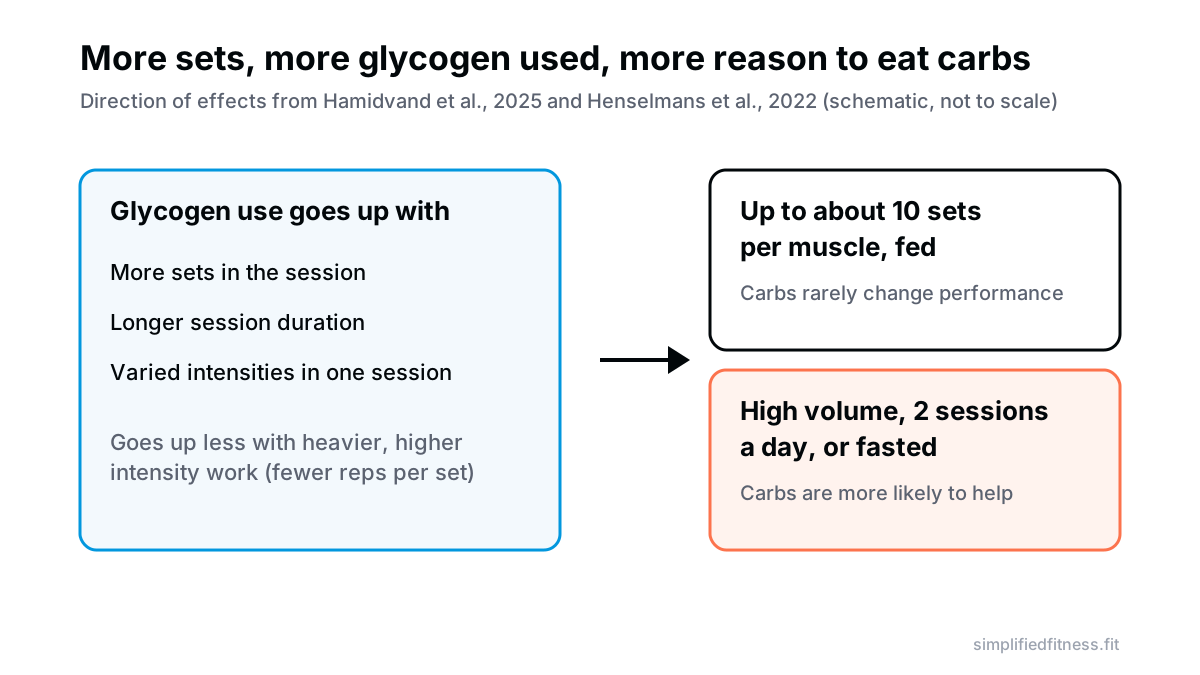
Yes, but not usually to empty. A 2025 meta-analysis pooled 20 studies (168 men, 12 women) and found a significant fall in vastus lateralis glycogen after one resistance session (Hamidvand et al., 2025). Depletion was greater with more sets and longer session duration, and smaller with higher intensity. Untrained people showed slightly more depletion than trained ones.
Two cautions. The prediction interval in that analysis was wide, meaning individual studies varied a lot. And the data come almost entirely from men, mostly measuring one thigh muscle.
An earlier review argued that true glycogen depletion from lifting is not very likely, and that low glycogen did not appear to blunt mTORC1 signalling, the key switch for muscle protein synthesis (Escobar et al., 2016). Put the two together and the picture is “meaningful but partial drawdown, with limited effect on the growth signal.”
Carbs, performance and training volume
This is where carbs earn their place. A 2022 systematic review of 49 studies found that higher carbohydrate intake did not improve acute performance in 13 studies and improved it in 6, mostly in studies with fasted control groups and workouts of more than 10 sets per muscle group (Henselmans et al., 2022). There was no evidence of a dose-response effect. After deliberate glycogen depletion, carbs helped in three studies, especially with twice-daily workouts, but not when the comparison group got the same calories. Longer-term strength changes were not influenced by carbohydrate intake in 15 studies.
The authors concluded that, in a fed state, carbohydrate per se is unlikely to affect strength training performance in workouts of up to 10 sets per muscle group, while higher volumes may benefit. They also flagged the need for better-controlled trials.
In plain gym terms:
- A tidy 12-16 hard sets full-body session after a normal meal? Carbs probably will not make or break it.
- Six days a week, 20-plus sets per muscle, mornings fasted? Carbs are a cheap way to protect set quality.
If you are building up volume, the idea of diminishing returns on junk volume and the dose-response of weekly sets matter more than any carb tweak. Fuel is there to support the volume you can actually recover from.
Carbs vs low carb for muscle growth
Here the evidence is surprisingly even-handed, with a slight lean in favour of carbs.
The pooled analysis. A 2026 meta-analysis of 11 randomized trials, comparing higher with lower carbohydrate intakes under matched protein, found no significant effect on muscle hypertrophy (SMD 0.15, p = 0.23). The results held in isocaloric trials. Certainty of evidence was rated low, and the authors noted that only a couple of studies used direct imaging such as ultrasound (Henselmans et al., 2026).
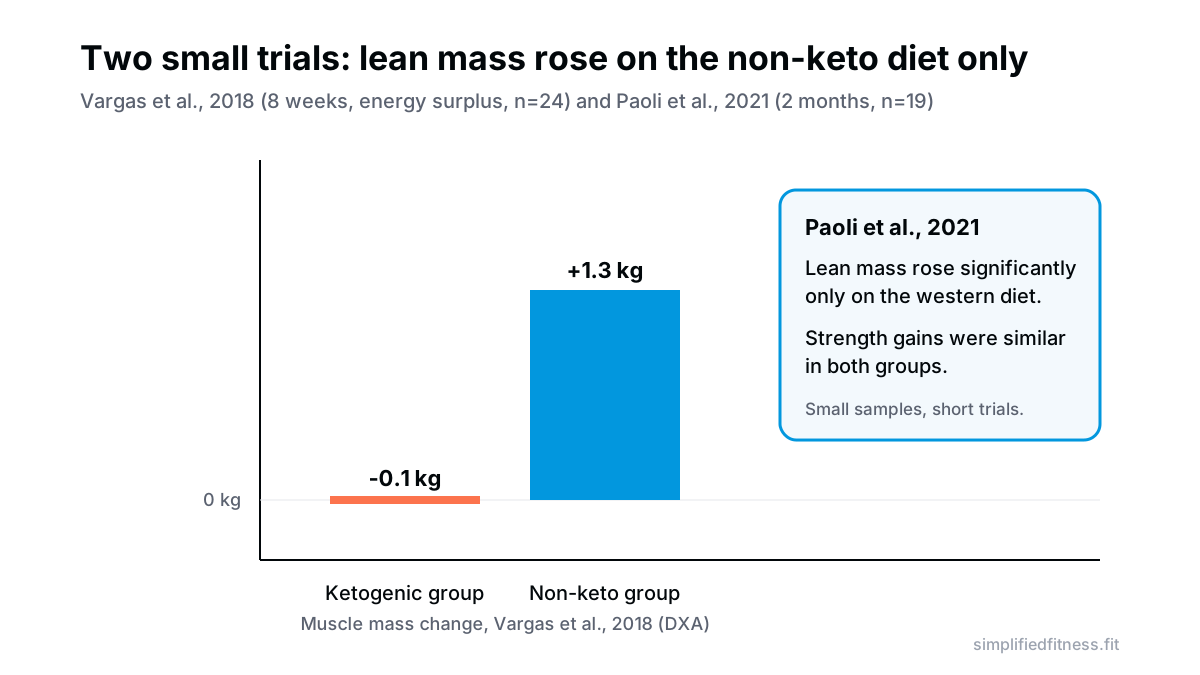
The ketogenic trials. Not everything agrees. In an 8-week trial of 24 trained men in an energy surplus, the ketogenic group showed no significant change in muscle mass (-0.1 kg), while the non-keto group gained about 1.3 kg (Vargas et al., 2018). The keto group did lose a little fat. In a 2-month trial of 19 competitive natural bodybuilders, lean mass rose significantly only on the western diet, though strength gains were similar and the authors cautioned that hypertrophy could be blunted on keto (Paoli et al., 2021).
A longer trial. In 48 men over 15 weeks, a high-carb, low-fat diet produced more skeletal muscle gain than a low-carb, high-fat diet, and maximal strength rose in the high-carb group but fell in the low-carb group. Body composition here was measured by bioimpedance, which is less precise than DXA or imaging (Kruszewski et al., 2024).
Why the mixed picture? The trials differ in energy balance, protein, duration, how “low” low-carb was and how muscle was measured. They are also small. The safest reading: very low carb diets have not shown an advantage for hypertrophy and in several small trials looked slightly worse, while moderate differences in carbs (say 3 vs 5 g/kg) probably matter little if protein and calories are covered. For the keto-specific deep dive, see low-carb and ketogenic diets for lifters.
Why do you gain scale weight when you eat more carbs?
Glycogen is stored with water, so when you eat more carbs your muscles hold more fluid, and the scale moves. Muscles can look fuller and feel harder, which people call “carb pump”. This is stored fuel and water, not new muscle tissue and not fat.
I have not found a trial that lets me state a reliable grams-of-water-per-gram-of-glycogen figure in this article, so I will not quote one. What matters practically: if you cut carbs sharply, expect a quick drop on the scale in the first days, and a quick rebound when carbs return. Do not read either as fat loss or fat gain.
This is also why comparing weekly averages works better than daily weigh-ins, and why bulking and cutting decisions should rest on trends across several weeks.
How many carbs per day for lifting?
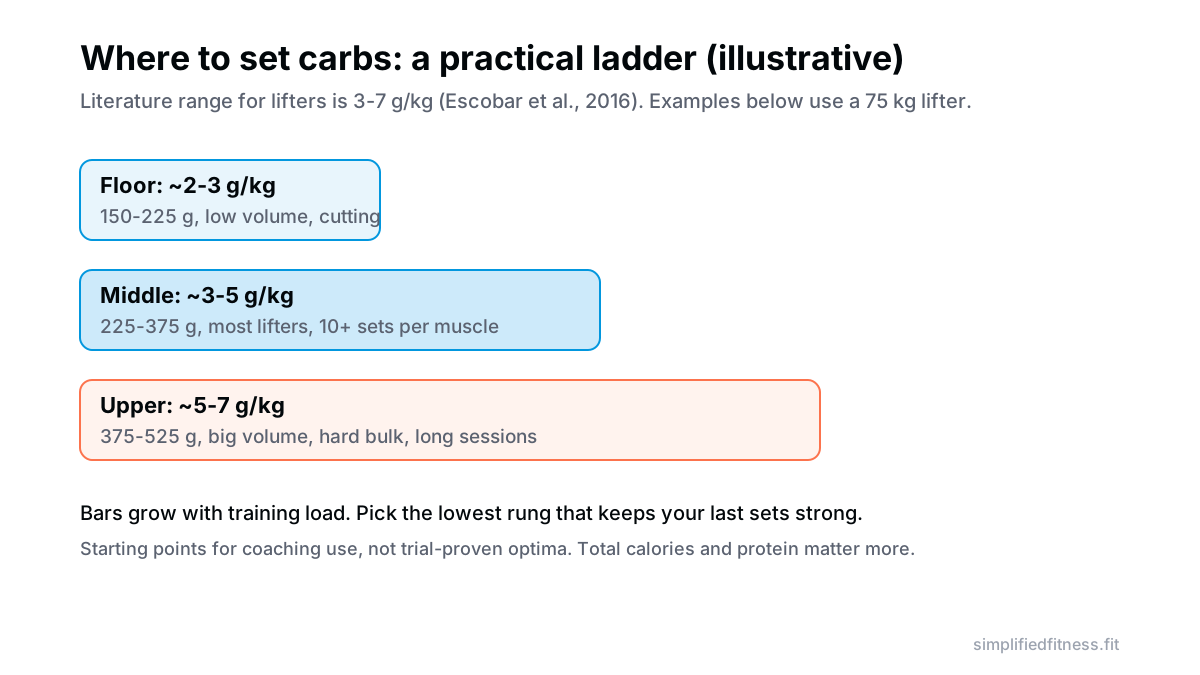
There is no trial-proven magic number. A 2016 review described the common recommendation as a moderately high 3-7 g/kg per day, and questioned whether such intakes are truly necessary for resistance training (Escobar et al., 2016). You will also see 8-12 g/kg quoted for maximising glycogen stores, which comes from the ISSN nutrient timing position stand (Kerksick et al., 2017), but that is aimed at maximal glycogen loading and is far more than most lifters need.
Here is a practical ladder based on those ranges. It is a coaching starting point, not a prescription.
| Situation | Carbs (g/kg/day) | 75 kg example |
|---|---|---|
| Cutting, low volume, prefer lower carb | 2-3 | 150-225 g |
| Most lifters, 10+ sets per muscle weekly | 3-5 | 225-375 g |
| Very high volume, hard bulk, two-a-days | 5-7 | 375-525 g |
How to use it:
- Set protein and total calories first. Our macro calculator does this in a minute.
- Fill the remaining calories with a carb target from the ladder, and fat gets the rest.
- Hold the number for 2-3 weeks, then judge by your gym logs, not by the pump.
Total calories matter more than the carb split. If you are not eating enough overall, adding carbs is just adding calories, which is why the isocaloric detail in the meta-analysis matters.
Indian carb sources that actually fit a lifter’s day
Most Indian diets already have carbs built in. The trap is the opposite problem: too little protein sitting next to a lot of rice and roti.
- Rice: a cooked cup is roughly 40-45 g of carbs. Easy to digest, handy before training.
- Roti: a medium one is roughly 15-20 g. Three rotis with dal and paneer is a solid base.
- Poha, upma, oats: quick pre-workout breakfast options.
- Potato, sweet potato, banana: cheap, portable, low in fibre when you need light food.
- Dal and rajma: carbs plus protein plus fibre.
These are approximations that vary with portion size and recipe, so check labels or an app if you need accuracy. For a full meal-by-meal layout, see our free diet plan.
If you also use creatine, there is related reading on creatine non-responders and carb co-ingestion. And for during-session fuel, the question of whether you need dextrin or sugar mid-workout is covered in intra-workout carbohydrates.
Common mistakes with carbs and muscle growth
Other things that trip people up:
- Chasing a specific carb number while ignoring total calories and protein.
- Judging carbs by the scale the next morning.
- Assuming a ketogenic plan is “more advanced” when trial data shows no muscle advantage.
- Eating carbs only around training and under-eating them the rest of the day.
When to talk to a doctor
If you have diabetes or prediabetes, take glucose-lowering medication or insulin, have kidney disease, or are pregnant, do not change your carbohydrate intake sharply without medical advice. Very low carb diets can interact with medication, and symptoms such as dizziness, persistent fatigue or heart palpitations are worth a conversation with your doctor.
The bottom line on carbs for hypertrophy
Carbs do not appear to be a direct growth trigger, and very low carb diets have not been shown to beat moderate ones for muscle. But carbs keep high-volume training productive, and the cheapest way to protect set quality is usually a moderate intake of 3-5 g/kg, higher only when your training load demands it.
Start in the middle, watch your last sets, and let your logs, not the scale, tell you whether to adjust.
Frequently Asked Questions
Do you need carbohydrates to build muscle?
No, carbohydrates are not strictly required, but they make hard training easier for most people. A 2026 meta-analysis of 11 randomized trials found no significant independent effect of carbohydrate intake on muscle hypertrophy, with low certainty of evidence. If you enjoy carbs and train with decent volume, keeping a moderate intake is the simpler path.
How many carbs per day do I need for lifting?
A reasonable starting range for most lifters is about 3-5 g per kg of body weight, which is 225-375 g for a 75 kg person. A 2016 review describes the traditional recommendation as 3-7 g/kg, while also questioning whether that much is truly needed. Start in the middle, then raise it only if your last sets or later sessions in the week fade.
What do carbs do for muscle growth?
Carbohydrates mainly fuel hard training and refill muscle glycogen, rather than directly switching on growth. Current evidence suggests the key growth signal, mTORC1, is not blunted by low carbohydrate availability. In practice, carbs help you complete more quality sets, and sets are what drive growth.
Does lifting weights deplete glycogen?
Yes, but usually partially. A 2025 meta-analysis of 20 studies found a significant drop in vastus lateralis glycogen after a single session, with more depletion as sets and session length increased. A 2016 review judged true depletion from lifting unlikely, so for most lifters normal meals between sessions are enough.
Can I build muscle on a low carb diet?
You can gain some muscle, but the evidence suggests you probably will not gain more than on a moderate-carb diet. A 2026 meta-analysis found no independent benefit from higher carbs, yet two small trials in trained people saw lean mass increase only on the non-ketogenic diet. If you prefer low carb for appetite or health reasons, keep protein and calories adequate and watch your training quality.
Do carbs make you retain water?
Yes, stored glycogen holds water inside muscle, so scale weight can shift noticeably within days when your carbohydrate intake changes sharply. This is normal physiology, not fat gain. Compare weekly averages rather than reacting to one morning weigh-in.
Should I eat carbs before or after training?
Total daily intake matters more than exact timing for most lifters. The ISSN nutrient timing position stand notes that fast glycogen restoration matters mainly when you have less than about 4 hours between hard sessions. Otherwise, eat a normal meal with carbs and protein around training and move on.
Are carbs more important on leg day?
They can matter more on high-volume days, since depletion grows with the number of sets and session length. Leg days often involve large muscle mass and many hard sets, so a carb-containing meal beforehand is sensible. Try rice, poha or roti with dal 2-3 hours before and see whether your later sets hold up.
What are good carb sources for Indian lifters?
Rice, roti, poha, oats, potatoes, bananas, dal and fruit are all practical choices. Whole grains and pulses add fibre and some protein, while rice and potatoes are easier on the stomach before training. Pick what fits your budget and digestion, since the research does not single out one source.
Can I train fasted without losing muscle?
Short-term trials show that fasted training can be fine for low-volume sessions, but higher-volume sessions are where fasted performance more often suffers. A 2022 systematic review found carbs helped more in studies with fasted control groups and workouts with over 10 sets per muscle group. If you train early, a banana or a small bowl of poha is a cheap fix.
Do I need carbs if I am cutting?
Not necessarily, because protein and total calories do most of the work in a deficit. Carbs are useful mainly for keeping training volume and intensity up when energy is low. Lower them if you like, but keep enough to lift well, and set targets with our macro calculator.
How fast do muscles refill glycogen after lifting?
There is no precise lifting-specific timeline, but a single session only partly drains glycogen, so normal meals between sessions usually cover it. Rapid refeeding strategies matter mainly when you train the same muscles or do a second hard session within about 4 hours. Eating carbs at regular meals is usually enough.
Sources & References
Every claim above is checked against peer-reviewed research (PubMed, U.S. National Library of Medicine) or guidance from established health bodies. How we fact-check.
- Henselmans M, et al. The Effect of Carbohydrate Intake on Muscle Hypertrophy: A Systematic Review and Meta-analysis. Sports Med. 2026. PMID: 41712097
- Henselmans M, et al. The Effect of Carbohydrate Intake on Strength and Resistance Training Performance: A Systematic Review. Nutrients. 2022. PMID: 35215506
- Hamidvand A, et al. Acute effects of resistance exercise on skeletal muscle glycogen depletion: A systematic review and meta-analysis. Physiol Rep. 2025. PMID: 41420384
- Escobar KA, et al. Carbohydrate intake and resistance-based exercise: are current recommendations reflective of actual need? Br J Nutr. 2016. PMID: 27993175
- Vargas S, et al. Efficacy of ketogenic diet on body composition during resistance training in trained men: a randomized controlled trial. J Int Soc Sports Nutr. 2018. PMID: 29986720
- Paoli A, et al. Effects of Two Months of Very Low Carbohydrate Ketogenic Diet on Body Composition, Muscle Strength, Muscle Area, and Blood Parameters in Competitive Natural Body Builders. Nutrients. 2021. PMID: 33530512
- Kruszewski M, et al. Effectiveness of high-fat and high-carbohydrate diets on body composition and maximal strength after 15 weeks of resistance training. Adv Med Sci. 2024. PMID: 38428587
- Kerksick CM, et al. International society of sports nutrition position stand: nutrient timing. J Int Soc Sports Nutr. 2017. PMID: 28919842

Umair Hazrami · Founder & Head Coach, Simplified Fitness
Umair Hazrami founded Simplified Fitness and the Simplified Lifter channel to cut through fitness noise. With 4+ years of consistent training and 10+ coaching clients, he writes every guide from the peer-reviewed research and links the sources so you can check them. Our editorial standards.
Educational content only, not medical advice. If you have a medical condition, are pregnant, or take medication, talk to a qualified doctor before changing your diet, supplements or training. Full disclaimer.
Keep reading

Nutrition
Alcohol and Muscle Growth: What a Heavy Night Does to MPS, Sleep and Recovery
Alcohol and muscle growth: does a heavy Saturday night wipe out your week? See what research says on MPS, REM sleep and recovery, and how to limit the damage.
7 min read

Nutrition
Ashwagandha and Cortisol: Does It Lower Stress and Boost Strength in the Gym?
Ashwagandha for lifting: what the trials show on cortisol, stress and strength gains, realistic dose (300-600 mg), who should skip it and how to buy it safely.
7 min read
Nutrition
Caffeine Sensitivity, CYP1A2 Genetics and Caffeine Cycling: Why Pre-Workout Works for Him, Not You
Caffeine sensitivity genetics explain why pre-workout gives your friend PRs and you anxiety. See what CYP1A2 and ADORA2A do, and how to find your dose.
8 min read

Nutrition
Creatine Non-Responders: Why It May Not Be Working and What to Try
Creatine non responder? Learn why roughly 1 in 4 people see little change, how baseline diet matters, and when carbs with creatine help. Studies linked.
7 min read